Bouillabaisse. The soup that smells of the sea and of sin
🎧 Listen (Audio)
Audio versions are read by a synthetic voice.
Listen in the Dobre Państwo podcast (Spotify) RSS
First there was the port. Marseille baking in the sun, wet nets, salt settling on the fishermen’s lips, and fish so common, so bony, that nobody wanted to buy them. They were thrown into a pot. No ceremony. No white tablecloths. No waiters in tuxedos.
Then the magic began. The broth thickened with saffron, garlic, olive oil and fennel. It smelled like the skin of a woman just back from bathing in a warm sea. Like a promise whispered too close to the ear. Like a night after which it is impolite to ask about good sense.
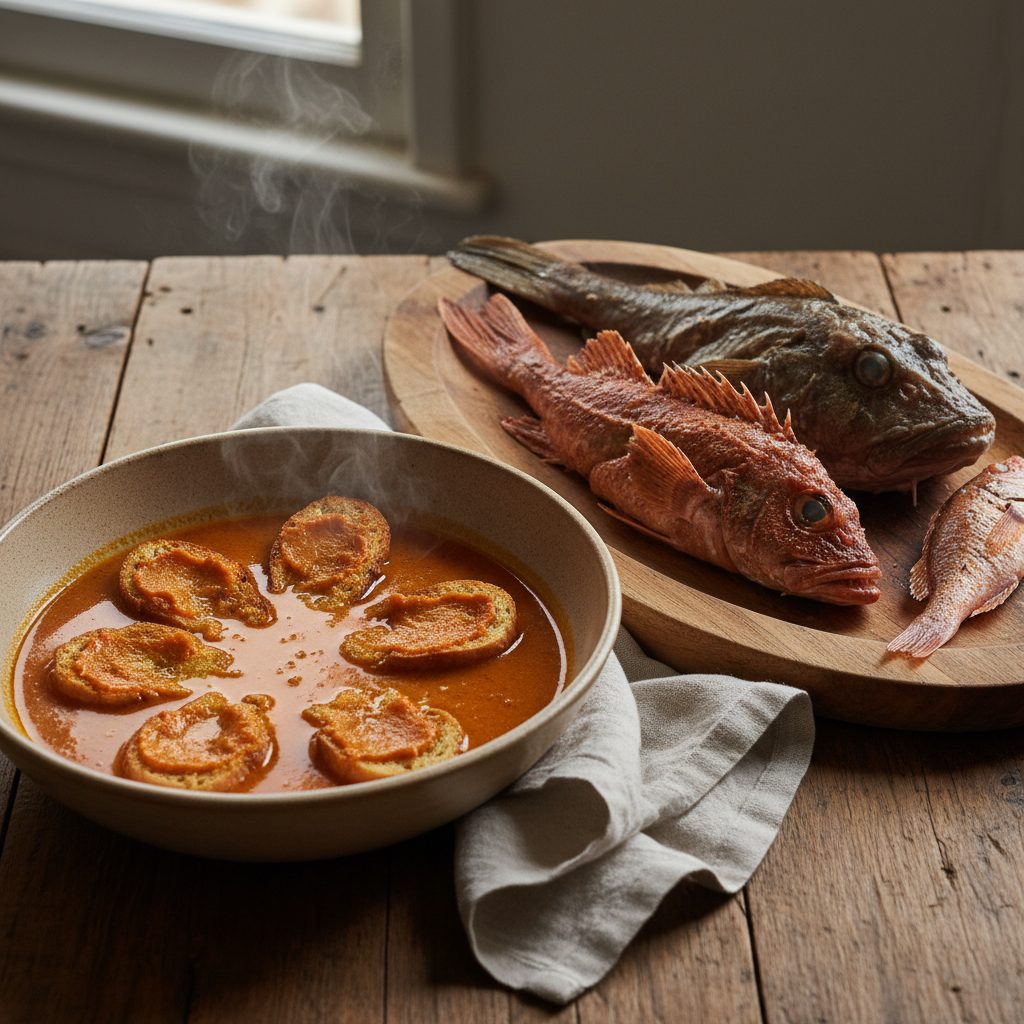
Bouillabaisse is a culinary flirtation. First it offers you a golden broth. Hot, intense, slightly spicy. You spread rouille on a crouton, velvety, garlicky, saffron-scented, and let the taste slowly melt your tongue.
Then the fish appear. Scorpionfish, conger, monkfish, John Dory. Whole, proudly arranged on a platter, portioned at the table. Unhurried. True pleasure, after all, does not care for fast food.
The people of Marseille guard the ritual jealously. In 1980 they wrote the Bouillabaisse Charter, because the world had begun shamelessly counterfeiting their passion. Frozen fish? Heresy. Tomato water for tourists? An insult. Lobster added only to push up the price? An ostentation worthy of a lover who confuses opulence with finesse.
Bouillabaisse loves a scandal. It has been served as a milkshake. Locked inside a burger. Blackened with cuttlefish ink. Given pastis, potatoes, wine. Purists clutched their hearts, cooks clutched their knives, and Marseille proved once again that the hottest romances always begin by breaking the rules.
It was food for the poor. Today it costs as much as a decent dinner for two. Because what was once rejected has become desired. Like a woman whose beauty went unnoticed by those who looked too quickly.
Bouillabaisse does not ask to be eaten. It tempts.
It smells of the ocean, saffron and garlic. It steams like a naked body after a bath. First it warms the mouth, then the throat, and in the end it leaves a hunger that no further spoonful can satisfy.
In Marseille they say: Quand ça bouille, tu baisses.
When it boils, lower the heat. Flavour, like desire, is best when it arrives slowly.
According to Roman mythology, the soup was cooked by the goddess Venus for her husband Vulcan, to put him to sleep so she could meet Mars. You feel a shiver in your mouth.
## Greeks, a beach and unsold fish
The story of bouillabaisse begins together with Marseille. Around 600 BC Greeks from Phocaea founded Massalia and brought with them a simple fish soup, kakavia. It is considered the direct ancestor of the Marseille soup. The city and the soup share the same birth certificate, which explains why the Marseillais defend both with equal ferocity.
For centuries it was soupe du pauvre, the soup of the poor. Fishermen cooked it on the beach, in a pot of seawater, from fish that could not be sold at the morning market: too bony, too damaged or too common. They were called poissons de roche, rockfish. Nobody wanted them, so they were eaten by those who caught them. The kitchen of poverty does not choose. It transforms.
The name is an instruction manual. The Provençal bolhabaissa joins bolhir, „to boil”, and abaissar, „to lower the heat”. Hence the saying „Quand ça bouille, tu baisses”. When it starts to boil, turn it down. Few recipes fit their entire technique into their name.
## The Charter, or the soup’s constitution
In 1980 eleven Marseille restaurateurs and chefs, among them from Miramar, Chez Fonfon and Le Rhul, drew up La Charte de la Bouillabaisse. It was a response to the multiplying places that served tourists frozen cod in water with tomato paste and called it tradition.
The Charter is as strict as any document written in self-defence. The fish must be exclusively fresh, never frozen, and exclusively Mediterranean. The base must be rascasse, red scorpionfish. Beside it, at least three other species from the list: congre, that is conger eel, baudroie or lotte, that is monkfish, saint-pierre, that is John Dory, vive, that is weever, and grondin, that is gurnard. Marseille can name its fish by surname, like a national team line-up.
The order of service is just as important. Bouillabaisse is not an ordinary soup but a performance in two acts. First comes the broth alone, intensely orange, with rouille, a spicy mayonnaise of olive oil, garlic, saffron and cayenne pepper, and with croutons rubbed with fresh garlic. Then, on a separate platter, the whole poached fish make their entrance, and the waiter fillets and portions them at the table, before the guests’ eyes.
Disputes over details continue. Lobster or crayfish is, for traditionalists, a heresy that serves only to inflate the price. Potatoes are a cheap filler to some, and to others an essential element that soaks up the aroma of the broth. Purists reject white wine, preferring water and olive oil. Every national cuisine has its theologians. Marseille’s has an exceptional number of them per square metre of harbour.
## From Venus to Pagnol
The oldest advertisement for bouillabaisse was written by mythology. Venus is said to have cooked a soup heavily seasoned with herbs and saffron for her husband Vulcan, god of fire and smiths, so that after a hearty meal he would fall into a deep sleep. Then she could meet Mars in peace. A soup as a sleeping draught for the husband and an aphrodisiac for the lover is a recommendation no guidebook will ever give.
Literature added its share. In 1849 William Makepeace Thackeray wrote „The Ballad of Bouillabaisse”, in which he called it a hotchpotch of all sorts of fish, and started a fashion for it among the British elite. Curnonsky, that is Maurice Edmond Sailland, the famous French food critic, called it soupe d’or, golden soup, after its saffron colour. Marcel Pagnol, in his 1932 play „Fanny”, joked that the whole world believes the Marseillais live on nothing but bouillabaisse and aioli. A stereotype of which Marseille is proud stops being a stereotype. It becomes a coat of arms.
Its fame has even left the Earth. An asteroid, 8523 Bouillabaisse, was named in honour of the soup. Few dishes are in orbit. This one circles the Solar System.
## Milkshake, burger and frozen fish
The twenty-first century brought the soup scandals. Lionel Levy, a Michelin-starred Marseille chef, served bouillabaisse at his restaurant Une Table au Sud in the form of a milkshake: layers of saffron potatoes, an emulsion of eggs, mascarpone and olive oil, John Dory in a glass and a parmesan straw. Sylvain Robert of L’Aromat made a bouillabaisse burger, with a fish patty, saffron mayonnaise and a Provençal herb confit. Traditionalists spoke of profanation. Cooks spoke of freedom. Both sides were right, and the soup got the publicity.
The more serious problem is less spectacular. At the Old Port, the Vieux-Port, disputes keep returning over places that sell tourists cheap fish soups made from frozen stock as „authentic bouillabaisse”. The masters warn that a dish costing less than 45–50 euros cannot be genuine, because fresh, rare Mediterranean fish are expensive. A real portion often reaches 100 euros. The soup once cooked from what nobody wanted now requires fish caught specially to order for luxury restaurants. Cinderella went to the ball and never came back.
## Cousins from Toulon, Martigues and across the ocean
The Marseille bouillabaisse is saffron-and-garlic, without white wine, served in two stages. Toulon adds potatoes as standard and a drop of pastis, an anise liqueur that strengthens the fennel notes. In Sanary-sur-Mer near Toulon, fishermen cook a gigantic bouillabaisse for 2,500 people every two years for the feast of Saint Peter. Martigues has the rare bouillabaisse noire, black with cuttlefish ink.
The ocean added distant relatives. San Francisco’s cioppino is not bouillabaisse but a fish stew created by immigrants from Liguria, with Pacific crab and tomatoes. There is also a hypothesis that the Creole gumbo of New Orleans grew out of an attempt to recreate bouillabaisse in Louisiana, with local shellfish instead of Mediterranean fish. An emigrant always cooks an old taste from new ingredients. What comes out is something different, and just as true.
From this whole story one piece of advice remains, written into the name itself. When it boils, lower the heat. It applies to the soup, to the arguments about it, and to everything that cooks too violently.
📖 Glossary
- rouille
- Pikantny majonez z oliwy, czosnku, szafranu i pieprzu cayenne, którym smaruje się grzanki podawane do bulionu bouillabaisse.
- poissons de roche
- Ryby skalne, zbyt ościste, poranione albo zbyt pospolite, by sprzedać je na targu. To z nich rybacy gotowali bouillabaisse.
- rascasse
- Skorpena czerwona, ryba, która według Karty musi być podstawą każdej prawdziwej bouillabaisse.
- kakavia
- Prosta grecka zupa rybna przywieziona przez Greków z Fokei do Massalii, uważana za bezpośredniego przodka bouillabaisse.
- bouillabaisse noire
- Rzadka odmiana z Martigues, czarna od atramentu mątwy.
Frequently Asked Questions
Where does bouillabaisse come from?
Around 600 BC Greeks from Phocaea founded Massalia and brought with them a simple fish soup called kakavia, considered the direct ancestor of bouillabaisse. For centuries it was a poor man’s soup, cooked by fishermen on the beach in a pot of seawater. It was made from fish that could not be sold at the morning market.
What does the name bouillabaisse mean?
The Provençal bolhabaissa joins bolhir, „to boil”, and abaissar, „to lower the heat”. Hence the Marseille saying „Quand ça bouille, tu baisses”: when it starts to boil, turn it down. The name is an instruction manual.
Which fish must be in a real bouillabaisse?
According to the Charter the fish must be exclusively fresh and exclusively Mediterranean. The base is rascasse, red scorpionfish, alongside at least three other species from the list: conger eel, monkfish, John Dory, weever and gurnard. Frozen fish is heresy.
How is bouillabaisse served in Marseille?
Bouillabaisse is a performance in two acts. First comes the intensely orange broth on its own, with rouille and croutons rubbed with garlic. Then the whole poached fish arrive on a separate platter, and the waiter fillets and portions them at the table.
What is the 1980 Bouillabaisse Charter?
La Charte de la Bouillabaisse was drawn up in 1980 by eleven Marseille restaurateurs and chefs, among them from Miramar, Chez Fonfon and Le Rhul. It was a response to places serving tourists frozen cod in water with tomato paste. It sets out the permitted fish and the order of service.
How much does a real bouillabaisse cost?
The masters warn that a dish costing less than 45–50 euros cannot be genuine, because fresh, rare Mediterranean fish are expensive. A real portion often reaches 100 euros. A soup once made from fish nobody wanted now requires fish caught to order for luxury restaurants.
Related Questions
- Where does bouillabaisse come from?
- What does the name bouillabaisse mean?
- Which fish must be in a real bouillabaisse?
- How is bouillabaisse served in Marseille?
- What is the 1980 Bouillabaisse Charter?
- How much does a real bouillabaisse cost?
🧠 Thematic Groups
- Historia: Grecy z Fokei przywieźli do Massalii zupę kakavia, a przez wieki bouillabaisse była soupe du pauvre gotowaną przez rybaków z niesprzedanych ryb skalnych.
- Technika i kanon: Karta z 1980 roku wymaga świeżych ryb śródziemnomorskich z rascasse na czele oraz podania w dwóch aktach, najpierw bulionu z rouille, potem ryb porcjowanych przy stole.
- Kultura: od mitu o Wenus i Wulkanie przez balladę Thackeraya, „złotą zupę” Curnonsky’ego i „Fanny” Pagnola po asteroidę 8523 Bouillabaisse.
- Spory i warianty: milkshake i burger marsylskich kucharzy, turystyczne podróbki na Starym Porcie, tulońskie ziemniaki z pastisem, czarna wersja z Martigues oraz dalecy krewni cioppino i gumbo.
Tags:
bouillabaisse
Marseille
French cuisine
Provence
fish soup
rascasse
poissons de roche
rouille
saffron
kakavia
La Charte de la Bouillabaisse
Vieux-Port
Marcel Pagnol
bouillabaisse noire
Venus and Vulcan
More in: Kuchnia niepolityczna
Content is created by Fundacja Dobre Państwo.
Edited and published by APA ONE, the Foundation's own AI-based editorial system.