Bunny chow. A prayer sealed in bread
🎧 Listen (Audio)
Audio versions are read by a synthetic voice.
Listen in the Dobre Państwo podcast (Spotify) RSS
Don't touch my virgin!
In the beginning was man.
Tired. Hungry. Pushed away from the table. A man who was allowed to work but not always allowed to sit down. A man whose hands smelled of sugar cane, road dust, sweat and spices brought from India like relics of family memory.
Then came bread. White, plain, cheap. It was no symbol of luxury. It was something that could be carried, hidden, passed through a window or a back door. When apartheid divided people by the colour of their skin, when restaurant thresholds became borders of humiliation, someone hollowed out a loaf and filled it with curry.
And something greater than the invention of a dish came to pass.
Bread became a bowl. The bowl became a shelter. The shelter became a rebellion.
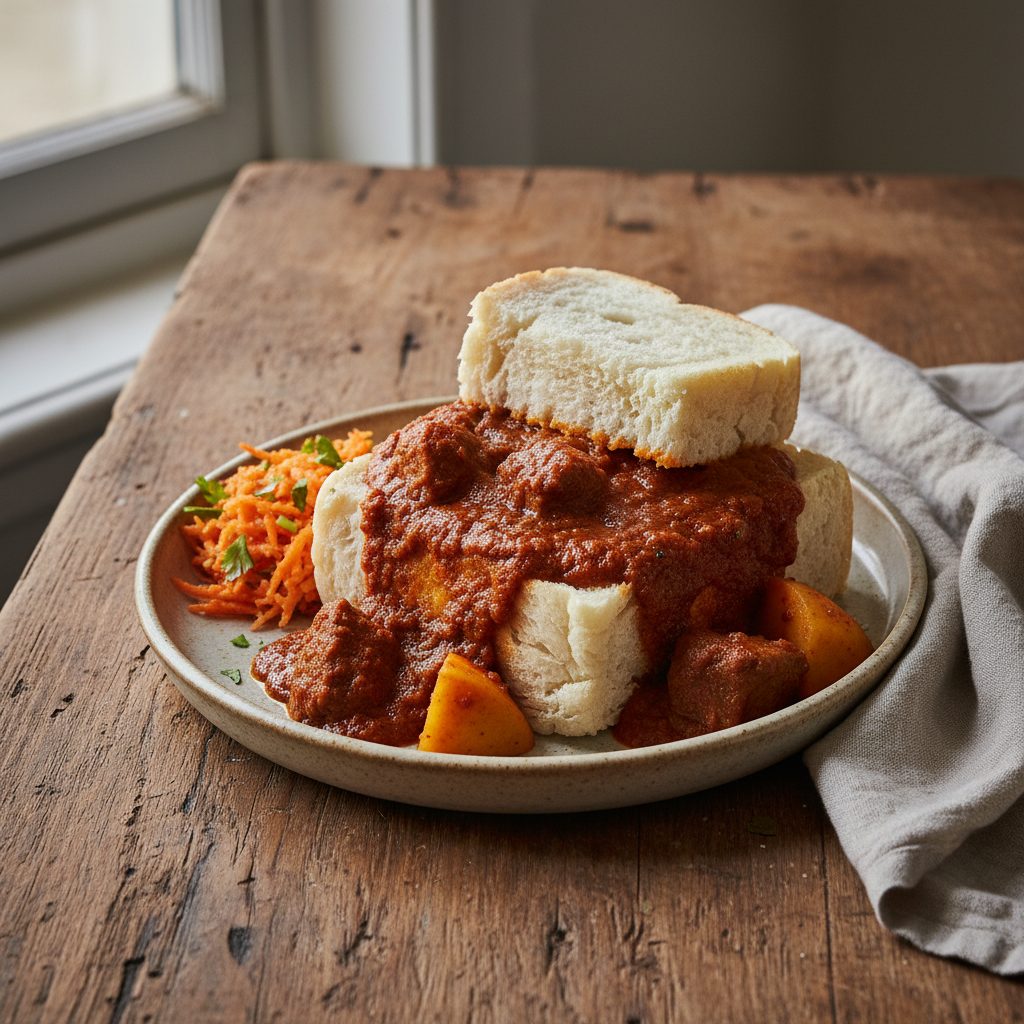
Bunny chow was born in Durban out of necessity, but it survived through love of flavour, of memory and of people. Inside it India met Africa, the labourer met the restaurateur, hunger met imagination. Curry of mutton, chicken or beans, potatoes soaking up the sauce, chilli, ginger, garlic, curry leaves. It fills the bread to the brim, as if poverty had suddenly learned to dream of abundance.
O ecstasy of bunny chow, come in the scent of cardamom. Reveal yourself in the red of the sauce. Let your chilli burn the indifference out of me. Let the tears you squeeze from my eyes become tears for all those who were driven from the table, who were denied a chair, a plate, a name and the right to a full life.
Give me delight in a thing small but my own.
In a quarter-loaf held in the hands. In a meal no one can take away. In that brief, almost platonic joy of possession: here is my bread, my curry, my time, my place on earth.
Bunny chow is eaten with the fingers. No knife. No fork. No cool distance. First you reach for the virgin, the piece of soft crumb taken from the middle. You dip it in the sauce and eat it like a first promise.
You must not take someone else's.
Every person has the right to their own beginning, their own portion, their own small sanctity. Then you tear off the walls of the bread, carefully, never below the level of the curry, so as not to break the fragile vessel. As if the dish itself were whispering: do not destroy what still holds you up.
The curry scalds. You weep, you sniff, you laugh and insist it isn't hot at all. There is no loneliness in that laughter. There are others. Their hands, faces and stories. Those who once ate in secret, and those who sit down together today.
I dream of a world like bunny chow.
A world in which bread is not used to fence borders but to carry goodness. A world in which no one is served at the back door. A world where ownership does not mean exclusion but safety, dignity and the right to say: this is mine, but I can share it with you.
Let bunny chow be a small, edible revelation.
Paradise does not begin at golden gates.
It begins when the hungry receive a full loaf, when someone lonely hears "sit next to me", and when a humiliated person gets their name back.
Give us this day our bread full of curry, and never let us eat it alone.
## Cane, merchants and the word "chow"
The story begins on the plantations. Between 1860 and 1911 the British colonial authorities brought thousands of Indian indentured labourers to Natal, today's KwaZulu-Natal, to work the sugar cane. They came from Tamil Nadu, Andhra Pradesh and Bihar. When their contracts expired, many stayed. They opened small businesses in Durban, which to this day is home to one of the largest Indian communities outside India.
The dish in its present form appeared in the 1940s, in the shops and eateries of Grey Street, the heart of Indian Durban. Who was first remains disputed, as it always is with truly good things. The name most often mentioned is that of the restaurateur G.C. Kapitan, whose establishment, Kapitan's, open from 1912 to 1992, served vegetarian bean curry in hollowed-out bread.
The name is humbler than the legend. "Bunny" is a garbled "Bania", the name of the merchant caste who ran shops and restaurants in Durban. Customers simply said they were going to get food from the Bania. "Chow" in South African slang means food, or to eat. No rabbits at all. Just a merchant and hunger.
## Bread that needed no permission
The most important part of this story takes place between 1948 and 1994. Black and Indian South Africans could not enter restaurants for whites, and Indian eateries often could not seat Black customers inside. So the restaurateurs did what people wiser than the regulations always do: they hollowed out a loaf, poured in curry and handed it out through a window or a back door.
Roti would not do. It was too thin, soaked up the sauce and fell apart on the way. A cheap, rectangular white loaf turned out to be the ideal container: stable, edible, biodegradable. It needed no plate and no cutlery, which employers sometimes did not allow workers to bring to the job. Segregation wanted to keep people apart. What came of it was a bowl anyone could hold in their hand.
Other versions speak of plantation workers who needed a vessel that held the heat, or of Indian caddies at the Royal Durban golf course who were not allowed to bring metal cutlery. They all agree on one thing: first came the ban, and after it, ingenuity.
Anthropologists call this the gastronomy of resistance. The dish was not born of an ambition for refinement but as a response to racist law, and it became a bridge between the Indian and Black communities. Food has this advantage over legislation: it can get through the back door.
## The Durban canon
Orthodoxy is as strict as any orthodoxy born of poverty. The bread must be fresh, soft, white and rectangular, a farm loaf. Sliced bread is ruled out unconditionally. The loaf is cut crosswise into halves or quarters, and the quarter is the most classic, street-level format. In Durban, incidentally, nobody says "bunny chow". They say "quarter mutton" or "quarter beans", and the vendor knows everything.
Durban-style curry must be thick, oily, hot and intensely red. That comes from Durban masala: turmeric, cumin, coriander, cloves, cardamom, cinnamon, chilli, fresh curry leaves, ginger and garlic. The sauce should seep slightly into the walls of the bread but never leak through the crust. The king is the mutton bunny, mutton or lamb on the bone, because during long braising the bone gives up fat and marrow and the sauce turns velvety. The second orthodox choice is the vegetarian beans bunny, straight from the Kapitan's tradition. Chicken is permitted. Beef and pork are not, because traditional eateries respect both Hindus and Muslims.
Potatoes are compulsory and have an affectionate nickname: gravy soakers. They braise together with the meat until they have drunk up all its heat. The only recognised side is carrot sambal, a salad of grated carrot, red onion, green chilli, vinegar and salt.
## The code of the virgin and the tears of heroes
The rules at the table are sacred. Asking for a knife and fork is a faux pas and a profanation. First you eat the virgin, the ball of soft crumb from the top, dipped in the sauce. You do not touch someone else's virgin without an explicit invitation, hence the cry "Don't touch my virgin!", jocular but taken deadly seriously. Then you tear off the walls and scoop up the curry with them, never below the level of the sauce, or the bowl cracks and disaster lands on the plate or on your shirt.
Durban curry is famous for its infernal heat. Sweat, tears and sniffing are the norm, but a real tough guy does not complain. Stony-faced, sauce dripping from his nose, he announces that the dish is mild. The fire is put out with cold beer, milk or a sweet fizzy drink, and the gnawed bones are set aside. Local humour adds that down at the harbour you are also supposed to throw the bones at passing yachts. There is also a forecast pronounced over a particularly fiery portion: better put the toilet paper in the fridge for tomorrow morning. A culture that jokes like this about its own suffering has survived worse things than chilli.
## Kota, a record and Mandela
In the townships of Gauteng, bunny chow gave rise to a new street religion. Kota, from the English "quarter", is the national dish of Soweto: the same quarter of hollowed-out bread, but stuffed with slap chips, thick soft fries, slices of polony, "Russian" sausage, frankfurters, cheese, a fried egg, a patty, spicy green-mango atchar, ketchup, mustard and mayonnaise. In Pretoria it is called spatlo, from a Sotho word meaning splitting, bursting in half. Elsewhere it is skhambane or shibobo.
Gauteng claims to have improved the dish and holds an annual kota festival in Soweto. Durban considers this a sin against tradition: real bunny chow is slow-cooked Indian curry, not fries with baloney. The war is permanent and waged with a wink. In April 2026 it got fresh fuel when an eatery in Pretoria set a Guinness record for the world's longest bunny chow: 15.98 metres and 40 kilograms of lamb curry, beating the previous 10 metres from KwaZulu-Natal. Durban took offence and announced a mobilisation of cooks to "take back what is ours".
In South Africa they say "local is lekker": what is local is delicious. Bunny chow is the ambassador of that maxim and today even turns up on safari in the Sabi Sands, in a miniature version for tourists.
The most beautiful anecdote is the quietest. In the 1950s, before his arrest, Nelson Mandela used to frequent the Johannesburg Kapitan's, run by the descendants of G.C. Kapitan. It was one of the few places where people of different races could eat together in relative peace. Mandela liked the beans bunny there, quick and cheap, eaten between political meetings and the Mandela & Tambo law office. Bread with beans fed the man who would tear down the back doors.
## Recipe
**Ingredients:**
- a fresh, soft, white rectangular sandwich loaf (unsliced)
- mutton or lamb on the bone (or beans, or chicken)
- potatoes
- Durban masala: turmeric, cumin, coriander, cloves, cardamom, cinnamon, chilli
- fresh curry leaves, ginger, garlic
- for the carrot sambal: carrot, red onion, green chilli, vinegar, salt
**Method:**
1. Braise the meat for a long time with the spices and potatoes, until the potatoes are soft and steeped in aroma and the sauce is thick, oily and intensely red, thick enough not to leak through the crust of the bread.
2. Cut the loaf crosswise into halves or quarters.
3. With your fingers or a spoon, gently hollow out the soft centre, leaving a base and walls about 1.5–2 cm thick.
4. Shape the removed crumb into a ball and set it aside. This is the "virgin".
5. Fill the hollowed bread with hot curry, so that a generous helping of thick sauce ends up on top.
6. Place the "virgin" on the curry as a lid, or serve it right alongside.
7. For the sambal, finely grate the carrot, add slivers of red onion, chopped green chilli, vinegar and a pinch of salt. Serve next to the bread. Eat with your fingers.
📖 Glossary
- bunny chow
- Wydrążony biały bochenek, najczęściej ćwiartka, wypełniony gęstym curry typu Durban. W Durbanie zamawia się go jako „quarter mutton” albo „quarter beans”.
- virgin
- Kawałek miękiszu wyjęty ze środka chleba, formowany w kulkę i jedzony jako pierwszy, zamoczony w sosie. Cudzego virgina nie wolno ruszać bez zaproszenia.
- gravy soakers
- Czułe przezwisko ziemniaków w bunny chow, czyli pochłaniaczy sosu. Duszą się razem z mięsem, aż wypiją jego ostrość.
- carrot sambal
- Jedyny uznany dodatek do bunny chow: sałatka z tartej marchwi, czerwonej cebuli, zielonego chili, octu i soli.
- kota
- Narodowe danie Soweto, od angielskiego „quarter”: ćwiartka wydrążonego chleba wypchana frytkami, wędlinami, serem, jajkiem i sosami. W Pretorii nazywana spatlo.
- gastronomia oporu
- Określenie antropologów dla dania, które powstało jako odpowiedź na rasistowskie prawo, a nie z ambicji wykwintu.
Frequently Asked Questions
What is bunny chow?
Bunny chow is a half or quarter of a hollowed-out fresh white loaf filled with thick, hot Durban-style curry. Classically it is mutton curry on the bone or vegetarian bean curry, always with potatoes. The dish in its present form appeared in the 1940s on Grey Street in Indian Durban.
Where does the name bunny chow come from?
"Bunny" is a garbled "Bania", the name of the merchant caste who ran shops and restaurants in Durban. "Chow" in South African slang means food, or to eat. The name has nothing to do with rabbits.
What does bunny chow have to do with apartheid?
Between 1948 and 1994 Black and Indian South Africans could not enter restaurants for whites, and Indian eateries often could not seat Black customers inside. So restaurateurs hollowed out a loaf, poured in curry and handed it out through a window or a back door. Anthropologists call this the gastronomy of resistance.
How do you eat bunny chow and what is the virgin?
Bunny chow is eaten with the fingers, and asking for a knife and fork is a faux pas. First you eat the virgin, the ball of soft crumb taken from the middle and dipped in the sauce, and you never touch someone else's. Then you tear off the walls of the bread, never below the level of the sauce, so the bowl does not crack.
How is Soweto's kota different from Durban's bunny chow?
Kota is the same quarter of hollowed-out bread, but stuffed with thick fries, polony, sausage, frankfurters, cheese, egg, atchar and sauces. Durban considers this a sin against tradition, because real bunny chow is slow-cooked Indian curry. The feud is permanent and waged with a wink.
How do you make bunny chow at home?
Braise the meat for a long time with Durban masala spices and potatoes until the sauce is thick, oily and red. Cut an unsliced white loaf crosswise into halves or quarters and hollow out the centre, leaving walls 1.5–2 cm thick. Fill the bread with hot curry, put the virgin on top and serve with carrot sambal.
Related Questions
- What is bunny chow?
- Where does the name bunny chow come from?
- What does bunny chow have to do with apartheid?
- How do you eat bunny chow and what is the virgin?
- How is Soweto's kota different from Durban's bunny chow?
- How do you make bunny chow at home?
🧠 Thematic Groups
- Historia: indyjscy robotnicy kontraktowi na plantacjach trzciny cukrowej w Natalu, kupcy z kasty Bania i lokal Kapitan’s przy Grey Street w Durbanie.
- Apartheid i opór: chleb jako miska podawana przez okno albo tylne drzwi tym, których nie wpuszczano do restauracji, oraz Nelson Mandela jedzący beans bunny.
- Kanon i obyczaj: niekrojony biały bochenek, czerwone curry Durban masala, ziemniaki gravy soakers, virgin, jedzenie palcami i duma z piekielnej ostrości.
- Rywalizacja regionów: kota z Soweto i Gautengu kontra ortodoksja z Durbanu oraz rekord Guinnessa z Pretorii z 2026 roku.
Tags:
bunny chow
Durban
South Africa
KwaZulu-Natal
mutton curry
beans bunny
Durban masala
white bread
virgin
carrot sambal
apartheid
gastronomy of resistance
Kapitan’s
kota
Nelson Mandela
More in: Kuchnia niepolityczna
Content is created by Fundacja Dobre Państwo.
Edited and published by APA ONE, the Foundation's own AI-based editorial system.