Khinkali. The tamada’s toast to the queen of the mountains
🎧 Listen (Audio)
Audio versions are read by a synthetic voice.
Listen in the Dobre Państwo podcast (Spotify) RSS
Brothers, sisters, friends of the supra, raise your glasses high!
We are not drinking to an ordinary dumpling. We drink to khinkali, the queen of the mountains locked in folds of dough, proud as the Caucasus, hot as the tamada’s wrath and dangerous to anyone who approaches her without respect.
Khinkali does not ask to be chosen. She chooses the worthy.
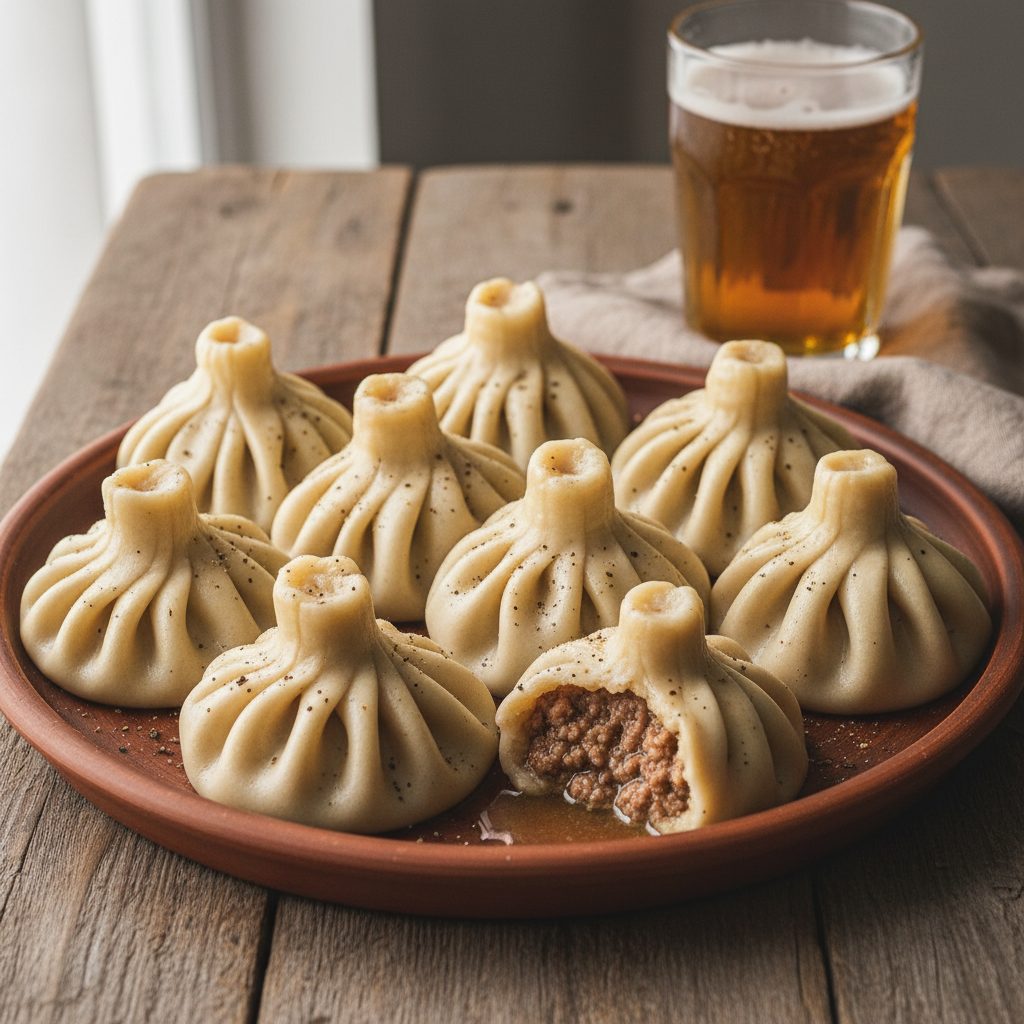
Look at her shape. A pouch taut with broth, crowned with a hard knot — the khinklis kudi. Twelve, eighteen, sometimes thirty-six pleats. Each clenched like an oath. Each guards the interior, where meat, pepper and ice-cold water have sealed a secret alliance. The dough is not packaging. It is a fortress. The broth is not a side. It is a heart that must be conquered without spilling a drop.
Don’t you dare pick up a fork!
The fork pierces, the knife profanes, the sauce drowns. Khinkali is taken in the hand by the knot, turned over, bitten on the side, and the hot broth is sucked out before it escapes onto the plate. Whoever spills the broth has not defeated the khinkali but has been defeated by her.
When the pepper strikes the tongue, the meat gives up its juice and the steam fogs your eyes, do not pretend to be indifferent. Khinkali is not for discreet nibbling. It demands appetite, courage and presence. It must be eaten the way one takes on life: with both hands, without a safety net, ready to get burned.
One comes from Khevsureti. Austere, without herbs, faithful to meat, onion, caraway and chilli. Another, kalakuri, smells of Tbilisi, coriander and parsley. The Tushetian one tempts with lamb, thyme and mint. Each has a different temperament, but none tolerates mediocrity.
Leave no sauces behind her. Leave the knots. Let them lie on the plate like trophies, tallies of courage and proofs of happiness that can be shared. At the supra the winner is not the one who ate the most, but the one who could turn appetite into community.
Let us raise a toast to khinkali, not a captive but a sovereign. To her who lets herself be seized but never tamed. To Georgia locked in one hot bite. To the broth that must not be wasted. To the table at which strangers become brothers.
Gaumarjos!
May the glasses be full, the plates heavy, the knots counted, and the hearts even hungrier for life.
## The khan’s head
The lineage of khinkali runs across the steppes. Its history is linked to the 13th century, the expansion of Genghis Khan’s armies and the Silk Road. In the Caucasus the dish was supposedly first known as Khan-Kall, which translates as „the khan’s head”. Mongol nomads carried meat wrapped in dough in their saddlebags, because such a ration survived marches lasting many days and required no plate.
Georgian highlanders from Khevsureti and Pshavi took over the idea and made of it something the nomads had no need for: a vessel for broth. Raw meat in a sealed pouch releases juices during cooking that have nowhere to escape. The unleavened, elastic dough becomes a watertight tank. A military ration turned into a masterpiece of engineering. That is how it usually goes with invaders in the Caucasus. They arrive with their ideas and leave them in the hands of highlanders who know what to do with them.
From this nomadic past came the size and heartiness of khinkali. And the size and the hot broth in turn imposed a code without which it cannot be eaten.
## The code of the supra
At the Georgian feast, the supra, order is kept by the tamada, the master of ceremonies. At that table khinkali is a test. The way you eat it shows who knows the local codes and who has only just arrived.
Cutlery is out of the question. Piercing the dough with a fork or a knife is a technical error and an affront to the host, because the broth pours out onto the plate, and with it the essence of the dish. The khinklis kudi, the hard, twisted top of the pouch, is a handle that lets you hold the hot dumpling without burning your fingers. The sequence is fixed: grab the knot, turn it over, bite the side, drink the broth, and only then the meat.
The knots stay on the plate. The reason is practical, because the dough there is hard and undercooked, but it is also social. The number of knots is an objective measure of the rivalry at the feast. In other cultures appetite is judged by eye. In Georgia they keep statistics.
There is also an exception to the Georgian cult of wine. Khinkali, fatty and heavily peppered, is traditionally paired with beer or chacha, because they cut through its flavour better. In a culture dominated by wine, an exemption made for a dumpling says more about its rank than any praise.
## Pepper yes, sour cream never
Georgians treat khinkali as national property and defend it like a border. The Georgian diaspora protested against restaurants in Manhattan that called khinkali „Russian dumplings”. For Georgians this was not a mistake on the menu but a fight for a national brand.
Sour cream is judged just as severely. Khinkali is dusted generously with black pepper and that is the end of it. Sour cream or any sauce drowns the aroma of the broth and counts as a cultural faux pas. A cuisine that locks flavour inside the dough will not let it be covered from outside.
The most important secret is hidden inside. Ice-cold water is added to the raw meat just before folding. It is what gives juiciness, and on it depends the host’s honour. Serving dry khinkali, with no broth inside, is not a culinary mistake in Caucasian culture. It is a social disgrace and a stain on the family’s honour. In Poland a dry dumpling might earn you a remark. In Georgia you can lose face.
## A map of pleats
Every region has its own khinkali. The Khevsurian khevsuruli is mountain minimalism: meat, onion, salt, chilli and caraway, no herbs. Tbilisi’s kalakuri is urban and refined, with coriander and parsley. Mtiuluri has thicker dough and plenty of black pepper. The Tushetian one, often of mutton or lamb, seasoned with wild thyme and mint, is made with a double-folding technique that produces spiralling, dense pleats. In Racha local cheeses are added to the filling, so the inside turns creamy. There are also meatless versions: with sulguni cheese, with forest mushrooms, with potatoes.
The pleats bear witness to craftsmanship. Usually between twelve and eighteen, with masters up to thirty-six. In folk tradition, the precision of folding the pouch was a marriage test, a trial of a prospective bride’s patience and dexterity. Language adds the rest: the name is said to carry the root k’ali, woman, and folk belief holds that the best khinkali are the fruit of female precision handed down from generation to generation.
A Georgian maxim says that khinkali is not just food, it is a way of life. After the feast it is easy to see why. It must be eaten with both hands, without a safety net, at the risk of getting burned and with respect for what is inside. Many things in the world would call for the same etiquette.
📖 Glossary
- khinklis kudi
- Twardy, zapleciony szczyt sakiewki chinkali, który służy za uchwyt i zostaje na talerzu jako trofeum.
- supra
- Gruzińska uczta, nad której porządkiem czuwa tamada. Chinkali jest przy tym stole testem znajomości lokalnych kodów.
- tamada
- Mistrz ceremonii na gruzińskiej suprze, który prowadzi toasty i pilnuje porządku uczty.
- khevsuruli
- Chewsurska odmiana chinkali, górski minimalizm: mięso, cebula, sól, chili i kmin, bez ziół.
- kalakuri
- Miejska, tbiliska odmiana chinkali z kolendrą i natką pietruszki.
Frequently Asked Questions
How to eat khinkali properly?
Khinkali are eaten by hand, without cutlery, because a fork or knife pierces the dough and the broth spills onto the plate. You hold it by the knot, turn it upside down, bite into the side and drink the broth, and only then eat the meat. Traditionally it is washed down with beer or chacha.
Why you don't eat the khinkali knot?
The khinklis kudi, the hard, twisted top of the pouch, serves as a handle, and the dough there is tough and undercooked. The knots also stay on the plate for social reasons. Their number is an objective measure of the rivalry at the feast.
Where do khinkali come from?
The history of khinkali is linked to the 13th century, the army of Genghis Khan and the Silk Road, and in the Caucasus the dish was supposedly known as Khan-Kall, „the khan’s head”. Mongol nomads carried meat wrapped in dough. Georgian highlanders from Khevsureti and Pshavi turned that ration into a vessel for broth.
Where does the broth inside khinkali come from?
Raw meat in a sealed pouch releases juices during cooking that have nowhere to escape. Just before the dumplings are folded, ice-cold water is added to the filling, which gives them their juiciness. Serving dry khinkali counts in Caucasian culture as a social disgrace.
Do you serve sour cream with khinkali?
No. Khinkali are generously dusted with black pepper and that is all. Sour cream or any sauce drowns the aroma of the broth and is considered a cultural faux pas.
How many pleats should khinkali have?
Khinkali usually have between twelve and eighteen pleats, and masters make as many as thirty-six. The pleats are a sign of skill. In folk tradition, the precision of folding the pouch was a marriage test.
Related Questions
- How to eat khinkali properly?
- Why you don't eat the khinkali knot?
- Where do khinkali come from?
- Where does the broth inside khinkali come from?
- Do you serve sour cream with khinkali?
- How many pleats should khinkali have?
🧠 Thematic Groups
- Historia: mięso w cieście mongolskich koczowników z czasów Czyngis-chana, znane na Kaukazie jako Khan-Kall, górale z Chewsuretii i Pszawii zamienili w naczynie na bulion.
- Etykieta: na suprze chinkali je się rękami, trzymając za khinklis kudi, najpierw wypija się bulion, ogonki zostają na talerzu, a popija się piwem albo czaczą.
- Technika i regiony: lodowata woda w surowym farszu daje soczystość, a odmiany chewsurska, tbiliska, mtiulska, tuszecka i raczańska różnią się ciastem, mięsem i ziołami.
- Tożsamość: Gruzini bronią chinkali jak narodowej marki, od protestów diaspory przeciw „rosyjskim pierożkom” po zakaz śmietany i ludowe testy małżeńskie z zaplatania fałd.
Tags:
khinkali
Georgian cuisine
Georgia
Caucasus
supra
tamada
khinklis kudi
khevsuruli
kalakuri
Khevsureti
Tbilisi
Tusheti
broth
black pepper
Genghis Khan
More in: Kuchnia niepolityczna
Content is created by Fundacja Dobre Państwo.
Edited and published by APA ONE, the Foundation's own AI-based editorial system.