Buttermilk yeast cake with fruit. A crumb that likes to declare war over the crumble
🎧 Listen (Audio)
Audio versions are read by a synthetic voice.
Listen in the Dobre Państwo podcast (Spotify) RSS
Poland is only a crumb in the world of the drożdżówka, the sweet yeast bun, a crumb that likes to declare war over the crumble.
The story began earlier than our school tuck shops, ministerial tables and national quarrels over a gram of sugar. Perhaps by the Nile, when wetted flour began to ferment under the Egyptian sun. Then Leeuwenhoek saw yeast under a microscope, Pasteur explained its work, and humanity turned biology into ritual, flavour and culture.
The French created brioche, the buttery aristocrat of baked goods. The Swedes rolled cinnamon and cardamom into kanelbullar. The Czechs and Slovaks filled koláče with curd cheese, poppy seed and plum butter, then sent them with emigrants all the way to Texas. The Silesians made kołocz a sign of weddings and community. Jewish challah braided dough together with the Sabbath, memory and the sacred.
Every culture adds its own flavour. Every culture speaks of itself through dough.
The Polish drożdżówka speaks of hospitality, the mid-morning snack, the Sunday table and childhood. Of seasonal fruit that needed no marketing department. Of plums, bilberries, apples and pears. Of buttermilk, a by-product from which the village kitchen made a technological advantage long before consultants christened common sense "zero waste".
Lactic acid softens the gluten. Natural emulsifiers hold in moisture. Yeast produces carbon dioxide. Chemistry does its part, and culture writes the rest.
In Polish we grow "as if on yeast", things sell "like warm buns", we live "like a doughnut in butter", and we warn that "this flour will make no bread". The language has a bakery.
Then the state stepped in. In 2015 the drożdżówka became contraband. Pupils smuggled sweet buns, salt and sugar, and the adults staged a great debate about health, freedom and the limits of paternalism. The small shopkeeper lost to the regulation, the local bakery lost to the rulebook, and the packaged croissant of a large corporation found itself strangely at home in the new reality.
Coincidence? In food policy, coincidences often have a sales department.
In 2016 drożdżówki returned to schools. In 2026 the dispute revived with new sugar limits, restrictions on meat and the planetary diet. Once again we heard that it was only about health. Always only. The state loves single-argument justifications, especially when the consequences have many storeys.
The drożdżówka is no innocent pastry. It is a ferment of biology, migration, religion, social class, enterprise, language, politics and memory.
You can limit sugar. It is harder to limit culture.
Culture, fortunately, is still rising as if on yeast.
To campaign with Herbert and his "power of taste": the drożdżówka is a matter of the taste of humanity.
## From the Nile flood to the microscope
The first yeast baker did not know he was one. Flour covered with water, perhaps after the Nile flooded, began to rise in the sun, and so accident became technology. The Egyptians soon went further: they added honey, eggs and spices, baking the first sweet ritual breads. From the very beginning sweetness had something to do with the sacred.
Understanding took thousands of years. In the 17th century Antonie van Leeuwenhoek saw yeast under a microscope. In the 19th century Louis Pasteur described alcoholic fermentation, in which yeast turns sugar into alcohol and carbon dioxide. It is this gas that makes dough rise. Humanity baked on faith for a long time before it began to bake with knowledge, and it is hard to say that flavour suffered for it.
## Buttermilk, or common sense before fashion
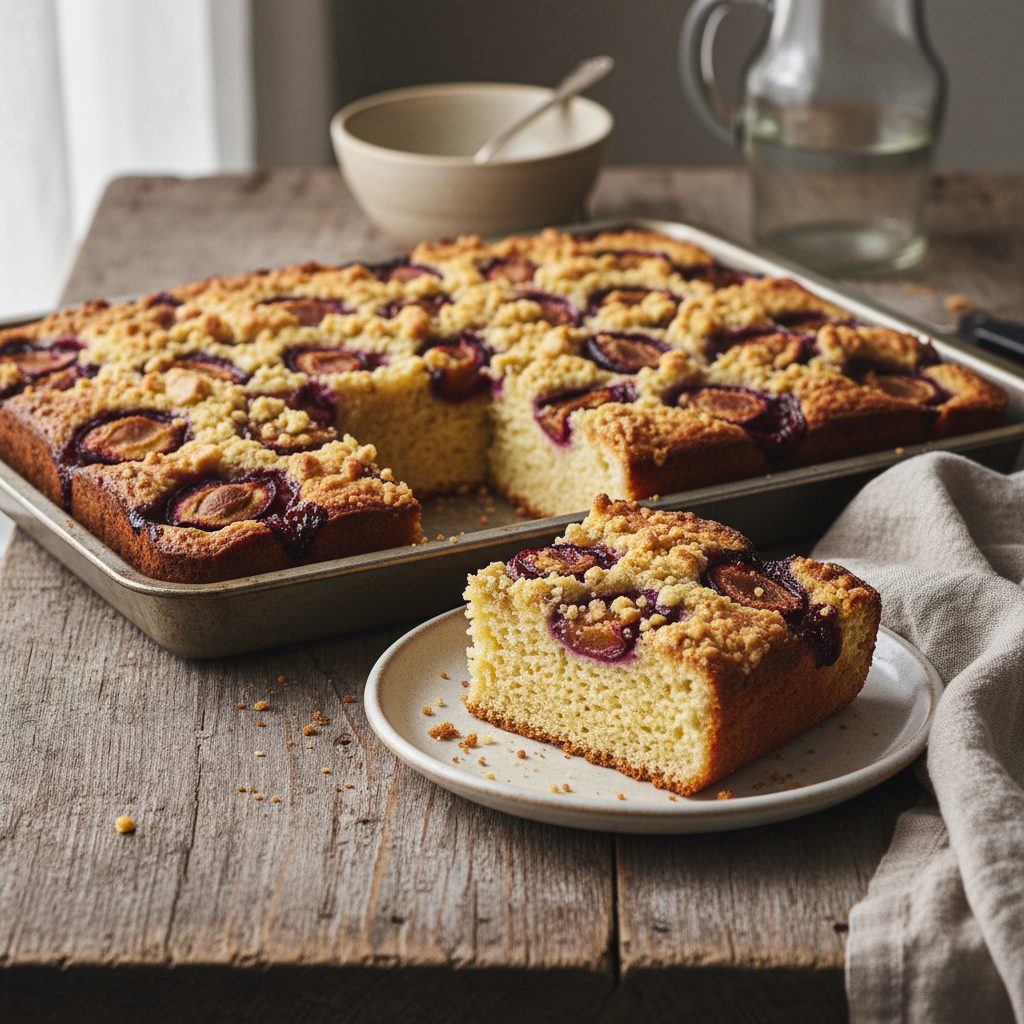
In Poland the drożdżówka, also called drożdżowiec, was a simple, filling village bake. Flour, eggs, butter, milk, fruit from the orchard: węgierka plums, apples, bilberries, cherries, and on top a generous crumble. In the western lands, for instance in the Niegosławice commune in the Lubusz region, drożdżowiec with fruit was placed on the list of traditional products as a sign of hospitality and a compulsory guest at the Sunday table.
Buttermilk entered the dough by the same logic by which the village kitchen took everything. It was a by-product of churning butter, cheap and always at hand. Housewives did not waste it, because nothing was wasted, and it soon turned out that a drożdżówka made with buttermilk was moister, fluffier, "soft as down", and stayed fresh longer than one made with milk.
Chemistry explains it without sentiment. Lactic acid lowers the pH of the dough, weakens the gluten and makes it more elastic, so after baking the crumb is soft and springy. The acidic environment also helps the yeast at the start of its work. Lecithin and milk fat from the buttermilk bind water within the starch structure, and staling, that is starch retrogradation, proceeds much more slowly. Grandmother did not know the word "retrogradation". She did, however, know the result.
The classic list of ingredients is short. Dough of wheat flour, ideally fine cake flour or bread flour, fresh yeast, sugar, room-temperature buttermilk, butter, eggs and yolks, which give the yellow colour, and a pinch of salt. Bold fruit: węgierka plums, strawberries, bilberries, apples with cinnamon, pears. Crumble of flour, sugar and cold butter. Nothing here needs advertising.
## A family with crumble
Europe knows this idea in many disguises. French brioche, known since the 15th century, can be so buttery that butter makes up 50–70 per cent of the weight of the flour, but it usually gets no fruit on top, raisins at most. Swedish kanelbullar are rolled into spirals, spread with butter and cinnamon sugar and sprinkled with coarse pearl sugar. Czech and Slovak koláče are round and flat, with a hollow for curd cheese, poppy seed or plum butter, and Czech emigrants turned them in Texas into "kolaches", with a success every exporter dreams of.
Silesian kołocz holds Protected Geographical Indication status in the Union and is a ritual bake, above all for weddings, with a cheese, poppy-seed or apple filling and buttery crumble laid on in a rustic way. Jewish challah, braided and rich in eggs, belongs to the Sabbath and is sometimes sprinkled with crumble or poppy seed. One leaven, many creeds.
## Contraband at break time
The regulation that threw sweet buns out of schools in 2015 was issued on 26 August, four days before it came into force on 1 September. Tuck shops and canteens had no time to adapt. Pupils, on the other hand, had time to organise. Older children bought drożdżówki at nearby discount stores, smuggled them in their backpacks and sold them to younger ones at break time with a mark-up. School folklore called them drożdżówka dealers. Because canteens were not allowed to salt or sweeten food, children brought salt from home in salt cellars and sugar in paper twists to season the bland lunches on the sly. The state wanted to teach healthy habits, and taught enterprise and conspiracy instead.
The adults wrote slogans: "Give us back our drożdżówki!", "A drożdżówka is not a crime", "Youth without a drożdżówka is no youth!". The matter entered the election campaign. A new regulation of 26 July 2016, in force from 1 September, brought drożdżówki back to schools, but with limits on sugar and fat in semi-sweet baked goods. A compromise, that is, a bun with a table attached.
In February 2026 another tuck-shop regulation was signed, in force from 1 September 2026. It introduced the planetary diet: meat in school lunches at most twice a week, compulsory plant-based dishes built on pulses and even stricter sugar standards. The media christened it "the end of iced break times".
There are two positions, and both carry weight. Some say the state has a duty to protect children from obesity and teach modern habits. Others say that parents, not the ministry, decide a child's diet, and that the drożdżówka is simply a piece of childhood. Some commentators also saw a class dimension: the ban hit small tuck shops and local bakeries, while packaged products with a long shelf life weathered it strangely well. The bun proved a better subject for an argument about the state than many a treatise.
## Kilometres of drożdżówki in Cielęta
The best answer to a quarrel is a festival. In Cielęta in the Kuyavian-Pomeranian region, the Rural Housewives' Circle together with the Brama Epok Foundation organises every year, in July or September, a Drożdżówka Festival, included in the European Heritage Days. The housewives bake "kilometres of drożdżówki", inspired by the traditional yeast kuch, and alongside it runs the National Reading, of "Nad Niemnem" or "Dziady", and talks by food historians. Mickiewicz with crumble on his fingers. This is what a culture looks like that cannot be regulated by decree.
Polish has known this for a long time. It has "to grow as if on yeast", "to sell like warm buns" and "buttery eyes", the dreamy gaze of lovers. Whoever looks like that at a tray of plums and crumble knows everything that is not in any table.
📖 Glossary
- drożdżowiec
- Inna nazwa drożdżówki: prosty, sycący wiejski wypiek z owocami i kruszonką, w gminie Niegosławice wpisany na listę produktów tradycyjnych.
- retrogradacja skrobi
- Czerstwienie pieczywa. W drożdżówce na maślance przebiega wolniej, bo lecytyna i tłuszcz mleczny wiążą wodę w strukturze skrobi.
- kołocz śląski
- Obrzędowy, przede wszystkim weselny wypiek drożdżowy z nadzieniem serowym, makowym albo jabłkowym i maślaną kruszonką, z Chronionym Oznaczeniem Geograficznym w Unii.
- koláče
- Czeskie i słowackie okrągłe, płaskie drożdżowe ciastka z wgłębieniem na twaróg, mak albo powidła, w Teksasie znane jako kolaches.
- dieta planetarna
- Zasady z rozporządzenia sklepikowego obowiązującego od 1 września 2026 roku: mięso w szkolnym obiedzie najwyżej dwa razy w tygodniu, obowiązkowe dania roślinne i surowsze normy cukru.
Frequently Asked Questions
Why is a yeast cake made with buttermilk fluffier and fresher for longer?
Lactic acid from the buttermilk lowers the pH of the dough, weakens the gluten and makes it more elastic, so the baked crumb is soft and springy. The acidic environment helps the yeast at the start of its work. Lecithin and milk fat bind water within the starch structure, so staling, or starch retrogradation, proceeds more slowly.
Where did yeast buns come from and who discovered yeast?
Fermentation may have begun by the Nile, when wetted flour started to rise in the sun, and the Egyptians added honey, eggs and spices to the first sweet ritual breads. In the 17th century Antonie van Leeuwenhoek saw yeast under a microscope. In the 19th century Louis Pasteur described fermentation, in which yeast turns sugar into alcohol and the carbon dioxide that makes dough rise.
What are the European counterparts of the Polish drożdżówka?
French brioche is very buttery but usually has no fruit on top, and Swedish kanelbullar are cinnamon spirals. Czech and Slovak koláče have a hollow for curd cheese, poppy seed or plum butter and reached Texas as kolaches. Silesian kołocz holds Protected Geographical Indication status and is a wedding bake, and Jewish challah belongs to the Sabbath.
Why did drożdżówki disappear from Polish schools in 2015?
A regulation issued on 26 August 2015, in force from 1 September, threw sweet buns out of schools and forbade canteens to salt or sweeten food. Pupils smuggled drożdżówki from discount stores and sold them to younger children, and brought salt and sugar from home. The dispute was about health, freedom and the limits of paternalism, and some commentators pointed out that the ban hit small tuck shops and local bakeries.
Did drożdżówki return to school tuck shops?
Yes. A regulation of 26 July 2016, in force from 1 September, brought drożdżówki back to schools with limits on sugar and fat. In February 2026 another regulation was signed, in force from 1 September 2026, with the planetary diet and even stricter sugar standards.
Where is the Drożdżówka Festival held?
In Cielęta in the Kuyavian-Pomeranian region, the Rural Housewives' Circle together with the Brama Epok Foundation holds a Drożdżówka Festival every year, in July or September, as part of the European Heritage Days. The housewives bake "kilometres of drożdżówki", alongside the National Reading and talks by food historians.
Related Questions
- Why is a yeast cake made with buttermilk fluffier and fresher for longer?
- Where did yeast buns come from and who discovered yeast?
- What are the European counterparts of the Polish drożdżówka?
- Why did drożdżówki disappear from Polish schools in 2015?
- Did drożdżówki return to school tuck shops?
- Where is the Drożdżówka Festival held?
🧠 Thematic Groups
- Historia i nauka: przypadkowa fermentacja nad Nilem, słodkie chleby obrzędowe Egipcjan, drożdże Leeuwenhoeka i fermentacja opisana przez Pasteura.
- Technika: maślanka jako wiejski produkt uboczny, kwas mlekowy zmiękczający gluten, wolniejsza retrogradacja skrobi, owoce sezonowe i kruszonka z chłodnego masła.
- Europejska rodzina: brioche, kanelbullar, koláče i kolaches, kołocz śląski z oznaczeniem geograficznym oraz szabatowa chałka.
- Państwo i bułka: szkolna kontrabanda z 2015 roku, powrót drożdżówek w 2016 roku, dieta planetarna z 2026 roku i spór o zdrowie, wolność rodziców i drobny handel.
Tags:
drożdżówka
drożdżowiec
buttermilk
crumble
węgierka plums
yeast
lactic acid
starch retrogradation
brioche
kanelbullar
koláče
Silesian kołocz
challah
school tuck shops
Drożdżówka Festival in Cielęta
More in: Kuchnia niepolityczna
Content is created by Fundacja Dobre Państwo.
Edited and published by APA ONE, the Foundation's own AI-based editorial system.