Fårikål. A pot beneath the northern lights
🎧 Listen (Audio)
Audio versions are read by a synthetic voice.
Listen in the Dobre Państwo podcast (Spotify) RSS
In the north people do not say much. The wind carries words away, the frost tests their worth, and the darkness teaches that light does not have to shout to save a person.
Fårikål is the dish of Norway.
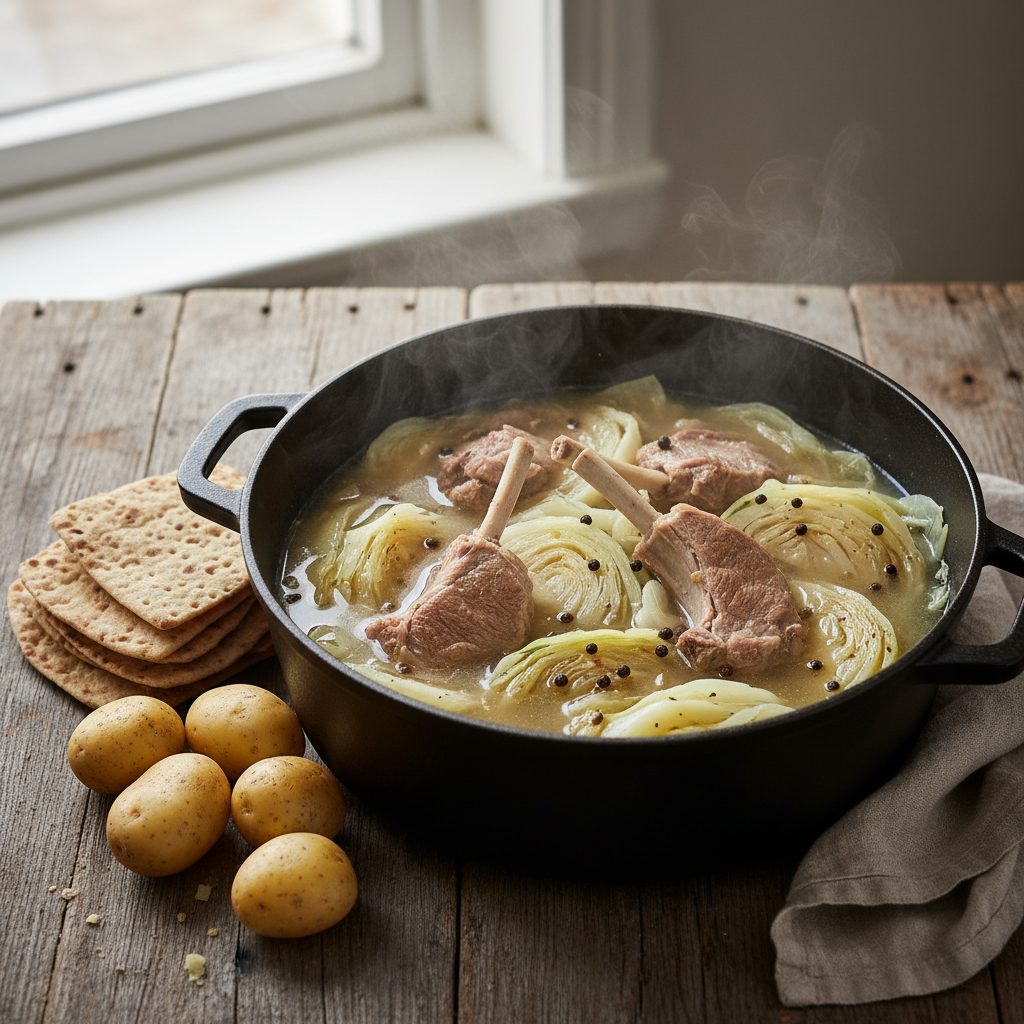
There is no showing off in it. No garnish arranged with tweezers. There is meat. Cabbage. Salt. Black pepper. A little water and a few hours of patience. The ingredients are laid in layers, shut under a lid and left in peace. You must not stir. You may only gently shake the pot, as if checking whether life is still breathing.
Fårikål literally means mutton in cabbage. The name is hard. The flavour has no intention of ingratiating itself with anyone. It is a filling, fatty, hot and honest dish. It probably arose from a Danish dish of goose and white cabbage. But goose was expensive, and sheep grazed on the Norwegian slopes. So the Norwegians did not copy a foreign tradition. They led it through their own climate, poverty, good sense and landscape. They turned the goose into mutton. A borrowing became an identity.
That is how true things are born. Not from purity of origin, but from the ability to transform.
In autumn the sheep came down from the mountain pastures. At the same time the cabbage was harvested. What the earth gave met what returned from the high meadows. This was not yet gastronomy. It was the order of the world. People knew winter would come, so they had to gather their loved ones, light the fire and feed the community.
Fårikål is served straight from a big pot set in the middle of the table. No hierarchy. No ceremony of exclusion. Everyone reaches for their own portion, but all eat from one source.
That is its quiet magic.
Not the aurora photographed by tourists. Not the green light drifting over the fjord for the delight of social media. The true aurora appears over the table when people stop being separate islands. When someone passes the potatoes. When someone tops up the broth. When the eldest tells a story the younger ones have heard ten times already, but today they listen to it differently.
The dish smells strongly. Cabbage and mutton know nothing of diplomacy. The odour permeates the flat, the clothes and the stairwell. In Norway neighbours sometimes complain. Some set out bowls of vinegar, others bake an apple cake afterwards to soften the aroma.
Never mind.
Brotherhood does not always smell of jasmine. Sometimes it smells of a pot that has been simmering for three hours. Sometimes it requires tolerance of someone else's cooking, history, presence and voice. Community begins where a person does not run away at the first discomfort.
Norwegians argue over whether lamb or older mutton is better. Whether the sauce may be thickened with flour. Whether the broth should be clear. A nation can be divided even by cabbage. But the dispute ends at the table, because the pot is bigger than the difference of opinion.
The rule says fårikål tastes best the next day. Overnight the flavours deepen, the meat grows more tender and the broth more uniform.
This is not only culinary advice.
Not everything needs to be judged at once. Not every relationship may be written off after the first conversation. Not every idea reveals its meaning straight away. Sometimes you have to let things meld in silence.
So cook fårikål. Set the pot in the middle of the table. Turn off the harsh light. Open the door to those who have eaten alone for too long.
Give them a hot portion.
Beneath the aurora, amid the cold and the darkness, the key sentence still sounds very simple.
Eat. You are at home here.
## The goose that became a sheep
The pedigree is Danish, and the trail leads to 19th-century Christiania, today's Oslo. Norway then lived under the strong influence of Danish culture and language, and the urban elites adopted the Danish dish gaas i hvidkaal, goose in white cabbage. Geese were rare and expensive in Norway, sheep were common, so the substitution happened by itself. The oldest written recipe appears in 1835 in Karen Dorothea Bang's "Fuldstændig Norsk Kogebog", which proposes replacing the goose with mutton. In her "Lærebog for Husholdningen" of 1845, Hanna Winsnes still gives a similar recipe for goose in cabbage.
Even the name is foreign. The word får came from Danish and Swedish, for Norwegian dialects say sau or smale. The writer Arne Garborg therefore wanted to rename the dish lam-i-kål, lamb in cabbage, to erase the Danish trace. He did not succeed. A dish that began as urban imitation of foreign elegance passed to peasants and workers and became a symbol of resistance to Danish and Swedish influence. It entered the everyday menu only in the 1930s, when the cultivation of head cabbage became widespread. The most Norwegian of dishes speaks with a Danish accent, and nobody minds.
## The sheep's calendar
Fårikål follows the rhythm of the year. In summer the sheep graze high in the mountains on herbs and grass. In autumn they come down to the valleys and slaktetiden begins, the slaughter season. In winter it was impossible to keep too many animals in the pens, so autumn was the only season with fresh meat, neither frozen nor salted. And that was exactly when the cabbage was harvested. The calendar wrote the recipe.
Norway takes care of its raw materials. Lofotlam, lamb from the Lofoten Islands, has a protected geographical indication, just like champagne. Sheep grazed on salty coastal pastures have meat that is seasoned before anyone reaches for the salt cellar.
The language remembers sheep as well as the kitchen does. "Ull er gull", wool is gold, because the sheep gave both dinner and a sweater. "Å koke bort i kål", to boil away in cabbage, is said of a matter that dissolved and came to nothing, like cabbage that loses its form in long cooking. Many a public debate has deserved such an epitaph.
## Wars in a single pot
Traditional fårikål was made from older sheep, fattier and tougher, which needed three hours. Purists claim that delicate lamb koker bort, boils away in the cabbage, and does not give the same depth. The younger generation prefers its milder smell and tenderness. The second front is flour. Østlandet cooks without it and prides itself on a clear, concentrated broth. The north uses jevning, sprinkling the layers with wheat flour, often mixed with spices, and serves the dish with rømme sour cream and more pepper. To the east this is a corruption of the essence; to the north, a necessity.
Vestlandet and Trøndelag throw in carrots, and in the west some cooks add stock from boiled ham. Oppland cooks the potatoes in the same pot and cannot imagine the table without flatbrød. Sogn once knew a version with no cabbage at all, a stew of mutton, swede, carrots and potatoes. Mutton in cabbage without cabbage. Tradition withstands more than its guardians think.
## The nation chooses cabbage
In 1972 listeners of the NRK radio programme "Nitimen" voted fårikål the national dish. In 2014 the then minister of agriculture and food, Sylvi Listhaug, called a new vote. Fårikål won again, with 45 per cent of the vote, although some chefs felt that a modern, multicultural Norway was better represented by Friday taco or Pizza Grandiosa. The chefs said one thing, the nation another. Cabbage won.
Since 1997, at the initiative of the meat information office Opplysningskontoret for kjøtt, today MatPrat, the last Thursday of September has been Fårikål Day. The smell of cabbage and mutton then hangs over schools, restaurants, canteens and homes. On 29 September 2012, in Spikersuppa park in Oslo, a record pot was cooked: 594.2 kilograms, 60 per cent lamb and 40 per cent cabbage, for about 10,000 guests. A gathering around the pot is called a fårikållag, and the greatest enthusiasts join clubs called fårening, which combines forening, association, with får. Norway can make an institution even out of dinner.
With the pot one drinks dark beer, bayer or bokkøl, and akevitt, while non-drinkers reach for eplemost, a tart apple juice. Plates must be warmed, because mutton fat sets quickly. Cold is the enemy here, and not only outside the window.
## Recipe
**Ingredients:**
- 1.5 kg mutton or lamb on the bone, with fat (leg, neck, shoulder)
- 1.5 kg head cabbage
- salt
- whole black peppercorns
- about 3–4 dl water (for a medium pot)
- optionally wheat flour for sprinkling the layers (northern version)
- to serve: potatoes boiled in their skins, flatbrød
**Method:**
1. Cut the cabbage into quarters or eighths, leaving the core in so the leaves do not fall apart.
2. Place the meat at the bottom of a large pot, fat side down.
3. Lay a thick layer of cabbage over the meat. Alternate the layers, sprinkling each with salt and whole peppercorns (in the north also with flour).
4. Pour in the water, bring to the boil and reduce the heat to a minimum.
5. Simmer, covered, for 2–3 hours, until the meat starts to come away from the bone by itself. Do not stir; at most, gently shake the pot.
6. Ideally, leave it overnight in a cool place and reheat slowly the next day.
7. Serve piping hot, on warmed plates, from the pot set in the middle of the table.
📖 Glossary
- fårikål
- Norweskie danie narodowe, dosłownie baran w kapuście: baranina z kością i kapusta duszone warstwami z solą i czarnym pieprzem.
- slaktetiden
- Jesienny czas uboju w Norwegii, gdy owce schodzą z górskich pastwisk, a mięso jest świeże, niemrożone i niesolone.
- jevning
- Północnonorweski sposób zagęszczania fårikålu przez posypywanie warstw mąką pszenną, często z przyprawami.
- Lofotlam
- Jagnięcina z Lofotów z chronionym oznaczeniem geograficznym, pochodząca od owiec wypasanych na słonych nadmorskich pastwiskach.
- fårikållag
- Spotkanie przy garnku fårikålu. Najwięksi entuzjaści zrzeszają się w klubach zwanych fårening.
Frequently Asked Questions
What is fårikål?
Fårikål literally means mutton in cabbage and is Norway's national dish. It consists of layers of bone-in mutton and cabbage sprinkled with salt and whole black peppercorns, stewed with a little water for 2–3 hours without stirring. It is served straight from a big pot in the middle of the table.
Where does fårikål come from?
Its pedigree is Danish. In 19th-century Christiania the urban elites adopted a Danish dish of goose in white cabbage, and since geese were rare and expensive in Norway, mutton took their place. The oldest written recipe dates from 1835, in the cookbook of Karen Dorothea Bang.
Do you add flour to fårikål?
It depends on the region. Østlandet cooks it without flour and prides itself on a clear broth. The north uses jevning, sprinkling the layers with wheat flour, and serves the dish with rømme sour cream and more pepper.
When is Fårikål Day in Norway?
Since 1997 the last Thursday of September has been Fårikål Day, at the initiative of the meat information office, today MatPrat. In 2012 a record pot weighing 594.2 kilograms was cooked in Spikersuppa park in Oslo for about 10,000 guests.
What is fårikål served with?
Fårikål is served with potatoes boiled in their skins, and in Oppland also with flatbrød. It is accompanied by dark bayer or bokkøl beer and akevitt, while non-drinkers choose eplemost apple juice. Plates must be warmed, because mutton fat sets quickly.
Why does fårikål taste better the next day?
Overnight the flavours deepen, the meat becomes more tender and the broth more uniform. That is why the recipe advises leaving the pot in a cool place overnight and reheating it slowly the next day.
Related Questions
- What is fårikål?
- Where does fårikål come from?
- Do you add flour to fårikål?
- When is Fårikål Day in Norway?
- What is fårikål served with?
- Why does fårikål taste better the next day?
🧠 Thematic Groups
- Historia: fårikål wyrósł z duńskiego dania z gęsi w białej kapuście, pierwszy zapis pochodzi z 1835 roku, a potrawa miejskich elit stała się symbolem oporu wobec wpływów duńskich i szwedzkich.
- Technika: mięso kładzie się tłuszczem do dołu, przekłada kapustą z solą i pieprzem, dusi 2–3 godziny bez mieszania i najlepiej odgrzewa następnego dnia.
- Regiony: Østlandet gotuje bez mąki, północ zagęszcza jevning i podaje z rømme, Vestlandet i Trøndelag dodają marchew, a spór dotyczy też jagnięciny i starszej baraniny.
- Kultura: fårikål dwukrotnie wygrał plebiscyt na danie narodowe, w 1972 i 2014 roku, ma swój dzień w ostatni czwartek września i jest opowieścią o wspólnym stole pod zorzą.
Tags:
fårikål
mutton in cabbage
lamb
white cabbage
black pepper
Norwegian cuisine
Norway
national dish
Fårikål Day
slaktetiden
jevning
Lofotlam
flatbrød
Karen Dorothea Bang
akevitt
More in: Kuchnia niepolityczna
Content is created by Fundacja Dobre Państwo.
Edited and published by APA ONE, the Foundation's own AI-based editorial system.