Carp Jewish-style. A fish that remembers the water
🎧 Listen (Audio)
Audio versions are read by a synthetic voice.
Listen in the Dobre Państwo podcast (Spotify) RSS
An old kitchen keeps a secret that cannot be written down in a recipe alone. Between the blade of the knife and the smell of onion, between the chill of the platter and the sweetness of raisins, hides the memory of generations. Karp po żydowsku, carp Jewish-style, is not just a dish. It is a parable served in aspic, a story of law, wandering, poverty, feast days and human ingenuity.
The carp has scales and fins; it meets the rules of kashrut. The scale protects the body, the fin lets it swim, but tradition sees further than the eye. A person needs rules that shield them from chaos, and courage that will not let them run aground. Protection without movement turns into fear, and movement without rules sometimes leads to where the water is deep but has no shore.
The fish's flesh was ground before Shabbat, so that on the holy day no one would have to separate the bones from what was edible. The law forbade selecting, but the prohibition did not destroy the flavour. On the contrary, it turned necessity into art. Fish flesh, onion, egg and matzo meal became delicate dumplings, soft as a childhood memory, though not always as gentle on the palate. They were cooked in advance, slowly, in a broth of heads, spines, vegetables and patience. When the stock cooled, collagen bound it into a clear jelly, as if time itself wanted to hold on to the smell of home.
Here one of the subtlest lessons of Judaism reveals itself: a limitation need not be a prison. It can be a frame that makes the picture visible. A person without any boundaries is like water spilled on a table. Only the vessel gives it shape.
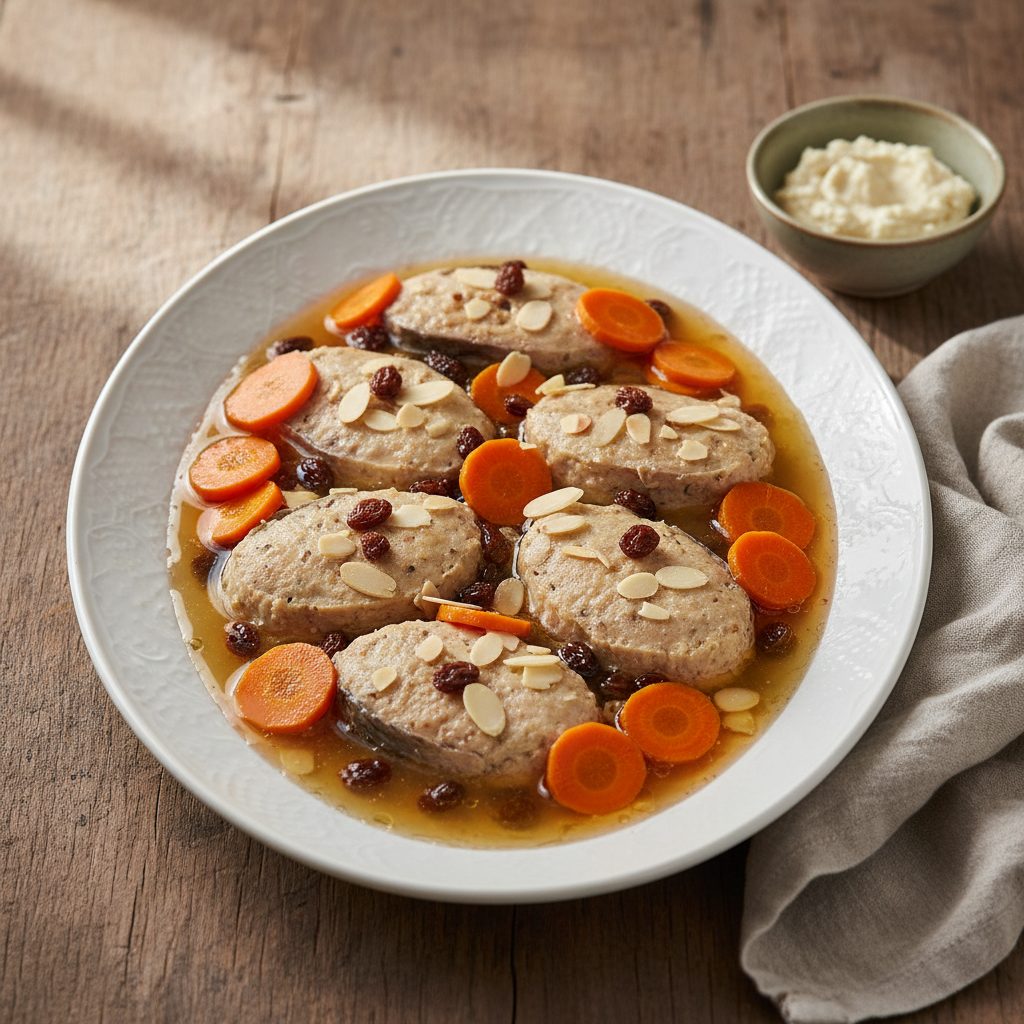
In the south the carp was sweetened with sugar, raisins and almonds. In Galicia, perhaps, they believed that since fate is often bitter, the feast at least should be seasoned with a promise of gentleness. In the north, among the Litvaks, the fish was salted and generously peppered, as if to remind everyone that the truth should not always taste like dessert. Between the two traditions ran the famous gefilte fish line, but it was a border without watchtowers. You crossed it with a spoon, a smell and a family anecdote.
Some saw hope in the sweetness, others suspected an attempt to cheat reality. Both were right, because life needs sugar but should not forget the pepper.
In Judaism the fish remains a special creature. It lives beneath the surface, hidden from the evil eye, immersed in a world that cannot be touched without breaking the surface. At Rosh Hashanah it is served with its head, so that in the new year a person may lead their own fate instead of meekly following someone else's tail. Its fertility symbolises the multiplying of good deeds, and its sweet taste carries the wish that the coming time be kinder than the last.
Carp Jewish-style teaches that the ordinary can be sanctified by intention. Bones can become the start of a broth, scraps a source of flavour, a prohibition a spur to invention, and a humble fish the bearer of a memory larger than itself.
The wisdom of this dish lies neither in the sugar nor in the pepper. It lies in the conviction that a person should be able to draw meaning from what is hard to swallow.
## Scales, fins and the ban on selecting
Kashrut, the Jewish dietary law, permits water creatures only if they have both scales and fins. The carp has both, large and clearly visible, so it is fully kosher. Fish have one more advantage over mammals and birds. They require no ritual slaughter, shechita, nor removal of blood by salting, and as pareve, neutral, food they can accompany both meat and dairy dishes. In the Jewish kitchen the fish is a diplomat. It sits down at every table.
The dish's form, ground dumplings or a filling pressed back into the skin, comes from the Shabbat prohibition of borer, that is selecting and sorting. It is one of the 39 kinds of work forbidden on Shabbat. You may not separate the inedible from the edible, so removing bones on the plate would break the law. Housewives solved the problem before Shabbat fell: they ground the flesh together with the small bones and shaped dumplings or stuffed the skin. Since cooking is also forbidden on Shabbat, the dish was eaten cold, and the collagen from Friday's boiling of the bones set into a cool jelly. Two prohibitions, one dish. The law did not invent the recipe, but it gave it its shape.
## Pike from a Bavarian Lent
The pedigree is surprising. The prototype of carp Jewish-style was born in 14th-century Christian Germany. Around 1350 a Bavarian cookbook gave a recipe for gefuelten hechden, stuffed pike, a refined dish of Catholic Lent, when meat was forbidden. Ashkenazi Jews adopted the technique and took it with them on their journey east. Along the way the pike gave way to the carp, which was widely farmed in Poland. The heyday came in the 19th century, when the royal carp was bred in Galicia, fast-growing and with fewer scales.
Catholic Lent supplied the recipe, the Jewish Shabbat gave it meaning, Polish ponds provided the fish. A dish regarded today as a model of Jewish culinary identity is a record of neighbourliness.
## The gefilte fish line
The Ashkenazi diaspora in Central and Eastern Europe was culinarily divided, and the linguist Marvin Herzog called the divide the "gefilte fish line". Galician Jews, from southern Poland and Ukraine, preferred their carp sweet. The reason was economic. At the turn of the 18th and 19th centuries beet sugar refineries sprang up, sugar became cheaper and people began adding it en masse, including to fish with raisins and almonds. The Litvaks, from Lithuania, Belarus and northern Poland, considered this barbaric and prepared the fish sharp and salty, with lots of black pepper. Theology divided the Jews into Hasidim and Misnagdim. Cooking divided them into sugar and pepper.
Migration wrote further chapters. In Britain the fish dumplings were often deep-fried. In Russia the broth and fish were coloured with beetroot. Sephardim from Morocco combined fish with a hot tomato sauce or a sweet soy glaze. The accompaniments changed. Horseradish, chrain, was mixed with beetroot for the red version, with mayonnaise or cream for the creamy one, and here and there even with mango, apricots or wasabi. Every diaspora has its own version of memory.
## Carp in the bathtub, carp in a bag
An anecdote circulates in Poland that carp became the main Christmas Eve dish on the initiative of the communist minister Hilary Minc, under the slogan "a carp on every Christmas Eve table". No one, however, ever officially spoke those words. Carp reached the tables of People's Poland because of extreme post-war shortages and the mass rebuilding of inland ponds. There was no slogan. There was poverty, and there was fish farming.
Across the ocean children found their own way of working through gefilte fish. In the 1972 children's book "The Carp in the Bathtub", a live carp bought for the Shabbat feast swims in the bathtub, the children grow attached to it like a pet and then live through its end. Anyone who remembers a carp in a Polish bathtub before Christmas Eve knows this story without reading it.
They also remember its darker side. The habit of carrying live carp in plastic bags without water took shape in the era of People's Poland shortages and shop tanks. Today it is a serious ethical and legal problem. After years of efforts by animal rights defenders, the Supreme Court, in a ruling of 13 December 2016, held that fish, as vertebrates, feel fear and pain, and that carrying them in bags in which they cannot breathe may amount to animal cruelty. Tradition does not exempt anyone from compassion.
## A herring is a fish too
Yiddish has the best joke about poverty: "Az s'iz nito keyn fish, iz hering oykh fish", when there is no fish, a herring is a fish too. It paraphrases a maxim from the tractate Pirkei Avot: in a place where there are no people, strive to be a person. Hebrew ish, a person, rhymes with Yiddish fish. Talmudic wisdom dressed up as a fish teaches you to accept a modest lot without losing your dignity.
Polish sayings are more down to earth. "Fish like to swim" was a call to wash fish down with alcohol, because otherwise it was supposed to turn to poison in the stomach. "Fish and mushrooms, flour and meadow" is the village definition of wealth. In Jewish tradition there remains Tashlikh, the New Year rite by the water, in which crumbs and sins are shaken out of pockets straight into the river, where the fish swim. The past is handed over to the water, which has seen everything already.
## Recipe
**Ingredients:**
- carp
- soup vegetables and onion for the broth
- a little wine or vinegar (optional)
- egg white for clarifying
- salt, lemon juice
- grated onion
- matzo meal or a soaked bread roll
- egg
- raisins, flaked almonds, a little sugar
- carrot and citrus for garnish, horseradish to serve
**Method:**
1. Divide the cleaned fish, separating the flesh from the spine and head.
2. From the bones, tail and heads, with plenty of soup vegetables and onion, cook a concentrated broth, optionally with a little wine or vinegar. Clarify it with a froth of egg white, which will gather the impurities, and strain.
3. Salt the carp flesh, sprinkle it with lemon and grind it thoroughly.
4. Combine the filling with grated onion, matzo meal or soaked bread and egg, knead and shape small oval dumplings, or press the flesh back into the fillet with its skin.
5. Simmer the fish and the steaks briefly over a low heat in the strained broth. At the end add raisins, flaked almonds and a little sugar.
6. Arrange the cooled fish on a platter, garnish with carrot and slivers of citrus and pour the stock over it. Serve cold, once the stock has set into aspic.
📖 Glossary
- gefilte fisz
- Faszerowana ryba kuchni aszkenazyjskiej: mielone rybne pulpety albo farsz wciśnięty z powrotem w skórę, podawane na zimno w galarecie.
- borer
- Szabatowy zakaz wybierania i sortowania, jedna z 39 prac zakazanych w Szabat, który nie pozwala oddzielać ości od mięsa na talerzu.
- parwe
- Pokarm neutralny w kaszrucie, jak ryba, który może towarzyszyć zarówno daniom mięsnym, jak i mlecznym.
- granica gefilte fisz
- Określenie Marvina Herzoga na kulinarny podział aszkenazyjskiej diaspory między słodkiego karpia Galicji a pieprznego karpia Litwaków.
- chrain
- Chrzan podawany do ryby, w wersji czerwonej z burakami, a w kremowej z majonezem albo śmietaną.
- Taszlich
- Noworoczny obrzęd nad wodą, podczas którego wytrząsa się z kieszeni okruchy i grzechy do rzeki, tam gdzie pływają ryby.
Frequently Asked Questions
Why is carp Jewish-style ground?
The dumpling form comes from the Shabbat prohibition of borer, selecting and sorting, one of the 39 kinds of work forbidden on Shabbat. Picking bones out on the plate would break the law, so before Shabbat housewives ground the flesh together with the small bones. Since cooking is also forbidden on Shabbat, the fish was eaten cold in an aspic made from Friday's broth.
Is carp kosher?
Yes. Kashrut permits water creatures that have both scales and fins, and carp has both. Fish require no ritual slaughter or removal of blood by salting, and as pareve food they may accompany both meat and dairy dishes.
Where does gefilte fish come from?
Its prototype was born in 14th-century Christian Germany. Around 1350 a Bavarian cookbook gave a recipe for gefuelten hechden, stuffed pike for Lent. Ashkenazi Jews took the technique east, where pike gave way to carp farmed in Polish ponds.
What is the difference between sweet and peppery gefilte fish?
Galician Jews preferred sweet carp, with sugar, raisins and almonds, because sugar from beet refineries became cheap at the turn of the 18th and 19th centuries. The Litvaks considered this barbaric and made the fish sharp and salty, with plenty of black pepper. Linguist Marvin Herzog called this divide the gefilte fish line.
Was carp for Christmas Eve Hilary Minc's idea?
An anecdote circulates about the slogan a carp on every Christmas Eve table, but no one ever officially said those words. Carp reached the tables of People's Poland because of extreme post-war shortages and the large-scale rebuilding of inland fish ponds.
How to make carp Jewish-style in aspic?
A broth is made from the bones, tail, heads, soup vegetables and onion, clarified with egg white and strained. The ground flesh is mixed with grated onion, matzo meal or soaked bread and egg, shaped into dumplings and briefly simmered in the broth with raisins, almonds and a little sugar. The cooled fish is covered with the broth and served cold once it sets.
Related Questions
- Why is carp Jewish-style ground?
- Is carp kosher?
- Where does gefilte fish come from?
- What is the difference between sweet and peppery gefilte fish?
- Was carp for Christmas Eve Hilary Minc's idea?
- How to make carp Jewish-style in aspic?
🧠 Thematic Groups
- Prawo i religia: karp spełnia zasady kaszrutu, a szabatowe zakazy borer i gotowania nadały potrawie formę mielonych pulpetów w zimnej galarecie.
- Historia: pierwowzorem był bawarski faszerowany szczupak na Wielki Post z około 1350 roku, a na wschodzie zastąpił go karp z polskich stawów, zwłaszcza karp królewski z Galicji.
- Kultura i diaspora: granica gefilte fisz dzieliła słodką Galicję i pieprznych Litwaków, a migracja przyniosła smażone, buraczane i sefardyjskie wersje.
- Pamięć i etyka: anegdota o Hilarym Mincu, książka The Carp in the Bathtub, karp w polskiej wannie i wyrok Sądu Najwyższego z 2016 roku o przenoszeniu ryb w workach.
Tags:
carp Jewish-style
gefilte fish
carp
fish aspic
Jewish cuisine
kashrut
Shabbat
borer
pareve
Galicia
Litvaks
Marvin Herzog
horseradish
Rosh Hashanah
Tashlikh
More in: Kuchnia niepolityczna
Content is created by Fundacja Dobre Państwo.
Edited and published by APA ONE, the Foundation's own AI-based editorial system.