Kibinai. The kibin that has to weep
🎧 Listen (Audio)
Audio versions are read by a synthetic voice.
Listen in the Dobre Państwo podcast (Spotify) RSS
In Trakai the evening descends slowly onto the lakes. First the castle dims, then the stalls fall silent, and on Karaimų Street there remains a smell of butter, pepper and baked onion. Whoever follows it long enough arrives at a table where the dish stops being food and becomes a story.
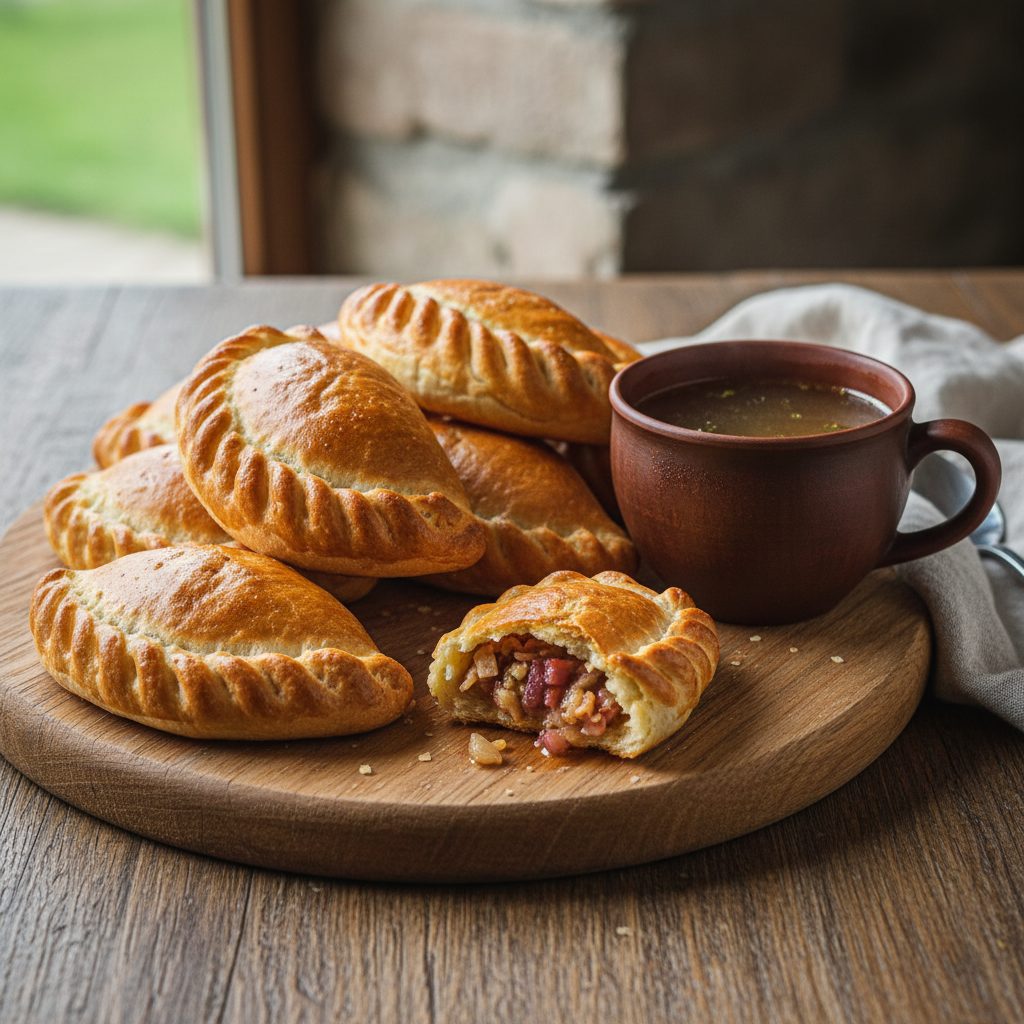
Kibinai came here with the Karaim, brought from Crimea by Grand Duke Vytautas the Great at the end of the 14th century. They were to guard castles, translate foreign languages, tend gardens and keep faith with their community. On the journey they took with them a recipe for pastry crescents filled with finely chopped lamb or beef. There was never any pork in them. Religion forbade it, but memory forbade it even more strongly.
The meat must not be minced. A mincer would rob it of its structure, its juices and its dignity. It has to be cut patiently, by hand, piece by piece. Almost as much onion as meat goes in, because it is the onion that, during baking, creates a hot broth inside. It is said that a true kibin has to weep. If no juice flows out after the first bite, somebody skimped on fat, onion or heart.
You eat it with your hands. Knife and fork are instruments of crime here: they pierce the pastry and let the most precious part escape. First you bite off a corner, then let out the steam, carefully drink the broth, and only then eat the rest. This is not a meal for the impatient. The kibin teaches that taste has its own rhythm, and that a person should not always impose a tempo on the world.
The characteristic frill hides a secret. According to the tale, the castle guards of old would grab it with dirty hands, eat the middle and throw away the hard handle. Medieval fast food thus had its own sanitary safeguard, long before anyone invented paper packaging and hygiene marketing.
Making kibinai was a family occupation. The older women watched over the dough, the younger ones chopped the meat, the children learned to plait the braid. At the table not only the recipe was passed on, but also language, legends and the rules of hospitality. More food was always prepared than the guests could eat. An empty tray would have been the host's disgrace.
Kibinai are finding their way into supermarkets, freezers and tourist advertising. Versions appear with pork, chicken, cheese, mushrooms and fruit. For some this is natural evolution. For the Karaim it is a challenge and a question about the line beyond which popularity begins to devour memory.
A community endures as long as it remembers what must not be minced, what must be shared with a guest, and why a good kibin ought to weep.
Traditionally they are washed down with clear broth or with the spiced Karaim herbal liqueur Krušnik.
## Three hundred and eighty-three families
The Karaim are the smallest ethnic and religious minority in Lithuania and Poland. Tradition links their arrival with Vytautas the Great, who around 1397–1398 returned from an expedition to Crimea and brought back 383 Karaim families. He settled them in Trakai, then the capital of the Grand Duchy, by the lakes Galvė and Totoriškės, and entrusted them with guarding the ducal castles, as well as with translation, crafts and gardens. It was in this small town that a cuisine survived whose heart became the kibin.
The Karaim are a people of Turkic origin; they speak a language of the Kipchak group and profess Karaism, a branch of Judaism that rejects the authority of the Talmud and reads Scripture literally. Biblical dietary laws therefore decide the filling. The traditional kibin is fatty lamb or beef, never pork. In the Karaim language it is called kybyn or et ayaklak, simply a meat pie. The humblest name hides the strictest rules.
## The hand, not the mincer
The traditional dough is a yeasted shortcrust or a rich shortcrust with sour cream. Flour, plenty of cold butter, eggs, thick sour cream. After kneading it must rest in the cold, even overnight. Only then, once baked, is it buttery, crisp and supple all at once.
Most important is the filling and its first commandment: the meat is cut by hand into very small cubes. In traditional homes a mincer is considered a culinary sin, because it robs the meat of its structure and juices. Add to that a great deal of raw, finely chopped onion, often almost in a one-to-one ratio. In the oven the onion softens and turns into a natural broth. Seasoning? Salt and freshly ground black pepper, sometimes a little marjoram. The filling is worked for a long time with a little water or butter. Karaim cooking does not trust ornament. It trusts proportions.
Finally the shape. Rounds of dough 10–15 centimetres across, filling on top, the edges brought together and pinched into a tight braid. The frill must be sealed, or the juice and fat will escape in the oven. What looks like decoration is in fact a gasket.
## The ritual of the first bite
Eating a kibin has its ceremony, and connoisseurs regard breaking it as a social faux pas. You hold the pastry with both hands by the two ends of the crescent. You gently bite off one corner so as to make a small opening. Through this opening you blow inside to cool the steam. Then you tilt the pastry and slowly drink the broth that has gathered. Only at the end do you eat the rest, the crisp pastry with its juicy, hand-cut filling.
Knife and fork are forbidden for a simple reason. Pierced pastry releases its whole essence onto the plate, the juice and the rendered fat. The meat inside dries out, and the pastry soaks up liquid and goes soft. The profanation here is purely physical.
Kibinai are filling and rich, so they are served with drinks that help to carry them. Clear, hot broth in a cup to sip while eating. Lightly sour kvass, which balances the fattiness of the lamb. And Krušnik, a strong, amber home-made liqueur of honey with warm spices and herbs brought from the East.
## Legends and proverbs
One legend tells that Vytautas, impressed by the valour and loyalty of the Karaim guards, asked their commander where they drew such vigour and clarity of mind. The commander pointed to a plate of steaming pastries prepared by his wife and replied that whoever eats them gains the strength of a bear and the agility of a falcon. From then on the Duke is said to have ordered that before every important battle his guard should receive fresh kibinai. The legend has a deeper meaning than an anecdote. A small community justified its place in a great state not only with the sword but with the kitchen.
A second tale explains the frill. The guards on the walls could rarely wash their hands, so they held the kibin by its thick, hard frill, ate the inside and the delicate pastry around it, and threw the soiled braid away. Handle and packaging in one.
Proverbs rarely name the kibin, but Karaim tradition, gathered in the collections "Biźnin ata sezłerimiz", is full of wisdom about bread and hospitality. "Whoever does not respect bread will have no bread," says one. "The guest comes in through the door, and happiness with him," says another, and in the homes of Trakai this always meant a tray of kibinai. The guest is a gift, so there must be more on the table than can be eaten. In Lithuania the saying about the kibin that has to weep was added to this collection.
## Pork, the freezer and the certificate
Popularity has its price. Lithuanians, for whom pork is the national meat, adapted the recipe, and today the pork kibin, kiauliena, is the most popular everyday variety there. Restaurants also offer chicken, turkey and game. In Poland kibinai took root in Podlasie, around Sejny, Suwałki and Białystok, where Lithuanian, Tatar and Polish influences intermingled. Versions appeared with cabbage and forest mushrooms, spinach with feta, curd cheese, and sweet ones with bilberries. Polish Tatars, who also do not eat pork, bake similar pastries, pierekaczewniki and janyki, and sometimes call versions with goose or turkey kibinai.
For the Karaim the most painful thing is not that someone bakes a pie with pork, but that they call it a traditional Karaim dish. Activists and community elders have protested many times, and heated exchanges continue under recipes online. Critics say bluntly that it is an ordinary meat pasty, not a kibin. Traditionalists are not fond either of frozen, mass-produced kibinai from retail chains, sprinkled with sesame or nigella and baked with cheap fats instead of butter. A local saying calls such a product heresy and an insult to the hands that braided it.
The dispute extends even to legal protection of the name itself. Attempts to bring kibinai under the EU certificate of Traditional Speciality Guaranteed or Protected Geographical Indication have stalled on the question of whether to allow pork, as the big producers want, or to restrict the name to Karaim lamb and beef, as the minority demands. There is no resolution. There is, however, a classic conflict between tourist success and the memory of a minority for whom the kibin is a carrier of identity.
## Recipe
**Ingredients:**
- dough: flour, plenty of cold butter (or high-fat margarine), eggs, thick sour cream
- filling: fatty lamb (young lamb) or beef
- plenty of raw onion, almost as much as the meat
- salt and freshly ground black pepper
- optionally a little marjoram
- a little water or butter for the filling
- to serve: clear broth in a cup, kvass or Krušnik liqueur
**Method:**
1. Make a dough from the flour, cold butter, eggs and sour cream, and leave it to rest in the cold, ideally overnight.
2. Cut the meat by hand into very small cubes. Do not mince.
3. Chop the onion finely and mix it with the meat in an almost 1:1 ratio. Season with salt, pepper and, if you like, marjoram, then work the filling for a long time with a little water or butter.
4. Roll out the dough and cut out rounds about 10–15 cm across.
5. Put filling on each round, bring the edges together and pinch them, plaiting a tight, perfectly sealed braid.
6. Bake at about 180–200°C until the kibinai turn golden.
7. Eat with your hands: bite off a corner, let the steam cool, drink the broth, and only then eat the rest.
📖 Glossary
- kybyn
- Karaimska nazwa kibina, obok et ayaklak, czyli po prostu pieróg mięsny.
- Karaimi
- Najmniejsza mniejszość etniczno-religijna Litwy i Polski, lud pochodzenia turkijskiego mówiący językiem z grupy kipczackiej i wyznający karaimizm.
- karaimizm
- Odłam judaizmu, który odrzuca autorytet Talmudu i czyta Pismo dosłownie. Jego biblijne prawa dietetyczne wykluczają wieprzowinę z farszu kibinów.
- Krušnik
- Mocna, bursztynowa karaimska nalewka domowa na miodzie z korzennymi przyprawami i ziołami, którą popija się kibiny.
Frequently Asked Questions
Where do kibinai come from?
Kibinai were brought by the Karaim, whom Vytautas the Great brought from Crimea around 1397–1398. Tradition speaks of 383 families settled in Trakai, then the capital of the Grand Duchy, who guarded the ducal castles. In Karaim a kibin is kybyn or et ayaklak, simply a meat pie.
How do you eat kibinai?
You hold the kibin with both hands by the two ends of the crescent and gently bite off one corner. You blow into the opening to cool the steam, then tilt the pastry and slowly drink the broth, eating the rest only at the end. Knife and fork are forbidden, because pierced pastry lets out the juice and fat.
Why is the meat for kibinai not minced?
In traditional homes a mincer is considered a culinary sin, because it robs the meat of its structure and juices. The meat is patiently cut by hand into very small cubes. Karaim cooking does not trust ornament; it trusts proportions.
What does it mean that a kibin must weep?
A true kibin must release juice at the first bite. The onion, added in almost equal proportion to the meat, softens in the oven and creates a hot broth inside. If there is no juice, someone skimped on fat, onion or heart.
Can kibinai be made with pork?
A traditional Karaim kibin never contains pork, because the biblical dietary laws of Karaism forbid it. In Lithuania the pork kibin is today the most popular everyday variety. What hurts the Karaim most is calling it a traditional Karaim dish, and this dispute is blocking EU protection of the name.
What is the crimped edge of a kibin for?
The edge, crimped into a tight braid, must be sealed so that the juice and fat do not escape in the oven, so it is in fact a seal. According to legend, castle guards held the kibin by its hard edge with dirty hands, ate the inside and threw the soiled braid away.
Related Questions
- Where do kibinai come from?
- How do you eat kibinai?
- Why is the meat for kibinai not minced?
- What does it mean that a kibin must weep?
- Can kibinai be made with pork?
- What is the crimped edge of a kibin for?
🧠 Thematic Groups
- Historia: Karaimi sprowadzeni z Krymu przez Witolda Wielkiego osiedli w Trokach, strzegli zamków i zachowali kuchnię, której sercem stały się kibiny.
- Technika: kruche ciasto z masłem i śmietaną leżakujące w chłodzie, mięso krojone ręcznie, cebula niemal jeden do jednego i szczelnie zaplatany warkocz.
- Rytuał i gościnność: jedzenie rękami, wypijanie bulionu przez odgryziony róg, rosół, kwas chlebowy i Krušnik oraz taca kibinów większa, niż goście zdołają zjeść.
- Tożsamość i spór: litewskie kibiny z wieprzowiną, podlaskie i tatarskie odmiany, mrożone wyroby masowe i niekończący się spór o unijną ochronę nazwy.
Tags:
kibinai
kibin
kybyn
Karaim
Karaim cuisine
Trakai
Lithuania
Crimea
Vytautas the Great
lamb
onion
shortcrust pastry
Krušnik
Karaism
Podlasie
More in: Kuchnia niepolityczna
Content is created by Fundacja Dobre Państwo.
Edited and published by APA ONE, the Foundation's own AI-based editorial system.