Rabbit with gooseberries. No king? Let's make a rabbit
🎧 Listen (Audio)
Audio versions are read by a synthetic voice.
Listen in the Dobre Państwo podcast (Spotify) RSS
In my home, tradition does not lie under glass. It smells of rosół, butter, pepper and sour gooseberries. It passes from story into gesture, from gesture into taste, and from taste into memory. I return to a recipe from 1682, written down by Stanisław Czerniecki in the Compendium ferculorum. This is not a reconstruction for a museum. It is a dish that ought to be put on the table.
We divide the rabbit into pieces, clean it thoroughly and cook it slowly in a good rosół, a clear broth, with onion, parsley, butter and whole black pepper. No hurry. The meat is to soften without losing its character.
When the rabbit is almost done, we add a handful of fresh green gooseberries. Not too early, because the fruit should give the sauce its summer sourness, not collapse into a shapeless mass. Gooseberries stood in for costly lemons. They remind us that Polish cooking knew the taste of balance long before anyone called it a gastronomic concept.
Separately, we beat three or four egg yolks with a pinch of salt. We pour a little hot broth onto them in a thin stream, stirring all the while. The yolks, tempered this way, go back into the pot. We warm the sauce very gently and stir with patience.
It must not be allowed to boil.
This is the most important rule of the dish, and perhaps not only of this dish. Too much heat curdles the sauce. Too much self-assurance curdles manners. For generations haste has spoiled more than it has cooked.
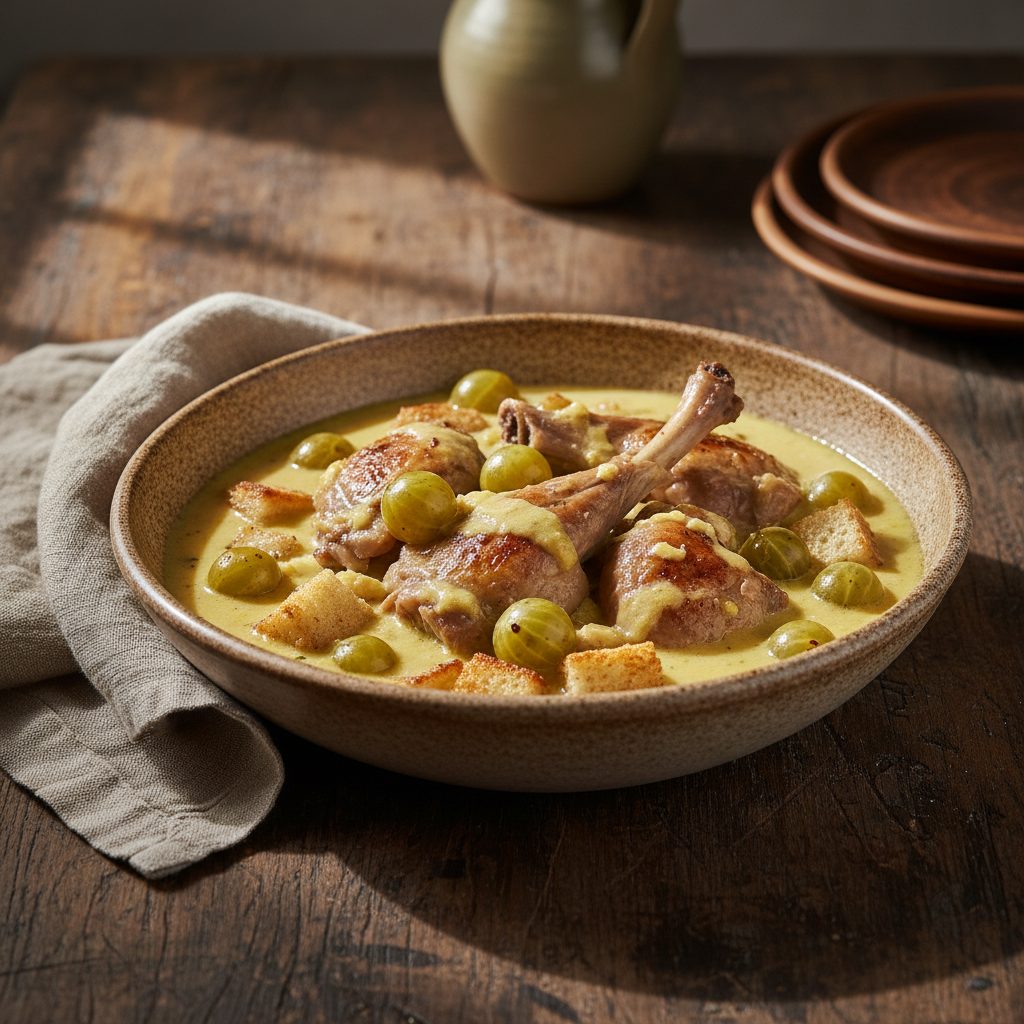
At the bottom of a bowl we lay golden croutons of white bread. On them go the tender pieces of rabbit, and over them the velvety, sour gooseberry sauce. We serve it hot.
That is how our ancestors cooked: in season, deliberately, with no complexes about other people's tables. They were not culinarily backward. They were thrifty, inventive and sensitive to contrast.
Heritage does not consist in mechanically reproducing the past. It consists in understanding its meaning, keeping its proportions and knowing what must not be boiled.
## A dish with whitened gooseberries
The Compendium ferculorum, or a collection of dishes, is the first printed Polish cookbook. In the 17th century, at the court of the Lubomirski family, the delicate meat of rabbit was prized and stood alongside other noble roasts. The best summer dish for rabbit hides in chapter one, under number LVI, as "potrawa z agrestem zabielanem", a dish with whitened gooseberries.
The original is as short as an order. It tells you to take a capon, or veal, or pigeons, or chickens, put them into broth, and when it is time to serve, to throw in peeled gooseberries, pour off a little broth, beat egg yolks and dissolve them with salt, bring it up gently, add croutons of white bread, and having warmed it through, serve it hot to the table.
There is no rabbit on that list. There is capon, veal, pigeons and chickens. But the recipe was a template, not a closed document, and it welcomes any delicate meat. Rabbit fits here better than many a candidate on the list. Few ingredients, a great deal of feel.
## Sourness instead of lemon
Gooseberries were picked in July and August. In old Polish cooking they were a key seasonal fruit, because their sharp, sour taste replaced the extremely expensive imported lemons. They brought freshness and balanced the fattiness of the meat. Today we would call them a local tool for flavour management. Back then it was enough to know that summer should have a touch of sourness.
The lesson is wider than a culinary one. The court could have sent for lemons, and yet it reached for fruit from its own garden. Not out of poverty, but out of good sense. Polish cooking was not only heavy, brown and built on the principle of "more sauce, fewer questions". It could be subtle, seasonal and aware of contrast. It joined the delicacy of meat with the tartness of fruit, courtly elegance with the simplicity of a local product.
## A broth that does not stink of wind
Czerniecki made demands of the stock as well. The broth must be such that it "stinks neither of water nor of wind". Hence the parsley, onion, butter and whole black pepper. The stock is the foundation here, not the background, because it is the stock that will later become the sauce.
The hardest moment comes at the end. The yolks, beaten with salt and tempered with hot broth, return to the pot and give the sauce its colour, body and velvet. That is the "zabielanie", the whitening. Czerniecki writes briefly: przywarz. In old Polish, przywarzenie means gentle warming, not boiling. If the liquid comes to the boil, the yolks will set and the sauce will curdle beyond repair. A public culinary debate in miniature: violent, curdled and impossible to rescue.
That is why family stories kept repeating that good cooking begins not with the recipe but with attentiveness. The rabbit is to soften, the gooseberries are to give up their sourness without vanishing, and the sauce is to stay smooth. Three conditions, one virtue: moderation.
## Without dressing up as our ancestors
You can look at tradition as an exhibit or as an invitation to a conversation. Cook something the old way, but without the kontusz, the nobleman's robe, and without pretending to speak baroque Polish. Keep the meaning, refresh the language, trust the taste. Czerniecki did not write for a museum. He wrote for a kitchen that every day had to send something hot to the table, and his recipe still fits that kitchen.
Know what may be changed. And what must not be boiled.
## Recipe
**Ingredients:**
- a rabbit, divided into pieces
- rosół for cooking the meat, with parsley, onion, butter and whole black pepper
- a handful of fresh green gooseberries, stalks removed
- 3–4 yolks of fresh eggs
- golden croutons of white bread, dried in the oven or lightly fried in butter
- salt to taste
**Method:**
1. Clean the rabbit pieces carefully, put them in a pot, cover with clear broth and cook slowly until tender.
2. When the meat is almost tender and serving time approaches, add a handful of gooseberries to the pot. The fruit should soften slightly and release its sourness, but must not fall apart.
3. Pour a little hot broth into a separate vessel.
4. In a small bowl, beat the yolks with a pinch of salt.
5. Slowly, in a thin stream, pour the reserved broth onto the yolks, stirring all the time.
6. Pour the tempered yolk mixture back into the pot with the rabbit and gooseberries.
7. Warm gently over a very low flame, stirring constantly. The sauce must not boil, or it will curdle.
8. Lay the croutons at the bottom of a deep bowl, put the rabbit on top, pour the gooseberry sauce generously over it and serve hot.
📖 Glossary
- Compendium ferculorum
- Pierwsza drukowana polska książka kucharska, wydana w 1682 roku przez Stanisława Czernieckiego, zwana też zebraniem potraw.
- zabielanie
- Dodanie do sosu żółtek rozbitych z solą i zahartowanych gorącym rosołem, które nadają mu barwę, gęstość i aksamit.
- przywarzenie
- Staropolskie określenie delikatnego podgrzania, nie gotowania. Zagotowanie sosu z żółtkami sprawiłoby, że się zwarzy.
- hartowanie żółtek
- Powolne wlewanie cienkim strumieniem gorącego rosołu do rozbitych żółtek przy ciągłym mieszaniu, zanim trafią z powrotem do garnka.
Frequently Asked Questions
How to make old Polish rabbit with gooseberries?
The rabbit is divided into pieces and cooked slowly in broth with onion, parsley, butter and whole black pepper. Towards the end a handful of green gooseberries goes in, followed by egg yolks beaten with salt and tempered with hot broth. The sauce is warmed gently, without boiling, and served over golden croutons of white bread.
Why did old Polish cooking use gooseberries instead of lemons?
Gooseberries were a key seasonal fruit in old Polish cooking, and their sharp, sour taste replaced extremely expensive imported lemons. They brought freshness and balanced the fattiness of the meat. The court could have sent for lemons, but reached for fruit from its own garden, not out of poverty but out of good sense.
What is the Compendium ferculorum?
The Compendium ferculorum, or a collection of dishes, is the first printed Polish cookbook, published in 1682 by Stanisław Czerniecki. It came out of the circle of the Lubomirski court. The recipe behind rabbit with gooseberries appears in chapter one, under number LVI, as a dish with whitened gooseberries.
Why must an egg-yolk sauce not be boiled?
If the liquid comes to the boil, the yolks set and the sauce curdles beyond repair. That is why the yolks are first tempered with hot broth, and once back in the pot the sauce is warmed very gently and stirred constantly. This is the most important rule of the dish.
What does przywarzyć mean in old Polish cooking?
In old Polish, przywarzenie means gentle warming, not boiling. Czerniecki uses the word at the moment the tempered yolks go back into the pot. The aim is for the sauce to thicken and turn velvety without coming to the boil.
Related Questions
- How to make old Polish rabbit with gooseberries?
- Why did old Polish cooking use gooseberries instead of lemons?
- What is the Compendium ferculorum?
- Why must an egg-yolk sauce not be boiled?
- What does przywarzyć mean in old Polish cooking?
🧠 Thematic Groups
- Historia: przepis pochodzi z Compendium ferculorum Stanisława Czernieckiego z 1682 roku, pierwszej drukowanej polskiej książki kucharskiej, gdzie figuruje pod numerem LVI jako potrawa z agrestem zabielanem.
- Technika: królika gotuje się powoli w rosole, agrest dodaje pod koniec, a sos zabiela zahartowanymi żółtkami, których nie wolno zagotować.
- Kultura: agrest zastępował drogie importowane cytryny, co pokazuje, że kuchnia staropolska bywała subtelna, sezonowa i świadoma kontrastu.
- Tradycja: dziedzictwo to nie mechaniczne odtwarzanie przeszłości, lecz rozumienie jej sensu, zachowanie proporcji i umiar.
Tags:
rabbit with gooseberries
gooseberries
rabbit
egg yolks
rosół
croutons
old Polish cuisine
Compendium ferculorum
Stanisław Czerniecki
Lubomirski family
zabielanie
przywarzenie
tempering egg yolks
seasonal cooking
More in: Kuchnia niepolityczna
Content is created by Fundacja Dobre Państwo.
Edited and published by APA ONE, the Foundation's own AI-based editorial system.