Kwaśnica. A sour coup d'état in a pot
🎧 Listen (Audio)
Audio versions are read by a synthetic voice.
Listen in the Dobre Państwo podcast (Spotify) RSS
Kwaśnica is not a soup. It is a sour coup d'état carried out in a pot against the aesthetics of the tiny plate, edible foam installations, and chefs who arrange three sorrel leaves with tweezers and then explain them like a doctorate in the semiotics of broad beans.
There is no illusion of craft. There is the craft of illusion. We were told that power requires finesse, a temperature controlled by satellite and a waiter reciting the pig's biography. Bullshit. Power comes with long, unchopped sauerkraut that nobody has rinsed of its character. It enters the cauldron with its own juice, its own memory and a sourness so insolent that it straightens the jaws of the fussy before they have time to ask for the wine list.
Smoked ribs do not blend into an aromatic profile. They take over the premises. Bacon does not flirt with the palate. Bacon hits you between the eyes with smoke and announces: sit down, eat, stop fussing. Lamb is not a texture. It is the highlander's ultimate argument, after which academic discussion loses its funding.
No carrot.
Carrot in kwaśnica is like glitter on a ciupaga, the highlander's axe-staff, a plastic stag outside a roadside inn and a "regional" sign printed in China. The sweet little vegetable tries to stage a festival of reconciliation of flavours here, but kwaśnica has not come to reconcile. It has come to drive out of the pot culinary kitsch, diluted tradition and all that restaurant folk-souvenir show in which śleboda smells of an air freshener with oscypek aroma.
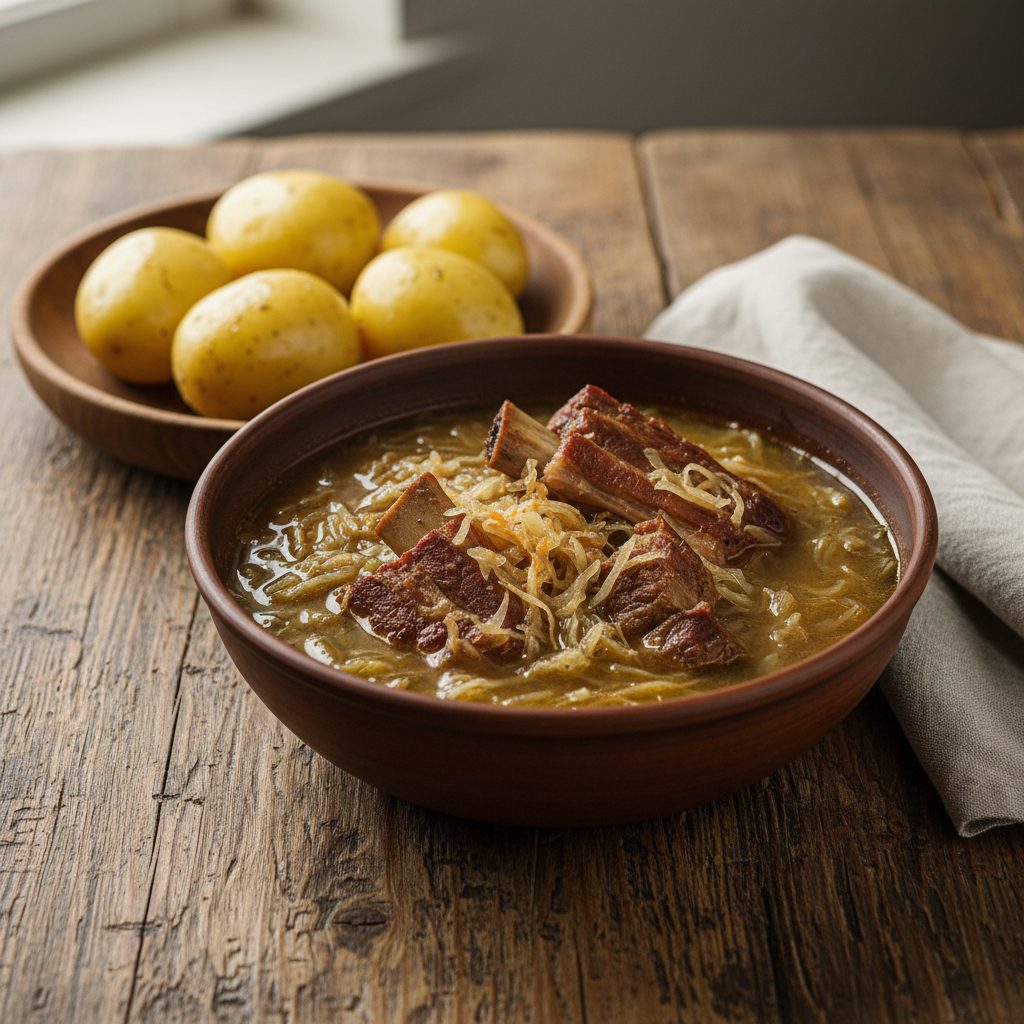
The potatoes are cooked separately. Sourness has its rights, and starch is not a member of parliament, free to ignore them with impunity. First the potato ripens in solitude, then it is admitted to an audience with the sour majesty. This is not a recipe. It is an initiation procedure.
Kwaśnica is an anthropology of survival served in a bowl. Preservation turned into metaphysics. Smoke, fat and fermentation, which together say more about civilisation than many a panel discussion entitled Authenticity in Times of the Transformation of the Consumer Experience.
When a snob leans over the steaming bowl and asks where the reinterpretation is, kwaśnica will answer in its own way.
It will let out a sour fart. Loudly. With dignity. Without a footnote.
Cooking does not have to pretend to be art. Real cooking is art when, after the first spoonful, a person stops posing, after the second starts to breathe, and after the third remembers having a spine. The rest is kapuśniak in a suit.
## A technology of survival
Kwaśnica was born not of fantasy but of necessity. In the Carpathians, in Podhale, Spisz and the Żywiec region, fresh vegetables were often a rare commodity and winter long and merciless. Fermenting cabbage was therefore the basic preservation technology, present in these parts since the Middle Ages and attested in the 16th and 17th centuries. A barrel of sauerkraut in the storeroom meant what a stocked pantry and an insurance policy mean today, both at once.
The other half of the pot depended on the rhythm of the farm, and above all on the pig slaughter. When there were smoked meats and lamb, kwaśnica gained density and power, and even in its everyday version it acquired the status of a festive meal. The smoke of the ribs and the raw sourness of the cabbage became the shared taste of the region, a kind of culinary dialect by which highlanders recognise their own faster than by their dress.
Śleboda, the highlander sense of freedom and self-sufficiency, is easiest to explain to a newcomer precisely over a bowl. Nobody imported anything here. Everything floating in the cauldron was grown, ripened or smoked on the spot.
## The holy canon
Dogmas apply in kwaśnica, and every deviation demotes it to common kapuśniak, which in the eyes of the local community is a worse mistake than oversalting.
The cabbage must be fermented, long, absolutely unchopped and unrinsed. The long strand of cabbage is the dish's signature, its look and its texture. With it comes the sauerkraut juice, kwas, which gives a clean, aggressive sourness. Whoever rinses the cabbage pours its character down the sink.
The meat must be animal in the best sense of the word: smoked ribs, bacon and lamb, giving the broth a deep, smoky profile.
Sweet root vegetables are categorically forbidden. Carrot, celery and parsley root bring a sweetness that destroys the purist character of the dish. This is not a whim but the border between kwaśnica and a vegetable soup with ambitions.
Finally the potatoes. They are cooked separately for entirely technical reasons. The high acidity of the broth does not let a raw potato soften, so they join the soup only in the bowl. Tradition and physics speak with one voice here, which happens less often than traditionalists would like.
## Podhale, the Beskids and the rest of Poland
The differences show best when you set three pots side by side. Podhale kwaśnica stands on lamb and smoked ribs, knows no thickening, and tastes sharp, sour and smoky. The Beskid version prefers smoked pork and bacon, and is sour and smoked. Neither contains root vegetables, and the potatoes wait on the side. The all-Polish kapuśniak is a different constitution altogether: ribs, bacon and sausage, carrot, celery and parsley root, often a roux or purée, potatoes cooked in the soup, a sweet-and-sour taste. A decent lunch. But not kwaśnica.
The most unusual version comes from the Żywiec region. There, for Christmas Eve, a meatless fish kwaśnica is prepared on a stock of carp heads, with beans and dried mushrooms. In this one bowl the austerity of Advent waiting meets the gifts of the forest, and through its fish base kwaśnica shakes hands with old Danubian traditions of fish soups. The highlander dogma thus has its feast day, when meat gives way to fish, but the sourness stays on duty.
Language adds its own seasoning. People speak of wasztowanie, a word taken from stacking layers of hay in a rick, a waszta. In the kitchen it means patiently building layers of flavour in the cauldron. Around Jabłonków you also hear siakanie, "cziarny" instead of "czarny", black. A recipe passed from mouth to mouth carries its pronunciation with it. Taste and dialect evolve together.
## Tischner, carollers and bread
The most beautiful review of kwaśnica was written by Father Józef Tischner in "Historia filozofii po góralsku", A History of Philosophy the Highlander Way. He credited it with the power to straighten the backs of the hunched and the jaws of the fussy. The sentence is at once a joke and a treatise. The soup restores dignity, fortitude and a backbone.
In Carpathian culture a full stomach goes together with a sense of safety and with blessing. There is a saying, "Chleb i woda – nie ma głoda", bread and water, no hunger, but full hospitality meant nothing less than a bowl of kwaśnica. New Year carollers received it as the highest form of thanks, and the hosts believed that a well-fed guest would secure them plenty for the coming year. Respect for food was absolute. Bread that fell on the floor was picked up and kissed. Kwaśnica was never wasted.
## Myth, festival and certificate
Every great dish acquires a pedigree that cannot be checked. Highlander folklore has stories tracing kwaśnica's roots back to the 4th century AD. Historical sources do not confirm this, but the myth tells the truth about something else: the conviction that this heritage has always been here.
Modern times have brought popularity and its dark side. The World Kwaśnica Festival in Żywiec and Bielsko-Biała promotes the soup on a mass scale, and record-breaking in giant cauldrons delights the media. Traditionalists watch with unease, because kwaśnica is a home dish, intimate, cooked for one's own, not for the counter. The fashion for the homely, in turn, favours certificates such as the "Jakość Tradycja", Quality Tradition, mark. Good, if they help protect the canon from simplification and the sweetness of carrot. Worse, if they turn śleboda into a label.
Because true śleboda begins with loyalty to one's own table. With long sauerkraut that nobody rinsed, and with a potato that knows its place.
📖 Glossary
- kwas
- Sok z kiszonej kapusty, który daje kwaśnicy czystą, agresywną kwasowość.
- śleboda
- Góralskie poczucie wolności i samowystarczalności, które najłatwiej wyjaśnić nad miską kwaśnicy, bo wszystko w kotle wyrosło albo zostało uwędzone na miejscu.
- wasztowanie
- Słowo wzięte od układania warstw siana w stogu, czyli waszty. W kuchni oznacza cierpliwe budowanie warstw smaku w kotle.
- siakanie
- Cecha gwary z okolic Jabłonkowa, np. „cziarny” zamiast „czarny”, przekazywana razem z przepisem z ust do ust.
Frequently Asked Questions
What is the difference between kwaśnica and kapuśniak?
Podhale kwaśnica is built on lamb and smoked ribs, knows no thickening or root vegetables, and the potatoes are served on the side. The all-Polish kapuśniak has ribs, bacon and sausage, carrot, celery and parsley root, often a roux or purée, and the potatoes are cooked in the soup. It tastes sweet and sour.
Why is carrot not added to kwaśnica?
Carrot, celery and parsley root bring a sweetness that destroys the purist, sour character of the dish. It is not a whim but the border between kwaśnica and a vegetable soup with ambitions. Any such deviation demotes it to ordinary kapuśniak.
Why are potatoes for kwaśnica cooked separately?
The reason is technical: the high acidity of the broth prevents raw potatoes from softening. That is why the potatoes are cooked separately and meet the soup only in the bowl. Tradition and physics speak with one voice here.
What kind of cabbage is used for kwaśnica?
The cabbage must be fermented, long, absolutely unchopped and unrinsed, because the long strand is the dish's signature. It comes with the sauerkraut juice, kwas, which gives a clean, aggressive sourness. Whoever rinses the cabbage pours its character down the sink.
What is the Christmas Eve fish kwaśnica from the Żywiec region?
In the Żywiec region a meatless fish kwaśnica is cooked for Christmas Eve on a stock of carp heads, with beans and dried mushrooms. Meat gives way to fish, but the sourness stays on duty. Through its fish base it echoes old Danubian traditions of fish soups.
What did Tischner write about kwaśnica?
Father Józef Tischner, in „Historia filozofii po góralsku” (A History of Philosophy the Highlander Way), credited kwaśnica with the power to straighten the backs of the hunched and the jaws of the fussy. The sentence is both a joke and a treatise: the soup restores dignity, fortitude and a backbone.
Related Questions
- What is the difference between kwaśnica and kapuśniak?
- Why is carrot not added to kwaśnica?
- Why are potatoes for kwaśnica cooked separately?
- What kind of cabbage is used for kwaśnica?
- What is the Christmas Eve fish kwaśnica from the Żywiec region?
- What did Tischner write about kwaśnica?
🧠 Thematic Groups
- Historia: kiszenie kapusty w Karpatach było technologią przetrwania długiej zimy, obecną od średniowiecza, a świniobicie dawało kwaśnicy wędzonki i moc.
- Kanon i technika: długa, niepłukana kapusta z kwasem, wędzone żebra, boczek i baranina, zakaz warzyw korzeniowych i ziemniaki gotowane osobno z powodu kwasowości wywaru.
- Regiony: podhalańska kwaśnica na baraninie, beskidzka na wieprzowych wędzonkach, wigilijna rybna z Żywiecczyzny i ogólnopolski kapuśniak jako inna konstytucja.
- Kultura: Tischner, kolędnicy ugaszczani kwaśnicą, szacunek dla chleba, mit o IV wieku, Światowy Festiwal Kwaśnicy i certyfikaty chroniące kanon przed kiczem.
Tags:
kwaśnica
sauerkraut
sauerkraut juice
smoked ribs
lamb
bacon
highlander cuisine
Podhale
Beskids
Żywiec region
kapuśniak
śleboda
wasztowanie
Józef Tischner
fish kwaśnica
More in: Kuchnia niepolityczna
Content is created by Fundacja Dobre Państwo.
Edited and published by APA ONE, the Foundation's own AI-based editorial system.