Moussaka. Do not read it, take it apart layer by layer
🎧 Listen (Audio)
Audio versions are read by a synthetic voice.
Listen in the Dobre Państwo podcast (Spotify) RSS
First you will smell it.
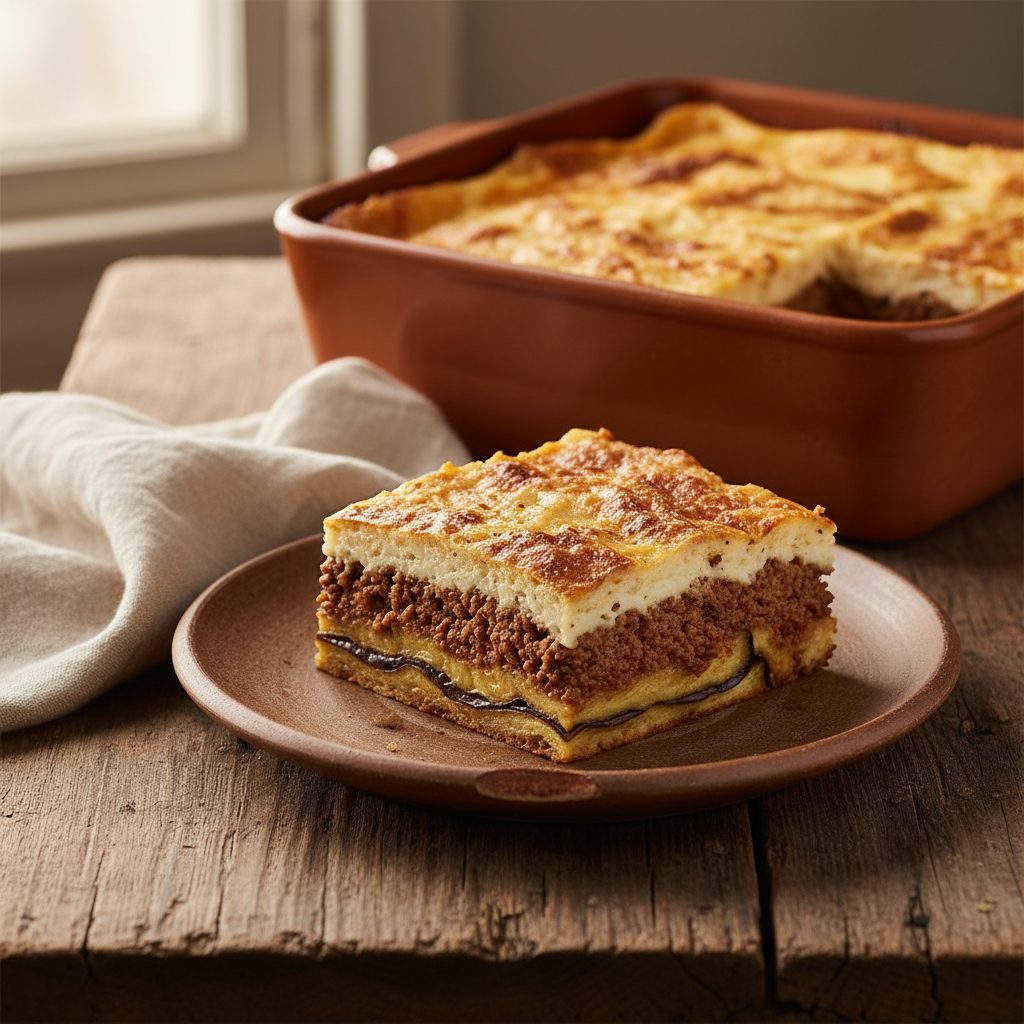
You cannot see it yet, and already it is close. Warm. Heavy with olive oil, cinnamon and promises. The aubergine surrenders slowly to the heat, softens, darkens, loses its resistance. The meat throbs beneath the spices. The béchamel flows over it, white, thick and shamelessly gentle.
Moussaka does not ask whether you are hungry. It makes you begin to desire.
Its name came from the East. From the Arabic musaqqa‘ah, something chilled, transformed, worked upon. Once it was cool, moist, soft with aubergine. It wandered through cities and ports, from mouth to mouth, from hand to hand, leaving a trail of aroma behind it.
Then came Nikolaos Tselementes. In the 1920s he dressed its oriental body in French béchamel. He put the chaos in order. He tightened the layers. He locked the softness inside a geometric construction. He wanted to Europeanise it, but the East would not let itself be erased. It stayed beneath the surface: in the cinnamon, in the aubergine, in a deep, slightly indecent warmth.
Moussaka has two faces. One is served at the table. The other awakens only under the knife.
The blade pierces the pale crust. The béchamel trembles. The inside parts, revealing layers of meat, vegetables and juices. Steam rises slowly, like a breath after a long wait. You touch the centre with your fork, but it will not let itself be possessed at once.
It must rest. Fifteen minutes. Perhaps thirty.
The cruellest rule of Mediterranean cooking says: do not take it when it is at its hottest. Let it ripen. Let the aromas meet, let the sauce sink deeper, let all the layers stop existing separately.
Patience is not a virtue. It is foreplay.
Greek moussaka rises proudly beneath its béchamel. Turkish moussaka knows no bounds, it melts between the lips like a stew. The Balkan one yields to potatoes, egg and yoghurt. The Arab one can be cool, vegetable and deceptively innocent.
Each says the same thing. Come closer. Taste.
See how many stories fit into a single bite.
The first is soft. The second deeper. At the third the cinnamon opens a hidden door, the olive oil stays on your lips, and the béchamel tames the fire only to let it return a moment later.
You eat more and more slowly. No longer out of hunger.
For the moment when the flavour reaches its peak and the plate stops being an object. It becomes a temptation.
Moussaka cannot simply be eaten.
Moussaka brings you to the point where you no longer know whether you are tasting it or it is tasting you.
## From Baghdad, served cold
Before moussaka became a bake, it was a word. The Arabic musaqqa‘ah means "chilled", "processed", and according to some readings "pounded". Each of these meanings says something different about the dish, and none of them heralds béchamel.
The oldest written sources, led by the 13th-century Baghdad treatise Kitab al-Tabikh, describe a dish that resembles nothing we take out of the oven today. It was rather a cold salad or a stew of aubergines. Only in the great, multilingual Ottoman Empire did moussaka move from cold to heat and acquire meat. It adapted to the climate, to the markets, to whatever happened to be at hand. A tradition that is now taken to be eternal turns out to be a series of house moves.
It is a good lesson for anyone who believes in static heritage. A dish that has changed even the temperature at which it is served has no single original. It has a biography.
## Béchamel as a political programme
The most radical turn in moussaka's history did not take place in a peasant kitchen but in one man's head. Nikolaos Tselementes, a chef trained in France, decided in the 1920s to Europeanise the Greek table. He added a thick béchamel sauce, arranged the ingredients in geometric layers, and turned a soft, sprawling dish into a construction.
It was not only about taste. The elites of the day equated Ottoman influence and "oriental" aromas with backwardness, and French technique was to be a passport to Europe. Laying a Western sauce over Eastern ingredients was an act of cultural policy, carried out with a spoon instead of a decree. An effective one, too, because to this day it is Tselementes's version that counts as canonical, and it is this version that tourists from all over the world consider the essence of Greece.
The East, however, survived where reformers do not look: in home recipes. Cinnamon and allspice in the meat filling stayed, despite the French disguise. The béchamel covered history but did not erase it. The third bite is enough to taste it.
## Whose moussaka is it
Geography decides the ingredients, history the form. Greek moussaka is an architecture of layers of aubergine, meat and béchamel, scented with cinnamon. The Turkish one knows no layers at all. It is an aromatic stew of aubergines and peppers, served with rice pilaf and cooling cacık yoghurt. In the Balkans, in Bulgaria and Serbia, aubergine gave way to potatoes, because local farming demanded it, and the whole is crowned with a topping of yoghurt and eggs. The Arab and Egyptian versions, called mesaqa‘ah, are often vegetarian and made with chickpeas. Egyptians let the dish rest for a whole day before serving it cold or warm. In a sense they are returning to the Baghdad source.
Such a diverse set of siblings is bound to quarrel over the inheritance. Greece and Turkey have been arguing for years over ownership of the national recipe, diplomatically and culturally. The dispute is as unresolvable as it is amusing. Both sides are fighting for a dish whose name is Arabic and whose most famous form is French.
## A social mirror
In Greece food rarely stays in the kitchen. Moussaka serves as a rhetorical tool and a mirror reflecting class and ideological disputes. One parliamentary exchange in 2017 gave birth to the meme of the "cosmic moussaka", exogiinos moussakas, which Greeks still use as shorthand for political absurdity and a government detached from life. When politicians stop being comprehensible, the nation translates them into the language of lunch.
In the Balkans moussaka left a different mark. Because of how much work it takes, it survived in folk stereotypes as a "test of the perfect wife". The stereotype has aged worse than the dish itself, but it tells the truth about the effort. Moussaka needs many pans, many hours and patience. Alex Andreou wrote in "The Guardian" that its layers let you take reality itself apart, and that the patience they demand becomes an act of resistance in the age of fast food. A Sunday table with moussaka is therefore more than a lunch. It is proof that someone had time for others.
## Rigour beneath the béchamel
Mastery of moussaka begins with the fight against bitterness. The aubergines must be carefully drained with salt before they go into the dish. The meat needs a link with the East, that is cinnamon and allspice. Then comes the building of the layers, an almost architectural task, because a badly assembled construction will collapse at the first cut.
Most important, however, is a rule that cannot be hurried. After baking, moussaka must rest for fifteen to thirty minutes. The structure of the flavour needs time to settle, and the layers need time to stop existing separately so that they do not slide apart on the plate. Whoever cuts at once gets a hot, runny mixture. Whoever waits gets a story.
Perhaps that is why moussaka is a festive dish. It cannot be eaten on the run. It teaches what modernisation programmes do not: that order without patience is merely neatly arranged chaos.
📖 Glossary
- musaqqa‘ah
- Arabskie słowo, od którego pochodzi nazwa musaki. Znaczy „schłodzone”, „poddane obróbce”, a według niektórych odczytań „stłuczone”.
- Kitab al-Tabikh
- XIII-wieczny bagdadzki traktat kulinarny, jedno z najstarszych źródeł opisujących musakę jako zimną sałatkę albo gulasz z bakłażanów.
- cacık
- Chłodzący turecki jogurt podawany z turecką musaką i ryżowym pilawem.
- mesaqa‘ah
- Arabska i egipska wersja musaki, bywa wegetariańska i z ciecierzycą. Egipcjanie pozwalają jej leżakować przez dobę.
- exogiinos moussakas
- „Kosmiczna musaka”, grecki mem zrodzony z parlamentarnej wymiany zdań w 2017 roku, skrót politycznego absurdu i oderwania władzy od życia.
Frequently Asked Questions
Where does moussaka come from?
Moussaka's name is Arabic, and the oldest written sources, led by the 13th-century Baghdad treatise Kitab al-Tabikh, describe something more like a cold salad or stew of aubergines. Only in the Ottoman Empire did moussaka move from cold to heat and acquire meat. It has no single original; it has a biography.
What does the word moussaka mean?
The Arabic musaqqa‘ah means „chilled” or „processed”, and according to some readings „pounded”. Each of these meanings says something different about the dish, and none of them heralds béchamel.
Who added béchamel to moussaka?
It was Nikolaos Tselementes, a French-trained Greek chef, in the 1920s. He added a thick béchamel and arranged the ingredients in geometric layers in order to Europeanise the Greek table. His version is still regarded as the canonical one.
What is the difference between Greek and Turkish moussaka?
Greek moussaka is made of layers of aubergine, meat and béchamel scented with cinnamon. The Turkish version has no layers; it is an aromatic stew of aubergines and peppers served with rice pilaf and cooling cacık yoghurt. In the Balkans aubergine gave way to potatoes, and the whole is crowned with a yoghurt and egg topping.
Why does moussaka need to rest after baking?
After baking, moussaka must rest for fifteen to thirty minutes, because the structure of its flavour needs time to settle. The layers then stop existing separately and do not slide apart on the plate. Whoever cuts at once gets a hot, runny mixture.
How to prepare aubergines for moussaka?
Mastery of moussaka begins with the fight against bitterness. The aubergines must be carefully drained with salt before they go into the dish. The meat needs cinnamon and allspice, and the layers must be built carefully so that they do not fall apart at the first cut.
Related Questions
- Where does moussaka come from?
- What does the word moussaka mean?
- Who added béchamel to moussaka?
- What is the difference between Greek and Turkish moussaka?
- Why does moussaka need to rest after baking?
- How to prepare aubergines for moussaka?
🧠 Thematic Groups
- Historia: musaka wędrowała od bagdadzkiego dania z bakłażanów na zimno przez osmański gulasz z mięsem do greckiej zapiekanki z beszamelem.
- Polityka kulturalna: Tselementes nałożył francuski beszamel na wschodnie składniki, by zeuropeizować grecki stół, a Grecja i Turcja wciąż spierają się o prawo do receptury.
- Regiony: grecka musaka jest warstwowa, turecka to gulasz z pilawem i cacıkiem, bałkańska stoi na ziemniakach z jogurtem i jajkiem, a egipska bywa wegetariańska z ciecierzycą.
- Technika i kultura: bakłażany odwadnia się solą, farsz przyprawia cynamonem i zielem angielskim, a upieczona musaka musi odpocząć, co czyni ją daniem świątecznym i aktem cierpliwości.
Tags:
moussaka
aubergine
béchamel
cinnamon
allspice
Greek cuisine
Turkish cuisine
Balkan cuisine
musaqqa‘ah
Nikolaos Tselementes
Kitab al-Tabikh
Ottoman Empire
cacık
layered bake
cosmic moussaka
More in: Kuchnia niepolityczna
Content is created by Fundacja Dobre Państwo.
Edited and published by APA ONE, the Foundation's own AI-based editorial system.