Ossobuco alla Milanese. A liturgy of bone, butter and saffron
🎧 Listen (Audio)
Audio versions are read by a synthetic voice.
Listen in the Dobre Państwo podcast (Spotify) RSS
Ossobuco alla Milanese belongs to those dishes before which a sensible person sets aside haste and a glutton surrenders the last remnants of modesty.
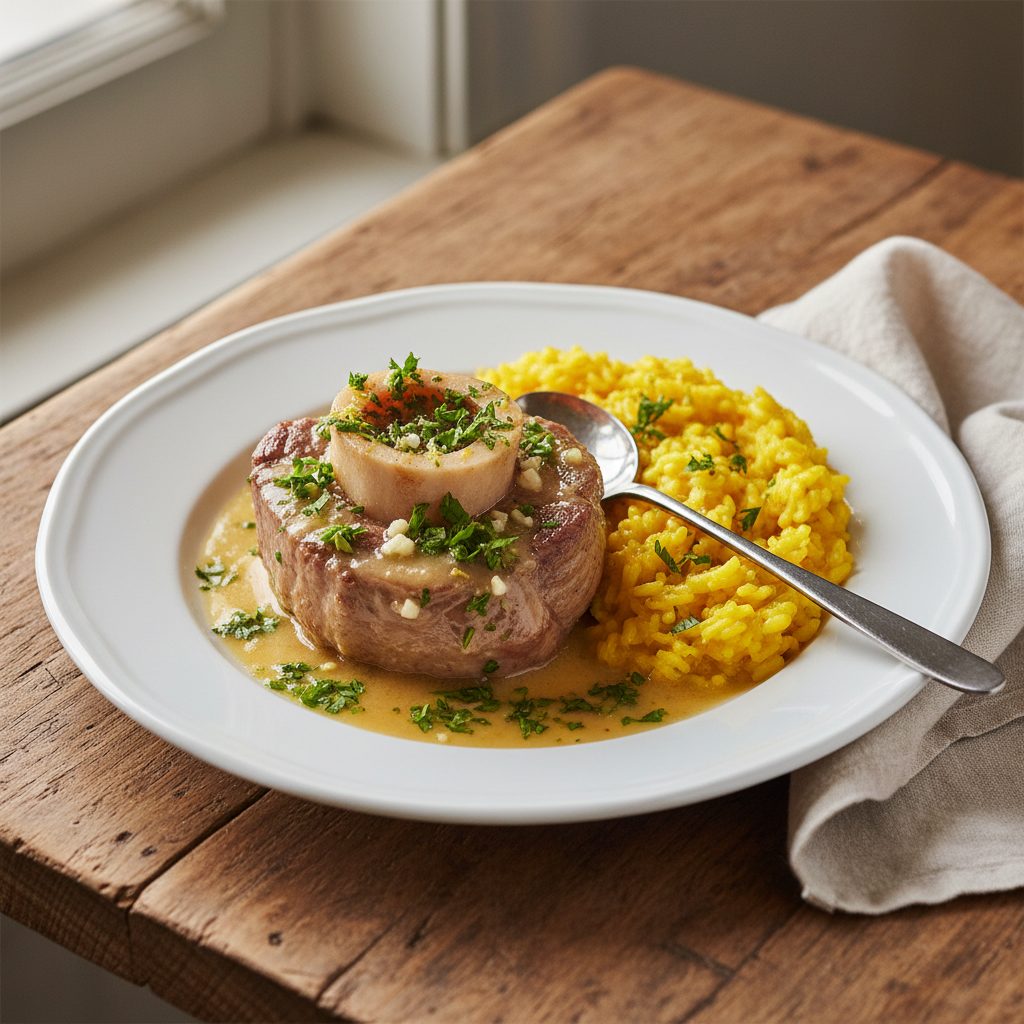
A slice of veal shank appears on the table. Two fingers thick. In the centre, a bone with a hole, òss bus, a reliquary filled with marrow. It is the most precious part of the rite, a hidden reward for the faithful who persevere to the end of the meal.
First the altar is prepared. The meat is nicked around the edges so that it will not curl in the heat, lightly dusted with flour and laid in butter. Not in olive oil. Butter is doctrine, not a suggestion. The shank turns golden slowly, until its surface takes on the colour of an old Milanese fresco.
Then comes the white wine. It hisses on the bottom of the pan like a brief response from the choir. The broth completes the ceremony. Onion, carrot and celery form a humble procession of aromas. Cloves and fennel seeds recall that the old kitchen was not afraid of deep, almost apothecary scents. Under patient heat the collagen is transformed into sauce. The meat softens. Time is reduced to an essence.
The gremolata appears: parsley, garlic, lemon zest, sometimes anchovy. Green, sharpness, light and salt. It is a culinary sign of the cross made over the weight of the meat. The lemon cuts through the fat, the garlic wakes the senses, and the anchovy does not betray its presence but strengthens everything it touches.
Beside it rests risotto alla Milanese. Rice steeped in saffron has the colour of a golden chasuble. It absorbs the sauce of the ossobuco and becomes part of the mystery. Meat, rice, butter and marrow do not compete. They form a communion of flavours in which each ingredient knows its place.
The final act comes at the end. The marrow is drawn from the bone with a narrow spoon called l'esattore, the tax collector. The instrument leaves nothing behind. It collects the last dues of pleasure. Abandoning the marrow would be not only a mistake. It would be culinary apostasy.
Purists argue about tomatoes. Some defend the pale version in bianco; others allow a red deviation. There is also a war over anchovies and fat. The sin remains the empty bone. Ossobuco without marrow is like a temple without the sacred, a feast without fulfilment, a promise without a finale.
The Milanese say that meat near the bone is the best. Ossobuco proves something more. The best is often what is hidden deepest. You need patience, the right spoon and a glutton's conscience.
## The land of butter
Ossobuco began in cucina povera, the poor kitchen that knew how to make something out of tough shank. It was ennobled by generations of Milanese housewives, the regiure, until it became the centre of Sunday lunch and an icon of Lombardy. The primal strength of veal met here with the aristocratic glow of saffron. Poverty and splendour at one plate, without complexes.
Lombardy, land of the Insubres and the Gauls, has worshipped butter for centuries. Tradition holds that it was the local Cisalpines who first treated Julius Caesar himself to it, and the dish uova in cereghin is said to be a keepsake of that. No wonder that in Milan frying in olive oil passes for a kind of heresy. Here fat is not a choice but a confession of faith.
As early as the 14th century veal shank and marrow belonged to the nourishing diet of the people of the Po valley, but the dish lived in oral tradition. It reached paper in 1879, in Giuseppe Sorbiatti's "Il Memoriale della Cuoca", published in Milan. There it was described as a dish the Milanese eat for breakfast. In the 19th century it was a calorie-rich breakfast for craftsmen before it was promoted to the lunch of the bourgeoisie. In 1891 Pellegrino Artusi, in "Science in the Kitchen and the Art of Eating Well", popularised "Oss Buss" throughout Italy, though it is Sorbiatti's version, with its strict approach to gremolata, that is considered closer to the Milanese truth. In 2007 the city granted the dish De.Co. status, Denominazione Comunale. The bone with a hole got its birth certificate.
## A technique that does not forgive
The name in dialect, òss bus, means "bone with a hole". That hole full of marrow dictates the whole architecture of the dish. The connoisseur chooses veal shank, geretto di vitello, ideally from the hind leg, from an animal fed only on milk. The slices are about 4 centimetres thick, "two fingers". The outer membrane, the nervetti, is nicked in several places so the meat does not curl.
It is fried only in butter, often with a sofritto of onion, carrot and celery. Once it has a golden crust, the meat is deglazed with dry white wine and braised in beef or veal broth cooked on bones. The collagen slowly turns into a silky sauce. It is a process that demands devout patience, not a talent for improvisation.
Sorbiatti had his secret: four cloves, chiodi di garofano, in the sauce, and a pinch of fennel seeds, semi di finocchio. Modern simplified versions forget this and lose the historical profile. Gremolata, from gremolà, to crumble, is parsley, garlic and lemon zest. The key and often omitted ingredient is anchovy, acciuga. Dissolved in the sauce five minutes before the end, it binds the meat to the citrus freshness and leaves no fishy aftertaste. A bridge of flavour that nobody sees and everybody feels.
## A tax collector at the table
Ossobuco alla Milanese is a piatto unico, a dish that suffices for a whole lunch. Its noblest companion is risotto alla Milanese. The velvety saffron rice and the deep sauce form a unity on the plate that must not be separated. In the Alps, meanwhile, they say that polenta without ossobuco is like a Sunday without sun.
The most intimate moment is the marrow, midollo. It is extracted with l'esattore, a long, narrow spoon of almost surgical precision. The name is Milanese irony. The instrument, like a revenue officer, collects every morsel of fatty goodness from inside the bone. Skipping this ritual is regarded in Milan as culinary ignorance. The tax collector is the only official here whom everyone greets with joy.
Language has recorded the philosophy of the bone in dialect. "La carna tacàa all'oss l'è la più bonna", the meat near the bone is the best. "L'è mej ruşghê un òs che un baston", better to gnaw a bone than a stick. And the phrase "fei l'os", to do the bone, meaning to enjoy the gifts of the table, however modest. Milan knows how to be grateful for a bone. That is a rare virtue.
## The tomato war and the theft of marrow
Ossobuco is a field of constant tension between orthodoxy and novelty. The sharpest dispute concerns the base of the sauce. A purist will accept only the in bianco version, with cinnamon and bay leaf. Tomatoes, though popular since the 18th century, are treated by conservatives as an unnecessary concession to the cooking of the south. Anchovy in the gremolata is a foundation for Sorbiatti's disciples and a bogeyman for some moderns. A fat schism divides the believers in butter from the supporters of lighter olive oil. Every departure from butter is deemed by the guardians of authenticity a betrayal of the spirit of Milan.
The greatest restaurant sin is "the theft of marrow". To serve a guest an empty bone, from which the marrow fell out in the pot or was removed for other purposes, such as the saffron rice, is the ultimate insult. Tomatoes can be forgiven. An empty bone cannot.
Tuscany has its own ossobuco alla Fiorentina: olive oil instead of butter, a rich tomato sauce in umido, sage and bay leaf instead of gremolata, fagioli all'uccelletto beans instead of risotto and over an hour and a half of braising for extreme tenderness. The story goes that in 18th-century Tuscan taverns called ammazzatoi, ossobuco was so common that the gnawed bones served the revellers as missiles in sudden brawls. Milan licks the bone clean with a spoon. Tuscany threw it.
International versions reach for beef or pork, red wine and tomato paste. This testifies to the vitality of the dish but takes it away from Milanese rigour. The original stays in Lombardy, in the bone with a hole, from which someone patiently collects the last dues.
## Recipe
**Ingredients:**
- slices of veal shank, ideally from the hind leg, about 4 cm thick ("two fingers")
- flour for dusting
- butter
- onion, carrot and celery for the sofritto
- dry white wine
- beef or veal broth, cooked on bones
- 4 cloves
- a pinch of fennel seeds
- for the gremolata: parsley, garlic, lemon zest, anchovy
- to serve: risotto alla Milanese or polenta
**Method:**
1. Nick the outer membrane around the edges of the slices in several places so that the meat does not curl while frying. Dust lightly with flour.
2. Brown the shank in butter, together with a sofritto of onion, carrot and celery, until the meat has a golden crust.
3. Deglaze with dry white wine.
4. Add broth, the cloves and fennel seeds, and braise slowly for about 75–90 minutes, until the meat is tender and the collagen has turned into sauce.
5. Prepare the gremolata from parsley, garlic and lemon zest. Dissolve the anchovy in the sauce 5 minutes before the end of braising.
6. Serve with risotto alla Milanese, sprinkled with gremolata. Extract the marrow from the bone with a narrow spoon.
📖 Glossary
- òss bus
- Mediolańska dialektalna nazwa ossobuco, oznaczająca „kość z dziurą”, czyli plaster giczy z otworem wypełnionym szpikiem.
- gremolada
- Posypka z natki pietruszki, czosnku i skórki cytryny, często z anchois, której nazwa pochodzi od gremolà, kruszyć.
- l'esattore
- Długa, wąska łyżeczka do wydobywania szpiku z kości, nazywana poborcą podatkowym, bo ściąga ostatnią drobinę.
- in bianco
- Jasna wersja ossobuco bez pomidorów, z cynamonem i liściem laurowym, jedyna uznawana przez purystów.
- De.Co.
- Denominazione Comunale, status nadany ossobuco przez Mediolan w 2007 roku.
- piatto unico
- Danie, które wystarcza za cały obiad, jak ossobuco alla Milanese z risotto.
Frequently Asked Questions
What does the name ossobuco mean?
The name in Milanese dialect, òss bus, means „bone with a hole”. It refers to the opening in a slice of veal shank filled with marrow. That hole dictates the whole architecture of the dish and is its most precious part.
How to make ossobuco alla Milanese?
Veal shank slices about 4 centimetres thick are nicked at the edges, dusted with flour and browned in butter with a sofritto of onion, carrot and celery. They are then deglazed with white wine and braised in broth with cloves and fennel seeds for about 75–90 minutes. The dish is served with gremolata and risotto alla Milanese.
What is gremolata?
Gremolata, from gremolà, to crumble, is parsley, garlic and lemon zest. Its key, often omitted ingredient is anchovy, which dissolved in the sauce five minutes before the end binds the meat to the citrus freshness and leaves no fishy aftertaste. The lemon cuts through the fat and the garlic wakes the senses.
What do you eat ossobuco marrow with?
The marrow is extracted with a long, narrow spoon called l'esattore, the tax collector. The name is Milanese irony, because the instrument collects every morsel of fatty goodness from inside the bone. Skipping this ritual counts in Milan as culinary ignorance, and serving an empty bone as an insult.
Does ossobuco contain tomatoes?
This is the sharpest dispute around the dish. A purist accepts only the in bianco version, with cinnamon and bay leaf, and conservatives treat tomatoes, though popular since the 18th century, as an unnecessary concession to southern cooking. Others allow a red deviation.
How does Milanese ossobuco differ from the Florentine version?
Ossobuco alla Fiorentina is made with olive oil instead of butter, in a rich tomato sauce in umido, with sage and bay leaf instead of gremolata. It is served with fagioli all'uccelletto beans instead of risotto and braised for over an hour and a half. The Milanese version sticks to butter, gremolata and saffron rice.
Related Questions
- What does the name ossobuco mean?
- How to make ossobuco alla Milanese?
- What is gremolata?
- What do you eat ossobuco marrow with?
- Does ossobuco contain tomatoes?
- How does Milanese ossobuco differ from the Florentine version?
🧠 Thematic Groups
- Historia: ossobuco wyrosło z cucina povera doliny Padu, trafiło na papier w 1879 roku u Giuseppe Sorbiattiego, spopularyzował je Pellegrino Artusi, a w 2007 roku Mediolan nadał mu status De.Co.
- Technika: gicz cielęcą nacina się, smaży wyłącznie na maśle, deglasuje białym winem i dusi w bulionie z goździkami i koprem włoskim, a gremoladę wzmacnia anchois.
- Rytuał: ossobuco podaje się z szafranowym risotto alla Milanese, a szpik wydobywa łyżeczką l'esattore, poborcą podatkowym.
- Spory i warianty: puryści walczą o wersję in bianco, masło i anchois, za największy grzech uchodzi pusta kość, a Toskania ma ossobuco alla Fiorentina z pomidorami i fasolą.
Tags:
ossobuco alla Milanese
veal shank
bone marrow
gremolata
anchovy
risotto alla Milanese
saffron
butter
Italian cuisine
Milan
Lombardy
marrow spoon
Giuseppe Sorbiatti
Pellegrino Artusi
ossobuco alla Fiorentina
More in: Kuchnia niepolityczna
Content is created by Fundacja Dobre Państwo.
Edited and published by APA ONE, the Foundation's own AI-based editorial system.