Pierekaczewnik. Dignity bound in layers
🎧 Listen (Audio)
Audio versions are read by a synthetic voice.
Listen in the Dobre Państwo podcast (Spotify) RSS
Pierekaczewnik is not a dish you simply put on the table, slice and forget. It is carried in almost ceremonially, like a story rescued from the fires of history, like a gift offered to guests, to ancestors and to the community. It is the memory of the Polish-Lithuanian Tatars rolled into a golden spiral; the testimony of a culture that lost the language of its forefathers but would not allow itself to be robbed of its taste, its faith or its dignity.
The name carries the sound of work. Pierekaczewnik — the word rolls across the palate like a rolling pin across dough, comes back, turns over, completes a circle. It summons patient and sure hands, stretching six sheets so thin that light passes through them as through parchment. It used to be said that you could read a book through well-rolled dough. This was no exaggeration but a measure of mastery.
Nothing here is made in haste. The dough must be springy, smooth and obedient to the hands. Each layer is washed with butter or goose fat, which gives it gloss, softness and a scent that slowly takes over the house. The sheets settle one upon another like the pages of a family chronicle. Only on the last one does the filling rest — mutton, beef, goose or turkey, chopped with onion and pepper, according to the rigour of halal.
The meat must not be mindlessly minced. It has to keep its structure so that during the long baking it gives up its juice — an essence sealed between the layers. Pierekaczewnik is eaten with attention, sometimes with a spoon, so as not to lose a single drop. In a culture of reverence for bread, wasting the juice would be more than a culinary mistake. It would be a slight against labour, against the gift and against hospitality.
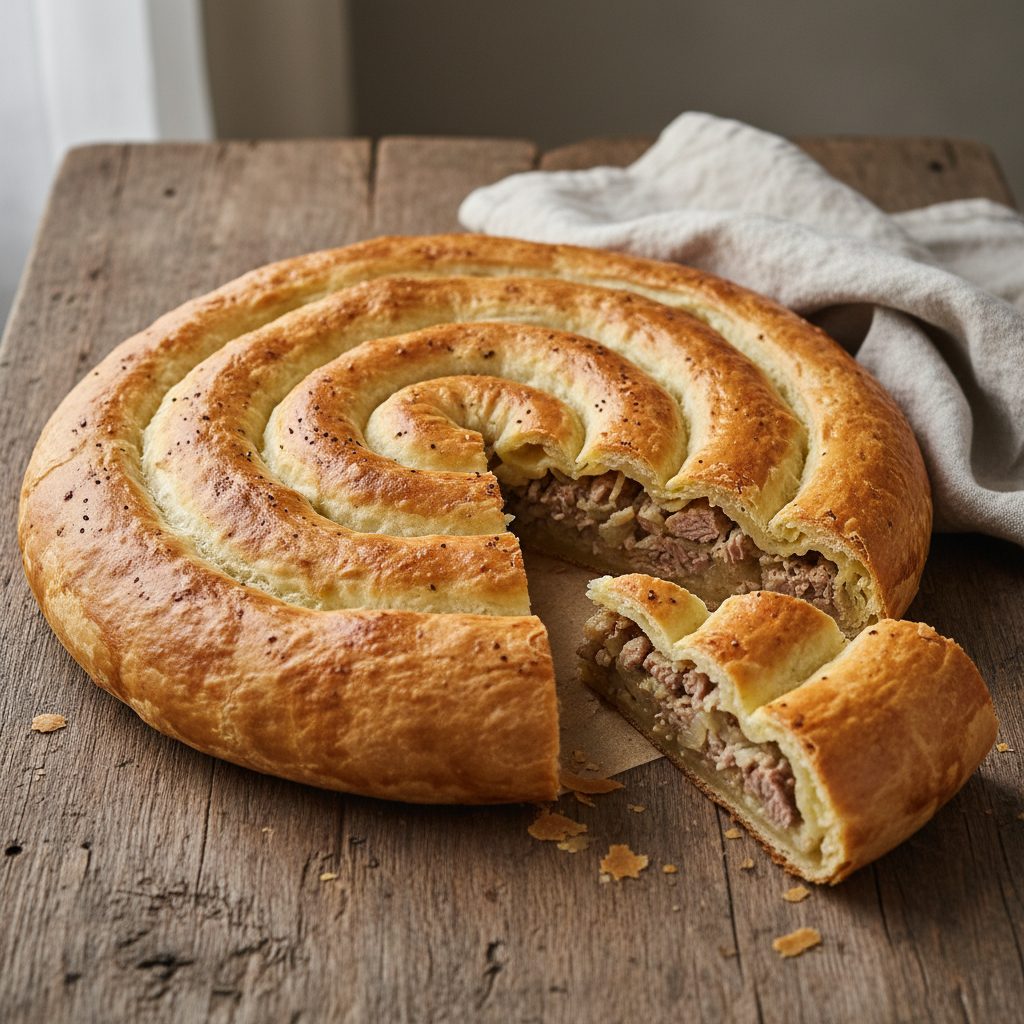
The filled dough is rolled into a long tube and coiled into a spiral resembling a snail's shell. In the oven it ripens slowly. It turns golden, flakes, grows crisp. The butter mingles with the aroma of roasting meat, onion and pepper. The scent becomes dense, warm, almost tangible. It announces a feast, but it also calls for silence, in which one first looks, breathes in and gives thanks, and only then tastes.
Pierekaczewnik is a Bayram dish, bound up with prayer, community and sadoga, that is, the ritual sharing of food for the sake of the living, the dead and the prosperity of the household. It sometimes weighs three kilograms, yet its true weight is not measured on scales. It is made up of centuries of memory, fidelity to religion, the tenderness of family transmission and time offered to another human being.
Protected as a Traditional Speciality Guaranteed, it remains a culinary monument to the Tatar presence in the Commonwealth. It is not a folkloric decoration, nor a product to be reworked at will. Its form, composition and method of preparation belong to a story that must not be made shallow, counterfeited or torn from its source.
It is worth bowing one's head before pierekaczewnik. Not before the pastry itself, but before the culture that made it a shelter for memory. Some nations write their history in stone, others in books. The Tatars wrote part of theirs in six transparent layers of dough.
As long as there are hands that know how to roll them out, that history has not been broken.
## A language that left a word behind
The paradox of this dish begins with its name. The Polish-Lithuanian Tatars, settled in the Grand Duchy of Lithuania since the 15th century, in time lost the language of their ancestors. They kept their faith, their customs and their cuisine, yet they call their most important pastry by an East Slavic word. The Belarusian pierakaczaunik and the Russian pieriekatywat', meaning “to roll over and over”, describe exactly what the hands do at the table. Assimilation took the vocabulary but could not take the recipe. The name tells you how it is made. The taste tells you who makes it.
The recipe circulated orally until, in the 1930s, Stanisław Kryczyński recorded it in the “Rocznik Tatarski”. Its modern renaissance is owed to Dżenneta Bogdanowicz, who drew directly on the tradition of the Nowogródek Tatars. In 2005 pierekaczewnik was entered on the List of Traditional Products, and since 2009 it has been the only Tatar dish in Poland with the EU certificate of Traditional Speciality Guaranteed.
The dish also deals neatly with Sienkiewicz's image of the “wild Tatar”. Someone who can stretch dough to transparency and waits two hours for the layers to separate does not fit the stereotype of the horseman from “With Fire and Sword”. Pierekaczewnik made its way, moreover, into noble manor houses and, alongside kołduny, entered the shared culinary code of the Commonwealth's elite. Stereotypes can be hard to digest. The pastry, despite its three kilograms, much less so.
## The rigour of halal and the juice between the layers
The dough is a pasta dough: cake flour, egg yolks, salt, oil, water. Add to that an enormous amount of fat, exclusively butter or goose fat. Margarine means the end of authenticity. The meat filling is made from mutton, beef, goose or turkey and must meet halal requirements. Pork is excluded, and the versions of similar form made with pork, which crop up here and there along with the fashion for Tatar cuisine, are regarded by the Tatars as a profanation of religious tradition.
The most important tool is the knife. The meat is chopped, not minced. Mincing is a sin against structure, because only chopped meat, mixed with plenty of onion and pepper, gives up its essential juice during baking. The raw filling sealed in the dough means that over two hours in the oven the pierekaczewnik bastes itself, and every layer soaks up the aroma.
There are also sweet versions, with curd cheese and raisins, with apples or with prunes. Dignity does not rule out dessert.
## An architecture of transparency
This is the most labour-intensive dish of Tatar cuisine. Six sheets of dough must be rolled out and stretched by hand to a thickness of one millimetre, until they become almost transparent. The ethnographic test of quality sounds like a riddle: you must be able to read a book through the sheet. At home it is a feat. In Tatar homes it is a duty.
The finished pastry weighs about three kilograms and measures about thirty centimetres across. Coiled into a spiral, into the shape of the letter “O”, it resembles a snail's shell. In the oven the layers flake, that is, they separate from one another like pages and turn crisp. Anyone who has ever rolled out dough themselves understands that this spiral holds hours of work.
Pierekaczewnik has a cousin in the south. The Balkan and Turkish börek, especially gül böreği, the rose snail, is a light street snack. In the Kresy, the eastern borderlands, the same idea grew to monumental proportions. Harsh winters demanded food of enormous energy density. The abundance of butter, goose and mutton was a display of prosperity, and a three-kilogram pastry expressed readiness to host an entire clan. An everyday snack, turned into a rare festive dish, had to grow and become more complicated. In the north even börek wears a sheepskin coat.
## Bayram, sadoga and the spoon
Pierekaczewnik appears on the tables during Kurban Bayram and Ramazan Bayram. Serving it is a form of sadoga, alms or a treat offered for the dead and for the prosperity of the community. This is not a cake to go with coffee. It is a religious gesture that can be eaten.
Etiquette calls for a spoon, as with kołduny, so as not to lose a drop of the juice gathered between the layers. It must be cut so that the liquid does not run out, and served hot, because only then is the fat liquid and the layers stay separate. Reverence for bread and hospitality are the Tatar answer to centuries of prejudice. A quiet answer, but a very filling one.
In 2010 Prince Charles, today King Charles III, tasted pierekaczewnik in Kruszyniany. The tasting became a symbol of Polish multiculturalism and of the Tatars' place in European pluralism. Diplomacy rarely tastes this good.
## Recipe
**Ingredients (one pastry of approx. 3 kg, approx. 30 cm across):**
- dough: cake flour, egg yolks, salt, oil, water
- plenty of butter or goose fat for brushing the layers
- halal meat: mutton, beef, goose or turkey
- plenty of onion
- pepper
- for the sweet version, instead of meat: curd cheese with raisins, apples or prunes
**Method:**
1. Knead the flour, yolks, salt, oil and water into a springy, smooth dough and divide it into six parts.
2. Chop the meat, do not mince it, and mix it with plenty of onion and pepper.
3. Roll out each part of the dough and stretch it by hand to a thickness of about one millimetre, until it becomes almost transparent.
4. Brush the sheets generously with butter or goose fat and lay them one on top of another.
5. Spread the filling on the last layer, roll the whole into a long tube and coil it into a spiral in a round dish.
6. Bake for about two hours, until the pastry turns golden and the layers begin to flake.
7. Serve hot, cutting so that the juice does not run out. Eat with a spoon.
📖 Glossary
- pierekaczewnik
- Bajramowe ciasto Tatarów polsko-litewskich z sześciu przezroczystych płatów przełożonych masłem i farszem z siekanego mięsa halal, zwinięte w spiralę.
- sadoga
- Rytualne dzielenie się jedzeniem, jałmużna albo poczęstunek w intencji żywych, zmarłych oraz pomyślności domu i wspólnoty.
- listkowanie
- Oddzielanie się warstw ciasta w piecu jak kartek, dzięki któremu pierekaczewnik robi się chrupki.
- gül böreği
- Turecki różany ślimak, odmiana böreka i lekka przekąska z ulicy, kuzyn pierekaczewnika z południa.
Frequently Asked Questions
What is pierekaczewnik?
Pierekaczewnik is the most labour-intensive dish of Tatar cuisine: six sheets of dough stretched to one millimetre, layered with butter or goose fat, with a filling of chopped meat. The whole is rolled into a tube and coiled into a spiral resembling a snail's shell. The finished pastry weighs about three kilograms and measures about thirty centimetres across.
Where does the name pierekaczewnik come from?
The Polish-Lithuanian Tatars lost the language of their ancestors, so they call their most important pastry by an East Slavic word. The Belarusian pierakaczaunik and the Russian pieriekatywat’, meaning “to roll over and over”, describe what the hands do at the table. The name tells you how it is made, the taste tells you who makes it.
What meat is used in pierekaczewnik?
The filling is made from mutton, beef, goose or turkey and must meet halal requirements. Pork is excluded, and the Tatars regard versions made with pork as a profanation of religious tradition. There are also sweet versions, with curd cheese and raisins, apples or prunes.
Why is the meat for pierekaczewnik not minced?
The meat is chopped, because only chopped meat, mixed with plenty of onion and pepper, gives up its essential juice during baking. The raw filling sealed in the dough means that over two hours in the oven the pierekaczewnik bastes itself. That is why it is eaten with a spoon, so as not to lose a drop.
When do Tatars eat pierekaczewnik?
Pierekaczewnik appears on the tables during Kurban Bayram and Ramazan Bayram. Serving it is a form of sadoga, alms or a treat offered for the dead and for the prosperity of the community. It is not a cake to go with coffee but a religious gesture that can be eaten.
Does pierekaczewnik have an EU certificate?
Yes. In 2005 pierekaczewnik was entered on the List of Traditional Products, and since 2009 it has been the only Tatar dish in Poland with the EU certificate of Traditional Speciality Guaranteed. Its form, composition and method of preparation belong to a tradition that must not be counterfeited.
Related Questions
- What is pierekaczewnik?
- Where does the name pierekaczewnik come from?
- What meat is used in pierekaczewnik?
- Why is the meat for pierekaczewnik not minced?
- When do Tatars eat pierekaczewnik?
- Does pierekaczewnik have an EU certificate?
🧠 Thematic Groups
- Historia: Tatarzy osiedli w Wielkim Księstwie Litewskim od XV wieku utracili język, ale zachowali wiarę i kuchnię; recepturę utrwalił w latach 30. Stanisław Kryczyński w „Roczniku Tatarskim”.
- Technika: sześć płatów rozciąga się do milimetra, smaruje masłem albo tłuszczem gęsim, a mięso się siecze, nie mieli, żeby w dwugodzinnym pieczeniu oddało sok.
- Religia i obyczaj: pierekaczewnik je się w Kurban Bajram i Ramazan Bajram jako sadogę, łyżką i na gorąco, z rygorem halal i bez wieprzowiny.
- Kultura: potrawa z certyfikatem GTS rozprawia się ze stereotypem „dzikiego Tatarzyna”, weszła na dwory szlacheckie, a w 2010 roku w Kruszynianach skosztował jej książę Karol.
Tags:
pierekaczewnik
Polish-Lithuanian Tatars
Tatar cuisine
halal
mutton
goose fat
flaky pastry
sadoga
Kurban Bayram
Traditional Speciality Guaranteed
Kruszyniany
Dżenneta Bogdanowicz
Stanisław Kryczyński
börek
Grand Duchy of Lithuania
More in: Kuchnia niepolityczna
Content is created by Fundacja Dobre Państwo.
Edited and published by APA ONE, the Foundation's own AI-based editorial system.