Neapolitan pizza. Hunger that became art
🎧 Listen (Audio)
Audio versions are read by a synthetic voice.
Listen in the Dobre Państwo podcast (Spotify) RSS
Neapolitan pizza is the meeting of the mouth with delight.
It arrives at the table hot, soft, slightly irregular. It does not pretend to be perfect. Its beauty lies in the fact that it bears the traces of hands, fermentation and fire. It was born in the poor quarters of Naples as a simple meal for people who needed something cheap, filling and immediate. In time it crossed the boundaries of the street, entered palaces and became one of the most recognisable symbols of Italian culture.
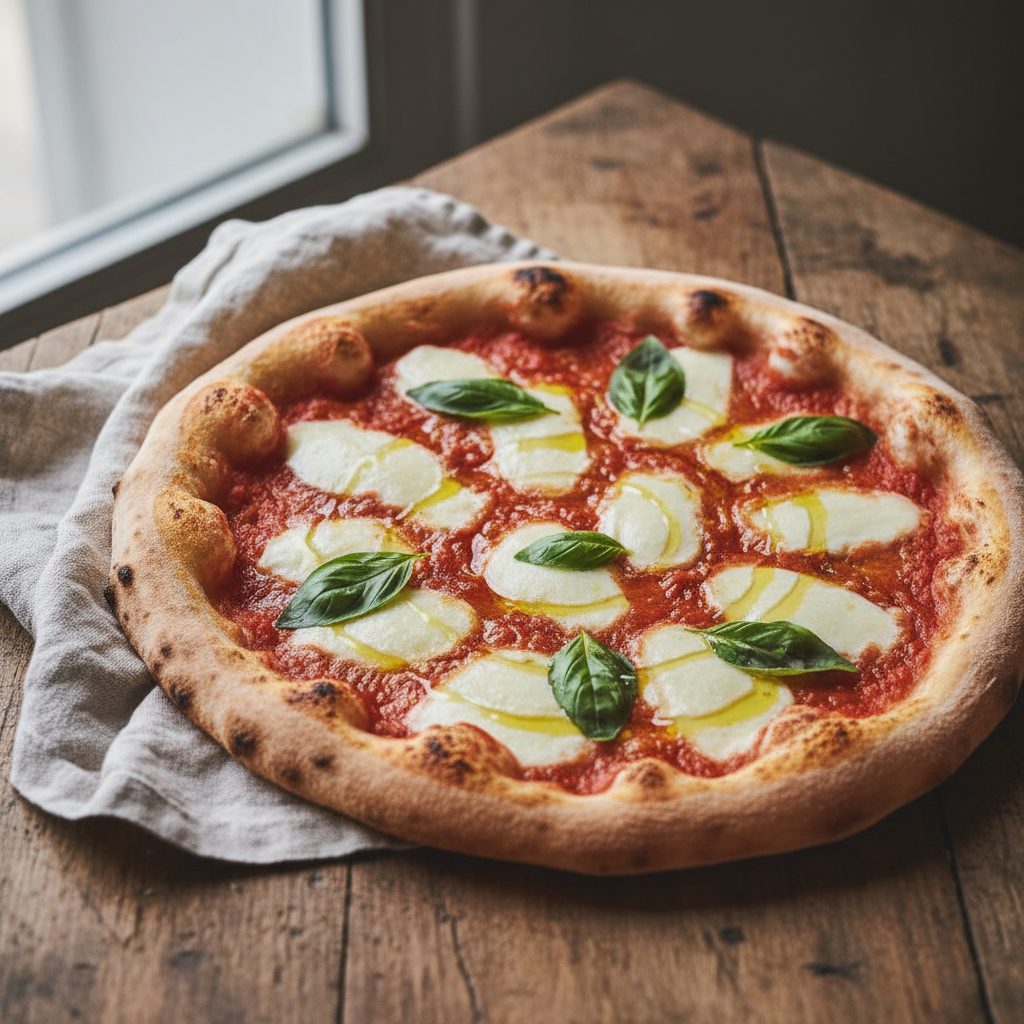
Its body is the dough. It must ripen without haste, sometimes for many hours, before the pizzaiolo touches it with open palms. He uses no rolling pin. He does not crush. He stretches, turns, pushes the air towards the edges, letting the cornicione rise high, light and almost insolent. Then comes the fire. The temperature reaches several hundred degrees, and the bake lasts barely a minute or a minute and a half. It is a short, violent transformation, in which the centre stays delicate and moist, the edges swell, and their surface is marked with dark spots resembling the traces of kisses left by the flame.
The margherita seduces with what it does not try to hide. The tomato brings sweetness and acidity, the mozzarella melts slowly, the basil cuts through the weight with a fresh aroma, and the olive oil runs over the surface in a thin spiral. It has few ingredients, which is why each one must be perfect. There is no room here for disguise, excess or noisy decoration. Simplicity becomes the most refined form of nakedness.
The first bite demands courage. Pizza should be eaten at once, while it still scalds, smells of smoke and has not yet had time to settle politely on the plate. The knife cuts through the soft centre, the cheese yields under pressure, the tomato opens the flavour, and the oil leaves a sheen on the lips. On the streets of Naples pizza is folded like a wallet and eaten without unnecessary ceremony. The sauce may run down your fingers. The cheese may stretch. Elegance, after all, lies not in keeping one's distance but in the ability to surrender to sensation without losing style.
Around pleasure a war over boundaries has long been waged. Gino Sorbillo's pineapple set off a national storm, Flavio Briatore's luxury pizzas provoked the anger of Neapolitan artisans, and the royal legend of the Margherita turned out to be, most probably, a brilliant marketing move. Even a myth can be appetising, especially when served hot.
Naples remembers, however, that true delight does not end on one's own plate. In the tradition of pizza sospesa someone pays for an extra pizza and leaves it for a stranger who cannot afford a meal. It is the most beautiful gesture in this history. Desire turns into tenderness, and taste becomes a form of solidarity.
It is not fast food. It is a promise that simplicity can be passionate, hunger can become art, and a single hot bite can, for a moment, silence the world at one's feet.
## The flatbread of the poor
Its roots reach back to the early 18th century and the port of Naples, a city of immense poverty. Flat breads with cheap toppings were the staple food of the poor, and the bakers, the pizzaioli, baked them and sold them straight on the street. They were called “picea” and were sprinkled with olive oil or lard and scattered with herbs or cheese. The tomato was not yet in the game.
It came from America, after the voyages of Columbus, and for a long time was considered poisonous. The Neapolitan poor did not have the luxury of being fussy, so they adopted it quickly. That is how the foundation of the sauce was laid, without which nobody today can imagine pizza. The most Italian colour in the world is an immigrant.
Alexandre Dumas, who visited Naples in 1835, called pizza the city's gastronomic thermometer. If it cost two liras, the season was good. If half a lira, Naples was suffering destitution. The poor bought a slice for the smallest coin, and bakers gave credit on food until the following week. This was called pizza a otto: eat today, pay in eight days. Naples invented consumer credit before the banks had learned the word.
## A king in disguise and a queen in the national colours
The flatbread quickly left the back alleys. King Ferdinand IV of Bourbon, who reigned at the turn of the 18th and 19th centuries, was a devotee and had a special oven built in the court's summer residence. According to one story, his wife, Maria Carolina of Habsburg, considered pizza vulgar and unworthy of the royal table, so the king would escape from the palace disguised as a peasant and eat in dark alleys, at Antonio Testa's pizzeria. The attempt to smuggle pizza into the court outraged the aristocracy. A monarch who has to disguise himself to eat his dinner is the best proof that power is not freedom.
The most famous story dates from June 1889. Raffaele Esposito was supposedly to prepare three pizzas for Queen Margherita of Savoy and Umberto I, and the one in the colours of newly unified Italy — red tomato, white mozzarella, green basil — so delighted the queen that it was given her name. Historians, among them Zachary Nowak, regard this version most likely as a later advertising ploy from the 1930s. Recipes for pizza with tomatoes, mozzarella and basil appeared in cookbooks several decades before the alleged visit. The name itself may have referred to the daisy, margherita in Italian, because of the radiating arrangement of the cheese slices. A flower instead of a crown. Less patriotic, but more plausible.
## The law, UNESCO and the forbidden rolling pin
Few dishes live under such strict law. In 1984 the True Neapolitan Pizza Association, AVPN, was founded. In 2009 the European Commission recognised Neapolitan pizza as a Traditional Speciality Guaranteed. In 2017 the art of the Neapolitan pizzaiuolo was added to UNESCO's list of intangible heritage.
The canon is short and merciless. Wheat flour type “0” or “00”, water, sea salt, fresh yeast and no fat in the dough. Tomatoes, ideally San Marzano from the volcanic soils at the foot of Vesuvius, elongated and sweet-and-sour. Mozzarella from buffalo milk or fior di latte from cow's milk. Basil only fresh, in whole leaves — in Neapolitan, vasenicola. Extra virgin olive oil, poured in a spiral before baking.
The dough ripens for at least eight hours, often a day or two. It is shaped only by hand. Rolling pins and presses are forbidden, because they crush the air bubbles that the pizzaiolo pushes from the centre towards the edges. A domed oven, fired with oak or beech, reaches 430–485°C, and the pizza spends 60–90 seconds inside. The centre is 3–4 millimetres thick, moist and floppy. The cornicione rises to 1–2 centimetres and bears scorch marks known as leopard spotting. In Naples stiff dough is considered a fault, not a virtue. American pizza wants to be crunchy and overloaded. Neapolitan pizza wants to be light and usually carries no more than three toppings.
## The wallet, beer and nothing with ketchup
Etiquette in Naples has an almost religious dimension. Pizza is eaten immediately after it comes out of the oven. In a restaurant with a knife and fork, from the soft centre towards the edges, without cutting it into stiff triangles, because Neapolitan dough does not stand upright. On the street it is folded a portafoglio or a libretto, in half and in half again, like a wallet or a book, wrapped in paper and eaten by hand.
Garlic sauce and ketchup are an insult to the pizzaiolo. Only chilli oil is acceptable. To drink, cold beer or water. A cappuccino with pizza is a mistake that gives away a tourist faster than a camera does.
Street vendors of old used to call out that a customer could eat a hundred of theirs in a single gust of wind. That is how light the dough was meant to be. A pizzeria on via Tribunali, in turn, is known for pizzas “as big as a cartwheel”. Italians also have the perverse “Che pizza!”, which means roughly “what a bore”. Not even a beloved dish can protect itself from language.
## Border wars and the gesture of suspension
At the turn of 2023 and 2024, in the heart of Naples, Gino Sorbillo introduced a margherita with pineapple, caramelised in the oven, on a white base with three cheeses. A national storm broke out over the limits of innovation. He himself explained that he wanted to fight culinary prejudice. Flavio Briatore's luxury pizzerias, selling pizzas for several dozen euros, and his remarks about cheap pizzas triggered protests in Naples. The bakers answered in the best way they knew: they handed out free pizza in the streets. The low price, they argued, comes from the tradition of food as a common good.
In Naples that tradition has several faces. After the Second World War the city lay in ruins, ovens were destroyed and wood was scarce. So women fried pizza fritta in the streets, dough stuffed with ricotta, cicoli and provola, in great cauldrons of oil. The 1954 film “The Gold of Naples” immortalised Sophia Loren as the beautiful wife of a pizzaiolo, selling it on the street. There was also a rustic pizza from a round metal tin, o' rutiello, thicker and crunchy on the bottom.
And alongside the suspended coffee, in poor districts such as Rione Sanità, lives pizza sospesa. Whoever can afford it pays for two. One they eat, the other they leave for someone hungry. Great cuisines are measured in stars. Naples measures itself by its second pizza.
## Recipe
**Ingredients:**
- wheat flour, very finely milled, type “0” or “00”
- water, sea salt, fresh yeast (no olive oil or butter in the dough)
- San Marzano tomatoes
- buffalo-milk mozzarella or fior di latte
- fresh, whole basil leaves
- extra virgin olive oil
**Method:**
1. Make a dough from the flour, water, salt and yeast without any fat and leave it to ripen for at least 8 hours, ideally 24–48, at a controlled temperature.
2. Shape the base only with your hands, without a rolling pin, patting and stretching the dough so as to push the air from the centre towards the edges. The centre should be 3–4 mm thick.
3. Add the tomatoes, mozzarella and basil, and finally pour olive oil over the top in a spiral.
4. Bake in a domed wood-fired oven, ideally fired with oak or beech, at 430–485°C for 60–90 seconds, until the edges rise and are covered with dark spots.
5. Eat at once: with a knife and fork from the centre, or folded in four, by hand.
📖 Glossary
- cornicione
- Wysoki, lekki brzeg pizzy neapolitańskiej, który rośnie na 1–2 centymetry i nosi ciemne przypalenia zwane panterką.
- pizza a otto
- Dawny neapolitański kredyt na pizzę: zjedz dziś, zapłać za osiem dni.
- pizza sospesa
- Pizza zawieszona, opłacona z góry przez klienta i zostawiona dla głodnego, którego nie stać na posiłek.
- a portafoglio
- Uliczny sposób jedzenia pizzy złożonej na pół i jeszcze raz na pół jak portfel, zawiniętej w papier i jedzonej z ręki.
- pizza fritta
- Smażona w kotłach z olejem pizza z ciasta nadziewanego ricottą, cicoli i prowolą, sprzedawana na ulicach zrujnowanego powojennego Neapolu.
Frequently Asked Questions
Where does Neapolitan pizza come from?
The roots of pizza go back to the early 18th century and the port of Naples, a city of immense poverty. Flat breads with cheap toppings, called “picea”, were the staple food of the poor and were sold straight on the street. The tomato came from America and was long considered poisonous, but the poor adopted it quickly.
Was pizza margherita really created for Queen Margherita?
According to legend, in June 1889 Raffaele Esposito made Queen Margherita of Savoy a pizza in the Italian colours and named it after her. Historians, among them Zachary Nowak, regard this most likely as an advertising ploy from the 1930s, since such recipes appeared decades earlier. The name may have referred to the daisy, margherita, because of the radiating arrangement of the cheese.
What are the rules of true Neapolitan pizza?
The dough is type “0” or “00” flour, water, sea salt and fresh yeast, with no fat, ripened for at least eight hours. The toppings are San Marzano tomatoes, buffalo mozzarella or fior di latte, fresh basil and extra virgin olive oil. The pizza bakes for 60–90 seconds in a wood-fired oven at 430–485°C.
Why is no rolling pin used for Neapolitan pizza?
Rolling pins and presses are forbidden because they crush the air bubbles that the pizzaiolo pushes by hand from the centre towards the edges. This lets the cornicione rise to 1–2 centimetres and become covered in scorch marks known as leopard spotting. The centre is meant to stay thin, moist and floppy.
How do you eat pizza in Naples?
Pizza is eaten straight out of the oven, in a restaurant with a knife and fork from the centre towards the edges. On the street it is folded a portafoglio or a libretto, in half and in half again, and eaten by hand. Ketchup and garlic sauce are an insult, cold beer or water is the drink, and a cappuccino gives away a tourist.
What is pizza sospesa?
Pizza sospesa is a Neapolitan tradition in which someone who can afford it pays for two pizzas. They eat one and leave the other for a stranger who cannot afford a meal. It lives alongside the suspended coffee in poor districts such as Rione Sanità.
Related Questions
- Where does Neapolitan pizza come from?
- Was pizza margherita really created for Queen Margherita?
- What are the rules of true Neapolitan pizza?
- Why is no rolling pin used for Neapolitan pizza?
- How do you eat pizza in Naples?
- What is pizza sospesa?
🧠 Thematic Groups
- Historia: pizza zaczęła się w XVIII wieku jako placek biedoty portowego Neapolu, a Alexandre Dumas nazwał ją w 1835 roku gastronomicznym termometrem miasta.
- Mit i monarchia: król Ferdynand IV Burbon zbudował piec w letniej rezydencji, a legenda Margherity z 1889 roku jest według historyków najpewniej późniejszą reklamą.
- Kanon i technika: AVPN od 1984 roku, GTS od 2009 i UNESCO od 2017 strzegą ciasta bez tłuszczu, formowania bez wałka i pieczenia 60–90 sekund w 430–485°C.
- Kultura i solidarność: od pizzy fritta z „Złota Neapolu” przez spory o ananasa Sorbilla i luksus Briatore po gest pizza sospesa.
Tags:
Neapolitan pizza
margherita
Naples
Italian cuisine
pizzaiolo
cornicione
San Marzano tomatoes
buffalo mozzarella
fior di latte
wood-fired oven
AVPN
UNESCO
pizza sospesa
pizza fritta
Gino Sorbillo
More in: Kuchnia niepolityczna
Content is created by Fundacja Dobre Państwo.
Edited and published by APA ONE, the Foundation's own AI-based editorial system.