Prażucha. Poverty that costs 49 zloty in a restaurant with a concrete wall
🎧 Listen (Audio)
Audio versions are read by a synthetic voice.
Listen in the Dobre Państwo podcast (Spotify) RSS
I have a particular weakness for dishes that for years were hidden from guests and today are served on stoneware, with a microleaf and the caption “a reinterpretation of tradition”. Prażucha is such a dish. First it was a disgrace. Then a memory. Today it is becoming a fashion.
Potatoes. Flour. Onion. Cracklings. Four ingredients from which the poor countryside could make lunch, supper, memory and identity. No parsley foam. No fermented dust. No chef talking for seven minutes about the philosophy of the tuber.
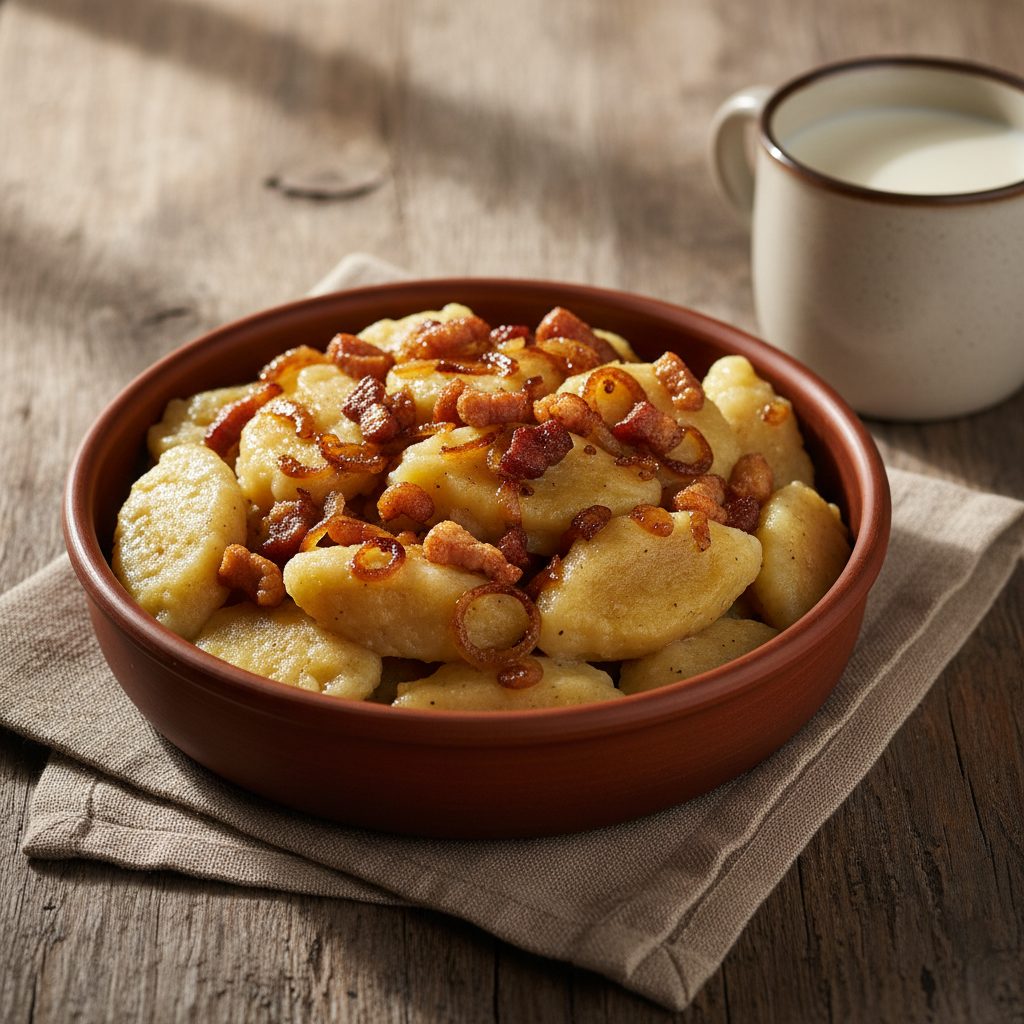
Prażucha does not seduce with subtlety. It puts the bowl on the table and says: eat. It is thick, sticky, heavy, warming. You dip the spoon in fat, cut off a portion, pour onion and cracklings over it, and wash it down with soured milk or buttermilk. The taste is simple, but not poor. It is an important difference, one that modern consumer culture stubbornly fails to understand.
In different parts of Poland it is called prazoki, porka, kulasza, fusze, dziady, śpiochy, psiocha or kluchy połom bite. One dish and so many names, as if every village wanted to say that our spuds with flour are a world of their own. And it was partly right. Regional cuisine did not arise from marketing. It arose from soil, poverty, climate and stubbornness.
Psiocha is the awkward one. The name provokes laughter, a blush or an instant communication crisis. Its source was supposedly the sound of steam escaping from the pot: “pssst, pssst”. Language can be cruel. What for one grandmother was the sound of cooking became, for later generations, a linguistic scandal about intimacy.
Prażucha was the food of the poor. In the 1950s and 60s its smell could be a reason for shame. Eating it meant that at home there was no meat, no money or no social advancement. People migrating to the cities therefore changed the name, as if one could rename one's own childhood. Prazoki sounded too rustic. Prażucha, somewhat more drawing-room. Class advancement sometimes took place not in the wallet but in the dictionary.
There is an anecdote about Bishop Tadeusz Pieronek, who asked Magda Gessler whether she knew prażuchy. She is said to have replied that she did not, but she knew racuchy. One of the lessons of Polish culture. You can be an icon of gastronomy and lose to a pot of potatoes.
Prażucha is coming back. To festivals, to restaurants, to stories about roots. The former symbol of want is becoming comfort food. What was once a source of shame is today celebrated as authenticity.
And rightly so. It is time to stop confusing simplicity with primitivism, poverty with a lack of culture, and peasant cooking with culinary failure.
Prażucha was not a second-rate dish. It was a technology of survival, a social memory and a small act of genius.
Should we serve it with a fashionable description? By all means.
Hand-formed potato and grain mass, confit onion, crispy pork fat, fermented milk drink.
Price: 49 zloty. Grandma turns in her grave, because she is the first to laugh.
## They'll get to eat more times
Prażucha grew out of the 19th-century poverty of the Polish countryside, especially where the soil was meagre: on the sands around Kielce, in the Żywiec region, in the poorer parts of the Lublin region. The potato, which spread widely in the 19th century, was cheap, hardy and easy to grow. Grain yielded poorly on weak land, so flour was precious. Prażucha solved an equation no economist could have solved: how to make the most food from the smallest amount of a scarce raw material.
The oldest inhabitants of the Żywiec Beskids put it without any theory: they made prażuchy, they said, because you got more prażuchy than bread out of the same flour, so you could eat them more times. Whoever had plenty of potatoes ate prażuchy in the morning. Whoever had few ate them morning and evening. That sentence is a better treatise on the economics of scarcity than many a dissertation.
The name comes from the Proto-Slavic “prażyć”, that is, to subject a product to high temperature without water, to roast, to toast flour dry. In some versions this is still done today, so that the flour takes on a nutty aroma.
## One dumpling, a hundred dictionaries
The map of names is a map of Poland in miniature. Prażuchy żywieckie were entered on the List of Traditional Products in 2006 and are often made from rye or wholemeal flour, once ground on quern stones. Prazoki from the Kielce region and around Łódź, entered a year later, are served as an accompaniment to soups. Porka and porkaż from the Świętokrzyskie region and southern Mazovia take their name from the scalding of the flour. Kulasza and lemieszka refer to Old Polish flour-only versions, still without potatoes. Dziady and śpiochy from Upper Silesia emphasise the modest, “old folks'” character of the dish.
Kluchy połom bite from Podlesice in the commune of Kroczyce, on the list since 2011, owe their name to the połka, a wooden club with a flat bottom for rhythmically pounding the mass. Local pride went further than the ministry's list. A folk music video and a symphonic piece were created about them. These are probably the only potato dumplings in the world whose pounding has been scored for orchestra. Other towns have monuments. Kroczyce have a club in a pot, and strings.
Two names say the most about history. The Kuyavian ziemniaczane fusze come from the German fuschen, to do something sloppily, which also gave Polish the word fuszerka, botched work. The name was meant to show how wretched the dish was: second-rate food, made in a hurry. Psiocha, entered on the list in 2014 as psiocha z Dolnego Powiśla, arrived in the Lower Vistula region with post-war settlers from the east. In colloquial speech the word means something completely different and indecent, as Michalina Wisłocka noted in “The Art of Loving”. Hence the blushes of tourists whom a hostess proudly offers hot psiocha with cracklings. Dialectologists reassure us. The name is onomatopoeic. The housewives of Borzechowo said so plainly: psiocha, because when the potatoes are scalded with the flour, it goes pssssst, pssssst. The pot was innocent. The dictionary was to blame.
## A shame that smelled of flour
In the 1950s and 60s, during the modernisation of the Polish People's Republic, prażucha became a symbol of backwardness. A house that smelled of scalded flour was regarded by the neighbours as incompetent, and its owners as people who could not earn enough for meat. Guests from the city must not be told what was for lunch.
Millions of people moved from the countryside to the cities at that time. They longed for the taste of childhood and went on cooking their dumplings, but behind closed doors and under another name. Prazoki and porka betrayed the provinces, so they were replaced by the nationwide, “drawing-room” prażucha. The label was changed, not the contents. It was perhaps the cheapest operation of social advancement in history.
Today prażucha returns as a festive delicacy, the star of festivals such as Śląskie Smaki, a dish served with pride in restaurants. From a bowl hidden from the neighbours to an orchestral score. The status of the dish changed faster than its composition.
## Querns, the hotplate and the strength of arms
Traditionalists believe that shop-bought flour spoils the texture. Ethnographers recorded the memories of a great-grandmother from the Żywiec region, born in 1912, according to whom good prażucha requires flour ground on the household quern just before cooking, with the right coarseness of grains and the bran left in. The second secret was the coal stove. The pot was moved to a hot but not directly heated part of the hotplate for half an hour, and the flour slowly swelled in the steam.
The rest is strength. Prażucha is not made by stirring but by pounding. A wooden pestle, a połka or a kopystka, and on and on, until the mass starts to come away from the sides and becomes one great dumpling. It is served with a generous dressing of fat, in poorer homes with butter or just onion, for children sometimes with sugar. Alongside, soured milk, buttermilk, sour kefir, more rarely sweet warm milk. In Greater Poland, the Świętokrzyskie region and around Łódź, prażuchy are placed in the middle of the table as an obligatory accompaniment to kapuśniak, kwaśnica, zalewajka or barszcz. Everyone scoops up dumplings and dips them in the soup. A shared bowl, as in the village.
## Recipe
**Ingredients:**
- potatoes
- wheat, rye or buckwheat flour
- salt
- dressing: pork fatback or bacon for cracklings, finely chopped onion
- to drink: soured milk, buttermilk or kefir
**Method:**
1. Peel the potatoes and boil them in salted water.
2. When they are almost soft, pour off the excess water, leaving about 1 glass at the bottom.
3. Tip the flour on top of the potatoes so that it forms a mound. Do not stir.
4. Cover tightly and cook over a low heat for 5–10 minutes, until the flour is scalded in the steam and loses its raw taste.
5. With a wooden pestle or kopystka, pound the whole vigorously and hard into a uniform, sticky mass that starts to come away from the sides of the pot.
6. Render the cracklings from the fatback or bacon and brown the onion deeply in the fat.
7. Dip a spoon in the hot fat and use it to cut off portions of the mass, forming irregular dumplings.
8. Pour plenty of cracklings and onion over them and serve with soured milk or buttermilk, or as an accompaniment to a sour soup.
📖 Glossary
- prażyć
- Prasłowiańskie słowo oznaczające poddawanie produktu wysokiej temperaturze bez wody, przypiekanie mąki na sucho; od niego pochodzi nazwa prażuchy.
- połka
- Drewniana pałka o płaskim spodzie do rytmicznego ubijania masy, od której nazwę mają kluchy połom bite z Podlesic.
- fusze
- Kujawska nazwa prażuchy od niemieckiego fuschen, robić coś niedbale, od którego wzięła się polska fuszerka.
- okrasa
- Tłuszczowy dodatek do prażuchy: skwarki ze słoniny albo boczku z rumianą cebulą, w biedniejszych domach masło albo sama cebula.
Frequently Asked Questions
What is prażucha?
Prażucha is a thick, sticky mass of potatoes and flour scalded in steam, pounded with a wooden pestle into one great dumpling. Portions are cut off with a spoon dipped in fat, topped with cracklings and onion and washed down with soured milk or buttermilk. It grew out of the 19th-century poverty of villages on meagre soils.
Where does the name prażucha come from?
The name comes from the Proto-Slavic “prażyć”, meaning to subject a product to high temperature without water, to roast, to toast flour dry. In some versions this is still done today, so that the flour takes on a nutty aroma.
What are the regional names for prażucha?
In different parts of Poland it is prazoki, porka, kulasza, fusze, dziady, śpiochy, psiocha or kluchy połom bite. Prażuchy żywieckie were entered on the List of Traditional Products in 2006, prazoki a year later, kluchy połom bite from Podlesice in 2011, and psiocha from the Lower Vistula region in 2014.
Why is prażucha also called psiocha?
The name is onomatopoeic and is said to come from the sound of steam escaping from the pot when potatoes are scalded with flour, “pssst, pssst”. Psiocha came to the Lower Vistula region with post-war settlers from the east. In colloquial Polish the word has an indecent meaning, hence the blushes of tourists.
Why were people ashamed of prażucha?
In the 1950s and 60s prażucha became a symbol of backwardness and a sign that there was no meat or money at home. People who migrated to the cities went on cooking it, but behind closed doors and under another name. The regional prazoki and porka gave way to the nationwide, “drawing-room” prażucha.
How to make prażucha?
Potatoes boiled until almost soft are drained, leaving about a glass of water, and a mound of flour is tipped on top without stirring. Covered, the flour scalds for 5–10 minutes, and then the whole is pounded with a pestle into a sticky mass. Portions are cut off with a spoon dipped in fat and topped with cracklings and onion.
Related Questions
- What is prażucha?
- Where does the name prażucha come from?
- What are the regional names for prażucha?
- Why is prażucha also called psiocha?
- Why were people ashamed of prażucha?
- How to make prażucha?
🧠 Thematic Groups
- Historia i ekonomia: prażucha powstała w XIX wieku na lichych glebach Kielecczyzny, Żywiecczyzny i Lubelszczyzny, by z małej ilości cennej mąki zrobić jak najwięcej jedzenia.
- Język i regiony: prazoki, porka, kulasza, fusze, dziady, śpiochy, psiocha i kluchy połom bite tworzą mapę Polski w miniaturze, z wpisami na Listę Produktów Tradycyjnych.
- Wstyd i awans: w PRL zapach zaparzanej mąki zdradzał biedę, więc migranci do miast zmieniali nazwę potrawy zamiast jej składu.
- Technika: mąka zaparza się w parze nad ziemniakami, a masę się ubija, nie miesza, i podaje z okrasą, zsiadłym mlekiem albo do kwaśnych zup.
Tags:
prażucha
prazoki
psiocha
kluchy połom bite
potatoes
scalded flour
pork cracklings
soured milk
peasant cuisine
Żywiec region
Kielce region
Kroczyce
List of Traditional Products
communist Poland
comfort food
More in: Kuchnia niepolityczna
Content is created by Fundacja Dobre Państwo.
Edited and published by APA ONE, the Foundation's own AI-based editorial system.