Pyzy, pampuchy and buchty. Europe kneads its cultural identity with its paws in the bowl
🎧 Listen (Audio)
Audio versions are read by a synthetic voice.
Listen in the Dobre Państwo podcast (Spotify) RSS
Central Europe does not live by treaties, constitutions and the Thirty Years' War alone. Sometimes it lives by yeast. And quite literally.
Pyzy, pampuchy and buchty are not just a floury side to go with the sauce. They are plump archives of memory, edible monuments and small memorials to domestic security. Their shape holds migrations, scarcity, the resourcefulness of housewives, the pride of language and that eternal truth that civilisation begins wherever someone covers a bowl with a tea towel and says: don't touch, it's rising.
The word pyza itself was connected with swelling, puffing up and putting on airs. From there it is only a step to a puffed-up pyza, and then to zapyziałość, a state in which a person grows smug faster than dough in a warm kitchen. Language, as you can see, does not mince its flour.
The pampuch, in turn, is a child of linguistic osmosis. The name derives from the German Pfannkuchen, though along the way it was so thoroughly domesticated that today it sounds as if it had been steaming under a lid since the days of the Piasts. In the regions it goes by parowaniec, parzak, parucha, pampuszka, klucha na łachu, and even ruchaniec. Ethnography knows names at which academic gravity has to step out into the corridor for a moment.
In the Polish imagination, Pyza sets off on the road. In the Czech fairy tale, Honza takes buchty wrapped in cloth with him. The Polish dumpling looks for the world; the Czech bun carries the world of home with it. One symbolises curiosity, the other return. Both prove that metaphysics is sometimes filled with plum butter.
These dishes grow out of a poor kitchen, but not a culturally poor one. Flour, yeast, steam, potatoes, curd cheese, poppy seed, honey, rum, cloves and plum butter formed a system of social resilience long before consultants invented the term. The pampuch needed no brand strategy. It was enough that it was warm.
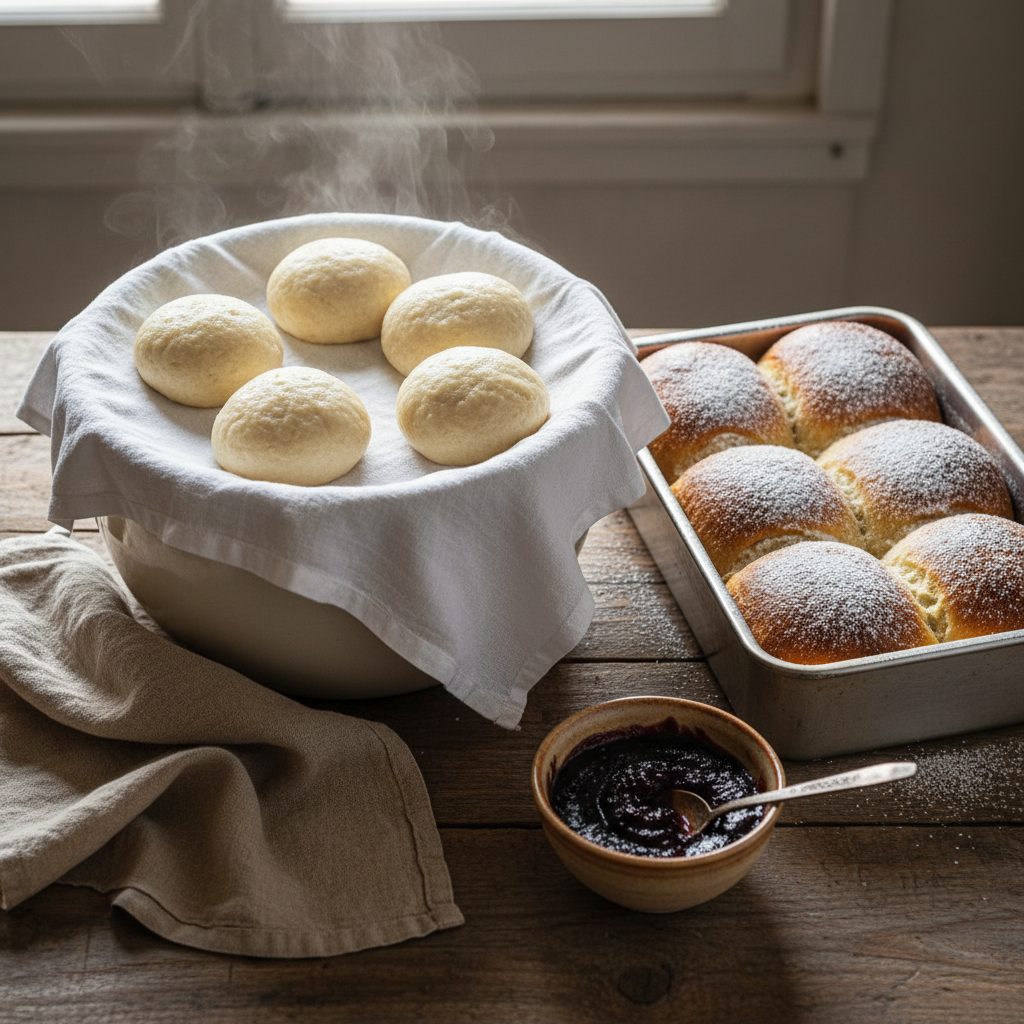
Technique matters. Kuyavian pampuchy were cooked na łachu, on a linen cloth stretched over boiling water. Czech buchty were packed tightly into a baking tin and brushed with butter so that they would stay soft and brazenly fluffy. Bavorské vdolky were fried and blessed with plum butter, cream or grated curd cheese, because a Czech knows that asceticism is a beautiful virtue, but not necessarily at dessert.
These are not just dishes. They are signs of regional continuity. Anchor flavours. Proof that tradition is not a museum exhibit but a practice repeated by hand, nose and appetite.
Central Europe has political borders. The real map runs from the pastry board to the baking tin. And it smells of yeast. If you know the taste of steamed dumplings, you are a winner.
## Pyzać, or to puff oneself up
The Old Polish verb "pyzać" meant to puff oneself up or to put on airs. The image was literal: yeast dough rises, swells and puffs out its chest under the tea towel like a nobleman at a local diet. The path is shared by the Slavs, because the Russian "pyžit'sja" also means to puff up and put on airs. In this part of the world, pride and yeast share one dictionary.
The word's family is large and unruly. A pyza is a big, round dumpling, made of potato or yeast dough. A chubby child or a person with full cheeks is called a pyza. Hunters use the word for the nose of a bison or an elk, bulbous and fleshy. In dialects a pyza can be a snout or a stouter neighbour, which is no longer a compliment.
The most interesting part comes next. Whoever puffed up like a pyza in time began to look down on those around him. Hence the archaic "wspyzać", to scorn, and the modern "zapyzieć", to grow sluggish and let oneself go. From dumpling to social diagnosis in three steps. Few dishes describe human character so precisely.
The pampuch takes a different road: it is a garbled German Pfannkuchen. The word came from across the fence, settled in, and today nobody asks for its passport.
## Parowańce, ruchańce and kluchy na łachu
Country people named pampuchy after the way they made them. Parowańce, parzaki, paruchy take their name from para, steam. Ruchańce from the movement of rising yeast, because the dough in the bowl really does move, which etymology records with full seriousness. Kluchy na łachu speak plainly of the tool: a linen cloth. In the Lublin region there are pampuszki, often savoury, with a filling of cabbage and mushrooms.
These names are linguistic fossils. They preserve the memory of pots, cloths and regional tastes more precisely than many a museum, because they are repeated every day, not once a year on a school trip.
## Pyza on the road, Honza with his bundle
Food in fairy tales is a prop of security. Hanna Januszewska's Pyza, from "Pyza na polskich dróżkach" (Pyza on Polish Paths), runs away from the pastry board and sets off into the world. She is curiosity, movement, the search for home comforts away from home.
The Czech Honza, the counterpart of our Jaś, does the opposite. He sets out into the world with a linen bundle full of homemade buchty. The buchty are a talisman: they give strength to fight evil and promise a return to mother. The Polish pyza runs away from routine; the Czech buchta is an anchor that lets you survive the strangeness of the world. Two nations, two philosophies of travel, one yeast dough. The Pole goes out into the world to check whether it feels like home elsewhere. The Czech takes home with him in a bundle, just in case. It is hard to say which method is wiser, but it is clear which is more filling.
## Cloth, baking tin, frying pan
Kuyavian pampuchy are on the List of Traditional Products and have a codified beauty. The finished bun is 6 to 10 centimetres across, pale beige, round with a flat bottom, because it rose on a flat surface, and a domed top. The secret is cooking na łachu: a linen cloth is stretched over boiling water, and the steam circulates gently under a metal bowl for about five minutes. Precision worthy of a laboratory, tools from a kitchen drawer.
Łódź, the old industrial melting pot, became a laboratory of another kind. Silesian, Greater Polish and Kuyavian influences met there, so potato pyzy, made from grated raw and boiled tubers, live side by side with their yeast cousins. They are often confused, though technically they are two different things. Same name, different soul.
The Czechs bake. Pečené buchty are laid in a baking tin one against another, and their sides brushed generously with melted butter so that no side crust forms. The dough stays endlessly soft. The fillings have a spicy temperament: povidlová with plum butter, rum and cinnamon, maková with poppy seed cooked in milk with honey and cloves. A category of their own are bavorské vdolky, little cakes fried in a pan, which know nothing of steam but get crispness, a dollop of plum butter and whipped cream or grated hard curd cheese.
## A novelty that became tradition
The most instructive story comes from fieldwork in Kuyavia. Residents recall that in the 1950s and 1960s pampuchy were considered a novelty, an unusual delicacy. Only with time did they become an "age-old" tradition. What we now call heritage was often born of post-war scarcity and housewives' ingenuity, not of the mists of the Middle Ages.
This is classic cucina povera, poor cooking, which turned out to be a foundation of resilience. Flour, water, yeast and a little warmth survived urbanisation, the standardisation of taste and several changes of political system. Not because someone protected them by statute, but because someone made them every Sunday. Tradition is not capital frozen in a museum. It is a habit that must be renewed every day, like a starter.
An ethnologist calls such dishes living artefacts. For ordinary people they are comfort food that works through anchor flavours: rum, honey, curd cheese with lemon. Their power lies not in the bowl itself but in what surrounds it. In kneading the dough together by hand, in the Czech hospoda, where buchty and vdolky seat people at one table. The global market unifies taste. The pyza puffs itself up and does not give in.
The smell of buchty with rum and cloves remains the most enduring point on the map of the region. The borders of states have changed. The cloth over the pot has stayed.
📖 Glossary
- pyza
- Duża, okrągła kluska ziemniaczana albo drożdżowa. Słowo pochodzi od staropolskiego „pyzać”, czyli nadymać się i pysznić.
- pampuch
- Drożdżowa kluska gotowana na parze, której nazwa wywodzi się od niemieckiego Pfannkuchen.
- łach
- Lniana ściereczka rozpinana nad wrzątkiem, na której gotuje się pampuchy na parze.
- buchty
- Czeskie drożdżowe bułeczki pieczone ciasno w brytfannie, z nadzieniem z powideł albo maku.
- bavorské vdolky
- Czeskie drożdżowe placuszki smażone na patelni, podawane z powidłami i śmietaną albo startym twarogiem.
- cucina povera
- Kuchnia uboga, która okazała się fundamentem odporności i przetrwała urbanizację i zmiany ustroju.
Frequently Asked Questions
Where does the word pyza come from and what does it have to do with zapyziałość?
The Old Polish verb "pyzać" meant to puff oneself up or put on airs, like yeast dough rising under a tea towel. Whoever puffed up like a pyza began to look down on others, hence the archaic "wspyzać", to scorn. The modern "zapyzieć" means to grow sluggish and let oneself go.
Where does the name pampuch come from?
Pampuch is a garbled German Pfannkuchen, domesticated so thoroughly that it now sounds native. In the regions it is called parowaniec, parzak, parucha, pampuszka, klucha na łachu and ruchaniec, after steam, the movement of rising yeast or the linen cloth.
How are dumplings cooked na łachu?
A linen cloth, the łach, is stretched over boiling water, and the pampuchy steam under a metal bowl for about five minutes. Kuyavian pampuchy on the List of Traditional Products are 6–10 centimetres across, pale beige, with a flat bottom and a domed top.
How do Czech buchty differ from bavorské vdolky?
Pečené buchty are baked packed tightly in a tin, their sides brushed with butter to keep them soft, filled with plum butter with rum and cinnamon or poppy seed with honey and cloves. Bavorské vdolky are little cakes fried in a pan and served with plum butter and whipped cream or grated curd cheese.
Are potato pyzy and yeast pyzy the same thing?
No. In Łódź, where Silesian, Greater Polish and Kuyavian influences met, potato pyzy made from grated raw and boiled tubers live alongside their yeast cousins. They are often confused, though technically they are two different things.
Are Kuyavian pampuchy an old tradition?
Fieldwork in Kuyavia shows that in the 1950s and 1960s pampuchy were considered a novelty and an unusual delicacy. Only with time did they become an "age-old" tradition. Heritage was often born of post-war scarcity and housewives' ingenuity.
Related Questions
- Where does the word pyza come from and what does it have to do with zapyziałość?
- Where does the name pampuch come from?
- How are dumplings cooked na łachu?
- How do Czech buchty differ from bavorské vdolky?
- Are potato pyzy and yeast pyzy the same thing?
- Are Kuyavian pampuchy an old tradition?
🧠 Thematic Groups
- Język: staropolskie pyzać, wspyzać i zapyzieć, niemiecki Pfannkuchen oraz ludowe nazwy parowańce, parzaki, ruchańce i kluchy na łachu.
- Baśń i tożsamość: Pyza Hanny Januszewskiej ruszająca w świat i czeski Honza z węzełkiem bucht jako dwie filozofie podróży.
- Technika: kujawskie pampuchy na łachu, łódzkie pyzy ziemniaczane i drożdżowe, czeskie buchty w brytfannie i smażone vdolky.
- Tradycja jako nawyk: pampuchy jako nowość lat 50. i 60., cucina povera, żywe artefakty i smaki-kotwice opierające się unifikacji.
Tags:
pyzy
pampuchy
buchty
steamed dumplings
yeast dough
klucha na łachu
parowańce
Pfannkuchen
bavorské vdolky
plum butter
Kuyavia
Łódź
Czech Republic
Pyza na polskich dróżkach
cucina povera
More in: Kuchnia niepolityczna
Content is created by Fundacja Dobre Państwo.
Edited and published by APA ONE, the Foundation's own AI-based editorial system.