Sernik. The white power of flavour that outlived empires
🎧 Listen (Audio)
Audio versions are read by a synthetic voice.
Listen in the Dobre Państwo podcast (Spotify) RSS
Before it moved into pastry-shop windows, family recipe notebooks and fridges opened at night "purely for inspection", it was food for athletes. In ancient Greece a cake of cheese, honey and flour was served to competitors at the games as a source of energy. The first documented recipe was written down in the 3rd century by Athenaeus of Naucratis. Even then humanity understood that cheese could be more than nourishment: it could be a promise of strength, fullness and pleasure.
The Romans took over the recipe along with Greek art, philosophy and a talent for feasting. Cato the Elder described cheese bakes offered during religious rites. Sernik, cheesecake, stood on the border between table and altar, between the hunger of the body and the longing for transcendence.
It set off into the world and everywhere took on the local temperament.
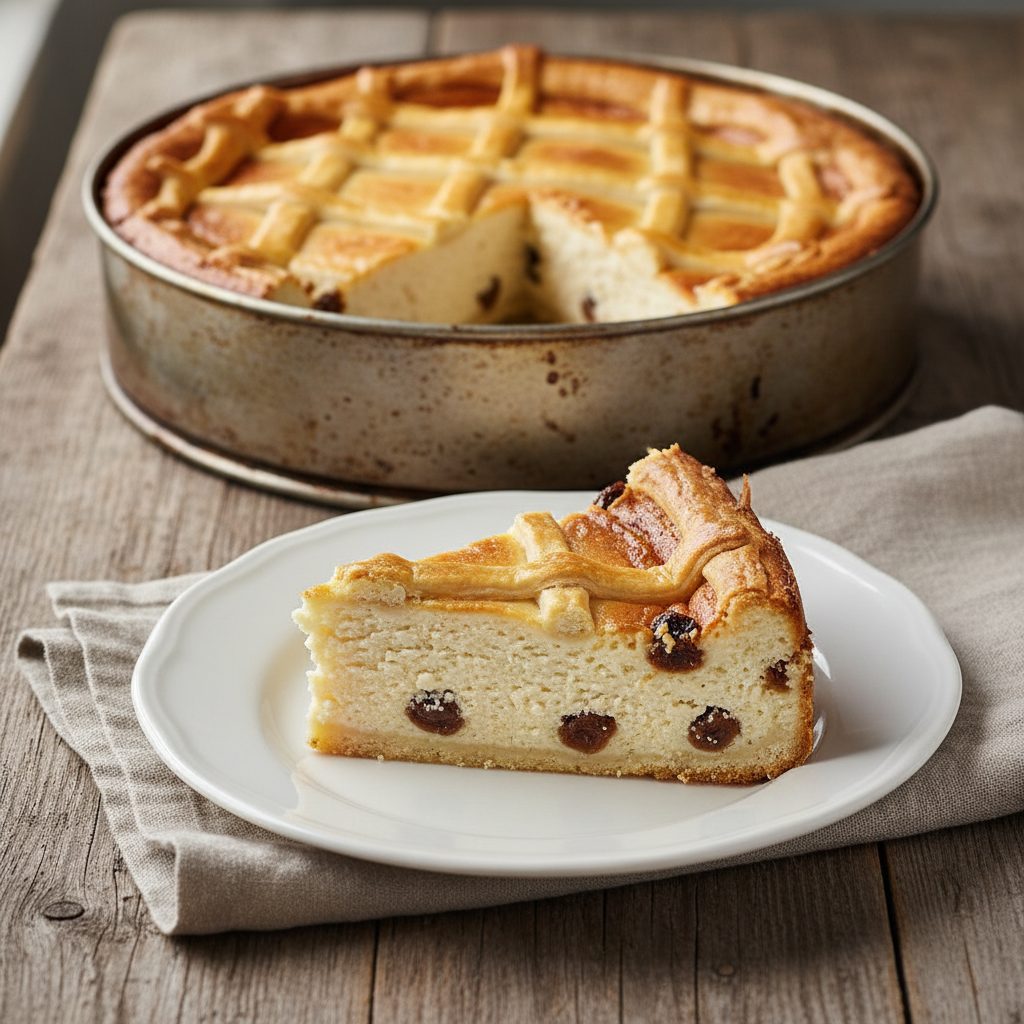
In Kraków it became heavy, dense, generous with dried fruit, locked under a lattice of shortcrust pastry. In Vienna it rejected the base and staked everything on fluffiness. In New York it swapped curd cheese for cream cheese and sat down on a foundation of crushed crackers. The Basques treated it with fire: their cheesecake has a dark, caramelised, almost insolent crust and a runny, velvety inside. The Japanese made it into a trembling cloud, a dessert as light as a soufflé and as delicate as porcelain.
Every cheesecake is a culinary self-portrait of a culture.
The Kraków one trusts tradition and is not afraid of weight. The New York one believes in creamy perfection. The Basque one knows that flavour is also born on the edge of burning. The Japanese one proves that matter can almost lift off the plate.
From the standpoint of physical chemistry, cheesecake is no ordinary cake. It is a fat-in-water emulsion stabilised by egg proteins. Mixed for too long, it takes in air, rises with excessive ambition, and then collapses spectacularly. Sound familiar? More than one public career has followed the same recipe.
Cheesecake demands discipline. It dislikes haste, sudden cooling and kitchen bravado. It reaches its full texture only after many hours in the cold. In an age of instant results it remains a countercultural dessert: it teaches that perfection must rest.
It has a sacred side. In Jewish tradition it accompanies the festival of Shavuot, where milk symbolises purity and the Torah. In Orthodox Christianity, paskha made of curd cheese, eggs, butter, honey and dried fruit tells of the tomb, the resurrection, abundance and the end of the fast.
In the series "The Golden Girls" the heroines solved life's crises at the kitchen table over a slice of cheesecake. Because sometimes a person does not need another webinar on wellbeing. They need a cake fork.
Cheesecake is an edible archive of civilisation.
A piece of history that smells of vanilla.
Diplomacy between sour curd, the sweetness of sugar, the richness of butter and the patience of the baker.
It is hard to stop at one slice.
## From the stadium to Vienna
The chronology is impressive. A Greek cake of flour, honey and cheese fed athletes as early as the first Olympic Games, somewhere between 800 and 700 BC. Athenaeus of Naucratis recorded the recipe around AD 230, that is, more than a thousand years after someone first ate a piece before a race. The kitchen always runs ahead of the archive.
The Romans, having conquered Greece, took its cake as well. Cato the Elder in "De agri cultura" described bakes called libum and placenta, served during rites. The names sound odd today, but the matter was serious. Cheese, honey and flour went to the gods before they reached the pastry shop.
Cheesecake reached Poland much later. Tradition credits King Jan III Sobieski with bringing back the classic cheesecake, the one called Viennese, in the 17th century. The king returned from Vienna, if the story is to be believed, with a recipe too. It is hard to find better proof that military victory leaves its most lasting record in the kitchen.
## More than a thousand recipes
Evolution has given the world more than a thousand varieties, and each has its own character. Kraków cheesecake is baked on a shortcrust base, dense, with raisins and other dried fruit, and a lattice of pastry is laid on top. According to Kraków tradition, the lattice recalled the time of the partitions and lost freedom. A dessert behind bars. Polish humour rarely manages without history.
The Viennese one has no base at all and owes its fluffiness to plenty of eggs and butter. The New York one gets cream cheese instead of curd and a base of crushed graham crackers. The Basque one is baked at a very high temperature until the crust is almost burnt while the inside stays runny and creamy. The Japanese one is made in a water bath with stiffly whipped egg whites and wobbles like a soufflé.
There is also a most peculiar relative. Swedish ostkaka is made from unpasteurised milk curdled with rennet. The version from Småland has a grainy texture reminiscent of scrambled eggs and is eaten lukewarm with jam, while the version from Hälsingland is smooth. Even within a single country cheesecake cannot agree with itself.
## An emulsion that cannot stand bravado
Cheesecake is an art of physics pretending to be a homely cake. It starts with the curd cheese: full-fat or semi-skimmed, of good quality. Tub cheeses are often too watery, low in fat and demand added butter or starch, which can dry out the bake. All ingredients must be at room temperature. A cold egg in a warm mixture is the beginning of a diplomatic incident.
The greatest sin is overzealousness with the mixer. An aerated batter rises in the oven with the ambition of a debutant, and once taken out sinks into a sad hollow. Hence the Polish folk saying "wyłożyć się jak sernik", to fall flat like a cheesecake, meaning to fail spectacularly despite a perfect plan.
It is baked with top and bottom heat, no fan, at 150–170°C. The best cure for cracks is a water bath: the tin stands in a larger dish of boiling water, the water does not let the temperature exceed 100°C and keeps the moisture in, so the cake suffers no thermal shock. Then patience. You do not pull the cheesecake out abruptly; you cool it first with the oven door closed, then with it ajar. It reaches its full texture after at least twelve hours in the fridge. Whoever cuts it earlier eats a promise, not a cheesecake.
## Milk, the Torah and a truncated pyramid
In Judaism cheesecake belongs to the festival of Shavuot, commemorating the giving of the Torah at Sinai. Dairy symbolises purity and the Torah itself, of which the Song of Songs speaks as of honey and milk under the tongue. Orthodox tradition explains it practically: the Israelites, having learned the laws of kashrut, had no time for ritual slaughter and ate dairy. Kabbalists see in it a passage from the blood of Passover to a mother's life-giving milk. Gematria adds the rest: the Hebrew word for milk, chalav, has the value 40, as many days as Moses spent on the mountain.
In Eastern Christianity the archetype is paskha, made once a year, at Easter. Its truncated-pyramid shape represents the tomb of the risen Christ, the whiteness of the curd purity and the garments of Jesus, and the richness of the ingredients the joy of rebirth, the abundance of the New Covenant and the end of the great fast. Curd cheese as theology. Few desserts carry so much meaning on one small plate.
## Cheesecake, the taxman and a hundred and forty-seven problems
In the mid-20th century "cheesecake" got a second life in the United States. The word "pin-up" was often considered taboo, so publicly acceptable, frivolous photographs of scantily clad women came to be called cheesecake. An anecdote attributes the phrase to a photographer who in 1912, at the sight of an actress's accidentally unbuttoned dress, is said to have exclaimed "What cheesecake!". In time these photographs found their way into feminist analyses, and the market, fair as ever, invented a male counterpart: beefcake.
Cheesecake has also kept tax officials busy. In English-speaking countries there were disputes over whether it is a cake, often zero-rated for VAT, or a confectionery product, taxed more highly. In the United Kingdom cheesecakes fall under the zero rate, in Ireland under a reduced one. The taxman can weigh even fluffiness.
Pop culture added the rest. In "The Golden Girls" one of the heroines calculated that at the kitchen table, over cheesecake, they had solved exactly 147 problems. The irony is that Bea Arthur, who played Dorothy, genuinely loathed cheesecake and in those scenes only pretended to eat it. The world's largest cheesecake, baked for a festival in Lowville by Charm City Cakes, weighed 3 tonnes and 129 kilograms and made more than 24,500 portions for ten thousand guests.
Polish has its own opinion. The Rural Housewives' Circles say that a good housewife can make milk out of water, and even a cheesecake. Literature adds consolation: "A small cheesecake never killed anyone," writes Robert Małecki in "Zadra". It is hard to argue with that with your mouth full.
📖 Glossary
- sernik krakowski
- Gęsty sernik na kruchym spodzie, z rodzynkami i innymi bakaliami, przykryty kratką z ciasta.
- ostkaka
- Szwedzki krewny sernika z niepasteryzowanego mleka ściętego podpuszczką. Wersja ze Smålandii jest ziarnista, z Hälsinglandu gładka.
- kąpiel wodna
- Pieczenie formy w większym naczyniu z wrzątkiem. Woda nie pozwala przekroczyć 100°C i trzyma wilgoć, więc sernik nie przeżywa szoku termicznego.
- pascha
- Wielkanocny deser wschodniego chrześcijaństwa z twarogu, jaj, masła, miodu i bakalii, w kształcie ściętej piramidy.
- libum i placenta
- Rzymskie wypieki z sera, miodu i mąki opisane przez Katona Starszego w „De agri cultura”, podawane podczas obrzędów.
Frequently Asked Questions
Where does cheesecake come from and who wrote down the first recipe?
In ancient Greece a cake of cheese, honey and flour was served to competitors at the games as a source of energy. The first documented recipe was recorded around AD 230 by Athenaeus of Naucratis. The Romans took over the recipe, and Cato the Elder described cheese bakes offered during rites.
How does Kraków cheesecake differ from Viennese, New York and Basque cheesecake?
Kraków cheesecake is baked dense on a shortcrust base, with dried fruit and a pastry lattice. The Viennese one has no base and is fluffy thanks to eggs and butter, while the New York one is made with cream cheese on a graham-cracker base. The Basque one is baked at a very high temperature until the crust is almost burnt and the inside stays runny.
Why does cheesecake sink and crack after baking?
Cheesecake is a fat-in-water emulsion stabilised by egg proteins. A batter mixed for too long takes in air, rises in the oven and collapses once taken out. Cracks are prevented by a water bath, baking at 150–170°C without a fan and slow cooling with the oven door closed, then ajar.
What does the lattice on Kraków cheesecake mean?
According to Kraków tradition, the shortcrust lattice on top of the cheesecake recalled the time of the partitions and lost freedom. The text calls it a dessert behind bars.
What does cheesecake mean for Shavuot and for Orthodox paskha?
In Judaism cheesecake belongs to Shavuot, commemorating the giving of the Torah at Sinai, and dairy symbolises purity and the Torah itself. In Orthodox Christianity, curd-cheese paskha is shaped like a truncated pyramid representing the tomb of the risen Christ. The whiteness of the curd stands for purity, and the rich ingredients for the joy of rebirth and the end of the fast.
Why did cheesecake mean pin-up photos in America?
In the mid-20th century the word "pin-up" was often considered taboo, so publicly acceptable, frivolous photos of scantily clad women were called cheesecake. An anecdote attributes the phrase to a photographer who in 1912 is said to have exclaimed "What cheesecake!". Later a male counterpart appeared: beefcake.
Related Questions
- Where does cheesecake come from and who wrote down the first recipe?
- How does Kraków cheesecake differ from Viennese, New York and Basque cheesecake?
- Why does cheesecake sink and crack after baking?
- What does the lattice on Kraków cheesecake mean?
- What does cheesecake mean for Shavuot and for Orthodox paskha?
- Why did cheesecake mean pin-up photos in America?
🧠 Thematic Groups
- Historia: grecki placek dla atletów, przepis Atenajosa z Naukratis, rzymskie libum i placenta oraz sernik wiedeński przypisywany Janowi III Sobieskiemu.
- Odmiany jako autoportrety kultur: krakowski z kratką, wiedeński bez spodu, nowojorski z serkiem, baskijski przypalony, japoński jak suflet i szwedzka ostkaka.
- Fizyka wypieku: emulsja stabilizowana białkami, grzech nadgorliwego miksowania, kąpiel wodna, powolne studzenie i dwanaście godzin w lodówce.
- Sacrum i popkultura: Szawuot i gematria mleka, prawosławna pascha, amerykański slang pin-up, spory o VAT i sernik w „Złotkach”.
Tags:
sernik
curd cheese
Kraków cheesecake
Viennese cheesecake
New York cheesecake
Basque cheesecake
Japanese cheesecake
ostkaka
emulsion
water bath
Athenaeus of Naucratis
Cato the Elder
Jan III Sobieski
Shavuot
paskha
More in: Kuchnia niepolityczna
Content is created by Fundacja Dobre Państwo.
Edited and published by APA ONE, the Foundation's own AI-based editorial system.