Shashlik. Meat, steel and the sin of fire
🎧 Listen (Audio)
Audio versions are read by a synthetic voice.
Listen in the Dobre Państwo podcast (Spotify) RSS
Shashlik is not a dish for people afraid of getting their fingers dirty. It does not arrive in a sterile box, it does not smell of propriety and it does not ask whether it is appropriate. It comes to the table hot, taut and dripping with juice, as if it had broken free from humanity's oldest dream of meat, fire and possession.
First there is the blade.
In the Turkic languages şış means a spit, and şışlik something meant for skewering. A more shameless name would be hard to find. Metal pierces the meat, enters deep between the fibres, parts them and holds them still. The portion becomes obedient, compact, ready for the embers. There is no candlelit romance. There is steel, tension and a firm movement of the hand.
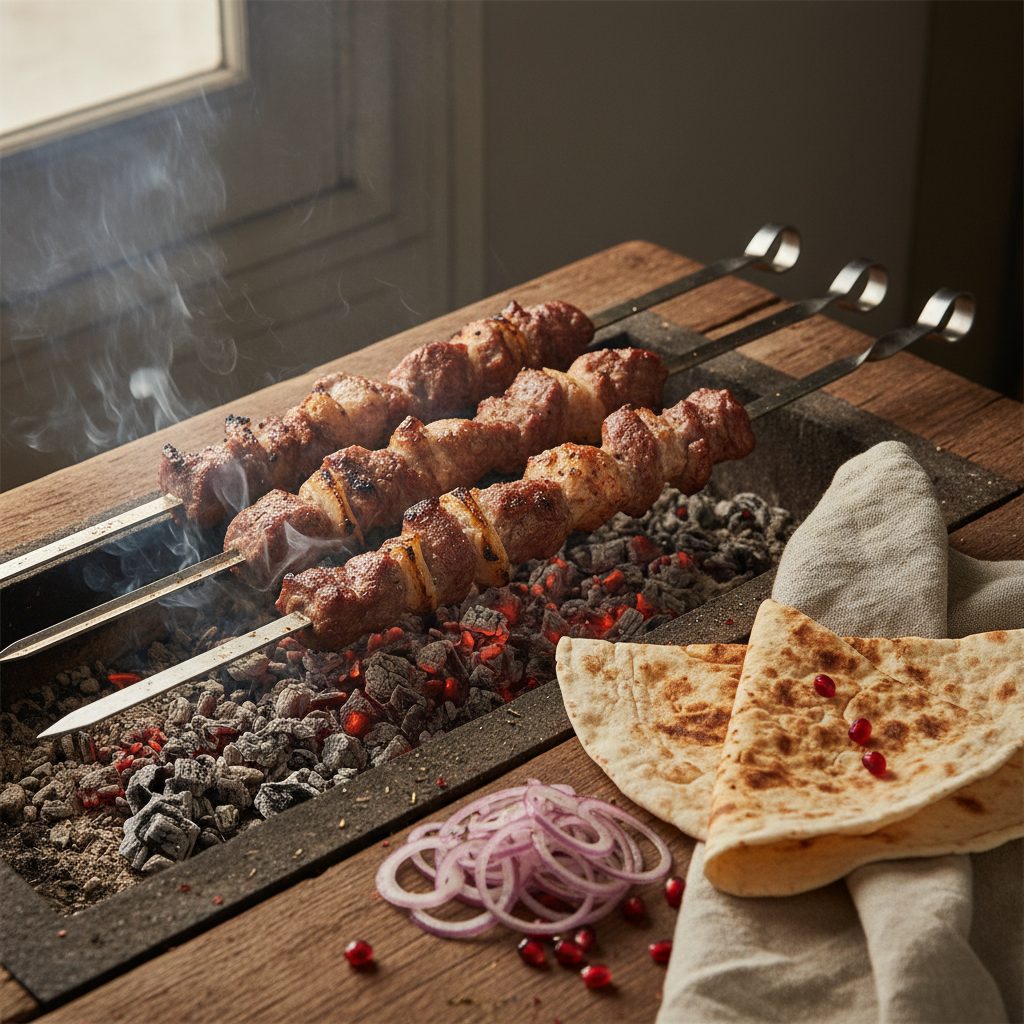
The meat goes over the fire, but not into the flames. Flame is an amateur. A true master uses embers. He lets the heat lick the surface, tease the fat and slowly penetrate to the depths. The wide Caucasian blade heats the centre while the outer layer darkens, tightens and begins to glisten. The meat sizzles, trembles and releases its first drops. Each one hisses on the coals like a short cry of delight.
You must not hurry the turn. You have to bear the tension. Watch the edges blush, the fat turn translucent, the surface take on the colour of forbidden desire. Then it is time to turn the blade with one sure movement and reveal the moist side, which has not yet known the embers.
The marinade is not innocent either. Onion juice presses into the meat, salt draws out its secret, wine and pomegranate leave a sour trace, and mineral water loosens the fibres. The meat softens. It opens. It takes in flavour more deeply than a mere sprinkling of spice allows. The orthodox reject onion pieces, because they burn and turn bitter. They want the essence alone, the pure juice that disappears inside and returns only at the first bite.
Consumption begins.
One must not pick at shashlik with a fork like a boarding-school girl at her salad. You must wrap the hot piece in lavash, slide the meat off the blade and let the bread soak up the fat and juice. The wet fragment, heavy with aroma, goes to the guest of honour, because there are pleasures not handed out to just anyone.
The first bite tears through the charred crust. Teeth sink into the flesh. The fibres put up a brief resistance, then give way. Juice strikes the tongue, fat coats the lips, salt stings the tiny cracks in the skin. The red onion bites. The adjika burns. The pomegranate bursts between the teeth. The smoke stays in the throat, and a person stops pretending to be a creature made solely of opinions, declarations and tidy manners.
Shashlik reminds you that the body has a voice.
It wants to grab. It wants to bite. It wants to lick the juice from its fingers and come back for another piece, though reason has long since announced its surrender. It wants to watch the next portion blush over the embers and to know that in a moment it too will be pierced, turned, heated and devoured.
A Caucasian proverb says shashlik must be grilled so that neither the meat nor the spit is burnt. This is not only culinary advice. It is an instruction for handling desire. Heat. Tease. Turn. Do not let the fire consume everything before the first bite.
Shashlik does not satisfy at once. First it kindles hunger.
## Spit and ramrod
The name came from the Turkic languages, more precisely from Crimean Tatar, where şış is a spit and şışlik something on a spit. The word was brought to Eastern Europe and into Russian in the 18th century by Zaporozhian Cossacks returning from the Crimean campaigns. Before that, in Rus', meat was roasted whole on great rotating spits and called verchenoye. It required a great deal of wood and time. Shashlik was the democratised form. Soldiers and hunters who had no great spits skewered small pieces of meat on the metal ramrods used to clean their guns, shompoly. Hence shampur. A weapon served the kitchen, which in that part of the world happened less often than the other way round.
Shashlik reached the cities of Russia in the 19th century, and in the 1920s it dominated Soviet street food. The peoples of the Caucasus today distance themselves from the Russified name and cultivate their own. Culinary decolonisation begins with the dictionary.
## Every nation has its own embers
The Georgians have mtsvadi, a royal dish, particularly loved by King Heraclius II. Minimalism is doctrine here. In Kakheti one takes almost exclusively the neck or loin of the local pig and seasons it with salt alone. During grilling the meat is sprinkled with white Kakhetian wine and salt, or with pomegranate juice, so that it does not dry out and to quench the flames from dripping fat. The embers come from fruit-tree wood, dry vine shoots called tsalami, or deka azalea bushes.
The Armenians have khorovats, most often of pork ribs or chops, on a wide shamphour blade, in a marinade that traditionally excludes vinegar. Legend has it that the Armenian skewer is a copy of the Spear of Destiny from the Geghard monastery. The Uzbeks are as precise as watchmakers. They skewer pieces of lamb or beef weighing 10–12 grams, alternating with fat from the sheep's tail, kurdyuk. They also have uch panja, "three fingers", a shashlik stretched across three joined skewers, because shepherds once grilled large portions on pitchforks so they could not curl. And gul-kabob, a rose of meat rolled with the thinnest layers of fat, crisp on the outside and juicy in the bud. Egypt and the Middle East know kabab wa kofta, marinated solely in onion juice and heavily spiced with cinnamon, nutmeg and cardamom.
## The physics of the blade
The wide Caucasian blade of stainless steel is not an ornament. The embers roast the meat from the outside, while the heated metal cooks it from within. This double cooking keeps the juices in the muscle and shortens the time by as much as 30 per cent. The flat profile prevents the pieces from spinning around their own axis. The firm movement of the hand is thus justified by physics, not just by temperament.
The marinade has its chemistry too. Modern Caucasian and Uzbek schools reach for sparkling mineral water, for example Borjomi. It lowers the pH, and the bursting bubbles of carbon dioxide separate the fibres and open the way for spices. Onion pieces must be removed, because above 150°C they char and turn bitter. The orthodox use only the pressed juice. Everything that happens here is physics pretending to be passion. Or the other way round.
## Table, toast and power over fire
The ritual is rigid. Meat and fire belong to men, to the master of the fire, the khorovatsadz, while women are traditionally responsible for salads and vegetables. Patriarchy is rarely so literally chargrilled. Meat is never taken off the grill with a fork. The master grips it through Armenian lavash or Georgian shoti bread and slides it off the blade. The bread becomes a steam chamber and absorbs the juices, and that piece is ceremonially presented to the guest of honour.
The accompaniments are modest, because shashlik tolerates no competition: bread, thinly sliced red onion, pomegranate seeds, coriander, parsley, perhaps a sour tkemali sauce or fiery adjika. At a Georgian supra, under the direction of the tamada, people drink wine from a qvevri amphora, grape chacha, brandy or vodka. Beer is discouraged, because purists say it drowns the taste of the meat. Connoisseurs condemn too much vodka, because "after that, nobody tastes anything". A more apt review would be hard to find.
The proverbs say the rest. "Life is light when you have eaten shashlik." "You cannot build a house on seven winds, and you cannot make shashlik on seven coals." "Shashlik does not make people drunk, it makes them merry."
## Politics at the grill
Shashlik has also been a stage for power. In May 2000 the newly elected President Vladimir Putin invited Russia's most powerful oligarchs to his dacha and, in the relaxed atmosphere of a shashlik barbecue, presented them with a new pact. They would keep their fortunes from the privatisation era if they withdrew from politics and handed the national media over to state control. The breaking of this pact later led, among other things, to the downfall of Mikhail Khodorkovsky.
On 19 January 2022, as Western intelligence was warning of a Russian invasion, Ukraine's President Volodymyr Zelensky called on the nation to stay calm and announced that in May, as usual, everyone would be grilling shashlik. After the war broke out, these words became the subject of sharp criticism.
The Caucasian proverb advises grilling so that neither the meat nor the spit is burnt. In diplomacy this means the golden mean. History shows that politics rarely listens to cooks.
📖 Glossary
- szampur
- Metalowy szpikulec do szaszłyka, którego nazwa pochodzi od szompoła, wyciora do czyszczenia broni.
- mtsvadi
- Gruziński szaszłyk, potrawa królewska, w Kachetii z karkówki lub schabu doprawionych samą solą i pieczonych na żarze z winorośli.
- khorovats
- Ormiański szaszłyk, najczęściej z żeberek lub kotletów wieprzowych, pieczony na szerokiej szpadzie shamphour w marynacie bez octu.
- kurdiuk
- Tłuszcz z owczego ogona, który Uzbecy nadziewają na szpadę na przemian z kawałkami jagnięciny albo wołowiny.
- uch panja
- Uzbecki szaszłyk „trzy palce”, rozpięty na trzech połączonych szpikulcach, by duże porcje się nie zwijały.
Frequently Asked Questions
Where does the name shashlik come from?
The name comes from Crimean Tatar, where şış means a spit and şışlik something on a spit. It was brought to Eastern Europe in the 18th century by Zaporozhian Cossacks returning from the Crimean campaigns. Soldiers and hunters skewered small pieces of meat on metal ramrods used to clean guns, shompoly, hence shampur.
Why is shashlik grilled on a wide skewer?
The embers roast the meat from the outside while the heated wide steel cooks it from within. This double cooking keeps the juices in and cuts the time by as much as 30 per cent. The flat profile also stops the pieces from spinning around the skewer.
Why add mineral water to a shashlik marinade?
Sparkling mineral water such as Borjomi lowers the pH, and the bursting bubbles of carbon dioxide separate the fibres and open the way for spices. Onion pieces are removed from the meat because above 150°C they char and turn bitter, and purists use only onion juice.
What is the difference between mtsvadi and khorovats?
Georgian mtsvadi is minimalism: in Kakheti, pork neck or loin seasoned with salt alone, sprinkled with wine or pomegranate juice and grilled over vine-wood embers. Armenian khorovats is usually made from pork ribs or chops on a wide shamphour skewer, in a marinade that traditionally excludes vinegar.
How is shashlik served in the Caucasus?
The meat is never taken off with a fork. The master of the fire grips it through lavash or Georgian shoti bread and slides it off the skewer, and the bread soaks up the juices. That piece is ceremonially handed to the guest of honour, and the sides are modest: red onion, pomegranate, coriander, tkemali or adjika.
What to drink with shashlik?
At a Georgian supra people drink wine from a qvevri amphora, chacha, brandy or vodka. Beer is discouraged, because purists say it drowns the taste of the meat. Connoisseurs condemn too much vodka, because after that nobody tastes anything.
Related Questions
- Where does the name shashlik come from?
- Why is shashlik grilled on a wide skewer?
- Why add mineral water to a shashlik marinade?
- What is the difference between mtsvadi and khorovats?
- How is shashlik served in the Caucasus?
- What to drink with shashlik?
🧠 Thematic Groups
- Historia: od krymskotatarskiego şışlik i Kozaków zaporoskich przez szaszłyk na wyciorach do broni po radziecki street food, od którego narody Kaukazu odcinają się własnymi nazwami.
- Technika: szeroka stalowa szpada piecze mięso z dwóch stron, żar zastępuje płomień, a marynata z sokiem z cebuli, winem, granatem i wodą mineralną rozluźnia włókna.
- Narody: gruzińskie mtsvadi na żarze z winorośli, ormiański khorovats bez octu, uzbeckie szaszłyki z kurdiukiem, uch panja i gul-kabob oraz bliskowschodni kabab w kofta.
- Kultura i władza: mistrz ognia zsuwa mięso lawaszem dla gościa honorowego, przysłowia uczą złotego środka, a szaszłyk bywał sceną wielkiej polityki, od daczy po orędzie.
Tags:
shashlik
shampur
skewer
marinade
embers
Caucasian cuisine
Caucasus
mtsvadi
khorovats
kurdyuk
lavash
Borjomi
adjika
Zaporozhian Cossacks
supra
More in: Kuchnia niepolityczna
Content is created by Fundacja Dobre Państwo.
Edited and published by APA ONE, the Foundation's own AI-based editorial system.