Taco. A song you eat with your hands
🎧 Listen (Audio)
Audio versions are read by a synthetic voice.
Listen in the Dobre Państwo podcast (Spotify) RSS
First comes the tortilla — corn, soft and warm, smelling of the field, of lime, of fire and of an old order of the world. It is made by nixtamalization, an ancient alchemy you do not need to understand in order to trust it. For there are truths that are not measured by argument or table. There are truths you take into your hand.
The hand arranges itself. The thumb supports the base, the fingers embrace the edges, and the little finger watches over the whole like a discreet guardian of the rite. The head bows at forty-five degrees in the gesture of el cabeceo, which is at once a bow, a first beat and a consent to the fact that in a moment everything may run down your fingers.
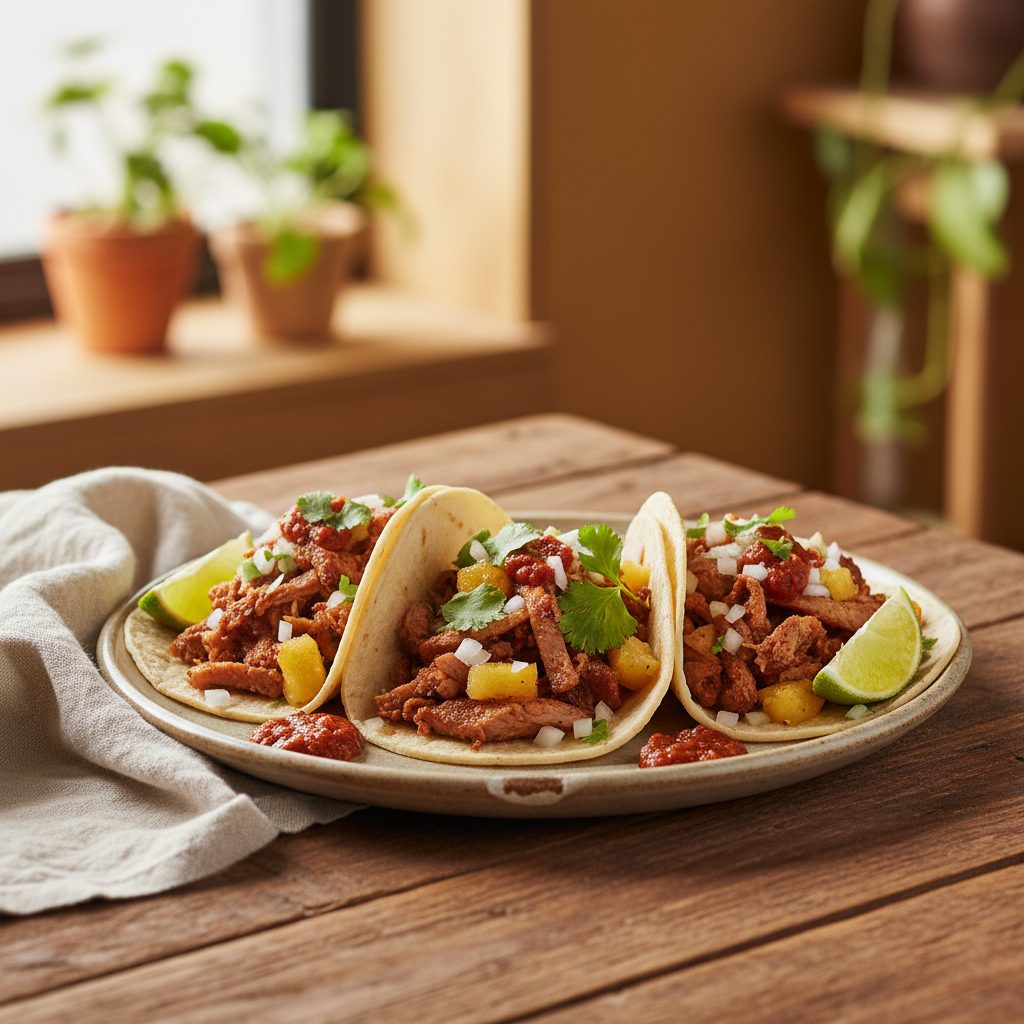
The tortilla bends but does not break. The meat from the spit trembles with heat, the onion crackles between the teeth, the coriander enters the breath, the lime falls like a sharp light, and the salsa wakes the tongue, burns the throat and opens the eyes. The pork brings weight, the pineapple sweetness, the chilli metes out penance, and the fat left on the hand proves that the body, too, has its own theology.
The truth about rapture is a matter of taste. Not of instructions, not of calories, not of cold judgement. Of taste.
A taco moves in the hand like a small instrument that must be felt, supported and tilted at the right moment. It is not eaten with cutlery, because cutlery belongs to those who wish to keep their distance. Here there is no distance. There is corn, onion, meat and fire, and between them a rhythm that passes from the fingers to the shoulders, from the shoulders to the hips and from the hips into the ground.
Every region of Mexico adds its own verse to the song. The north smells of beef and wheat tortillas, the centre turns tacos al pastor on a spit inherited from Lebanese shawarma, the coasts serve fish and shrimp, Yucatán brings cochinita pibil, achiote and bitter orange, and Oaxaca reminds us that even a grasshopper can become poetry when it meets garlic and lime.
The people have long known this truth. When love is lacking, there are still tacos al pastor. When someone exaggerates, they say he puts too much cream on his own tacos. When someone lies, his tongue, too, may serve as a filling. These sayings need no commentary, because taste recognises falsehood, pride and loneliness faster than reason.
The hand raises the tortilla, the hip catches the rhythm, the tongue meets the salsa, and somewhere beneath the surface of the sentence the guitar already knows what to do. A trumpet slices the night, a heel strikes the ground, and for a brief moment the bills, the quarrels, the diets and all the badly tuned affairs of the world disappear.
What remains is one hot tortilla, one hand, one bite and one epiphany.
Un taco al día es la llave de la alegría — a taco a day is the key to joy.
The rest is only the silence between two verses.
## A charge in paper
The word "taco" was originally a regionalism of Mexico City and its surroundings. In Guanajuato or San Luis Potosí people said burrito; in Yucatán, codzito. The most convincing theory links the name to the silver mines of the 18th century. There a taco meant an explosive charge, gunpowder wrapped in paper into a tube and inserted into holes in the rock. Tacos de minero, miners' tacos, cheap and filling working-class food, looked much the same. Other theories point to a Germanic root meaning a peg, or to the Nahuatl word tlahco, "half", "in the middle". The first version is the most beautiful. A dish that explodes in the mouth, named after gunpowder.
The foundation, however, is older than the mines. The peoples of the Valley of Mexico ate small fish wrapped in corn cakes called tlaxcalli. The chronicler Bernal Díaz del Castillo described the first taco feast involving Europeans, which Hernán Cortés gave for his captains in Coyoacán. The conquistadors came for gold, and one of the first things they learned was to eat with their hands.
## The alchemy of lime
The tortilla is to the taco what rice is to sushi. Not the wrapping, but the foundation. Nixtamalization consists of cooking and soaking corn in water with lime. The process removes fungal toxins and, above all, releases niacin, vitamin B3, and digestible amino acids. It is what protected the peoples who lived on corn from pellagra. The grain is ground into dough, and the tortilla is baked on a comal, where it gains its elasticity. Knowledge for which Europe needed laboratories fitted, in Mesoamerica, into a pot.
The etiquette is just as strict and rules out cutlery. The body leans over the plate at 45 degrees in the gesture of el cabeceo, in English the taco lean, so that the salsa does not land on your shirt. The thumb, index and middle fingers hold the tortilla, and the little finger steadies it from below. Poetry describes this as liturgy, the etiquette manual as mechanics. Both are right, because in good cooking physics and rite are one and the same.
## A map in one hand
The north grills carne asada beef over charcoal, for instance arrachera, and wraps it in wheat tortillas. You can taste ranch culture in it. The capital has al pastor, pork from a vertical trompo spit. It was introduced by the second generation of Lebanese immigrants, who swapped the lamb of shawarma for pork and added pineapple. There is also barbacoa, lamb or beef braised in an earth oven under agave leaves and served with consommé broth, and tacos de canasta, "sweated" in a basket, made in the morning with potatoes or beans, the cheapest on the street.
The coasts serve fish and shrimp, often battered, with cabbage and pico de gallo. Yucatán marinates pork in achiote and bitter orange juice and bakes it in the ground by the pib method, following Maya tradition. Oaxaca fries chapulines grasshoppers with garlic and lime, a pre-Columbian source of protein. One tortilla, and beneath it an entire country.
## The taco on the road
Globalisation began with the "Chili Queens" of San Antonio, who at the turn of the century sold exoticism to American tourists. Tex-Mex gave the world minced beef, cheddar and the hard shell, invented with mass production in mind. Los Angeles created Kogi, Korean marinades in Mexican form. Grenoble came up with tacos français, which have little in common with a taco but the name: a toasted wheat tortilla with chips and cheese sauce. The Navajo make Indian tacos on frybread instead of tortillas. The dish is a memento of the survival of Native Americans, forced to live on government rations of flour and lard.
The taco became a matter for lawyers, too. For years the slogan "Taco Tuesday" was a trademark of the Taco John's chain, which blocked smaller businesses. In 2023, after the intervention of Taco Bell and LeBron James, the slogan was freed and recognised as a common good of culinary culture. Tuesday returned to the people.
After decades of industrial simplification, the authentic taco, a soft corn tortilla with coriander, onion and radish, is enjoying a renaissance. The world went all the way around it and came back to lime and corn.
## A tongue with a filling
Mexican idioms say the same thing as the song, only more briefly. "De lengua me como un taco", I'll make myself a taco out of that tongue, is thrown in the face of a liar and braggart. "Echarle mucha crema a tus tacos", to put too much cream on your tacos, means to embellish excessively. "Echarse un taco de ojo", to eat a taco with your eyes, means to feast your eyes on someone attractive. "A falta de amor, unos tacos al pastor", for want of love, some tacos al pastor, is a whole philosophy of consolation in a few words. A nation that measures life by the tortilla does not need many therapists. A good spit is enough.
📖 Glossary
- nixtamalizacja
- Gotowanie i moczenie kukurydzy w wodzie z wapnem, które usuwa toksyny grzybowe i uwalnia niacynę, chroniąc przed pelagrą.
- el cabeceo
- Pochylenie ciała nad talerzem pod kątem 45 stopni podczas jedzenia taco, po angielsku taco lean, żeby salsa nie spadła na ubranie.
- trompo
- Pionowy rożen, na którym piecze się wieprzowinę do tacos al pastor, odziedziczony po libańskiej shawarmie.
- comal
- Płyta, na której wypieka się kukurydziane tortille, nadając im elastyczność.
- tacos de canasta
- Tacos „pocone” w koszyku, robione rano z ziemniakami albo fasolą, najtańsze na ulicy Miasta Meksyk.
Frequently Asked Questions
Where does the name taco come from?
The most convincing theory links the name to 18th-century silver mines, where a taco was gunpowder wrapped in paper into a tube and inserted into holes in the rock. Tacos de minero, the miners' food, looked similar. Other theories point to a Germanic root meaning a peg or to the Nahuatl word tlahco, meaning in the middle.
What is corn nixtamalization?
It is cooking and soaking corn in water with lime. The process removes fungal toxins and releases niacin, vitamin B3, and digestible amino acids, which protected corn-dependent peoples from pellagra. The grain is then ground into dough and the tortillas are baked on a comal.
How to eat a taco properly?
A taco is eaten with the hands, without cutlery. The body leans over the plate at 45 degrees in the gesture of el cabeceo, the taco lean, so the salsa does not land on your shirt. The thumb, index and middle fingers hold the tortilla, while the little finger steadies it from below.
Where do tacos al pastor come from?
Tacos al pastor were introduced in Mexico City by the second generation of Lebanese immigrants. They swapped the lamb of shawarma for pork roasted on a vertical trompo spit and added pineapple.
What are the regional types of tacos in Mexico?
The north grills carne asada beef and wraps it in wheat tortillas. The capital has al pastor, barbacoa from an earth oven and cheap tacos de canasta. The coasts serve fish and shrimp, Yucatán cochinita pibil in achiote and bitter orange juice, and Oaxaca fried chapulines grasshoppers with garlic and lime.
What do Mexican sayings about tacos mean?
De lengua me como un taco is thrown at liars and braggarts, and adding too much cream to your tacos means embellishing. Echarse un taco de ojo means feasting your eyes on someone attractive. A falta de amor, unos tacos al pastor means that when love is lacking, there are still tacos al pastor.
Related Questions
- Where does the name taco come from?
- What is corn nixtamalization?
- How to eat a taco properly?
- Where do tacos al pastor come from?
- What are the regional types of tacos in Mexico?
- What do Mexican sayings about tacos mean?
🧠 Thematic Groups
- Historia: nazwa taco najpewniej pochodzi od ładunku prochu w kopalniach srebra, a Bernal Díaz del Castillo opisał pierwszą ucztę taco z udziałem Europejczyków wydaną przez Cortésa w Coyoacán.
- Technika: fundamentem jest kukurydziana tortilla z nixtamalizacji wypiekana na comalu, a etykieta każe jeść dłońmi, pochylając się pod kątem 45 stopni.
- Regiony: północ ma carne asada w pszennej tortilli, stolica al pastor z trompo i barbacoę, wybrzeża ryby, Jukatan cochinita pibil, a Oaxaca pasikoniki chapulines.
- Globalizacja i język: od Chili Queens z San Antonio przez Tex-Mex, koreańskie Kogi i tacos français po uwolnienie hasła Taco Tuesday w 2023 roku, a meksykańskie idiomy mierzą życie tortillą.
Tags:
taco
tacos al pastor
corn tortilla
nixtamalization
Mexican cuisine
Mexico
el cabeceo
trompo
carne asada
barbacoa
cochinita pibil
achiote
chapulines
Tex-Mex
tacos de minero
More in: Kuchnia niepolityczna
Content is created by Fundacja Dobre Państwo.
Edited and published by APA ONE, the Foundation's own AI-based editorial system.