Hunter's bigos. Tradition is meant to bubble
🎧 Listen (Audio)
Audio versions are read by a synthetic voice.
Listen in the Dobre Państwo podcast (Spotify) RSS
Hunter's bigos enters the kitchen like a nobleman entering a regional diet. It is sure of itself, smelling of smoke, forest and a hint of brawl. It does not knock. It does not apologise. It takes off its kontusz robe, leans its sabre against the table and checks whether the host has by any chance tried to save on meat.
Bigos is not a dish for people who ask whether it can be cooked faster, lighter, cheaper and without fat. You can dance a polonaise in a tracksuit, but why then pretend you took part in culture?
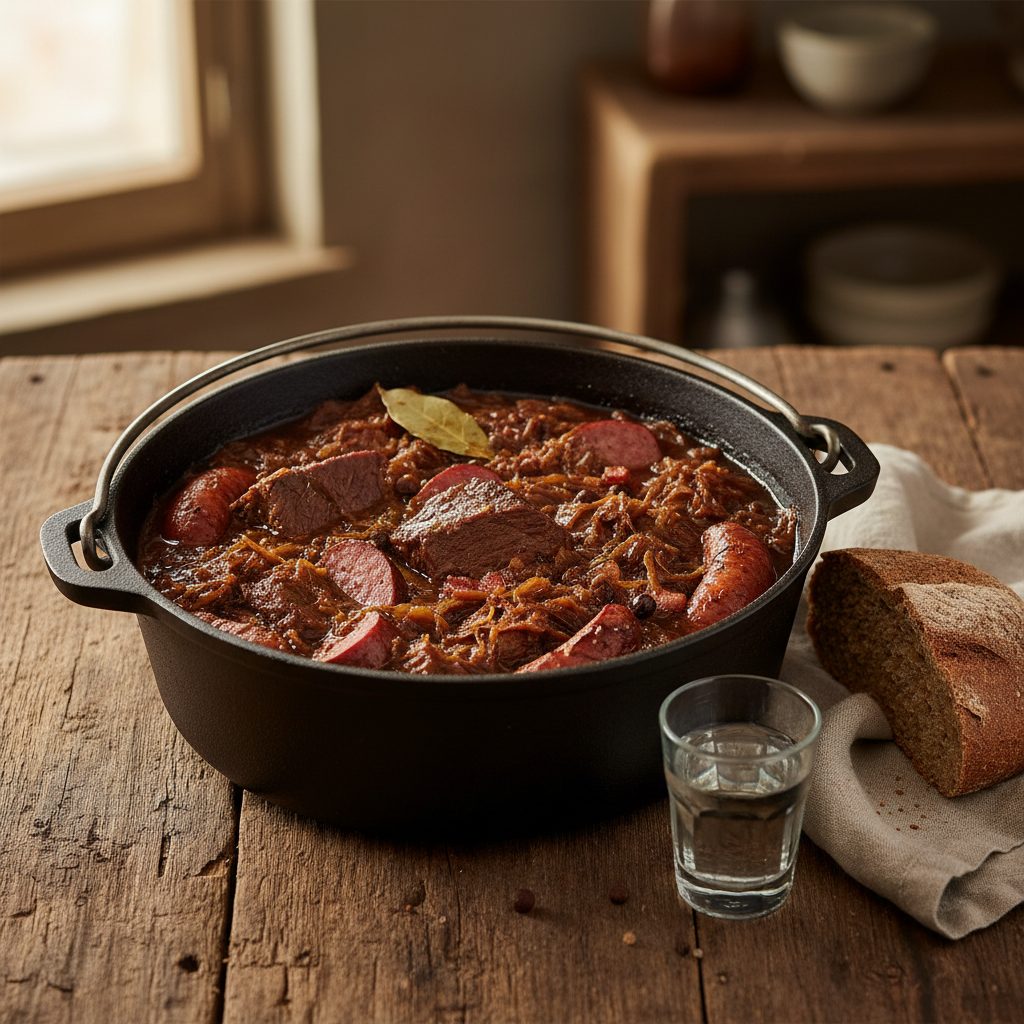
There must be at least as much meat as cabbage. This is not a suggestion but the constitutional order of the pot. Half should be wild boar, roe deer or red deer, and the rest brisket, pork knuckle, bacon and smoked sausages. Everything is fried in lard, because lard does not go through identity crises and does not dress up as olive oil. It knows who it is. Among free people this is a valuable trait.
Bigos does not acknowledge haste. It cooks for several days, rests, freezes, returns to the fire and grows wiser with every reheating. The cabbage softens, collagen turns into gelatine, the fat stops floating separately, and the flavours form a confederation more perfect than many a political alliance.
At the hunting ground it was cooked in a tightly closed cauldron. The lid was sealed with dough, and when the pressure blew it off, a salute rang out. Today kitchen appliances beep discreetly. Lunch used to announce its readiness with a shot. It is hard to imagine a more Polish difference between civilisations.
"Bigosowanie" itself was not always culinary. In the 17th century it meant hacking an opponent to pieces with a sabre in duels, raids and quarrels at the regional diets. The nobility would first debate at length about freedom, law and honour, and then, when the arguments lost their edge, draw arguments of steel. Thus was born participatory democracy, the version with a hilt.
Pasek could tell tales over a goblet, Sienkiewicz would add a banner and a betrayal, and Mickiewicz would remind us that the taste, colour and scent of bigos cannot be worthily captured in words. Literature tried to describe it, but the pot always beat the pen.
Bigos is a manifesto of diversity. The Lithuanian version seduces with apple and garlic. The Galician remembers poverty, so it welcomes beans and potatoes. The Hungarian blazes with paprika, the Greater Poland one flirts with tomato, and the Silesian sees no reason to deny itself dumplings. Each region adds its own accent, yet the whole still speaks Polish — loudly, proudly and without subtitles.
The oldest bigos was not made of cabbage. It was a hash of meat, fish or crayfish seasoned with lemon, vinegar, honey and spices. Cabbage came later, as a cheaper rival to lemons. History performed its favourite trick. The dish of the mighty went down to the thatched cottages, grew, turned sour and returned to the salons as a symbol of national abundance.
Bigos takes in influences but does not lose its character. It combines game with farmyard meat, poverty with splendour, manor with tavern, Lithuania with Silesia, the hunt with poetry and the feast with the brawl. It is a community that does not require uniformity. It is enough that each ingredient brings to the pot the best it has.
Let us help ourselves without shame. With bread, a glass and panache. Let it smell of forest, smoke, history and a touch of sin.
Tradition is not porcelain behind glass. Tradition is meant to bubble, steam, argue and win by taste.
## The constitution of the pot
Orthodox hunter's bigos leaves little freedom. The most important thing is the ratio of meat to cabbage, which must be at least one to one. The weight of the meat must at least equal the weight of the cabbage, and in refined versions it exceeds it by 1.2 to 1.5 times. Whoever puts in more cabbage than meat is cooking something else and should have the courage to admit it.
The meat composition has its golden ratio. Half is game: wild boar, roe deer, red deer. One fifth is farmyard meat, brisket and pork knuckle. The remaining three tenths are smoked sausages and bacon. For frying, only natural lard, pork or goose.
There are also prohibitions. Lean poultry is excluded from hunter's bigos, because during long cooking it becomes dry and tough. There is no tomato purée in it, which Old Polish cuisine simply did not know. According to some traditions, true Old Polish bigos is made only with sauerkraut, with no admixture of fresh cabbage, which gives a very intense taste. Orthodoxy, as usual, has several schools.
## The physics of patience
Cooking bigos is a physico-chemical process and optimally lasts three to five days. Slow stewing in an acidic environment turns tough collagen into soluble gelatine. This binds water and fat, forming a smooth sauce. That is where the deep sheen of good bigos and its velvety texture come from. The fat does not float on the surface like an unwanted guest. It is absorbed by the community.
The second secret is frost. Freezing bigos, ideally outdoors, is what technologists call cryoconcentration. Ice crystals growing in the cabbage tear its cell walls, so after reheating it becomes extraordinarily soft, and the layer of fat does not separate from the rest. The Polish winter turns out here to be not an obstacle but an ingredient.
It is served hot, most often with wholemeal rye bread. To drink, a glass of clear vodka or herbal vodka, żubrówka, starka, piołunówka, or perhaps a dry red wine. Old Polish texts joked that bigos is hard to digest and, eaten without vodka, becomes "an open illness". Tradition thus took care not only of the recipe but also of its insurance.
## A hash with lemon
The history of bigos is full of plot twists. In the "Compendium ferculorum" of 1682, the first Polish cookbook, bigos contains no cabbage at all. It is a refined hash of meat, crayfish or fish, seasoned sweet-and-sour and hot with lemons, wine vinegar, honey and exotic spices. A dish for tables that could afford lemons.
Sauerkraut appeared only in the 18th century as a cheap substitute for lemons. It supplied the sourness and, along the way, the volume. Thus was born bigos hultajski, the rogue's bigos, at first a dish of the poor that in time conquered the manors. Polish cuisine knows few social careers as successful. Cabbage came into the salon through the back door and left through the front.
## Bigosowanie, or etymology with a sabre
Before the word became purely culinary, in 17th-century Poland "bigosować" meant hacking an opponent into small pieces with a sabre during regional diets, raids and duels. Jan Chryzostom Pasek mentions it in his memoirs, and Henryk Sienkiewicz in "The Deluge". The language keeps a trace of this in the saying "narobić bigosu", to make a bigos, that is to stir up confusion or trouble. It is hard to find better proof that in Poland cooking and politics have always been mixed in one pot.
Literature showed the gentler side. Wincenty Pol summed it up in a maxim: "Bigos – that is a dish! Kulig – that is fun!", kulig being a sleigh-ride party. Adam Mickiewicz in "Pan Tadeusz" wrote the most famous apotheosis of bigos, admitting that it is hard to render in words its wondrous taste, its colour and its marvellous scent. The national poet capitulated before the pot. It is the highest compliment a dish can receive.
## A map of bigos
The regions went their own ways. Lithuanian bigos gets fresh cabbage, crushed garlic and tart wine apples, which give it a fruity sourness. The Galician version, shaped by poorer realities, made up for a shortage of meat with white beans and potatoes. The Hungarian, inspired by Szeged goulash, is generously seasoned with hot and sweet paprika and finished with sour cream. The Greater Poland version has tomato purée, garlic and marjoram, exactly what the orthodox of the hunting cauldron would throw out. The Silesian arrives with kluski dumplings or kopytka potato dumplings.
This diversity is not betrayal but principle. Bigos has always been a dish made from whatever is at hand, and in every region something different is at hand.
## A salute and a complaint
The most spectacular custom comes from the hunting ground. Bigos was heated in special cauldrons whose lids were sealed with raw bread dough. When the pressure in the pot rose, the dough cracked, the lid flew off with a bang and a salute rang out. It was the sign that the food was ready. No kitchen timer has such dramaturgy.
Not everyone came away from this encounter delighted. In Jaroslav Hašek's "The Good Soldier Švejk", Lieutenant Dub announces an official complaint to brigade command after eating "Polish-style bikoš", accusing the cooks of rotten cabbage and poor meat, and pays for the feast with severe stomach trouble. The literary scandal has its moral. Bigos forgives neither skimping on meat nor the absence of a glass.
And whoever respects the constitution of the pot is rewarded with something that cannot be bought in a jar: a dish that every day grows wiser than the one who cooked it.
📖 Glossary
- bigosowanie
- W XVII-wiecznej Polsce rąbanie przeciwnika szablą na drobne kawałki podczas sejmików, zajazdów i pojedynków.
- bigos hultajski
- Bigos z kapustą kiszoną, która w XVIII wieku zastąpiła drogie cytryny. Początkowo potrawa biedoty, z czasem zawojowała dwory.
- kriokoncentracja
- Przemrażanie bigosu, przy którym kryształki lodu rozrywają ściany komórkowe kapusty, więc po odgrzaniu jest ona bardzo miękka.
- Compendium ferculorum
- Pierwsza polska książka kucharska z 1682 roku, w której bigos jest siekanką z mięsa, raków albo ryb, bez kapusty.
- wiwat
- Huk odskakującej pokrywy myśliwskiego kociołka uszczelnionej ciastem chlebowym, znak, że bigos jest gotowy do jedzenia.
Frequently Asked Questions
How much meat should hunter's bigos contain?
The weight of the meat must be at least equal to that of the cabbage, and in refined versions it exceeds it by 1.2 to 1.5 times. Half is game, that is wild boar, roe deer or red deer, one fifth brisket and pork knuckle, and three tenths smoked sausages and bacon. It is fried only in pork or goose lard.
Why is bigos cooked for several days?
Optimal cooking of bigos takes three to five days. Slow stewing in an acidic environment turns tough collagen into soluble gelatine, which binds water and fat into a smooth sauce. Hence the deep sheen and velvety texture of good bigos.
Why freeze bigos?
Freezing bigos, ideally outdoors, is cryoconcentration. Ice crystals tear the cell walls of the cabbage, so after reheating it becomes exceptionally soft, and the fat does not separate from the rest. The Polish winter is an ingredient here, not an obstacle.
Where does the word bigos come from?
In 17th-century Poland bigosować meant hacking an opponent to pieces with a sabre during regional diets, raids and duels. Jan Chryzostom Pasek and Henryk Sienkiewicz in „The Deluge” both mention it. A trace survives in the saying „narobić bigosu”, to stir up a mess.
Did old bigos contain cabbage?
No. In the „Compendium ferculorum” of 1682, the first Polish cookbook, bigos is a hash of meat, crayfish or fish seasoned with lemons, wine vinegar, honey and spices. Sauerkraut arrived in the 18th century as a cheap substitute for lemons and gave rise to bigos hultajski, the rogue's bigos.
How do regional varieties of bigos differ?
The Lithuanian version has fresh cabbage, garlic and tart apples, while the Galician one makes up for a lack of meat with beans and potatoes. The Hungarian is seasoned with paprika and finished with sour cream, the Greater Poland version has tomato purée, garlic and marjoram, and the Silesian is served with dumplings.
Related Questions
- How much meat should hunter's bigos contain?
- Why is bigos cooked for several days?
- Why freeze bigos?
- Where does the word bigos come from?
- Did old bigos contain cabbage?
- How do regional varieties of bigos differ?
🧠 Thematic Groups
- Kanon: mięsa co najmniej tyle, ile kapusty, połowa z dziczyzny, smalec zamiast oliwy, bez chudego drobiu i bez przecieru pomidorowego.
- Technika: od trzech do pięciu dni duszenia zamieniającego kolagen w żelatynę i przemrażanie bigosu, które zmiękcza kapustę i spaja tłuszcz z sosem.
- Historia i język: od staropolskiej siekanki z cytryną w Compendium ferculorum przez bigos hultajski po bigosowanie szablą i powiedzenie narobić bigosu.
- Literatura i regiony: Mickiewicz, Pol, Pasek, Sienkiewicz i Hašek oraz bigos litewski, galicyjski, węgierski, wielkopolski i śląski.
Tags:
hunters bigos
bigos
sauerkraut
game meat
wild boar
lard
Polish cuisine
Old Polish cuisine
Compendium ferculorum
bigos hultajski
bigosowanie
cryoconcentration
Pan Tadeusz
Adam Mickiewicz
Jan Chryzostom Pasek
More in: Kuchnia niepolityczna
Content is created by Fundacja Dobre Państwo.
Edited and published by APA ONE, the Foundation's own AI-based editorial system.