Coq au vin. The French art of seduction by fire, wine and patience
🎧 Listen (Audio)
Audio versions are read by a synthetic voice.
Listen in the Dobre Państwo podcast (Spotify) RSS
Coq au Vin is not a dish for the innocent. It is mature, dark and shamelessly aware of its own worth, like a Balzacian woman who no longer pretends to girlish freshness, because she knows the price of experience, the weight of a glance and the pleasure of waiting.
Into the pot goes not a delicate little chicken but an old, tough rooster, muscular, stubborn, almost unusable. It aroused the master’s desire. French cuisine does not reject what is difficult.
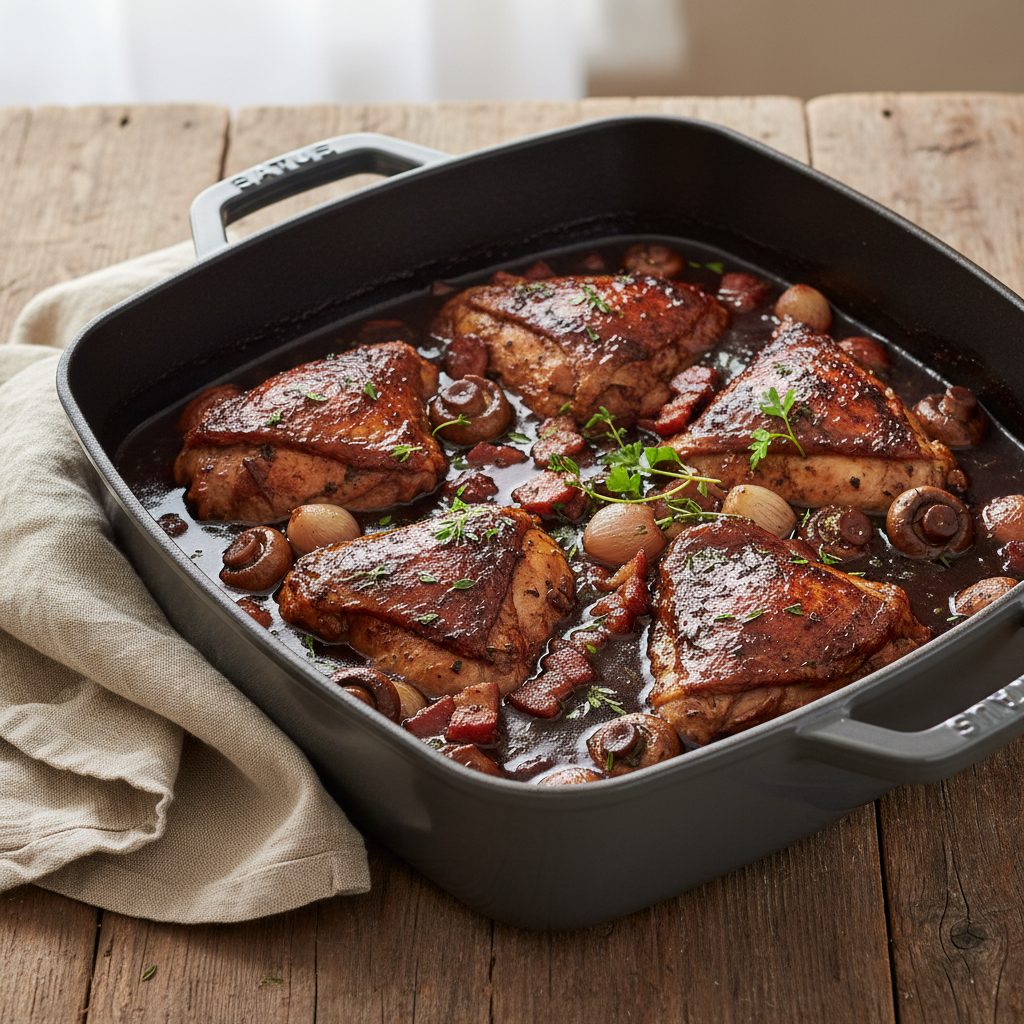
It takes possession of the raw material, immerses it in wine, surrounds it with the aroma of bacon, onion, mushrooms and herbs, and then torments it over a slow flame until its pride softens, the collagen turns to silk and the meat surrenders to the fork of its own accord.
It is the triumph of technique over obstinacy. Braising is not cooking but a long rite of seduction. The wine penetrates the fibres, the acid loosens their resistance, the heat works patiently, without violence. Nothing may be hurried. Pleasure does not tolerate haste, and a sauce, like a woman, remembers every lapse of attention.
Burgundy chooses Pinot Noir, earthy, velvety, heavy with promises. Alsace lightens the dish with Riesling and cream, giving it an air of innocence. Jura tempts with Vin Jaune, morels and Bresse chicken — a bird with blue legs, white flesh and a red comb, as if France herself had undressed and lain down on a platter.
A licentious tradition demands that the sauce be thickened with the rooster’s blood combined with cognac. It must be tempered slowly, by adding hot liquid, and then introduced into the pot once it is off the heat. One moment of inattention, one indecent boil, and the emulsion curdles, losing its sheen. Modernity, more prudish, replaces the blood with bitter cocoa, keeping the same almost black colour and the taste of a secret.
The bacon, pearl onions and mushrooms are prepared separately. Each ingredient must keep its firmness, its own aroma and its distinct allure before being admitted to the shared revelry. The finale unites all the bodies in a thick, glossy sauce.
Coq au Vin was born of peasant thrift, but it entered haute cuisine like a mature seductress entering a salon, without apology. It reminds us that true luxury lies not in the youth of the produce but in the ability to draw out its last drop of flavour.
Once the wine is poured, it must be drunk. Once the rooster is immersed, the work must be carried through to the end.
The historical significance of the dish is inseparably tied to the political promise of King Henry IV, who declared his wish to put a chicken in every pot.
## A chicken in every pot, a rooster in wine
Henry IV’s promise, la poule au pot, was a political programme that fitted into a single pot. The vision of universal prosperity made meat something that was owed to the peasant too, and gave eating poultry a civic and festive dimension. The king promised a chicken. The kitchen filled in the rest and put a rooster in the pot.
Here begins the paradox on which the whole dish stands. What went into the pot was a mature bird several years old, whose muscles were too tough for roasting or frying. No sensible person would have served it on a platter. Thrift, however, demanded that it be eaten, and since it could not be fried, it had to be persuaded. Long braising in acidic wine turns connective tissue into gelatine. The meat becomes buttery but does not lose its wild, intense aroma. This is not culinary mercy. It is engineering.
A modern farmed chicken would fail this exam. It lacks the density of fibre and the maturity to survive hours of cooking. A real rooster weighs around three or four kilograms and has developed bones which, as they cook, release gelatine and thicken the sauce by themselves. Youth can make you a dinner. Experience makes coq au vin.
## Blood, cognac and eighty degrees
The most orthodox element of the recipe is liaison au sang, thickening the sauce with blood. The rooster’s fresh blood is mixed with a little cognac, which delays clotting. Then comes the tempering: a few spoonfuls of hot sauce at a time are gradually added to the bowl of blood, stirring constantly. The mixture prepared in this way is poured into the pot at the very end, after it has been taken off the heat.
The sauce may then be gently warmed, but it must not boil. Above 80°C the blood proteins set irreversibly, the emulsion curdles, and the dark, glossy enamel turns into lumps. French cuisine has its dogmas, and this is one of the strictest.
Where fresh blood is hard to come by, good cocoa is permitted. It gives an almost black colour, a deep sheen and a dry note that converses well with the acidity of the wine. Tradition cannot stand change, unless the change keeps the colour.
The garnish, the garniture, is subject to the discipline of the Cordon Bleu school. Smoked bacon, pearl onions and mushrooms are fried separately and combined with the meat only at the end. The vegetables then keep an al dente texture, and the whole does not turn into a shapeless mass. Community, yes, but not melting into one.
## A map written in wine
In France the wine is the architect of the dish, and the region chooses the wine. Burgundy keeps to the canon: Pinot Noir, elegance, earthy notes, velvet. Alsace makes coq au Riesling, with Riesling or the underrated Sylvaner, adds crème fraîche or sour cream and repaints the sauce the colour of ivory. Jura offers the most luxurious version, on the oxidised „yellow wine” Vin Jaune with its aroma of nuts and spice, with morels and Bresse chicken. That bird is a patriot by birth: blue legs, white body, red comb, a tricolour flag on its claws.
Beaujolais has its coq au pourpre or coq au violet, made with young Beaujolais nouveau, purple and fruity. Champagne braises the rooster in champagne and gets meat of unusual delicacy. Over everything hangs one rule: drink what you cook with. Reduction forgives nothing, because it concentrates both the virtues and the faults of the wine. Poor wine makes a poor sauce, only more so.
## The rooster in court
In France the rooster does not end on the plate. Legend goes back to 52 BC and the siege of Gergovia. Vercingetorix is said to have sent Julius Caesar a tough, combative rooster as a sign of resistance. Caesar replied with an invitation to a feast at which he served the same bird braised in wine. Gallic strength lost to Roman technique, at least in the kitchen.
In modern times the dispute over the rooster moved to the courtroom. In 2019 Maurice, a rooster from the island of Oléron, was sued by holiday-home owners for crowing in the morning. The case grew to national importance. Under its influence, at the initiative of a retired farmer and mayor, Bruno Dionis du Séjour, parliament passed a law in 2021 protecting the „sensory heritage of the countryside”. The crowing of roosters and the smell of manure became protected cultural assets. France, the country that made the rooster into a dish, decided to protect it while alive as well.
Coq au vin owes its 20th-century world career to Julia Child. Her book „Mastering the Art of French Cooking” and her television programmes made it the showcase of French cuisine and a symbol of domestic sophistication. The peasant pot made it into American drawing rooms.
## Language at the table
The French speak of the human condition in the language of the kitchen. To be like a rooster in pastry, être comme un coq en pâte, means to bask in luxury and care. La poule au pot has remained a metaphor for stable prosperity. Quand le vin est tiré, il faut le boire: once the wine is poured, it must be drunk, so a decision once taken must be carried through. A meal without wine is like a day without sunshine. And whoever adds water to their wine, mettre de l’eau dans son vin, softens their stance and seeks compromise.
In coq au vin adding water is forbidden. This dish knows no compromise with haste, with a young bird or with cheap wine. It teaches that great cooking begins with respect for the raw material others would throw away, and with the patience others have no time for.
📖 Glossary
- liaison au sang
- Zagęszczenie sosu świeżą krwią koguta zmieszaną z koniakiem, zahartowaną gorącym sosem i wlaną do garnka po zdjęciu z ognia.
- garniture
- Dodatki do coq au vin: wędzony boczek, cebulki perłowe i pieczarki, smażone osobno i łączone z mięsem na końcu.
- la poule au pot
- Obietnica króla Henryka IV, kura w każdym garnku, która stała się metaforą stabilnego dobrobytu.
- Vin Jaune
- Utlenione „żółte wino” z Jury o aromacie orzechów i przypraw, podstawa najbardziej luksusowej wersji dania.
- dziedzictwo sensoryczne wsi
- Przedmiot francuskiej ustawy z 2021 roku, która uczyniła pianie koguta i zapach obornika chronionym dobrem kultury.
Frequently Asked Questions
Why is an old rooster used for coq au vin?
A mature rooster several years old has muscles too tough for roasting or frying, but long braising in acidic wine turns the connective tissue into gelatine. The meat becomes buttery and keeps its intense aroma. A real rooster weighs about three to four kilograms, and its bones release gelatine that thickens the sauce by itself, which a farmed chicken cannot do.
How do you thicken coq au vin sauce?
The most orthodox method is liaison au sang: fresh rooster blood is mixed with cognac, tempered with hot sauce and poured into the pot after it comes off the heat. The sauce must not boil, because above 80°C the blood proteins set. Where fresh blood is hard to find, good cocoa is allowed, giving an almost black colour.
Which wine to use for coq au vin?
The region chooses the wine: Burgundy uses Pinot Noir, Alsace Riesling or Sylvaner, Jura the oxidised Vin Jaune, Beaujolais young Beaujolais nouveau, and Champagne its champagne. One rule governs them all: drink what you cook with. Reduction concentrates both the virtues and the faults of the wine.
Where does coq au vin come from?
The dish was born of peasant thrift and is tied to Henry IV’s promise, la poule au pot, a chicken in every pot. Legend reaches back to the siege of Gergovia and a rooster that Vercingetorix supposedly sent to Caesar. Coq au vin owes its 20th-century global career to Julia Child and her book „Mastering the Art of French Cooking”.
How do regional versions of coq au vin differ?
Burgundy sticks to the canon with Pinot Noir. Alsace makes coq au Riesling with crème fraîche or sour cream and an ivory-coloured sauce. Jura serves the most luxurious version with Vin Jaune, morels and Bresse chicken, and Beaujolais a purple coq au violet.
How to prepare the garnish for coq au vin?
The garniture of smoked bacon, pearl onions and button mushrooms is fried separately and combined with the meat only at the end. That is the discipline of the Cordon Bleu school. The vegetables stay al dente and the whole dish does not collapse into a shapeless mass.
Related Questions
- Why is an old rooster used for coq au vin?
- How do you thicken coq au vin sauce?
- Which wine to use for coq au vin?
- Where does coq au vin come from?
- How do regional versions of coq au vin differ?
- How to prepare the garnish for coq au vin?
🧠 Thematic Groups
- Historia: od obietnicy Henryka IV o kurze w każdym garnku i legendy o Wercyngetoryksie i Cezarze po Julię Child, która zrobiła z coq au vin wizytówkę kuchni francuskiej.
- Technika: stary kogut duszony godzinami w kwaśnym winie, sos zagęszczany krwią z koniakiem poniżej 80°C lub kakao i garniture smażona osobno.
- Regiony i wino: Burgundia z Pinot Noir, Alzacja z Rieslingiem i śmietaną, Jura z Vin Jaune i kurczakiem z Bresse, Beaujolais i Szampania.
- Kultura i język: kogut Maurice przed sądem, ustawa o dziedzictwie sensorycznym wsi i francuskie powiedzenia o winie, kogucie w cieście i dolewaniu wody do wina.
Tags:
coq au vin
French cuisine
rooster in wine
braising
liaison au sang
garniture
Pinot Noir
Burgundy
Alsace
Jura
Vin Jaune
Bresse chicken
Henry IV
la poule au pot
Julia Child
More in: Kuchnia niepolityczna
Content is created by Fundacja Dobre Państwo.
Edited and published by APA ONE, the Foundation's own AI-based editorial system.