Cymes from Mercosur. On culture, memory and globalisation that lands in the pot
🎧 Listen (Audio)
Audio versions are read by a synthetic voice.
Listen in the Dobre Państwo podcast (Spotify) RSS
Cymes, known in English as tzimmes, is not merely a dish. It is the story of a community that for centuries learned to store memory not only in books but also in the language of everyday gestures, family rituals and flavours returning to the festive table.
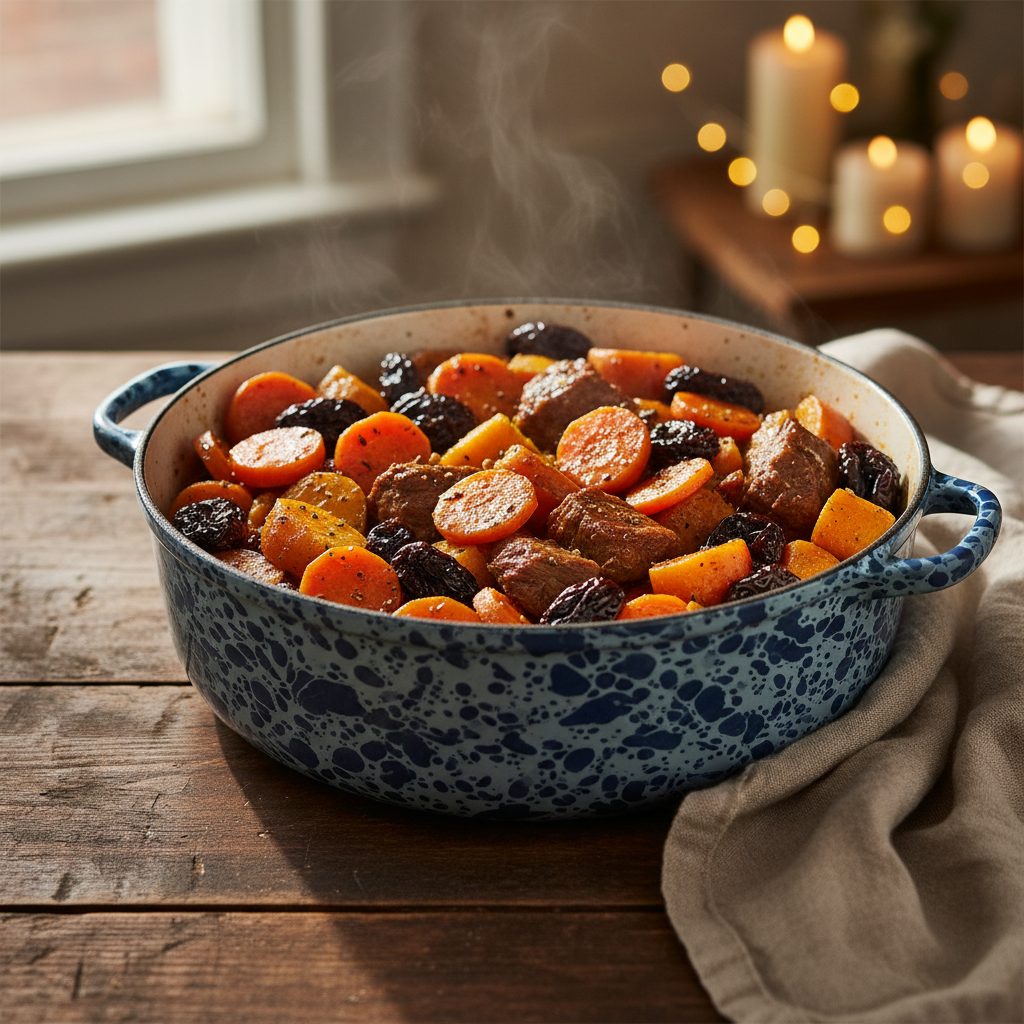
In Ashkenazi tradition, carrots are cut into rounds that resemble coins. The seemingly small gesture has meaning, because the Yiddish word meren means both carrot and growing, multiplying and increasing. The dish becomes a symbolic wish for prosperity, and the kitchen turns into a space where the materiality of food meets hope, memory and religious imagination.
Cymes takes time. It must mature slowly, over a low flame, as if to remind us that things that truly matter do not yield to the logic of instant results. You cannot hurry flavour, or memory, or community without risking the loss of their depth. Yiddish gave rise to the expression machen a tzimmes, meaning to make a great fuss about something. What looks like exaggeration from the outside is sometimes a form of care for matters that must not be simplified.
In the pot meet carrots, prunes, honey, sweet potatoes, fat and beef. Each ingredient keeps its own history, and slow cooking together lets them create a whole that cannot be reduced to a single identity. This is not a culinary blender of differences but a polyphony, in which otherness is not annihilated but given a place in a broader composition.
Cymes practised multiculturalism long before it was made into an academic term, a political promise and the subject of endless debates about the limits of integration in a stew of worldviews.
Into the Ashkenazi pot goes beef from the lands of Mercosur. With it comes the whole world of global trade: container ships, cold stores, certificates, agreements, margins and political declarations that try to convince us that a lower price is always a synonym for progress.
Cymes reminds us that community does not arise from thoughtlessly throwing everything into one pot. It needs rules, proportions, time and responsibility. It demands an answer to the question of who chooses the ingredients, who sets the rules, who pays the full bill, and who vanishes from sight when trade starts speaking the language of inevitability.
Ashkenazi tradition suggests that diversity can be a treasure, but not every mixture becomes a community.
Mercosur beef will cook the cymes.
## Coins of carrot
At its simplest, cymes is sweet braised carrots. Except that in Ashkenazi cooking nothing is "just". Carrots cut into rounds resemble coins, and the Yiddish meren links carrot with multiplying and increasing. The plate becomes a wish. Not a prayer said aloud, but a quiet request spoken with a knife and a chopping board.
Cymes most often appears on the table at Rosh Hashanah, the Jewish New Year. Sweet things are eaten then, so that the whole coming year will be sweet. Honey, prunes, gold-coloured carrots. There is a logic here older than economics: prosperity cannot be decreed, but it can be summoned, by eating slowly and together.
## A big fuss about a carrot
Polish borrowed the word "cymes" from Yiddish and made it into praise. "To jest cymes" means: this is the best, exquisite, finger-licking good. Yiddish went the other way and drew from the same dish machen a tzimmes, making a big fuss. One carrot, two philosophies. The Pole sees in cymes a reward. The Jew sees in it a ceremony that cannot be cut short.
Both are right. Cymes is exquisite precisely because someone made a fuss about it. Braising over a low flame, watching, topping up, tasting. Things that come out quickly rarely deserve to be called a cymes.
## Polyphony in one pot
The pot brings together ingredients that at first glance do not belong together. A root vegetable from the north, dried fruit, sweet honey, fat, sometimes a sweet potato, sometimes a piece of beef. Each brings its own memory. Each keeps its own taste. Only time makes them begin to talk to one another instead of shouting each other down.
Here lies the whole lesson of cymes. Community is not a mixture, it is a proportion. Too much honey and the dish becomes a dessert pretending to be dinner. Too little and the carrot tastes like a diet. The cook does not abolish differences, he weighs them. He does it patiently, because he knows that composition cannot be made up for with fire.
## Beef from the other hemisphere
Mercosur is a common market of South American states, among them Argentina, Brazil, Paraguay and Uruguay, lands associated with endless pastures and beef. The trade agreement between the European Union and Mercosur is meant to open European markets to their farm products. For some it means progress and cheaper supermarket shelves. For some European farmers it means competition they cannot win on equal terms.
Cymes does not settle trade disputes. But it asks questions that negotiators do not like to ask. Where does the ingredient come from? Who chose it? Who set the proportions? Who will pay the full bill when it turns out that cheaper does not mean better? A pot into which everything cheapest is thrown does not cook a community. It cooks an accident.
Ashkenazi tradition survived for centuries precisely because it knew what went into the pot and why. Globalisation readily adopts the language of diversity. It less often adopts the discipline of proportion.
## Recipe
**Ingredients:**
- carrots
- prunes
- honey
- fat (animal fat in the traditional version; oil will do)
- salt
- water
- optionally: sweet potatoes, beef
**Method:**
1. Peel the carrots and cut them into rounds, into coins.
2. If the cymes is to include meat, first brown the beef in the fat, add water and braise until tender.
3. Add the carrots and, if using, the chopped sweet potatoes. Put in the prunes, add the honey, a pinch of salt and just enough water to keep the ingredients from sticking.
4. Braise covered over a low flame, slowly, stirring and checking from time to time, until the carrots are soft and the sauce thick and glossy.
5. Towards the end, remove the lid so the sauce can reduce. Serve warm, ideally at a festive table.
📖 Glossary
- cymes
- Aszkenazyjska słodko duszona marchew, często ze śliwkami, miodem, batatami i wołowiną. W polszczyźnie potocznej także rzecz wyborna.
- meren
- Słowo w jidysz oznaczające zarówno marchew, jak i wzrastanie, pomnażanie oraz przybywanie.
- machen a tzimmes
- Wyrażenie w jidysz oznaczające robienie wokół czegoś wielkiego zamieszania.
- Mercosur
- Wspólny rynek państw Ameryki Południowej, wśród nich Argentyny, Brazylii, Paragwaju i Urugwaju.
Frequently Asked Questions
What is cymes?
Put most simply, cymes, known in English as tzimmes, is sweet braised carrots from Ashkenazi cuisine. The pot brings together carrots, prunes, honey, fat, and sometimes sweet potatoes and beef. It takes time and must mature slowly over a low flame.
Why are carrots for cymes cut into coins?
In Ashkenazi tradition carrots are cut into rounds resembling coins, because the Yiddish word meren means both carrot and growing, multiplying and increasing. The dish thus becomes a symbolic wish for prosperity.
When is cymes eaten?
Cymes most often appears on the table at Rosh Hashanah, the Jewish New Year. Sweet things are eaten then so that the whole coming year will be sweet.
What do the Polish to jest cymes and the Yiddish machen a tzimmes mean?
Polish borrowed the word „cymes” from Yiddish and turned it into praise: „to jest cymes” means this is the best, exquisite. In Yiddish, machen a tzimmes means making a big fuss about something. A Pole sees a reward in cymes; a Jew sees a ceremony that cannot be cut short.
What does cymes have to do with the Mercosur agreement?
Mercosur is a common market of South American states, including Argentina, Brazil, Paraguay and Uruguay, and its agreement with the European Union is meant to open European markets to their farm products. Cymes does not settle trade disputes, but it asks where an ingredient comes from, who set the proportions and who will pay the full bill.
How to cook carrot cymes?
Peel the carrots and cut them into coins; if using beef, brown it first and braise it until tender. Then add the carrots, optionally sweet potatoes, prunes, honey, a pinch of salt and a little water. Braise covered over a low flame until the carrots are soft, and uncover at the end to reduce the sauce.
Related Questions
- What is cymes?
- Why are carrots for cymes cut into coins?
- When is cymes eaten?
- What do the Polish to jest cymes and the Yiddish machen a tzimmes mean?
- What does cymes have to do with the Mercosur agreement?
- How to cook carrot cymes?
🧠 Thematic Groups
- Tradycja i symbolika: marchew w monetach, jidyszowe meren i słodkie potrawy na Rosz ha-Szana jako życzenie dostatku.
- Język: polskie „to jest cymes” jako pochwała i jidyszowe machen a tzimmes jako zamieszanie wokół rzeczy, których nie wolno upraszczać.
- Wspólnota jako proporcja: cymes jako wielogłos, w którym składniki zachowują własny smak, a kucharz nie znosi różnic, tylko je waży.
- Globalizacja: wołowina z Mercosur, umowa handlowa z UE i pytanie, kto wybiera składniki i kto płaci pełny rachunek.
Tags:
cymes
tzimmes
carrots
prunes
honey
sweet potatoes
beef
Ashkenazi cuisine
Yiddish
meren
machen a tzimmes
Rosh Hashanah
Mercosur
EU–Mercosur agreement
globalisation
More in: Kuchnia niepolityczna
Content is created by Fundacja Dobre Państwo.
Edited and published by APA ONE, the Foundation's own AI-based editorial system.