Fasolka po bretońsku. A national biography in one pot
🎧 Listen (Audio)
Audio versions are read by a synthetic voice.
Listen in the Dobre Państwo podcast (Spotify) RSS
I ate fasolka po bretońsku, Breton-style beans, and a moment later received an alert from the Government Centre for Security about strong winds.
A French name, American beans, Polish sausage, a military appetite. Fasolka po bretońsku is like a national biography. Unclear origins, contents dependent on deliveries, and the result always heavy.
The French say „à la bretonne” of dishes with white beans. They have their elegant cassoulet with duck, goose and culinary dignity. We took the beans, threw in bacon, sausage and the conviction that if the spoon stands up, dinner has succeeded. One of the first Polish traces of a similar dish was a military cookbook from 1918. Hardly surprising, since beans are cheap, high in calories and let a whole unit march — though not necessarily in close formation.
The British and Americans added their three beans’ worth with baked beans, which the Heinz company sealed in a can and released onto the world. The Polish answer was more direct: if you can add meat, you should add so much of it that the beans feel like a side dish.
In the Polish People’s Republic, fasolka became the queen of milk bars, canteens, student halls, building sites and campsites. When there was no bacon, the pot received mortadella, frankfurters or mysterious offcuts whose past was best left uninvestigated. The sauce was thickened with flour, carrot and faith that the customer would ask for a bread roll anyway. It was sometimes as thick as the propaganda of success, sometimes as thin as the supply in the shops. A jar of fasolka saved lives, the host’s reputation and Saturday nights.
The dish can pretend to be aristocratic thanks to Fasola Wrzawska, Fasola Korczyńska or Piękny Jaś from the Dunajec Valley. It can be military, greasy and garlicky, Old Polish with mushrooms and plum butter, and even vegan with tofu. Fasolka excludes no one. At most, it later clears the room.
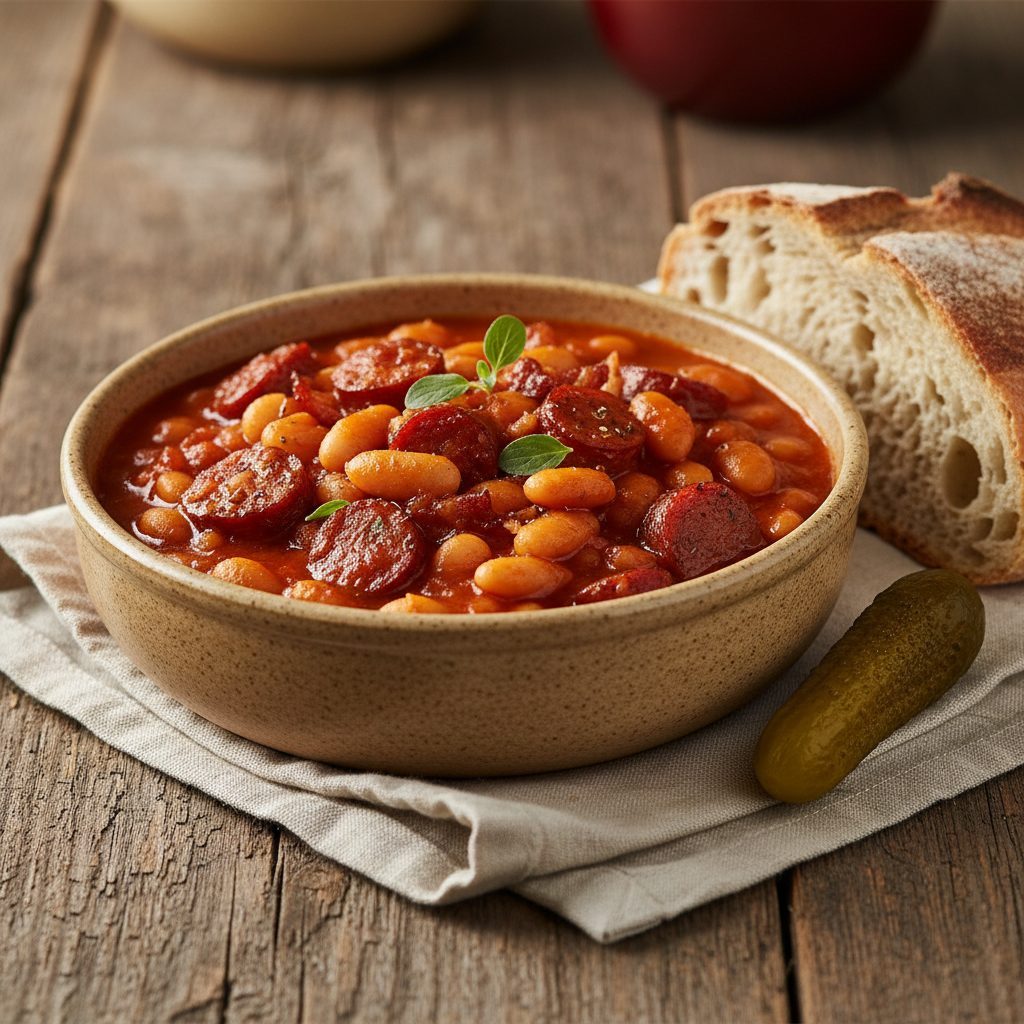
It is served boiling, in a deep bowl, with bread for wiping up the sauce and the evidence. A pickled cucumber eases the gravity of the situation. A small pot does not exist. Fasolka is instinctively cooked for a regiment, though it vanishes before Monday.
Then came politics. In 2019 fasolka ended up in the files of the Central Anti-Corruption Bureau and in tabloid folklore through a morals-and-corruption scandal involving Stefan Niesiołowski. According to the materials disclosed, the hot dish was supposed to accompany meetings of an even higher temperature. The internet got what it needed. Politics, sex, sausage and tomato sauce. The national meme was ready.
Students called it fa-po-bre. Dieticians talk about oligosaccharides. The people talk about strong winds and government alerts. One thing remains certain: fasolka po bretońsku is no ordinary dish. It is Polish history served hot — a little French, a little military, a little crisis-driven, and after consumption decidedly expansive.
## Three passports of one bean
The name promises Brittany and lies a little, and a little not. In France „à la bretonne” means dishes served with white beans, especially the famous Breton variety coco de Paimpol. The trouble is that those dishes are based on beans stewed with onion, tomatoes and herbs. They lack the generous meat content without which Polish fasolka would be merely a pulse soup and a sense of unfulfilment.
The second hypothesis leads to Languedoc, to cassoulet: a rich stew of white beans, bacon, pork rind, sausages and confit duck or goose, baked in an earthenware dish. Polish fasolka would be its simplified version, brought over in the nineteenth century, after the Napoleonic wars, by returning soldiers or French cooks. If so, all that was left to us of the whole cassoulet were the beans and the bacon, while the duck walked back to France.
The third trail is the best documented and the least romantic. One of the earliest written sources close to the Polish recipe is the first Polish military cookbook, „Kuchnia garnizonowa oraz wskazówki dotyczące racjonalnego odżywiania wojska” (Garrison Cooking and Guidance on the Rational Feeding of the Army), published in Paris in 1918. From the very beginning, then, fasolka was soldiers’ fare: high in calories, simple, and prepared in quantities counted in companies.
The fourth direction is baked beans, the British-American beans baked in tomato sauce. Their roots reach back to the Native American cultures of North America, from whom the colonists took the recipe, and the Heinz company spread it around the world in a can. Modern Polish fasolka resembles it the way a country cousin resembles a city cousin. The same genes, different manners.
## Queen of the jars
In the People’s Republic, fasolka attained legendary status. It was a fixed, cheap and filling item on the menu of every milk bar and workers’ canteen, the ideal meal for the working class and poor students. When there was no meat in the shops, cooks and housewives showed a creativity no planning commission would have been ashamed of. Smoked sausage and bacon were replaced by diced mortadella, frankfurters or „cold-cut offcuts”, a mixture of leftovers from butcher’s shops. When there was no tomato paste, the sauce was thickened with a flour roux or with blended boiled carrot and onion, diluted with stock and a substitute for purée.
The bars served it in two extremes. Either as a thick, almost creamy stew, thickened with flour, or as a thin red soup in which a few beans and pieces of sausage floated. Both versions were genuine. Both said something about the supply situation.
A jar or tin of fasolka was one of the few products that almost always stood on the half-empty shelves. It rescued workers on building sites, students in dorms and tourists at campsites. The obligatory, sacred accompaniment was a fresh kaiser roll or a Poznań bread roll. Fasolka was not a culinary choice back then. It was a certainty in a world short of certainties.
## Aristocracy of the pulses
The base is simple: beans, bacon, sausage, tomatoes. But Poland has bean varieties that allow this dish to enter the drawing rooms, and with a European Union certificate, a protected designation of origin. Fasola Wrzawska, from the fork of the Vistula and the San, from the Gorzyce commune, has very large, kidney-shaped, glossy seeds with thin skins and a buttery taste. „Fasolka po wrzawsku” cooks faster and is more delicate, the premium version. Fasola Korczyńska from around Nowy Korczyn in the Świętokrzyskie region has a very thin skin and fewer of the substances responsible for bloating, which makes it, let us say, the diplomat among pulses. The bean from the Dunajec Valley, the large „Piękny Jaś”, Handsome Johnny, from Lesser Poland, owes its velvety texture and sweetish taste to the valley’s microclimate.
The culinary variants spread further still. The military version is very thick and fatty, with smoked bacon, fatback and sometimes overcooked pork knuckle, heavily seasoned with garlic, marjoram and pepper, served straight from the field kitchen. Fasolka po staropolsku, Old Polish style, gets dried forest mushrooms instead of tomatoes, a little honey or plum butter and warm spices. Vegetarian and vegan versions replace sausage and bacon with smoked tofu, soy chunks or vegan sausages, taking their smoky aroma from smoked sweet paprika. Tradition turns out to be more flexible than its defenders.
## Fasolka in the case files
The most unexpected chapter in the history of fasolka was written not by a kitchen but by an investigation. In 2019 its name began to circulate in the media in connection with a corruption case handled by the Central Anti-Corruption Bureau, in which the name of Stefan Niesiołowski, a former Deputy Speaker of the Sejm, came up. According to materials disclosed by the media at the time, hot fasolka po bretońsku was said to appear at meetings described in that case.
One basic thing must be said here, because decency applies at the table too. Investigators' allegations and press leaks are not a verdict, and everyone enjoys the presumption of innocence. We do not judge the case and do not try to. We only note a cultural phenomenon: a dish from milk bars and army cauldrons became a political meme overnight. The fasolka had nothing to say. As usual, it spoke up only after being eaten.
## The ritual of the big pot
Fasolka has unwritten rules. It must be served very hot, almost boiling, „bubbling”, because only then do the thick tomato sauce and the fat from the smoked meat merge into a single whole. The vessel: a deep plate, a stoneware bowl or a military or scout mess tin. Bread is not a side but a tool. Sourdough bread or a crusty roll serve to wipe the last of the sauce from the bottom of the plate. The heaviness is balanced by sour accents: pickled cucumber, marinated pattypan squash, a tangy salad.
The most sociological phenomenon, however, is what might be called big-pot syndrome. Fasolka cannot be cooked in small quantities. In Polish homes, therefore, a pot is cooked that is by design meant to last the whole family from Saturday to Thursday. An ethnographic joke has it that it disappears on Monday evening anyway. A five-year plan, fulfilled in three days.
## Fa-po-bre and strong winds
In student slang the dish exists as „fa-po-bre”. It means the absolute minimum of effort: a cheap, filling dinner from a jar, heated in the microwave or quickly in a pan. A synonym for life on a budget and a lifeline for dorms and campsites.
There is also stomach folklore that cannot be left out, because it demands attention on its own. The oligosaccharides in beans have powerful bloating properties, and a great many jokes have grown up around this. The classic is the one about the government alert that opens this story. A separate category of sayings regards fasolka as a „high-risk dish before a first date”.
Fasolka po bretońsku is, then, a dish that hides nothing. Not its origins, not its shortages, not its consequences. Perhaps that is exactly why it is so Polish. It begins with a French name, passes through barracks and queues, and ends at a table where everyone knows what will happen next, and asks for seconds all the same.
📖 Glossary
- à la bretonne
- Francuskie określenie dań podawanych z białą fasolą, zwłaszcza z bretońską odmianą coco de Paimpol.
- cassoulet
- Langwedocki gulasz z białej fasoli, boczku, skórki wieprzowej, kiełbasek i konfitowanej kaczki albo gęsi, zapiekany w glinianym naczyniu.
- baked beans
- Brytyjsko-amerykańska fasola pieczona w sosie pomidorowym o korzeniach w kulturach indiańskich, rozniesiona po świecie w puszce przez firmę Heinz.
- syndrom wielkiego gara
- Zjawisko gotowania fasolki w ilości, która ma starczyć od soboty do czwartku, a znika w poniedziałek wieczorem.
- fa-po-bre
- Studencki skrót fasolki po bretońsku, synonim taniego obiadu ze słoika i życia na budżecie.
Frequently Asked Questions
Where does fasolka po bretońsku come from?
Its origin is unclear and follows several trails: French dishes „à la bretonne”, the cassoulet of Languedoc and British-American baked beans. The best-documented trace is the first Polish military cookbook, „Kuchnia garnizonowa oraz wskazówki dotyczące racjonalnego odżywiania wojska” (Garrison Cooking and Guidance on the Rational Feeding of the Army), published in Paris in 1918. From the start, the dish was soldiers’ fare.
Why is Polish baked bean stew called Breton?
In France „à la bretonne” means dishes served with white beans, especially the Breton coco de Paimpol variety. Those dishes, however, are based on beans stewed with onion, tomatoes and herbs, without a generous helping of meat. The name promises Brittany and lies a little, and a little not.
What was fasolka po bretońsku like in communist Poland?
In communist Poland the dish was a fixed, cheap and filling item on the menu of every milk bar and canteen. When meat was scarce, bacon and sausage were replaced by mortadella, frankfurters or cold-cut offcuts, and the sauce was thickened with flour or carrot. A jar of it was almost always on the half-empty shelves.
Which beans are best for fasolka po bretońsku?
Poland has varieties with a protected designation of origin. Fasola Wrzawska has large, kidney-shaped seeds with thin skins and a buttery taste, while Fasola Korczyńska has very thin skins and fewer of the substances responsible for bloating. Piękny Jaś from the Dunajec Valley owes its velvety texture and sweetish taste to the valley’s microclimate.
How to serve fasolka po bretońsku?
It is served very hot, almost boiling, in a deep plate, a stoneware bowl or a mess tin. Sourdough bread or a crusty roll is used to wipe up the sauce. The heaviness is balanced by sour accents: pickled cucumber, marinated pattypan squash, a tangy salad.
What does fa-po-bre mean?
„Fa-po-bre” is the student name for fasolka po bretońsku. It stands for the absolute minimum of effort: a cheap, filling dinner from a jar, heated in the microwave or quickly in a pan. It is a synonym for life on a budget and a lifeline for dorms and campsites.
Related Questions
- Where does fasolka po bretońsku come from?
- Why is Polish baked bean stew called Breton?
- What was fasolka po bretońsku like in communist Poland?
- Which beans are best for fasolka po bretońsku?
- How to serve fasolka po bretońsku?
- What does fa-po-bre mean?
🧠 Thematic Groups
- Historia i pochodzenie: francuskie „à la bretonne”, hipoteza cassoulet przywiezionego po wojnach napoleońskich, wojskowa książka kucharska z 1918 roku i baked beans Heinza.
- PRL: fasolka jako królowa barów mlecznych, stołówek i słoików, z mortadelą i okrawkami zamiast boczku i sosem zagęszczanym mąką lub marchewką.
- Odmiany: chronione fasole Wrzawska, Korczyńska i z Doliny Dunajca oraz wersje wojskowa, staropolska z grzybami i powidłami, wegetariańska i wegańska.
- Obyczaj i folklor: podanie wrzącej fasolki z chlebem i ogórkiem kiszonym, syndrom wielkiego gara, studenckie fa-po-bre i żarty o oligosacharydach i alertach RCB.
Tags:
fasolka po bretońsku
Polish cuisine
white beans
bacon
sausage
tomato sauce
à la bretonne
cassoulet
baked beans
communist Poland
milk bar
Fasola Wrzawska
Fasola Korczyńska
Piękny Jaś
fa-po-bre
More in: Kuchnia niepolityczna
Content is created by Fundacja Dobre Państwo.
Edited and published by APA ONE, the Foundation's own AI-based editorial system.