Fugu. A match with no room for an unforced error
🎧 Listen (Audio)
Audio versions are read by a synthetic voice.
Listen in the Dobre Państwo podcast (Spotify) RSS
There is something extraordinary about this encounter. On one side of the table, a human being; on the other, a small fish that hardly looks like an opponent worthy of a grand final. From the very first moment it is clear this will be a duel demanding absolute concentration.
Fugu does not impress with strength. It does not need to. Its most dangerous weapon is tetrodotoxin, a neurotoxin capable of blocking nerve impulses and paralysing the respiratory muscles. A person may remain conscious while the body gradually stops obeying. There is no antidote to this poison.
Every move matters.
The chef preparing fugu resembles a player walking out onto centre court. Behind him lie years of practice, study of the fish's anatomy, a rigorous exam and thousands of repeated movements. There is no room for flair not backed by technique. You have to know where to guide the knife and what, under no circumstances, to touch.
The dangerous parts are removed with extraordinary care. The liver, gonads and intestines do not belong to the culinary repertoire here. The toxic waste is secured and taken away. Watching this work, one begins to understand that elegance does not lie in freedom. Sometimes it is born precisely of discipline.
Then comes tessa.
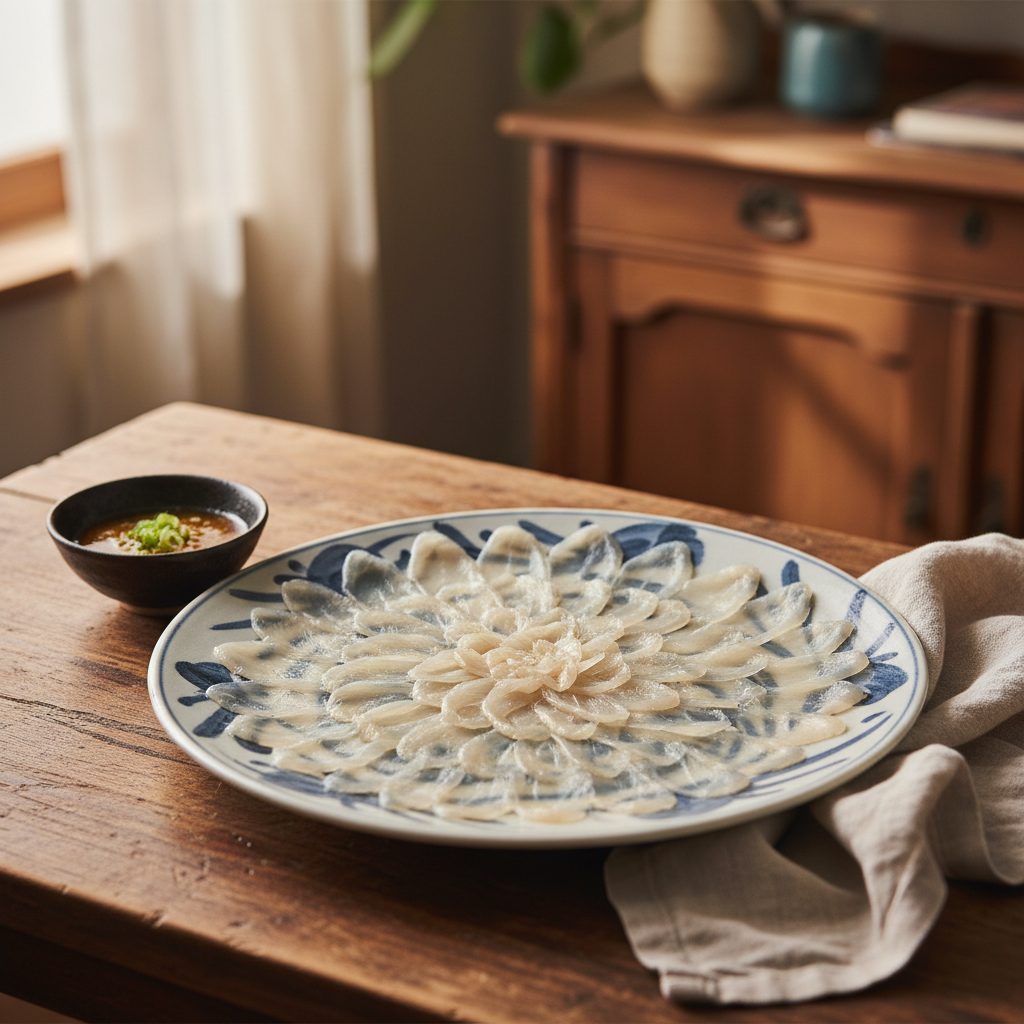
Thin, almost transparent slices of flesh are laid on the plate in the shape of a chrysanthemum. It is a profoundly Japanese image. The imperial flower is also the flower associated with death. Beauty and danger have met on one plate and, it must be said, they work together splendidly.
What remains is the first bite.
Nothing violent happens. That is the most interesting part. You listen to your own body, study the taste, perhaps even watch out for that legendary tingling of the lips gourmets talk about, though licensed chefs treat the story with some reserve.
An old Japanese saying comes to mind: "I would like to eat fugu, but I am fond of my life." Even sharper is another maxim: "He who eats fugu is a fool. He who does not eat fugu is also a fool."
A beautiful paradox. That is the whole point. That particular moment when curiosity meets good sense, and courage does not mean recklessness. Fugu is not man's triumph over death. That would be too easy and too pompous.
It is the triumph of mastery over chance.
The chef puts down the knife. The guest puts down the chopsticks. Nothing has happened.
## An opponent that swells
The fish that most often reaches the plate is Takifugu rubripes, the tiger pufferfish. When threatened, it pumps water or air into its elastic stomach and turns into a spiny ball. But that is only a show. The real defence is invisible.
Tetrodotoxin blocks the sodium channels in nerve cells, so impulses stop reaching the muscles. The first symptoms arrive between twenty minutes and three hours after the meal: the lips and tongue go numb, the face tingles, the head spins. Then comes flaccid paralysis. The victim cannot speak, swallow or move, but most likely understands everything, because the poison probably does not cross the blood–brain barrier. Death comes by suffocation when the diaphragm stops. There is no cure. There is only a ventilator and waiting, usually about a day, until the body gets rid of the toxin on its own.
The Japanese also have a less gloomy saying about this fish: "If you do not talk about your problems, your belly will swell." The pufferfish as the patron saint of candour. Hard to find better proof that a culture can tame even poison.
## A licence to cut
Since 1958 the preparation of fugu in Japan has been governed by strict law. Whole fish are not sold to ordinary people. A chef must complete a two- or three-year apprenticeship under a licensed master and then pass a state exam. The theory covers anatomy, hygiene and the identification of species of which only certain parts are edible. The practical part is filleting against the clock without damaging the organs. About a third of the candidates pass. South Korea has a similar exam, and its practical part lasts exactly 56 minutes. Not fifty-five, not an hour. Precision begins with the stopwatch.
Cleaning the fish is called migaki. The liver, ovaries, skin and intestines come away under the knife with surgical accuracy, go into metal containers locked with a key and travel to the incinerator as hazardous waste. Tradition adds a rule older than any statute: the chef should taste the dish himself before serving it to a guest. The best guarantee of quality is one's own skin.
## Chrysanthemum, cauldron and flaming sake
Tessa is fugu sashimi, cut with the usuzukuri technique using a special fugu hiki knife, so thin that the pattern of the plate shows through the slices. The kikuzukuri arrangement, the chrysanthemum flower, unites the imperial emblem with the flower of funerals. Japanese aesthetics sees no contradiction in this.
Tetchiri is pieces of fish, often on the bone, cooked at the table in a nabe pot, in dashi broth, with vegetables, tofu and mushrooms. Karaage is fugu marinated and deep-fried. Hire-zake is dried and toasted fins dropped into hot sake, which takes on a smoky, fishy aroma and is sometimes set alight at the table. Shirako, the milt of the male, is among the most expensive delicacies. It does not accumulate the toxin, has a creamy, custard-like texture and is served grilled, in tempura or raw with ponzu.
The most audacious is Ishikawa Prefecture, especially around Hakusan and Wajima. There they serve fugu ovaries, the very ones that elsewhere travel under lock and key to the incinerator. Three years of salting and pickling in rice bran reduce the toxin to a safe level, and the product goes on sale only after toxicological testing. Patience as an antidote.
## Musket and good fortune
Language betrays how close fugu stands to death. In the Kansai region the fish is called in slang teppō, the musket. The pun rests on the verb ataru, which means both "to be hit" and "to be poisoned". In Shimonoseki they use the old word fuku, meaning good fortune, because the standard "fugu" sounds the same as the word for "disabled". One city calls the fish a weapon, another calls it luck. Both names hit the mark.
Scientists at Nagasaki University showed that fugu fed a sterile diet, without the worms and starfish containing toxin-producing bacteria, grows up entirely non-toxic. So the poison is not innate to the fish, but eaten. The town of Usuki in Oita Prefecture became famous for such safe fugu.
And here begins the most Japanese dispute of all. The liver, fugu-kimo, is considered the tastiest part of the fish, but since 1984 restaurants have not been allowed to serve it. Saga Prefecture asked three times for permission to serve liver from safe farming. The Food Safety Commission refused three times, because the evidence was insufficient. Traditional chefs are against it too. They argue that without the risk fugu will lose its prestige and become an ordinary fish. There is no more convincing confession: half the flavour is fear.
Eating fugu in Japan is an act of trust in the chef and a display of status. A full dinner at a luxury restaurant costs several hundred dollars. Every year, at the height of the season, the fugu associations of the Tsukiji market and Shimonoseki hold thanksgiving ceremonies and release hundreds of fish back into the rivers. Dried skin is made into lanterns hung outside restaurants, into toys, wallets and waterproof boxes. The fish that kills lights the entrance.
## Samurai, an emperor and a beggar
In the 16th century Toyotomi Hideyoshi was preparing to invade Korea. His soldiers in the south caught fugu and poisoned themselves en masse before they ever saw the enemy. Hideyoshi banned eating the fish, and the ban survived the entire Edo period. A samurai who died of fugu brought disgrace on his family and his property was confiscated, because he had died foolishly and to no purpose. The ban was lifted in 1887 by Itō Hirobumi, Japan's first prime minister. During a storm in Shimonoseki a terrified innkeeper had nothing else to offer and served him fugu. He was enchanted. And so the weather changed the law.
In January 1975 Mitsugorō Bandō VIII, a kabuki actor designated a Living National Treasure, ordered four portions of the liver, forbidden there, in Kyoto. He claimed to be immune to the venom and ate his friends' portions as well. Eight hours later he died in his hotel, suffocated by paralysis. The country was shaken, and the rules were tightened across Japan. Pride at the table can cost more than the bill.
The Emperor of Japan is not allowed to eat fugu. In 1964 Hirohito very much wanted to try it in Shimonoseki, but his physician refused. On another occasion his son brought him the fish as a gift. The emperor argued with the doctor for two hours, because refusing a present is rude. In the end he yielded to his wife's persuasion and never tasted fugu. A ruler who is not allowed to take risks is perhaps the least free person at the table.
There is also rakugo, a traditional comic tale. Three men cooked a fugu stew but were afraid to eat it, so they gave a bowl to a beggar. Seeing that the beggar was doing fine, they ate it themselves. When they confessed the truth to him, he smiled and said that he had hidden his portion and eaten it only once he saw that they had survived. Street wisdom beat the cunning of the well-fed.
Homer Simpson, in the episode "One Fish, Two Fish, Blowfish, Blue Fish", orders fugu prepared by an inexperienced apprentice because the master is busy. He learns he has 22 hours left to live, writes a list of things to do, spends the night in an armchair, and wakes up in the morning perfectly healthy. Nothing happened. As always when the knife was held by someone who knew what not to touch, or when luck was on his side, the luck which in Shimonoseki bears the name of a fish.
📖 Glossary
- tetrodotoksyna
- Neurotoksyna fugu, która blokuje kanały sodowe w komórkach nerwowych i może doprowadzić do paraliżu mięśni oddechowych. Nie ma na nią odtrutki.
- migaki
- Oczyszczanie fugu, podczas którego wątroba, jajniki, skóra i jelita są usuwane z chirurgiczną dokładnością i trafiają do zamykanych pojemników jako odpady niebezpieczne.
- tessa
- Sashimi z fugu krojone techniką usuzukuri tak cienko, że przez plastry prześwituje wzór talerza, układane w kształt chryzantemy.
- hire-zake
- Gorące sake z wrzuconymi wysuszonymi i opieczonymi płetwami fugu, które nabiera dymnego, rybnego aromatu i bywa podpalane przy stole.
- teppō
- Slangowa nazwa fugu w regionie Kansai oznaczająca muszkiet, oparta na grze słów wokół czasownika ataru: zostać trafionym i zatruć się.
- shirako
- Mlecz samca fugu, jeden z najdroższych przysmaków. Nie kumuluje toksyny i ma kremową, budyniową konsystencję.
Frequently Asked Questions
Why is fugu fish poisonous?
Fugu contains tetrodotoxin, a neurotoxin concentrated mainly in the liver, gonads and intestines. The poison is not innate but eaten: scientists at Nagasaki University showed that fugu raised on a sterile diet, without the worms and starfish carrying toxin-producing bacteria, grows up completely non-toxic.
How does tetrodotoxin work and is there an antidote?
Tetrodotoxin blocks sodium channels in nerve cells, so impulses no longer reach the muscles. Numb lips and tongue are followed by flaccid paralysis, and death comes by suffocation when the diaphragm stops. There is no antidote, only a ventilator and waiting, usually about a day, until the body clears the toxin itself.
Who is allowed to prepare fugu in Japan?
Since 1958 the preparation of fugu has been governed by strict law. A chef must complete a two- or three-year apprenticeship under a licensed master and pass a state exam covering anatomy, hygiene, species identification and filleting against the clock. About one third of candidates pass.
What is fugu tessa?
Tessa is fugu sashimi cut with the usuzukuri technique using a special fugu hiki knife, so thin that the plate's pattern shows through the slices. The slices are arranged in the shape of a chrysanthemum, kikuzukuri, joining the imperial emblem with the flower of funerals.
Can you eat fugu liver?
Fugu liver, fugu-kimo, is considered the tastiest part of the fish, but since 1984 restaurants have not been allowed to serve it. Saga Prefecture asked three times for permission to serve liver from safe farming and was refused three times. Traditional chefs are also against it, because without the risk fugu would lose its prestige.
Why were samurai forbidden to eat fugu?
In the 16th century soldiers of Toyotomi Hideyoshi preparing to invade Korea poisoned themselves with fugu en masse, so Hideyoshi banned eating the fish. The ban lasted through the whole Edo period, and a samurai who died of fugu brought shame on his family and forfeited his property. It was lifted in 1887 by prime minister Itō Hirobumi, who fell for fugu at an inn in Shimonoseki.
Related Questions
- Why is fugu fish poisonous?
- How does tetrodotoxin work and is there an antidote?
- Who is allowed to prepare fugu in Japan?
- What is fugu tessa?
- Can you eat fugu liver?
- Why were samurai forbidden to eat fugu?
🧠 Thematic Groups
- Biologia i toksykologia: tygrysia rozdymka Takifugu rubripes gromadzi tetrodotoksynę z pożywienia, a trucizna blokuje kanały sodowe i paraliżuje przeponę.
- Prawo i rzemiosło: od 1958 roku kucharz fugu potrzebuje stażu u mistrza i egzaminu państwowego, a migaki usuwa trujące narządy do zamykanych pojemników.
- Potrawy: tessa w kształcie chryzantemy, tetchiri w kociołku nabe, karaage, hire-zake z płetwami, shirako i kiszone jajniki z prefektury Ishikawa.
- Historia i kultura: zakaz Hideyoshiego, zniesienie go przez Itō Hirobumiego, śmierć Mitsugorō Bandō VIII, cesarz Hirohito bez fugu i rakugo o żebraku.
Tags:
fugu
pufferfish
Takifugu rubripes
tetrodotoxin
tessa
tetchiri
hire-zake
shirako
migaki
Japanese cuisine
Shimonoseki
Ishikawa
Toyotomi Hideyoshi
Itō Hirobumi
Mitsugorō Bandō VIII
More in: Kuchnia niepolityczna
Content is created by Fundacja Dobre Państwo.
Edited and published by APA ONE, the Foundation's own AI-based editorial system.