Savoy cabbage rolls with buckwheat. Love at first wrap
🎧 Listen (Audio)
Audio versions are read by a synthetic voice.
Listen in the Dobre Państwo podcast (Spotify) RSS
Gołąbki smell of grandmother's kitchen, of steam settling on the windowpanes, of a heavy lid lifted from the pot and the impatient question: can we eat yet? The taste of childhood is rarely sophisticated in an ostentatious way. It lives in simple ingredients that someone put together with patience.
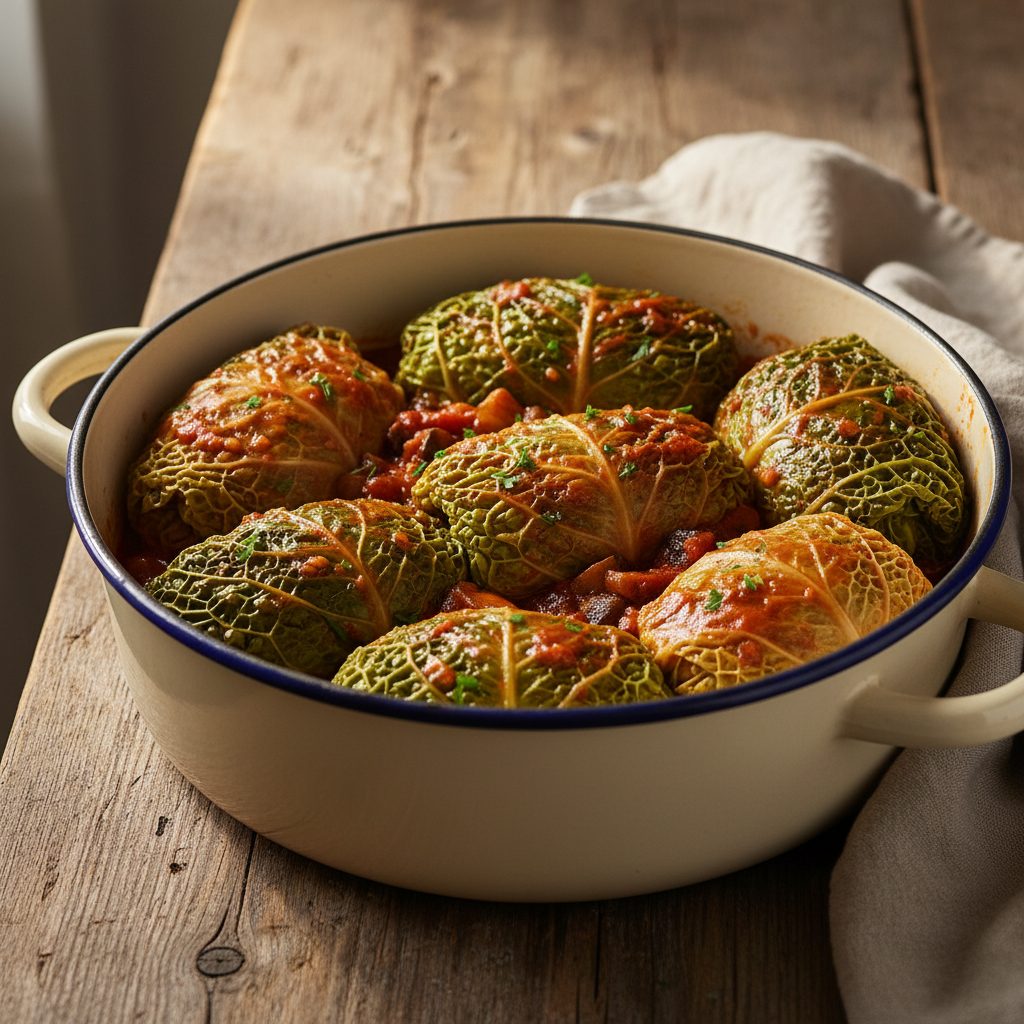
Savoy cabbage, soft and delicate, is not packaging. The crinkled leaf holds the sauce, protects the filling and gives every bite its own architecture. Inside, buckwheat groats, once called hreczka, bring a nutty, earthy, deep flavour. The taste of fields, of pantries and of regions where nothing went to waste and modesty did not mean culinary boredom.
Gołąbki are a lesson in anthropology. They show how dishes travel between cultures, change their language and adapt to the climate. The Middle Eastern art of wrapping a filling in vine leaves found a new home in cabbage in the north of Europe. Dolma, sarmale, holishkes, kåldolmar and our gołąbki belong to one great family of dishes which say that for centuries people have been trying to wrap the world in something safe.
It is also a social story. In the manor kitchen, cabbage leaves protected the meat of young pigeons. In peasant homes, a filling of groats, onion and a little meat became a brilliant answer to scarcity. Poverty could be brutal, but ingenuity knew no hierarchy of estates. In time, the imitation of luxury became a masterpiece in its own right.
Every region added its own accent to the story. In Podlasie there were hołubcie and łupcie, in Kashubia gòłąbczi, in Greater Poland gałąbki, and in Jewish tradition holishkes. One dish, many languages of memory.
Gołąbki teach us about work. "Roast gołąbki don't fly into your gąbka by themselves" is not just a proverb. It is a philosophy of cooking and of life. You have to scald the leaves, prepare the filling, roll each parcel, lay it down carefully and give it time. Flavour does not like haste. Good things ripen under a lid.
Gołąbki taste like home. Not because they were always perfect, but because someone made them for us with their own hands.
Love at first wrap? Perhaps. A memory that is still warm.
Savoy cabbage gołąbki with buckwheat are an emblematic dish that successfully connects the past, from Persian roots and Wielądko's court pigeons, with a need for authenticity and respect for local produce.
## A cabbage roll, not a bird
The name looks obvious. The roll resembles a sitting bird with folded wings, hence gołąbek, a little pigeon. The linguist Marek Stachowski suspects, however, that the matter is older and more exotic. The Polish name may be an oriental loan, from Persian kalam, meaning "cabbage", or kalam pič, a "cabbage roll", and also from Armenian kałamb. The pigeon appeared only on Slavic soil, thanks to folk etymology, which likes words to resemble something. The bird flew into the name later than the cabbage.
The dish's genealogy confirms the trail. Gołąbki are close relatives of Middle Eastern dolma and Balkan sarmale. The technique of wrapping a filling in vine leaves, travelling north, had to find a plant that would survive frost. It found cabbage, that "northern vine". Cooking is pragmatic: it takes the idea from the Levant and the leaf from its own field.
## Pigeon at the manor, groats in the cottage
In Poland gołąbki settled in during the 18th and 19th centuries and had two faces from the start. At the courts, under the influence of French cuisine, young pigeons were roasted wrapped in cabbage leaves so the delicate meat would not dry out. Wojciech Wielądko, in "Kucharz doskonały" (The Perfect Cook) of 1783, gives a recipe for "gołąbki with meat", and "Kucharz polski" (The Polish Cook) of 1826 calls them "an excellent household dish".
In the countryside there was no noble fowl. There were groats and scraps of meat. So the poorer classes took over the shape and the name, and swapped the content. The culinary masquerade allowed them to share in luxury, if only symbolically. History knows few forgeries as successful. The original, the pigeon in cabbage, is remembered by hardly anyone today. The imitation stands on every Sunday table.
Legends add their share. One tells of a housewife from the time of the Swedish wars who made a dish from leftover groats and meat that reminded the children of sitting birds. Another credits the popularity of gołąbki to royal master cooks who wanted to give cabbage a form worthy of a monarch's table. Both are possible. Neither is necessary.
## Why savoy, and why buckwheat
Savoy cabbage has leaves more elastic and delicate than white cabbage. They do not crack when rolled tightly, a brief blanching is enough, and they soften faster when braised, so the filling keeps its shape. The blistered, crinkled surface is not mere decoration. It absorbs and holds the sauce, so every bite is fuller.
Buckwheat matters more here than the cabbage. It is buckwheat, not the later rice, that testifies to the dish's Old Polish pedigree. It gives the filling a loose texture and a nutty, earthy aroma that contrasts nicely with the sweetness of braised cabbage. Hreczka was grown especially widely in the Lublin region and the former eastern borderlands, the Kresy, and its availability made gołąbki an egalitarian dish. Rice is neutral. Buckwheat has an opinion.
The filling allows variations. The noblest versions reach for veal, or pork with smoked bacon. Lenten versions for wild mushrooms. Add scalded onion and, in some regions, grated potatoes too.
## A map of wrapping
The Lublin region calls itself the heartland of buckwheat. Janów Lubelski holds a festival called "Gryczaki" and promotes the Gryczak Janowski. The borderland tradition from around Ternopil, with gołąbki made of groats and potatoes, survived thanks to resettlement to Opole Silesia. The version from Wilamowice Nyskie, combining buckwheat with raw grated potatoes, was entered on the Ministry of Agriculture's List of Traditional Products. The cuisine of the displaced proved more durable than borders.
The names change every few dozen kilometres. Hołubcie in Podlasie and the Lublin region, hołubci in Podkarpacie, łupcie in Podlasie, gòłąbczi or golce in Kashubia, gałąbki in Greater Poland, zawijanki kapuściane, cabbage wraps, in Lesser Poland.
For Ashkenazi Jews, holishkes are a ritual dish. They are eaten at Sukkot as a sign of abundance, and at Simchat Torah two rolls laid side by side recall the scrolls of the Torah. Swedish kåldolmar have the most surprising pedigree of all. They owe it to the Ottoman creditors of King Charles XII, who stayed in Stockholm in the 18th century and planted there the custom of stuffing leaves. The royal debt, it seems, was repaid in cabbage too.
## A land no one ever reached
The proverb about gołąbki that do not fly by themselves into the gąbka, that is, the mouth, alludes to Cockaigne, the mythical land of idleness where food made its own way into your mouth. The utopia of the hungry was the reverse side of destitution. The proverb cancels it. The Great Dictionary of the Polish Language of the Polish Academy of Sciences defines diligence as the trait of someone who works a lot and willingly. Gołąbki illustrate the definition: scalding, filling, wrapping, arranging, braising. Nothing here flies by itself.
Perhaps that is why they taste like home. A home does not build itself either.
📖 Glossary
- hreczka
- Dawna nazwa kaszy gryczanej, która wnosi do farszu gołąbków smak orzechowy, ziemisty i głęboki.
- holiszki
- Gołąbki w tradycji Żydów aszkenazyjskich, potrawa rytualna jadana w Sukkot na znak obfitości, a w Simchat Tora układana parami na wzór zwojów Tory.
- kåldolmar
- Szwedzkie gołąbki, których zwyczaj zaszczepili w XVIII wieku w Sztokholmie osmańscy wierzyciele króla Karola XII.
- Kukania
- Mityczna kraina lenistwa, w której jedzenie samo trafiało do ust, do której nawiązuje przysłowie o gołąbkach i gąbce.
- kapustozwój
- Dosłowne znaczenie perskiego kalam pič, od którego według Marka Stachowskiego może pochodzić nazwa gołąbków.
Frequently Asked Questions
Where does the name gołąbki come from?
At first glance the roll resembles a sitting bird, a little pigeon. Linguist Marek Stachowski, however, suspects an oriental loan: from Persian kalam, cabbage, or kalam pič, a cabbage roll, and from Armenian kałamb. The pigeon entered the name only later through Slavic folk etymology.
Why is savoy cabbage used for cabbage rolls?
Savoy cabbage has more elastic and delicate leaves than white cabbage, so they do not crack when rolled tightly and need only a brief blanching. They soften faster when braised, so the filling keeps its shape. The crinkled, blistered surface absorbs and holds the sauce.
Were gołąbki once made with pigeons?
Yes, at noble courts, under French influence, young pigeons were roasted wrapped in cabbage leaves so the meat would not dry out. Wojciech Wielądko gives a recipe for gołąbki with meat in his 1783 cookbook „Kucharz doskonały”. In the villages there were no birds, only groats and scraps of meat, and that imitation has survived to this day.
Why buckwheat gołąbki rather than rice?
It is buckwheat, not the later rice, that testifies to the dish's Old Polish lineage. It gives the filling a loose texture and a nutty, earthy aroma that contrasts with the sweetness of braised cabbage. Buckwheat was grown especially in the Lublin region and the former eastern borderlands, which made gołąbki an egalitarian dish.
What are cabbage rolls called in different regions of Poland?
In Podlasie and the Lublin region they are hołubcie, in Podkarpacie hołubci, and in Podlasie also łupcie. Kashubia says gòłąbczi or golce, Greater Poland gałąbki, and Lesser Poland zawijanki kapuściane. In Jewish tradition they are holishkes.
What does the proverb about roast pigeons not flying into your mouth mean?
The Polish proverb says roast gołąbki do not fly by themselves into the gąbka, the mouth, alluding to Cockaigne, the mythical land of idleness where food flew into your mouth on its own. The proverb cancels this utopia of the hungry: nothing comes without work. Gołąbki illustrate it literally, since you have to scald the leaves, make the filling, roll, arrange and braise.
Related Questions
- Where does the name gołąbki come from?
- Why is savoy cabbage used for cabbage rolls?
- Were gołąbki once made with pigeons?
- Why buckwheat gołąbki rather than rice?
- What are cabbage rolls called in different regions of Poland?
- What does the proverb about roast pigeons not flying into your mouth mean?
🧠 Thematic Groups
- Etymologia i genealogia: nazwa gołąbków może pochodzić od perskiego kalam, a potrawa jest krewną bliskowschodniej dolmy i bałkańskiego sarmale.
- Historia społeczna: na dworach w XVIII i XIX wieku pieczono gołębie w kapuście, a wieś podmieniła ptaka na kaszę i resztki mięsa.
- Technika i składniki: kapusta włoska jest elastyczna i trzyma sos, a gryka daje farszowi sypkość i orzechowy aromat.
- Regiony i kultury: hołubcie, łupcie, gòłąbczi, gałąbki, Gryczak Janowski z Lubelszczyzny, żydowskie holiszki i szwedzkie kåldolmar.
Tags:
gołąbki
savoy cabbage
buckwheat groats
hreczka
Polish cuisine
dolma
sarmale
holishkes
kåldolmar
hołubcie
Lublin region
Wojciech Wielądko
Marek Stachowski
Cockaigne
Gryczak Janowski
More in: Kuchnia niepolityczna
Content is created by Fundacja Dobre Państwo.
Edited and published by APA ONE, the Foundation's own AI-based editorial system.