Haggis. Your head is full of mince
🎧 Listen (Audio)
Audio versions are read by a synthetic voice.
Listen in the Dobre Państwo podcast (Spotify) RSS
Haggis does not come to the table. It makes an appearance.
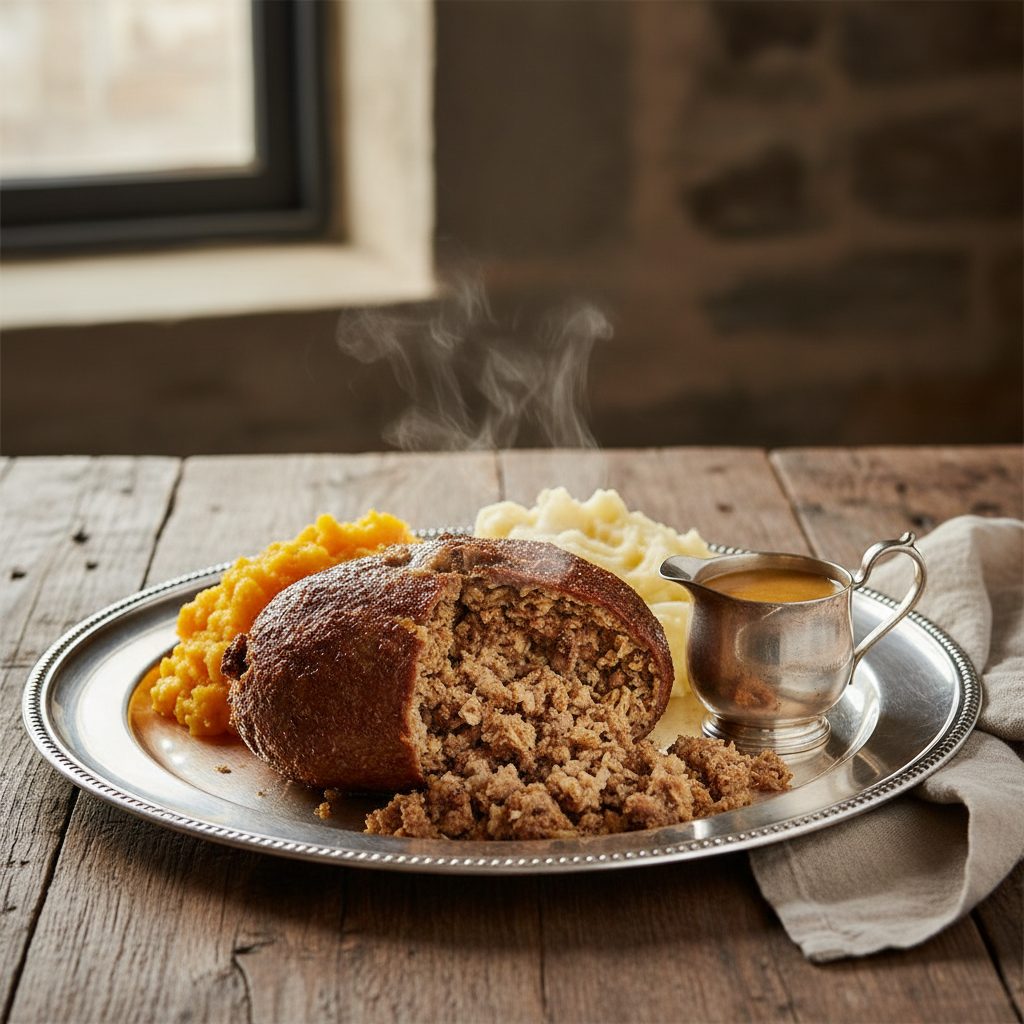
First you hear the bagpipes. Then a step. Slow, solemn, almost coquettish. On a silver platter rests something that should not be beautiful, and yet draws the eye with the force of forbidden things. Unassuming. Warm. Closed in on itself. A secret that very much wants to be discovered, but lacks the courage to ask for it outright.
The Scots call it their national dish, though its past is more elusive than a glance cast over a glass of whisky. Some find traces of the Romans in it; others hear in the name the echo of a Norse word for chopping. The English point to old recipes and try to take the precedence away from the Scots. But does desire ask for a title deed? Haggis belongs to whoever knows how to crave it.
Here meet the heart, liver and lungs of a sheep, finely chopped, wrapped in suet, onion and oats. Pepper teases the tongue. Coriander slips by discreetly. Nutmeg leaves a trace on the palate so delicate that it is hard to tell whether it was really there, or whether one merely wished to feel it.
The mixture is hidden in its casing and immersed in slow heat. Nothing must be hurried. The oats must swell. The flavours must learn one another. Haggis matures without haste, for several hours, tightly sealed, slightly taut, ever more ready for the moment when someone finally dares to cut it open.
On Burns Night the host recites the ode. He sharpens the knife. The blade flashes. The guests fall silent.
Climax, and the incision.
Steam rises from within, warm and fragrant. It is a moment of triumph, but also of exposure. Haggis has nothing left to hide. It lies open, generous, defenceless before appetite.
It is served with potatoes and swede, soft and creamy, soothing its peppery nature. Sometimes a whisky sauce flows over it — smooth, golden, a touch impudent. The glass beside it is not obligatory. It is merely a suggestion.
Haggis flirts with the world. It turns up in tacos, burgers, pakoras, on pizza. It lets itself be breaded, fried and sealed inside a chicken breast. It has a plant-based version; temptation does not need a single body to keep its character.
The Scots joke that somewhere in the mountains wild haggises run free, fluffy creatures with shorter legs on one side, made for circling the hillsides in one direction only. Perhaps it is just a legend.
Appetite is often a legend.
First we laugh at it. Then we glance at it once more. Later we try a small bite, supposedly with no strings attached.
When it is already too late, the haggis looks up from the plate like an innocent temptation and seems to whisper: but I never seduced you.
Great chieftain o' the puddin-race — you are the Victor.
## Whose pudding is it
The origin of haggis is as misty as a Highland morning. The practical theory says the dish was born of necessity. Offal spoiled quickly, especially on a hunt, and an animal's stomach was a ready-made vessel. The Romans may have been the first to cook chopped organs in one. The Scandinavian theory, following the etymologist Walter William Skeat, derives the word from the Old Norse haggw or the Icelandic hoggva, "to hack", "to chop". Haggis might therefore have sailed to Scotland in Viking boats.
The English have the documents. A mention of a dish called "hagese" appears around 1430 in the "Liber Cure Cocorum" from Lancashire, and in 1615 Gervase Markham, in "The English Huswife", described it as very popular in England. Only Robert Burns, in 1786, with his "Address to a Haggis", tied it for good to Scottish identity.
In 2009 the food writer Catherine Brown recalled the English recipe of 1615, and a storm broke out, dubbed the Haggis Stooshie. Scottish butchers and patriots took offence, and the historian Peter Brears added fuel to the fire by claiming that the association of haggis with Scotland was invented in the 1820s, like tartans. National identity often turns out to be younger than the recipe it prides itself on.
## Burns Night
On 25 January haggis becomes theatre. The cook carries it in on a silver platter escorted by a piper; the guests rise and applaud. The host recites the "Address to a Haggis". At the line "His knife see rustic Labour dight" he ostentatiously sharpens the knife; at "An' cut you up wi' ready sleight" he slits the stomach lengthwise and releases the steaming interior. More cautious hosts make a small cut before the ceremony so the hot filling does not explode over the guests. Then a whisky toast in honour of the haggis, and only then may one eat. Few dinners demand poetry, a knife and music before they allow themselves to be eaten.
On the plate wait neeps and tatties, separate purées of swede and potato. Mixed together they are called clapshot. Then a creamy whisky sauce, or simply a dram. In Aberdeen haggis sometimes lands next to ordinary minced meat, mince, because the north-east does not care for ceremony.
## Forbidden fruit
Since 1971 traditional Scottish haggis has been illegal in the United States. The Department of Agriculture ruled that sheep's lungs, which make up 15 per cent of the recipe, are unfit for consumption, because stomach fluids and pathogens can get into them during slaughter. American imitations use beef or mutton hearts and fat, give up the lungs and turn to artificial casings. The ban did what bans do: it set off smuggling of the original for Scottish émigrés. Nothing raises the value of a dish like a ban on eating it.
In 2014 the poet Ian Blake triggered a bomb alert at Birmingham airport. A tightly wrapped haggis in his luggage looked on the X-ray screen like plastic explosive. Security confiscated the food, but failed to notice a metal dagger in the same bag. The pudding proved more dangerous than steel.
## A wild animal and a throw from the barrel
The wild haggis, Haggis scoticus, is a Scottish joke about a fluffy little animal with shorter legs on one side. In Glasgow a stuffed specimen even made it into a museum display case. Haggis hurling, an allegedly ancient sport of throwing a haggis from the top of a whisky barrel, was invented in 1977 by the columnist Robin Dunseath to test the gullibility of tourists. The 2011 Guinness record, 66 metres, belongs to Lorne Coltart, and the rules require the haggis not to burst on landing and to remain fit to eat. A joke with a rulebook stops being a joke and becomes a tradition.
In 2014 Hall's of Scotland cooked a haggis weighing 1,010 kilograms and about 2.8 metres long, and sold it in portions at the Royal Highland Show in aid of cancer research. Princess Anne is reputed to be a devotee of Macsween's haggis and is sometimes seen with miniature portions at agricultural shows. In 1984 John Macsween also invented a vegetarian version, with lentils, beans, nuts, mushrooms and vegetables, but with the same oats and pepper.
Scots speech remembers everything. "The haggis is in the fire" means disaster and refers to the clumsy singeing of a sheep's fleece, after which dinner tasted of scorched hair. "What's no i' the bag will be i' the broo", said the Highlander, piercing the haggis with his dagger — what is not in the stomach will be in the broth, nothing goes to waste. And "Yer heid's full o' mince", your head is full of mince, is said to someone talking nonsense. For a pudding, that happens to be a compliment.
## Recipe
**Ingredients:**
- sheep's pluck: heart, liver and lungs
- mutton suet
- onion
- pinhead oats
- salt, black pepper, coriander, nutmeg, mace
- stock to moisten the filling
- a sheep's stomach (or an artificial casing or ox intestine)
- to serve: swede purée, potato purée, whisky sauce
**Method:**
1. Boil the offal with the windpipe hanging over the side of the pot so that impurities can drain away. Discard the windpipe and gristle.
2. Finely chop the meat together with the suet, onion and oats.
3. Season with salt, pepper, coriander, nutmeg and mace, and moisten with stock.
4. Loosely fill the stomach, leaving room for the oats to swell.
5. Sew or tie it tightly and prick it with a needle so the steam does not burst the casing.
6. Simmer gently for 3–4 hours, until the inside reaches at least 74°C.
7. Serve with neeps and tatties and whisky sauce.
📖 Glossary
- pluck
- Owcze podroby, czyli serce, wątroba i płuca, podstawa farszu haggisa.
- neeps and tatties
- Osobne purée z brukwi i z ziemniaków podawane do haggisa. Wymieszane razem nazywają się clapshot.
- Noc Burnsa
- Szkocka uroczystość 25 stycznia, podczas której haggis wnosi się przy dudach, recytuje „Address to a Haggis” i ceremonialnie go rozcina.
- Haggis Stooshie
- Burza z 2009 roku po przypomnieniu angielskiego przepisu na haggis z 1615 roku, która podważyła szkockie pierwszeństwo.
- haggis hurling
- Rzekomo pradawny sport rzucania haggisem ze szczytu beczki po whisky, wymyślony w 1977 roku dla sprawdzenia łatwowierności turystów.
Frequently Asked Questions
What is haggis made of?
Haggis is sheep's pluck, the heart, liver and lungs, cooked and finely chopped with suet, onion and pinhead oats. It is seasoned with salt, pepper, coriander, nutmeg and mace. The filling loosely stuffs a sheep's stomach, which is simmered for 3–4 hours.
Where does haggis come from?
Its origin is misty: the Romans may have invented it, and the Scandinavian theory derives the name from an Old Norse word for chopping. The English have the oldest documents, a mention from around 1430 and a description by Gervase Markham from 1615. Robert Burns tied haggis to Scotland for good in 1786.
What happens on Burns Night?
On 25 January the cook carries the haggis in on a silver platter, escorted by a piper, while the guests stand and applaud. The host recites Address to a Haggis, sharpens the knife and cuts open the stomach at the right line. Then comes a whisky toast to the haggis, and only then may everyone eat.
Why is haggis banned in the USA?
Since 1971 traditional Scottish haggis has been illegal in the United States, because the Department of Agriculture ruled sheep's lungs unfit for consumption. Stomach fluids and pathogens can get into them during slaughter. American imitations leave out the lungs, and the ban has fuelled smuggling of the original.
What is haggis served with?
Traditionally with neeps and tatties, separate purées of swede and potato; mixed together they are called clapshot. Add a creamy whisky sauce or simply a dram.
What is a wild haggis?
The wild haggis, Haggis scoticus, is a Scottish joke about a fluffy little creature with shorter legs on one side, built to circle the hillsides in one direction only. In Glasgow a stuffed specimen even ended up in a museum display case.
Related Questions
- What is haggis made of?
- Where does haggis come from?
- What happens on Burns Night?
- Why is haggis banned in the USA?
- What is haggis served with?
- What is a wild haggis?
🧠 Thematic Groups
- Historia: haggis może mieć korzenie rzymskie lub nordyckie, Anglicy mają zapisy z około 1430 i 1615 roku, a Robert Burns w 1786 roku uczynił go symbolem Szkocji.
- Technika: owcze serce, wątroba i płuca siecze się z łojem, cebulą i owsem, doprawia pieprzem i gałką, luźno wypełnia żołądek i gotuje 3–4 godziny do co najmniej 74°C.
- Rytuał: w Noc Burnsa haggis wnosi się przy dudach, gospodarz recytuje odę i rozcina żołądek, a na talerzu czekają neeps and tatties i sos z whisky.
- Kultura i prawo: amerykański zakaz z 1971 roku, alarm bombowy na lotnisku, dziki haggis, haggis hurling i szkockie idiomy robią z puddingu narodową legendę.
Tags:
haggis
sheep offal
sheep stomach
oats
suet
Scottish cuisine
Scotland
Burns Night
Robert Burns
Address to a Haggis
neeps and tatties
whisky sauce
wild haggis
haggis hurling
Haggis Stooshie
More in: Kuchnia niepolityczna
Content is created by Fundacja Dobre Państwo.
Edited and published by APA ONE, the Foundation's own AI-based editorial system.