Labskaus. A dish that does not ask for approval
🎧 Listen (Audio)
Audio versions are read by a synthetic voice.
Listen in the Dobre Państwo podcast (Spotify) RSS
It does not look like culinary diplomacy. It does not smile for the camera. It does not angle for likes.
Labskaus comes to the table like an old sailor with a scar, a silence and a story you do not tell over dessert.
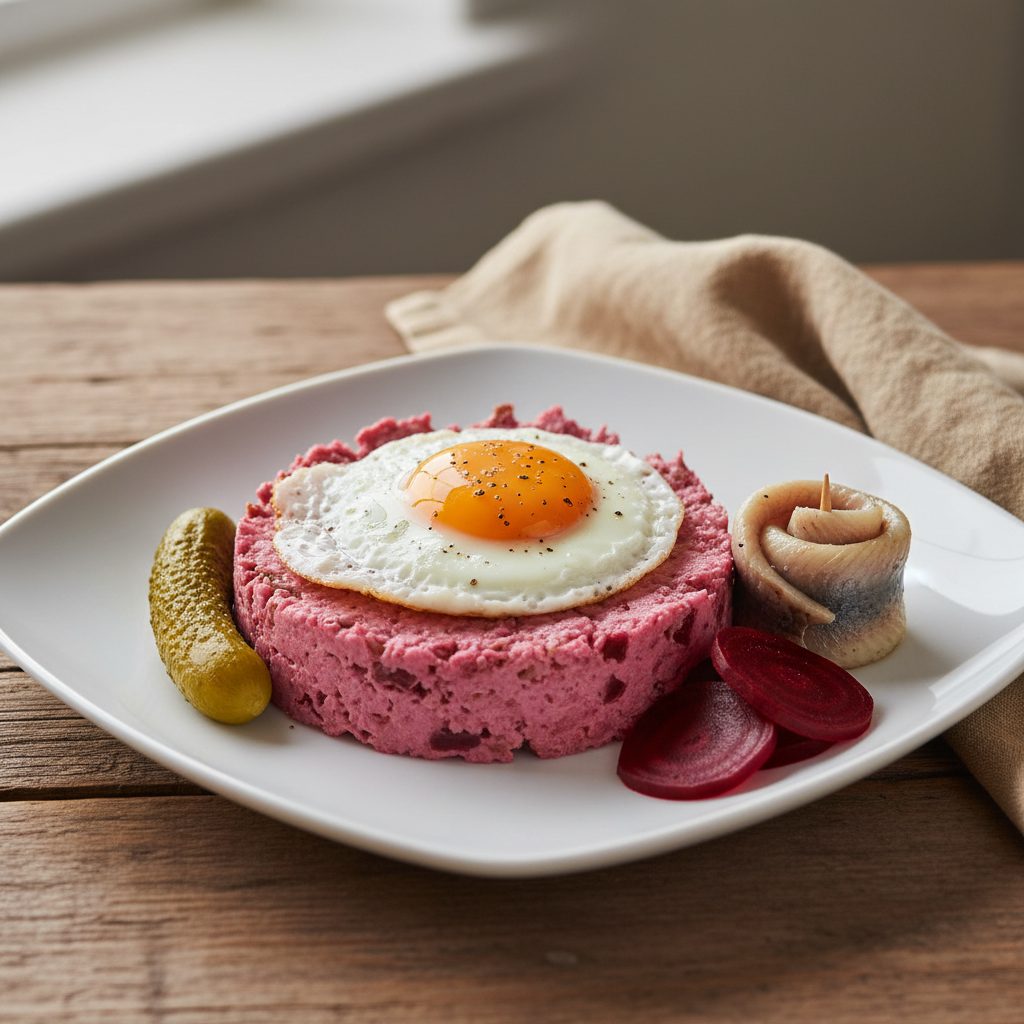
Pink. Thick. Rough in form, surprisingly subtle in taste. Corned beef, potatoes, onion, beetroot, egg, gherkin and herring. Each ingredient speaks a different language, but together they form a harbour Esperanto of hunger, survival and pleasure.
It is a strong dish, but not a crude one. Masculine, but not brutal. It can hit you with salt, hold you with the sweetness of beetroot, cut through the fat with a sour gherkin, and a moment later slip you a herring like a maritime provocation.
In a single bite Hamburg, Bremen, the Baltic, Scandinavia and Liverpool meet. German order grinds against sailors' chaos. The beef argues with the fish. The beetroot sets the tone, the egg eases the tension, and the potato does what Europe does best: it tries to hold everything together.
Labskaus was born of necessity. On the old sailing ships freshness was a luxury, and softness a salvation for sailors ravaged by scurvy. Meat was chopped, ship's biscuits were soaked, and the ingredients were combined into a nourishing mass. No garnish. No illusions. Food was meant to keep a man alive. Taste came later, as a reward for surviving.
The dish came down off the ships into the ports and travelled on. In Denmark it became a stew. In Norway it thickened with vegetables. In Liverpool it gave its name to the city's inhabitants and their accent. Few dishes can say: I fed people, I built an identity, and on top of that I started a brawl over herring.
Labskaus is not a dish of compromise. Some insist the fish may only lie alongside. Others mix it into the meat without a qualm. Purists speak of profanation. Its supporters answer with a fork.
It is worth trying. Not in order to be enchanted at first sight. In order to let taste win over prejudice.
Labskaus reminds us that the greatest pleasures are not always beautiful. Sometimes they are pink, salty, unsettling and full of history. You need the courage to take the first bite.
At sea, mixing fish and beef in one pot was once considered a culinary profanation and a waste of precious, separate rations.
## A good bowl or a dish for louts
Today labskaus is associated with Hamburg, but its roots go deeper into the maritime history of northern Europe. The first mentions date from around 1706, and linguists are still arguing about the name. The most likely theory is Baltic: Latvian "labs kauss" or Lithuanian "labas káušas", a good bowl, a hot pot. Baltic sailors may have carried the word round the ports of the Hanseatic League. The Low German theory links "Lappen", a flap of meat, with "Kaus", a bowl. The English have their own version. In 1706 Ned Ward wrote of "lobscouse", which has been read as food for rough people, or even as "lout's course", a dish for louts.
Three etymologies, three temperaments. The Balt praises the bowl, the German describes the contents, the Englishman judges the company. Every nation says more about itself than about the dish.
## Biscuits instead of potatoes
Many gourmets regard potatoes as the foundation of labskaus. Historically, that is a mistake. In the 16th and 17th centuries potatoes were not yet common in Europe, still less on ships. The ship's cook, the Smutje, built the dish on ship's biscuits, Schiffszwieback, soaked in water, beer or broth. Add to that corned beef, because without refrigeration meat had to be heavily salted to survive months at sea. Before use it was soaked to get rid of the excess salt, and chopped fine. Everything was fried in lard with plenty of onion, pepper and nutmeg.
The smooth texture was no whim. A diet without vitamin C led to scurvy; sailors suffered from bleeding gums and lost their teeth in droves. They could not chew tough, stringy meat and biscuits. The mash let toothless seamen take in nourishing calories. Softness as a form of mercy.
There is also a legend about a storm. The cook could not keep his pots steady on the heaving galley stove, so in desperation he threw all the leftovers into one cauldron, cooked them to pieces and beat them into a sticky mass. It turned out that the thick mash clung to bowls and spoons even in violent rolls and did not end up on the deck. An invention born of compulsion that outlived the fleet.
## The dark secret of the ship's galley
Labskaus also has a chapter nobody mentions at the table. Before the age of refrigeration, meat supplies on ships went off, rotted and filled with maggots. Serving the crew grey, stinking scraps risked mutiny. The cooks found a way out. They chopped the meat to a pulp and added masses of onion, beetroot vinegar and strong spices: nutmeg, pepper, allspice. The smell disappeared. The pinkish-red dye of the beetroot hid the grey or greenish colour. To this day a dark sailors' joke goes round that in labskaus you will find everything a sailor lost over the past week.
Another myth, however, has to be debunked. The old cooks did not put the ingredients through a mincer, because Karl Drais invented it only in the middle of the 19th century. In the golden age of sail, in the 17th and 18th centuries, tough corned meat was chopped by hand with a heavy cleaver on a rolling deck. Tedious and dangerous work. The mash we now call tradition once cost a good many calluses and more than one cut.
## A map of ports
From the sailing ships the recipe spread through the ports of the North Sea and the Baltic, and everywhere it took on a local face. The Hamburg version is intensely pink: corned beef, or cheaper tinned beef, potatoes and onion mashed with beetroot juice. A fried egg on top is compulsory, with a pickled gherkin and a marinated herring on the side. Bremen, 95 kilometres away, has its own variant and its own pride in the proportions and the fineness of the chop. Mecklenburg is the most ascetic: mashed potato and tinned beef, no beetroot and no fish, so the colour comes out brown.
Scandinavia went the way of stew. Danish skipperlabskovs gives up tinned meat in favour of fresh beef or pork, is rarely pink and resembles a thick potato stew with chunks of meat. Norwegian lapskaus and Swedish lapskojs are full of root vegetables, carrots and swede, and are closer to a filling one-pot winter soup than to a smooth purée.
Labskaus went furthest in Liverpool. Brought by sailors from the Continent as "lobscouse", later shortened to "scouse", it became such a common food of poor dockers that the city's inhabitants and their accent were named after it. Scousers. Few dishes can boast that someone speaks in their name.
## The herring war and five glasses
The most famous temple of labskaus is the Hamburg restaurant Old Commercial Room, opposite St. Michael's Church. On its walls hang photographs of hundreds of famous guests who dared to try it. Among those who ate there were members of The Beatles, Joe Cocker and Roberto Blanco. The actor Mario Adorf, suspicious of the dish's appearance, first asked for a microscopic portion in a small glass. That same evening he ate five full portions. Chancellor Helmut Schmidt, at his birthday parties on 23 December, ordered labskaus from there as the obligatory midnight snack for all his guests.
The greatest bone of contention remains the fish. Some coastal recipes call for matjes herring to be minced straight into the mass. Purists consider this a crime. Reinhard Rauch, owner of Old Commercial Room, which was named Hamburg's best labskaus in 2020, forbids adding fish to the mass. He maintains that the pink colour should come from the curing salt, and that a cook who at sea threw fish into the common pot with the meat would have been keelhauled by the crew. The fish, herring or rollmops, has the right to lie only alongside.
So labskaus is a dish with rules, even though it looks like the absence of them. Everything in one mass, and yet not everything may be mixed into it. At sea it was a matter of rations. On land something better remained: a reason to argue at the table that ends in a second helping.
📖 Glossary
- labskaus
- Marynarskie danie z północnej Europy z peklowanej wołowiny, ziemniaków, cebuli i buraka, w wersji hamburskiej różowe i gładkie, podawane z jajkiem, ogórkiem i śledziem.
- Smutje
- Okrętowy kucharz, który budował dawny labskaus na rozmoczonych sucharach i peklowanej wołowinie.
- Schiffszwieback
- Suchary okrętowe rozmaczane w wodzie, piwie albo bulionie, które przed upowszechnieniem ziemniaków stanowiły podstawę labskausu.
- scouse
- Skrócona forma liverpoolskiego „lobscouse”, jedzenia ubogich dokerów, od którego nazwano mieszkańców Liverpoolu i ich akcent.
- skipperlabskovs
- Duńska odmiana labskausu ze świeżej wołowiny albo wieprzowiny, przypominająca gęsty gulasz ziemniaczany z kawałkami mięsa.
Frequently Asked Questions
What is labskaus and what is it made of?
Labskaus is a sailors' dish from northern Europe, today associated with Hamburg. The Hamburg version is a pink mass of corned or tinned beef, potatoes and onion mashed with beetroot juice. It is served with a fried egg, a pickled gherkin and a marinated herring on the side.
Where does the name labskaus come from?
Linguists still argue about it. The most likely theory is Baltic: Latvian „labs kauss” or Lithuanian „labas káušas”, meaning a good bowl. The Low German theory links „Lappen”, a flap of meat, with „Kaus”, a bowl, while the English one ties „lobscouse” to a dish for louts.
Why does labskaus have a mushy texture?
A diet without vitamin C led to scurvy on ships, and sailors lost their teeth in droves, so they could not chew tough meat and biscuits. The mash let them take in nourishing calories. Legend also says the thick mass clung to bowls in stormy rolls, and chopping with onion and beetroot helped hide the smell and colour of spoiling meat.
Does labskaus contain herring?
This is the greatest bone of contention. Some coastal recipes call for matjes to be minced straight into the mass, while purists consider it a crime. Reinhard Rauch of Hamburg's Old Commercial Room forbids adding fish to the mass and insists that herring or rollmops may lie only alongside.
What does labskaus have to do with Liverpool?
Sailors from the Continent brought the dish to Liverpool as „lobscouse”, later shortened to „scouse”. It became such a common food of poor dockers that the city's inhabitants and their accent were named after it. They are the Scousers.
How does Hamburg labskaus differ from the Scandinavian version?
Hamburg labskaus is intensely pink and smooth, with beetroot, a fried egg, gherkin and herring. Danish skipperlabskovs uses fresh beef or pork, is rarely pink and resembles a thick potato stew. Norwegian lapskaus and Swedish lapskojs are full of root vegetables and closer to a filling one-pot soup.
Related Questions
- What is labskaus and what is it made of?
- Where does the name labskaus come from?
- Why does labskaus have a mushy texture?
- Does labskaus contain herring?
- What does labskaus have to do with Liverpool?
- How does Hamburg labskaus differ from the Scandinavian version?
🧠 Thematic Groups
- Historia i etymologia: pierwsze wzmianki o labskausie pochodzą z około 1706 roku, a nazwę wywodzi się z bałtyckiej dobrej miski, dolnoniemieckiego płata mięsa albo angielskiego dania dla prostaków.
- Technika i konieczność: na żaglowcach danie robiono z sucharów i ręcznie siekanej peklowanej wołowiny, a papkowata konsystencja ratowała bezzębnych od szkorbutu marynarzy.
- Geografia: wersja hamburska jest różowa, bremeńska dumna z proporcji, meklemburska brunatna, skandynawska przypomina gulasz, a w Liverpoolu danie dało nazwę Scousers.
- Kultura i spór: hamburska Old Commercial Room gościła The Beatles i Helmuta Schmidta, a jej właściciel zabrania mieszania śledzia z masą.
Tags:
labskaus
corned beef
beetroot
herring
matjes
ship biscuits
scurvy
Hamburg
Liverpool
scouse
lapskaus
skipperlabskovs
Old Commercial Room
German cuisine
sailor food
More in: Kuchnia niepolityczna
Content is created by Fundacja Dobre Państwo.
Edited and published by APA ONE, the Foundation's own AI-based editorial system.