Mapo Tofu. A journey to the place where taste becomes experience
🎧 Listen (Audio)
Audio versions are read by a synthetic voice.
Listen in the Dobre Państwo podcast (Spotify) RSS
There are dishes that satisfy hunger. And there are those that open the door to another culture, set memory, curiosity and all the senses going at once. Mapo Tofu is not a calm dish for a casual tasting. It is an encounter with Chengdu, the capital of Sichuan, where heat is not a culinary showpiece but the language of a story.
Mapo Tofu was born in 1862, in a small eatery near the Wanfu bridge. Madam Chen cooked meals for labourers and porters carrying rapeseed oil. The guests brought their own tofu, a little meat and oil, and the hostess turned these modest ingredients into a dish that was warming, nourishing and surprisingly refined. Madam Chen's face bore the marks of smallpox, which is why she was called "Mapo", the pockmarked granny. A nickname that might have remained a local anecdote became the name of one of China's most recognisable dishes.
Authentic Mapo Tofu leads the diner through eight classic experiences. Má means the numbing tingle of Sichuan pepper. Là is the deep heat of chili and fermented doubanjiang paste. Tàng reminds us that the dish must be served almost boiling. Xiān brings freshness and umami, nèn the silky delicacy of the tofu, and xiāng the aroma of garlic, ginger and spring onion. Sū describes the crispness of hard-fried meat, while huó stands for the freshness of the green garnish that brings the red sauce to life.
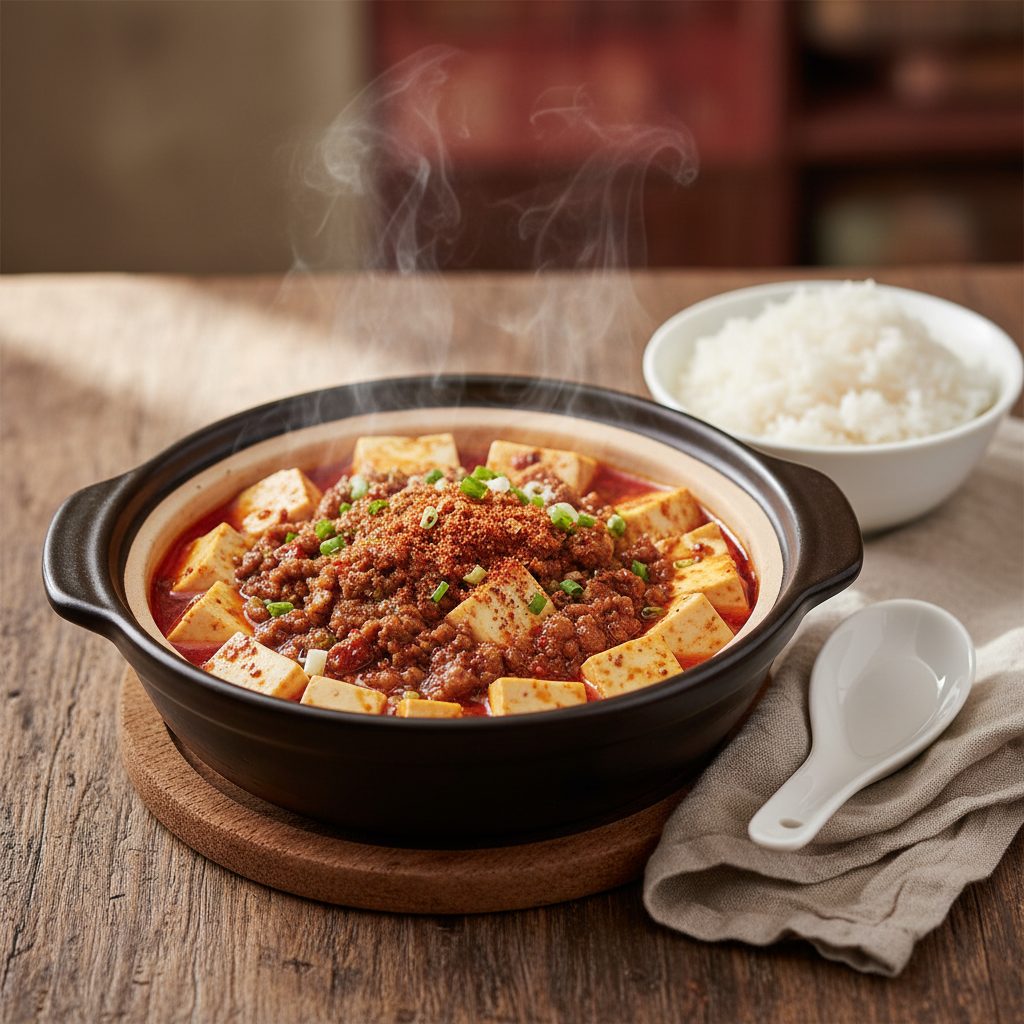
It is a dish built on contrasts. Soft tofu meets crisp meat. A fiery sauce wraps an ingredient that is mild and almost neutral. Heat mingles with the citrus aroma of Sichuan pepper, and the intensity is calmed by a bowl of white rice. Mapo Tofu is best eaten with a spoon, scooping up tofu, meat and sauce all at once. Chopsticks would be too brutal a tool here — the delicate cubes could fall apart before they reached the mouth.
In Sichuan Mapo Tofu remains uncompromising: hot, numbing and steaming. In southern China it tends to be sweeter and milder. In Japan it turned into the popular Mabo Dofu, made with miso, a thicker sauce and far less Sichuan pepper. In Western versions beef is often replaced with pork, and in plant-based versions with finely chopped mushrooms, which keep the necessary crispness and umami.
The dish's history includes disputes over authenticity, attempts at official standardisation of the recipe, and even a years-long ban on importing Sichuan pepper into the United States. For decades the spice was culinary contraband there. Paradoxically, bans and travels helped Mapo Tofu become a global dish.
The tingle remains extraordinary. Sichuan pepper is neither pepper nor chili. The hydroxy-alpha-sanshool it contains stimulates the tongue's touch receptors, producing a subtle, almost electric vibration. Taste thus stops being merely taste. It becomes touch.
Mapo Tofu is a reminder that great experiences are not always born of luxury. Sometimes tofu, fire, patience and someone able to combine simplicity with courage are enough.
## The granny from beneath the Wanfu bridge
The year 1862 is the time of the Qing dynasty and the reign of the Tongzhi Emperor. The Wanfu bridge lay on the northern outskirts of Chengdu and was a busy crossing for people to whom nobody ever raised monuments. This was the route of the porters carrying rapeseed oil from nearby Xinfan into the city. To save money, they brought their own ingredients to the eatery: fresh tofu, a little chopped beef and oil. They asked for something quick, filling and hot.
The eatery was called Chen Xingsheng and belonged to Chen Chunfu. The cooking was done by his wife, in some sources named Chen Liu. She combined silky tofu with crisp fried beef, fermented broad bean and chili paste from Pixian, fermented black beans, chili oil and a great deal of ground Sichuan pepper. Word spread through the city faster than oil down a porter's back. In time the place was officially renamed Chen Mapo Tofu, and it still operates in Chengdu today, with a Bib Gourmand in the Michelin guide.
There is a beautiful injustice in this story. A woman whose name we cannot be sure of went down in history thanks to her scars. China remembered her by her nickname, the world by her plate. Cooking has often proved fairer than the chronicles, because it records not titles but works.
## The eight marks of perfection
Sichuan tradition measures Mapo Tofu by eight marks, and each has its reason. Tàng, heat, is not only a matter of serving temperature. The layer of chili oil on top works as an insulator and keeps the tofu hot to the last bite. Nèn, delicacy, means the consistency of a custard or a pudding, but not a mush. Sū requires the beef to be dry-fried until crisp and crumbly, because only then does the contrast with the silky tofu make sense. Huó, liveliness, is green garlic stalks or spring onion thrown in at the very end so that they keep their colour and crunch.
The ceremony of the table is just as precise. Mapo Tofu is served in hot stone or clay bowls that hold the heat for a long time. It is eaten with a spoon, because chopsticks destroy the tofu, while a spoon lets you scoop the right proportion of tofu, meat and red sauce in one go. A bowl of steamed white jasmine rice is compulsory, acting as a buffer against the heat and the saltiness. To drink, cold beer or green tea. They put out the fire, but do not call it off.
## From Chengdu to Tokyo
In its homeland the dish keeps an extreme level of málà, numbness and heat. The beef is often fried in beef tallow for a deeper flavour, and the paste must come from Pixian. In the Cantonese regions and in southern China everything mellows. Sichuan pepper almost disappears, the sauce thickens and sweetens with sugar and sweet soy sauce, and the beef is replaced with minced pork.
The most interesting transformation took place in Japan. The dish was popularised there by Chen Kenmin, regarded as the father of Japanese-Chinese Sichuan cooking and father of Chen Kenichi, the legendary "Iron Chef". In the mid-20th century the Japanese could not stand the hot, numbing taste, so Chen Kenmin replaced doubanjiang with mild miso, Hatcho for example, and sweet tianmianjiang paste, added chicken stock, removed the Sichuan pepper and thickened the sauce with potato starch. The result was Mabo Dofu, sweet, mildly spicy and gentle, a favourite quick home meal. The pockmarked granny got a Japanese passport and a new personality. In the West the meat is often pork, and vegetarian and vegan versions reach for finely chopped mushrooms, shiitake for instance, which imitate the crispness of sū well and supply umami.
## Forty years of contraband
In 1968 the US Department of Agriculture banned the import of Sichuan pepper. The concern was citrus canker bacteria, which could decimate American orchards, because Sichuan pepper belongs botanically to the same family as lemons and oranges. The upshot was that for almost forty years authentic Mapo Tofu could not be legally cooked in America. Chinatown cooks brought the pepper in their luggage and sold it under the counter. Merchants recalled that in the 1990s in New York and San Francisco people asked in a whisper for "the real stuff".
The ban was lifted in 2005, on condition that the pepper be heated to 60°C. The orthodox claim that it lost some of its aroma and numbing power as a result. Either way, the contraband had done its job. Nothing advertises a spice like a ban.
## Disputes over the standard and the name
In Chengdu itself a public debate erupted when a culinary association tried to introduce official standards for classic Sichuan dishes, Mapo Tofu among them. The standard specified, among other things, the size of the tofu cubes, the proportion of beef and the origin of the doubanjiang, from Pixian only. Critics replied that officials were destroying creativity and commercialising a folk tradition. The internet added a joke modelled on the French champagne rules: true Mapo Tofu must come from the land of pockmarked grannies, everything else is merely sparkling bean curd lumps. Anyone who has tried to codify taste knows that this parody is closer to the truth than the authors of the standards would like.
In 2024 the dispute moved to America. David Chang and his Momofuku brand sent letters to smaller companies, mostly from the Asian-American community, demanding that they stop using the name "Chili Crunch", the crunchy chili oil without which modern versions of Mapo Tofu are hard to imagine. Criticism and boycotts rained down. In April 2024 Chang apologised and withdrew from enforcing the trademark. Chili oil turned out to be a common good before anyone managed to register it.
Chengdu came out of these disputes unscathed. Thanks in part to dishes like this one, UNESCO named it in 2011 the world's second City of Gastronomy.
## Fifty hertz
Finally, physics. Sichuan pepper is the dried husk of the fruit of a shrub from the rue family, and its numbing has nothing to do with the capsaicin of chili. Hydroxy-alpha-sanshool acts on the touch receptors of the tongue and, as research has shown, makes them vibrate at a frequency of about 50 hertz, fifty cycles per second. Hence the sensation of a mild electric shock, or of touching a battery with your tongue.
So we eat a dish that not only tastes but also vibrates. The labourers from beneath the Wanfu bridge did not know the word "receptor". They knew only that after a bowl from Madam Chen it was easier to carry oil into the city. Sometimes that is worth a whole theory.
📖 Glossary
- Mapo
- Przydomek pani Chen, twórczyni dania, znaczący ospowata babcia, od śladów po przebytej ospie na jej twarzy.
- doubanjiang
- Fermentowana pasta z bobu i chili, w klasycznym Mapo Tofu obowiązkowo z Pixian, źródło głębokiej ostrości là.
- málà
- Połączenie drętwienia pieprzu syczuańskiego i ostrości chili, które w Syczuanie Mapo Tofu utrzymuje na skrajnym poziomie.
- hydroxy-alpha-sanshool
- Związek z pieprzu syczuańskiego, który pobudza receptory dotykowe języka do drgań z częstotliwością około 50 herców.
- Mabo Dofu
- Japońska, łagodna wersja Mapo Tofu z miso, tianmianjiang i gęstszym sosem, prawie bez pieprzu syczuańskiego.
Frequently Asked Questions
Where does Mapo Tofu come from and what does the name mean?
Mapo Tofu was born in 1862 in the Chen Xingsheng eatery near the Wanfu bridge in Chengdu. Madam Chen cooked there for porters carrying rapeseed oil, who brought their own tofu, meat and oil. Her face bore the marks of smallpox, so she was called Mapo, the pockmarked granny, and the nickname gave the dish its name.
What are the eight marks of perfection of Mapo Tofu?
Má is the numbing of Sichuan pepper, là the heat of chili and doubanjiang, tàng the scalding temperature, xiān freshness and umami, nèn the silky delicacy of the tofu, xiāng the aroma of garlic, ginger and spring onion. Sū stands for the crispness of the fried meat, and huó for the freshness of the green garnish added at the end.
Why is Mapo Tofu eaten with a spoon?
Chopsticks destroy the delicate cubes of tofu, which could fall apart before reaching the mouth. A spoon lets you scoop up the right proportion of tofu, meat and red sauce at once. A bowl of white jasmine rice is compulsory as a buffer against the heat.
What is the difference between Japanese Mabo Dofu and Sichuan Mapo Tofu?
Mabo Dofu was popularised in Japan by Chen Kenmin, because in the mid-20th century the Japanese could not stand numbing heat. He replaced doubanjiang with mild miso and sweet tianmianjiang paste, added chicken stock, removed the Sichuan pepper and thickened the sauce with potato starch. The result was a sweet, mildly spicy dish.
Why was Sichuan pepper banned in the USA?
In 1968 the US Department of Agriculture banned its import for fear of citrus canker bacteria, because Sichuan pepper belongs botanically to the same family as lemons and oranges. For almost forty years it was contraband in Chinatowns. The ban was lifted in 2005 on condition that the pepper be heated to 60°C.
Why does Sichuan pepper numb the tongue?
The numbing has nothing to do with the capsaicin in chili. The hydroxy-alpha-sanshool in the pepper acts on the touch receptors of the tongue and makes them vibrate at about 50 hertz. Hence the sensation of a mild electric shock or of touching a battery with your tongue.
Related Questions
- Where does Mapo Tofu come from and what does the name mean?
- What are the eight marks of perfection of Mapo Tofu?
- Why is Mapo Tofu eaten with a spoon?
- What is the difference between Japanese Mabo Dofu and Sichuan Mapo Tofu?
- Why was Sichuan pepper banned in the USA?
- Why does Sichuan pepper numb the tongue?
🧠 Thematic Groups
- Historia: w 1862 roku pani Chen zamieniała skromne składniki tragarzy oleju w rozgrzewające danie, a jadłodajnia Chen Mapo Tofu działa w Chengdu do dziś.
- Technika i stół: osiem znaków doskonałości, wołowina podsmażona na sucho do chrupkości, zielone łodygi czosnku na końcu, gorąca gliniana misa, łyżka i biały ryż.
- Warianty: bezkompromisowe málà w Syczuanie, słodsze wersje kantońskie z wieprzowiną, japońskie Mabo Dofu Chena Kenmina i zachodnie wersje z grzybami shiitake.
- Spory i nauka: czterdzieści lat amerykańskiego zakazu pieprzu syczuańskiego, debata o normach w Chengdu, spór o nazwę Chili Crunch i drgania receptorów z częstotliwością 50 herców.
Tags:
Mapo Tofu
tofu
Sichuan pepper
doubanjiang
chili oil
málà
Sichuan cuisine
Chinese cuisine
Chengdu
Wanfu bridge
Madam Chen
Mabo Dofu
Chen Kenmin
hydroxy-alpha-sanshool
Pixian
More in: Kuchnia niepolityczna
Content is created by Fundacja Dobre Państwo.
Edited and published by APA ONE, the Foundation's own AI-based editorial system.