Calf brain. A delicacy between the table, history and ritual
🎧 Listen (Audio)
Audio versions are read by a synthetic voice.
Listen in the Dobre Państwo podcast (Spotify) RSS
Calf brain belongs to those dishes that leave no one indifferent. Some are enchanted by its velvety texture and subtle flavour; others are intimidated by its anatomical literalness. It is precisely this ambivalence that has made it one of the most fascinating products of European cooking: a delicacy of aristocrats, a bourgeois dish, the food of thrifty households and the subject of rigorous religious rules.
In France, brain is part of the famous tête de veau, calf's head. The dish is traditionally served on 21 January, the anniversary of Louis XVI's appointment with the guillotine. The republican banquet turned food into political allegory. The head on the platter was meant to recall the head of the monarch. Over time the revolutionary demonstration mellowed, and veal was promoted into the repertoire of classical cuisine. Its particular admirer was Jacques Chirac, who ordered tête de veau on his travels around France, making it almost the culinary coat of arms of his presidency.
The brain must be soaked for a long time in acidulated water, carefully cleaned of membranes and vessels, and then gently cooked in an aromatic stock with vinegar or lemon. The acid sets the protein and protects the fragile structure from falling apart. Then comes the time for frying, a crisp breadcrumb coating, capers, gribiche or ravigote sauce. Richness demands a counterpoint, and creaminess wants a crunch.
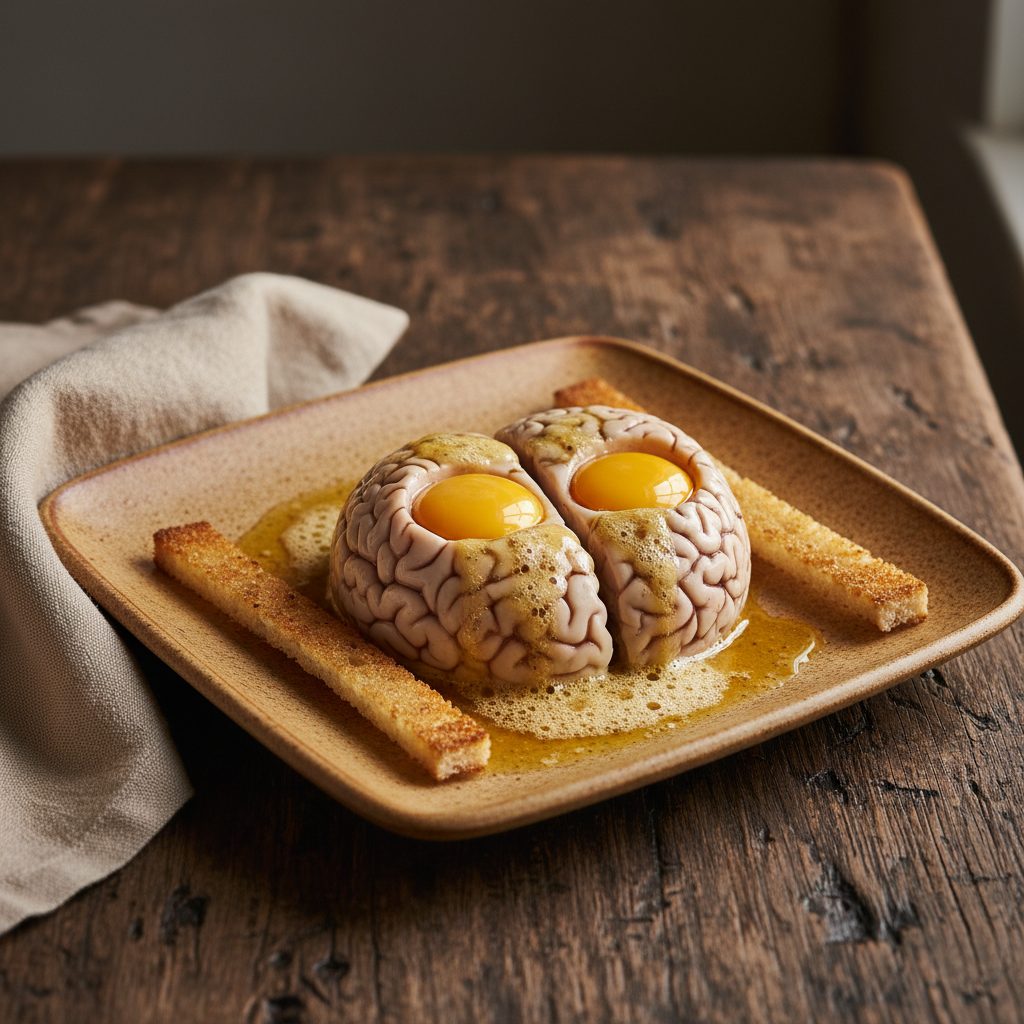
In old Poland, brain was considered a delicacy. Norkowska recommended baking it with onion and eggs, while Pani Elżbieta served it with raw egg yolks, toast and deeply browned butter. Under communism the dish lost some of its drawing-room splendour but gained everyday popularity. Pork or calf brain was fried with onion and served on bread as the more refined cousin of scrambled eggs.
The Jewish tradition tells a different story. Because of the prohibition on consuming blood, brain requires especially thorough cleaning, cutting of the membranes, salting and sometimes roasting over an open flame. Flavour must yield precedence to ritual purity.
Today brain returns under the banner of nose-to-tail, the idea that the whole animal should be used, not only its most presentable parts. It is rich in DHA, B vitamins, zinc and phosphorus. It remains something more than a product. It is an edible document of culture, where revolution, religion, thrift, luxury and culinary daring meet. On the plate, the history of Europe tempts you, seasoned with butter, vinegar and a touch of mischief.
Calf brain is a testament to culinary craft, in which anatomy meets the sacred, and politics meets the intimacy of the table.
## A head on a platter
The January custom has its originator. In 1794 citizen Romeau proposed republican banquets as an alternative to religious holidays, on the anniversary of the execution of Louis XVI in 1793. At first a pig's head was served, a metaphor so literal as to be downright rude. In the 19th century, under the influence of the English Calves' Head Club, pork was replaced by veal. There are two interpretations. One sees in the change a nostalgia for the lost youthful innocence of the nation under tyranny. The other, more prosaic, recalls that in the 19th century veal was promoted to the rank of an upper-class meat. The revolution began with a pig and ended with a delicacy. Revolutions usually end that way.
Jacques Chirac made the dish his emblem. For him tête de veau belonged to the family of plat canaille, "roguish" dishes, rough and yet refined, and it built the image of a politician close to the people. He celebrated it at the Parisian restaurant Le Père Claude and at the Lyon bouchon Café des Fédérations. The president of the republic ordering a head on a platter is an image France needs no commentators for. It writes its own punchlines.
## Three French verbs
The French school reduces the preparation of brain to three actions. Dégorger is soaking for many hours in cold water, often with ice, to remove blood and impurities. Éplucher is the painstaking manual removal of membranes and vessels under running water, until the tissue becomes immaculately white. Pocher is gentle poaching in an aromatic court-bouillon with vinegar, or in a so-called blanc, a stock with flour, lemon juice or vinegar and salt. The acid sets the protein and keeps the structure in check, so that nothing falls apart during the later frying.
Then the rule of thermal shock applies. Brain is served either very hot, straight from the pan, or cold, set in aspic as part of tête de veau. There is nothing interesting in between. Add contrast: crisp toast and the sour counterattack of lemon, capers, gribiche sauce made with yolks and capers, or ravigote. Velvet needs a setting; otherwise it is simply soft.
## Polish-style: butter and yolk
The Polish school went in the direction of butter and egg yolks. In 1903 Marta Norkowska advised frying onion in butter and baking the whole thing in the oven until the eggs set. In 1931 Pani Elżbieta laid the brain whole on a plate, placed raw yolks in hollows and poured deeply browned butter over everything. Calf brain was regarded as an accessible luxury, a festive alternative to the cheaper and more common pork brain.
The communist era moved it from the festive table to the breakfast table. With meat in short supply, brain fried with onion on a slice of bread stood in for scrambled eggs. It was their cousin who had gone to better schools but did not put on airs.
## Blood and law
Kashrut forbids blood without exception, because blood is held to be the carrier of the animal's soul. Halakha distinguishes three kinds: dam hanefesh, gushing at the moment of slaughter; dam hatamtzit, seeping slowly after slaughter; and dam haevarim, trapped in tissues and vessels. Brain, heavily supplied with blood and wrapped in membranes, poses an extreme challenge to these rules. The Shulchan Aruch and Maimonides' Mishneh Torah describe the procedure. The brain is removed from the skull before salting, because the bone blocks the blood from draining. The membranes are cut or removed. The brain itself is salted generously, and since salting may not suffice, Orthodox tradition recommends roasting over an open flame, which draws out blood most effectively.
Here creamy texture loses to ritual purity. There is a kind of honesty in this that many cuisines lack: it is clear from the start what matters more than flavour.
## After BSE
The BSE epidemic, mad cow disease, changed the market. Regulations restricted or banned the sale of brains and spinal columns of cattle above a certain age, usually 12 months, and practically eliminated beef brain. That is why calf brain dominates the trade today. Today's consumers, moreover, want meat without anatomical features, so offal has slipped into the realm of taboo. The nose-to-tail movement is trying to pull it back out, replacing old ritual fears with a new moral argument. If the animal gave its life, it is only proper to eat all of it.
## Recipe
Polish-style brain after Pani Elżbieta (1931), with the raw material prepared the French way.
**Ingredients:**
- calf brain
- cold water for soaking
- salt
- a few tablespoons of vinegar
- fresh raw egg yolks
- butter
- thin, crisp slices of toast
**Method:**
1. Soak the brain for several hours in cold water to rid it of blood.
2. Carefully clean it of membranes and vessels under running water.
3. Cook it in well-salted water with a few tablespoons of vinegar.
4. Lay the brain whole on a plate and, with the back of a spoon, press small hollows into it.
5. Place the raw egg yolks in the hollows.
6. Pour deeply browned butter over everything.
7. Put a thin, crisp slice of toast on each side of the brain and serve hot at once.
📖 Glossary
- tête de veau
- Francuska cielęca głowizna, której częścią jest móżdżek, tradycyjnie podawana 21 stycznia w rocznicę zgilotynowania Ludwika XVI.
- court-bouillon
- Aromatyczny wywar z octem, w którym delikatnie gotuje się oczyszczony móżdżek, żeby kwas ściął białko.
- plat canaille
- Francuska kategoria potraw „łobuzerskich”, surowych, a jednak wykwintnych, do której należy tête de veau.
- dam haevarim
- W halasze krew uwięziona w tkankach i naczyniach, obok dam hanefesh tryskającej przy uboju i dam hatamtzit wyciekającej po nim.
- nose-to-tail
- Idea wykorzystywania całego zwierzęcia, a nie tylko jego najbardziej reprezentacyjnych części, pod której sztandarem wraca móżdżek.
Frequently Asked Questions
How to prepare calf brain for cooking?
The French school reduces it to three steps. Dégorger means soaking for hours in cold water, often with ice; éplucher means removing the membranes and vessels under running water; pocher means gently poaching in a court-bouillon with vinegar or in a blanc with flour and lemon. The acid sets the protein and keeps the fragile structure from falling apart.
Why do the French eat calf's head on 21 January?
In 1794 citizen Romeau proposed republican banquets on the anniversary of Louis XVI's execution as an alternative to religious holidays. The head on the platter was meant to recall the monarch's head. At first a pig's head was served; in the 19th century, under the influence of the English Calves' Head Club, veal replaced it.
How was calf brain served in old Polish cooking?
In 1903 Marta Norkowska advised baking it with onion fried in butter and eggs. In 1931 Pani Elżbieta laid the brain whole on a plate, set raw egg yolks into hollows and poured deeply browned butter over it. Under communism, brain fried with onion on bread stood in for scrambled eggs.
Is brain kosher?
Kashrut forbids consuming blood, and the heavily blood-filled brain poses an extreme challenge to that rule. It is removed from the skull before salting, the membranes are cut or removed, it is salted generously, and Orthodox tradition also recommends roasting it over an open flame. Ritual purity takes precedence over creamy texture.
Why can't you buy beef brain?
After the BSE epidemic, regulations restricted or banned the sale of brains and spinal columns from cattle above a certain age, usually 12 months. This practically eliminated beef brain, which is why calf brain dominates the market today.
What to serve with calf brain?
Brain is served either very hot or cold, set in aspic. Its velvety texture needs contrast: crisp toast, the sour note of lemon, capers, gribiche or ravigote sauce. Polish-style, it comes with raw egg yolks and browned butter.
Related Questions
- How to prepare calf brain for cooking?
- Why do the French eat calf's head on 21 January?
- How was calf brain served in old Polish cooking?
- Is brain kosher?
- Why can't you buy beef brain?
- What to serve with calf brain?
🧠 Thematic Groups
- Historia i polityka: republikański bankiet z tête de veau w rocznicę egzekucji Ludwika XVI zaczął się od świńskiego łba, a skończył na cielęcinie, która w XIX wieku awansowała do rangi delikatesu.
- Technika: francuska szkoła przygotowania móżdżku to dégorger, éplucher i pocher, a potem szok termiczny i kontrast chrupiących grzanek, kaparów oraz sosu gribiche lub ravigote.
- Kuchnia polska: Norkowska zapiekała móżdżek z cebulą i jajkami, Pani Elżbieta podawała go z surowymi żółtkami i zrumienionym masłem, a PRL zrobił z niego śniadaniowego kuzyna jajecznicy.
- Religia i rynek: kaszrut wymaga usunięcia krwi przez solenie i opiekanie nad ogniem, a po BSE móżdżek wołowy zniknął z obrotu, zaś ruch nose-to-tail próbuje przywrócić podroby na stół.
Tags:
calf brain
tête de veau
offal
browned butter
raw egg yolks
court-bouillon
gribiche sauce
Polish cuisine
French cuisine
kashrut
Louis XVI
Pani Elżbieta
Marta Norkowska
nose-to-tail
BSE
More in: Kuchnia niepolityczna
Content is created by Fundacja Dobre Państwo.
Edited and published by APA ONE, the Foundation's own AI-based editorial system.