Mutton curry. The goat that keeps the memory of a civilisation
🎧 Listen (Audio)
Audio versions are read by a synthetic voice.
Listen in the Dobre Państwo podcast (Spotify) RSS
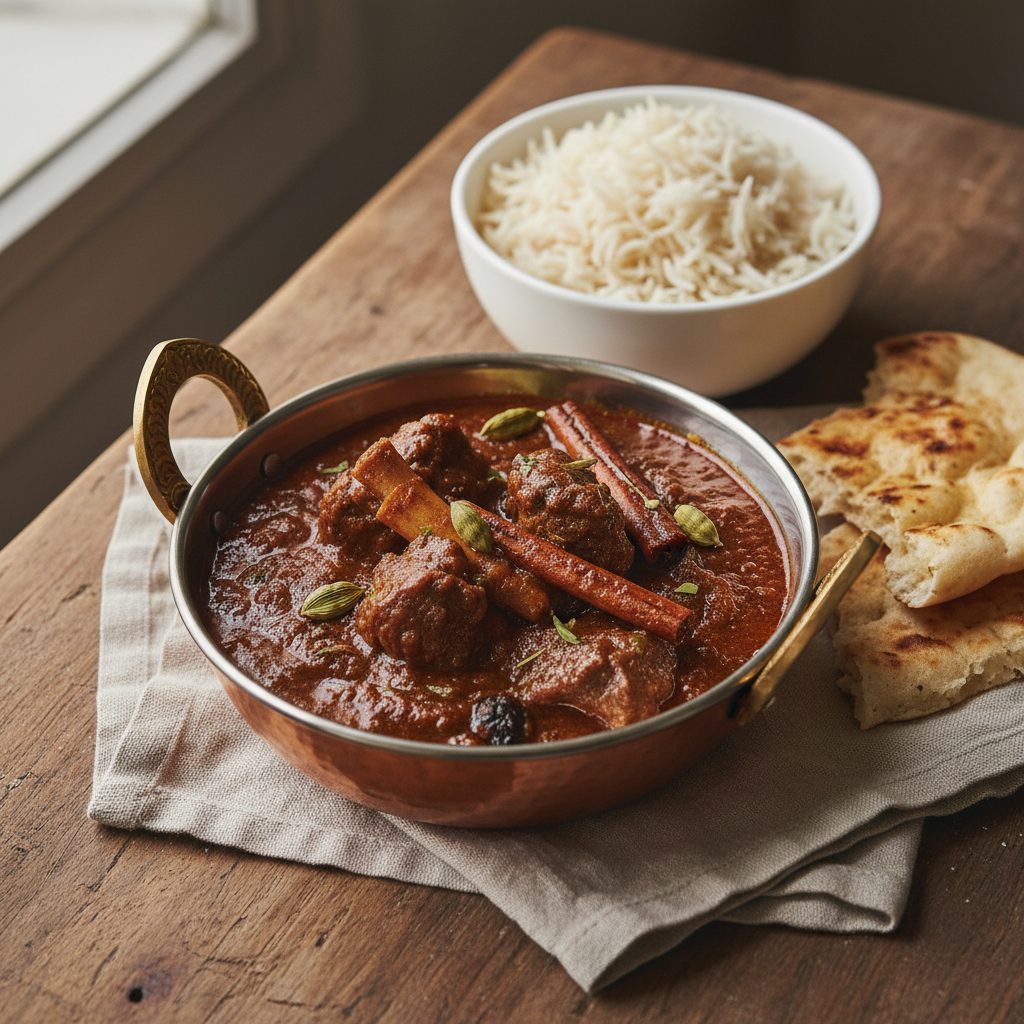
Mutton curry smells of smoke, cardamom, cinnamon, ginger and hot mustard oil. First it hits the nose. Then it stings the eyes. It settles on the tongue as a heavy, spicy, slightly fatty sauce that does not ask permission. It takes you by the hand and leads you on.
In India the word mutton does not mean mutton, but goat. The British brought the name, but it was Indians who gave it taste, ritual and soul. Goat was eaten here long before colonial uniforms, dining cars and the porcelain of empire. Medieval Bengali texts already mention it. The history of this meat does not begin in an English dictionary. It begins by the fire.
In Bengal kosha mangsho reigns: a dark, thick, almost velvety curry, fried for a long time until onion, spices and meat merge into a sauce the colour of burnt amber. In Bihar Champaran mutton matures in a clay pot sealed tight with dough. Inside, whole heads of garlic, meat on the bone and raw mustard oil braise together. The pot stays silent. The aroma makes the whole speech for it.
Kashmir shows that even a single curry can have two religious hearts. Muslims use onion and garlic. Hindu Pandits give them up, reaching for asafoetida and dried ginger. The same landscape, similar meat, a different spiritual geometry of flavour.
Railway Mutton Curry is a dish created in colonial times for British passengers, whom Indian heat evidently overwhelmed more than the political ambitions of empire did. The cooks softened the sauce with yoghurt or coconut milk. So was born a culinary compromise between the English palate and the Indian chilli.
In Durban, meanwhile, the descendants of Indian labourers created bunny chow, a fiery curry shut inside a hollowed-out loaf of white bread. The potatoes there are called gravy soakers. They soak it up completely, soften, fall apart and give up all their flavour at the first press of the tongue.
Mutton curry can explode politically. A video in which politicians were preparing Champaran mutton set off a storm over religion, fasting and the right to eat meat. Cases of beef being sold as more expensive goat led to restaurant closures, arrests and social tension. It is not only spices that simmer in the pot. Faith, identity, class, memory and politics simmer there too.
Curry demands goat on the bone, a yoghurt marinade, patience and fire. It does not recognise haste. The meat has to be fried, braised, splashed with liquid and waited on until the fibres soften, the marrow enriches the sauce and the kitchen fills with a smell so intense that the neighbours begin to believe in providence.
It is best eaten with the right hand. The fingers mix rice with curry, test the temperature, feel the tenderness of the meat and the stickiness of the sauce. In India a meal does not end with taste. It is touch, smell, ritual and community.
Mutton curry reminds me why I love Indian culture. Nothing here is only food. A goat becomes a story of migration. A spice is a mark of identity. A pot is an archive of civilisation.
The traveller licks his fingers and asks for seconds.
## Dictionary versus pasture
In the West, mutton is the meat of an older sheep. On the Indian subcontinent and in parts of the Caribbean it means goat by default. The confusion is not accidental but statistical. Goat was and remains one of the most widely eaten meats in India, because most religious communities accept it, unlike beef and pork. When, under the British Raj, English words began to seep into slaughterhouses and kitchens, the term "mutton" stuck to the most popular red meat. The empire brought the label. The pasture decided what to stick it on.
Goat, however, was in India long before the label. Medieval Bengali literature, the poems known as Mangalkavyas, such as the Manasamangal, Chandimangal and Dharmamangal, describes many ways of cooking and eating goat meat. Colonialism did not invent this dish. It merely gave it a foreign name, as it did with mountains, rivers and people.
## A map of a single pot
Bengal has kosha mangsho, thick and dark, with little liquid, because the sauce reduces through long frying, called precisely kosha. It is made with mustard oil and served at the festival of Kali Puja. Bengal also has its own watchword, robibarer mangsho, Sunday meat. It is the ritual of cooking mutton curry every Sunday: family warmth, slowness and a return to oneself after a week of work. Some nations have Sunday chicken soup. Bengal has Sunday goat.
In Bihar, in the district of Champaran, they make Champaran mutton, also called ahuna mutton. A clay handi pot is sealed tight with dough and baked slowly over coals, with whole heads of garlic and raw mustard oil. In Kashmir Muslims cook with plenty of onion and garlic, while the Pandits, mindful of ritual purity, reach for asafoetida, that is hing, and powdered dried ginger, saunth. Maharashtra has kala rassa, "black curry", which gets its colour and depth from heavily roasted desiccated coconut and poppy seeds.
The accompaniments change along with the map. Most often it is fluffy rice, basmati for example, or breads: naan, parotta, roti, chapati. In southern India curry is served with ragi mudde, nourishing balls of finger-millet flour. In Durban, with a loaf of white bread.
## Train, port and short stories
Railway Mutton Curry was born at the end of the 19th century in the dining cars of the Indian railways. British officers and aristocrats could not stand the burning heat, so the cooks softened the curry with yoghurt or coconut milk and gentler spices. The result is a dish that is a monument to the colonial era: adapted to the master, cooked by the servant, eaten today with nostalgia by both.
Durban tells a less comfortable story. Between 1860 and 1911 more than 150,000 Indian indentured labourers were brought there. From their cooking grew a fiery curry with potatoes, gravy soakers that absorb the spicy meat juices, and bunny chow, curry in a hollowed-out quarter loaf. Bread instead of a plate is the cooking of people who had no time for tableware.
The diaspora has its literature too. The Malaysian Tamil writer M. Shanmughalingam published a collection of short stories, "Marriage and Mutton Curry", a satirical and warm portrait of the Tamil community in Malaysia and Singapore. The title dish there is a sign of family tradition, of marital protocol and of the effort to keep one's identity in a changing world. Curry turns out to be easier to carry across the sea than custom.
## When a pot becomes a public matter
In 2023 opposition politicians recorded a video in which one teaches the other to cook Champaran mutton. The film went online during the holy month of Sawan, when many Hindus fast and abstain from animal products. A nationwide storm broke out, and the dispute quickly stopped being about the recipe. People talked about dietary freedom, religious feelings and the history of India. One dish was enough to start a quarrel about a whole country.
The second kind of scandal is more mundane. In India there have been cases of beef being served as more expensive goat, which, given strict laws on cow slaughter and religious prohibitions, ended in closed premises, arrests and tension. Similar frauds, beef sold as lamb or as mutton curry, came to light in Europe as well, for instance in Scotland after the horsemeat scandal of 2013.
English has an idiom for this phenomenon from a different shelf: mutton dressed as lamb, someone older pretending to be younger. Here the disguise is worse. Cheaper meat pretends to be dearer, and in India it touches the sacred as well.
## How to eat with the right hand
Tradition says mutton curry is eaten with the bare hand, the right one only. The curry is mixed with the rice using the fingertips, formed into small morsels and pushed into the mouth with the thumb. With breads, you tear off a piece of naan or parotta and make a little hood of it to scoop up the meat and sauce. The hand feels temperature, texture and thickness. In Indian culture this is considered part of the taste, not a lack of manners.
A European with a fork eats faster. An Indian with his hand eats more, because he also eats by touch.
## Recipe
**Ingredients:**
- goat on the bone, ideally shank and shoulder
- yoghurt (dahi)
- ginger-garlic paste
- turmeric
- salt
- onion
- tomatoes
- mustard oil or ghee
- green and black cardamom, cinnamon, cloves, bay leaves, cumin, ground coriander, hot red chilli
- fresh coriander
- to serve: basmati rice or naan, parotta, roti, chapati
**Method:**
1. Marinate the goat in yoghurt with ginger-garlic paste, turmeric and salt. The lactic acid will soften the tough fibres.
2. In mustard oil or ghee, fry the spices, onion, tomatoes and meat for a long time (the bhuna method, that is kosha).
3. Add minimal amounts of water gradually, so that the meat braises in its own juices.
4. Cook slowly until the meat is tender and the bones and marrow have thickened the sauce.
5. Serve hot with rice or breads and eat with your right hand.
📖 Glossary
- mutton
- Na Zachodzie mięso starszej owcy, a na Półwyspie Indyjskim i w części Karaibów domyślnie kozina.
- kosha
- Bengalska technika długiego smażenia, przez które sos curry redukuje się do gęstej, ciemnej masy. Odpowiada metodzie bhuna.
- robibarer mangsho
- Bengalskie niedzielne mięso, czyli rytuał gotowania mutton curry w każdą niedzielę.
- Champaran mutton
- Bihárskie curry, zwane też ahuna mutton, pieczone powoli na węglach w glinianym garnku handi zalepionym ciastem, z całymi główkami czosnku i surowym olejem musztardowym.
- gravy soakers
- Durbańska nazwa ziemniaków w curry, które chłoną pikantne soki mięsne.
- kala rassa
- Maharasztryjskie „czarne curry”, któremu kolor i głębię dają mocno uprażone wiórki kokosowe i mak.
Frequently Asked Questions
Is mutton in India sheep or goat?
In the West mutton is the meat of an older sheep, but on the Indian subcontinent and in parts of the Caribbean it means goat by default. Goat is one of the most widely eaten meats in India, because most religious communities accept it. Under the British Raj the English word stuck to the most popular red meat.
What is kosha mangsho?
Kosha mangsho is a Bengali mutton curry, dark, thick and almost velvety, with little liquid. The sauce reduces through long frying, called kosha, in mustard oil. It is served at the festival of Kali Puja and on Sundays, as robibarer mangsho.
How did Railway Mutton Curry come about?
Railway Mutton Curry was born at the end of the 19th century in the dining cars of the Indian railways. British officers and aristocrats could not stand the burning heat, so cooks softened the curry with yoghurt or coconut milk and gentler spices. It is a culinary compromise and a monument to the colonial era.
What is bunny chow?
Bunny chow is a fiery curry served in a hollowed-out quarter loaf of white bread. It was created in Durban by the descendants of Indian indentured labourers brought there between 1860 and 1911. The potatoes in the curry are called gravy soakers, because they absorb the sauce.
How to make mutton curry?
Goat on the bone is marinated in yoghurt with ginger-garlic paste, turmeric and salt. The spices, onion, tomatoes and meat are then fried for a long time in mustard oil or ghee, using the bhuna method, with minimal splashes of water. It cooks slowly until the meat is tender and the marrow thickens the sauce.
How to eat curry with your hand?
Tradition says mutton curry is eaten with the right hand only. The curry is mixed with rice using the fingertips, formed into small morsels and pushed into the mouth with the thumb, while a piece of naan is shaped into a little hood to scoop up sauce. The hand feels temperature and texture, which in Indian culture counts as part of the taste.
Related Questions
- Is mutton in India sheep or goat?
- What is kosha mangsho?
- How did Railway Mutton Curry come about?
- What is bunny chow?
- How to make mutton curry?
- How to eat curry with your hand?
🧠 Thematic Groups
- Język i historia: w Indiach mutton oznacza kozinę, którą opisywały już średniowieczne bengalskie poematy Mangalkavyas, a angielska nazwa przylgnęła do niej za brytyjskiego Raju.
- Regiony i technika: Bengal ma kosha mangsho, Bihar Champaran mutton z glinianego handi, Kaszmir wersje z cebulą i czosnkiem albo z asafoetidą, a Maharasztra kala rassa.
- Kolonializm i diaspora: Railway Mutton Curry złagodzono dla Brytyjczyków, w Durbanie powstało bunny chow, a M. Shanmughalingam opisał tamilską diasporę w „Marriage and Mutton Curry”.
- Polityka i rytuał: nagranie gotowania Champaran mutton w miesiącu Sawan wywołało burzę, oszustwa z wołowiną udającą kozinę kończyły się aresztowaniami, a curry je się prawą dłonią.
Tags:
mutton curry
goat meat
Indian cuisine
India
Bengal
kosha mangsho
Champaran mutton
Railway Mutton Curry
bunny chow
Durban
mustard oil
asafoetida
Kashmir
bhuna
eating with the right hand
More in: Kuchnia niepolityczna
Content is created by Fundacja Dobre Państwo.
Edited and published by APA ONE, the Foundation's own AI-based editorial system.