Napoleonka. A thousand layers of temptation
🎧 Listen (Audio)
Audio versions are read by a synthetic voice.
Listen in the Dobre Państwo podcast (Spotify) RSS
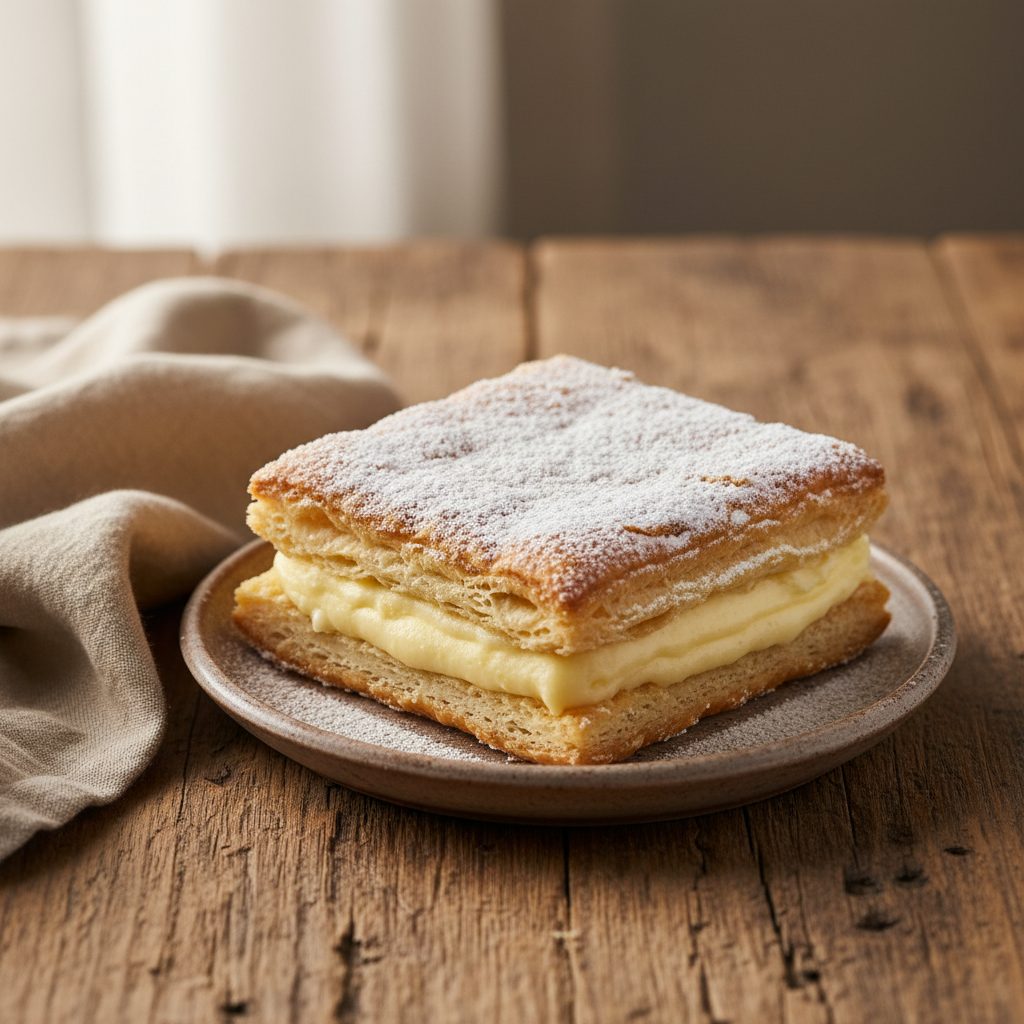
First you hear the crack. Thin, brittle, almost shameless. Then the pastry yields under the little fork, the cream escapes sideways, and the icing sugar stays on your lips like evidence of guilt. A napoleonka cannot be eaten elegantly. It is that perfect, and that lascivious.
The name does not behave decently. Most probably it does not come from Napoleon at all, but from the French napolitain — Neapolitan. Language twisted the word, imagination added the emperor, and a Warsaw patisserie called "Napoleonka" completed the legend. A mistake became a brand. A dessert became an urban myth.
Underneath hides the French mille-feuille: a thousand leaves, a thousand crevices for butter, air and promise. It is an architecture that must be demolished in order to know its interior. Layer by layer.
There is no single napoleonka. The Warsaw one likes to show off with icing and a light meringue cream. The kremówka of Lesser Poland hides beneath an innocent dusting of sugar. The Łódź version builds storeys: custard below, whipped cream above. Wrocław mixes up the names on top of that, as if the dessert itself would rather not reveal who it really is.
The dessert has accreted meanings. In France "administrative mille-feuille" means bureaucracy. Office upon office, regulation upon regulation, a layer of responsibility no one wants to bite into. In Poland the kremówka entered national memory thanks to Karol Wojtyła's recollection of his school-leaving exams in Wadowice. From a pastry it became a relic of everyday life, a memory of youth, a sacred thing served on a cardboard tray.
Then came a temptation greater than appetite: the temptation of profit. Margarine began to replace butter, craft gave way to production, flavour to marketing. The price of the legend remained, but its consistency went missing. A napoleonka without butter is like a myth without truth: still sweet, but suspiciously hollow.
The napoleonka remains a double dessert. It is flaky and heavy, simple and many-layered, of the people and of luxury. It crumbles, and yet it binds memories together. It dirties your fingers, yet keeps up appearances of elegance.
Do not ask whether it is a napoleonka or a kremówka. Ask what has been hidden between the sheets of pastry.
Butter or margarine? Craft or calculation? History or a cleverly sold legend?
The first bite gives pleasure. The second seduces you into suspicion.
Only the third reveals the secret.
In sociology, the term "cream-cake Catholicism" describes a superficial form of devotion, focused on outward attributes and sentimentality, as a shallowing of the Pope's intellectual legacy.
## Naples, a mistake and Napoleon Square
The pedigree is Neapolitan, French and Varsovian all at once. Mille-feuille, "a thousand leaves", is associated with Paris, but its roots are tied to Naples. On its way to Central Europe the French adjective napolitain lost a few letters and gained an emperor. That is how words travel: they pass through so many mouths that in the end they say what people wanted to hear.
Topography did the rest. In pre-war Warsaw, Feliks Gołaszewski opened the "Napoleonka" patisserie at Świętokrzyska 26, next to Napoleon Square, and he did so deliberately. The success was so great that further addresses followed: Nowy Świat 53 and Puławska 3. The patisserie became a landmark of the city. In a photograph from 1937 a delegation of Esperantists poses in front of Gołaszewski's shop. People building a common language for all of humanity stood before a sign born of a linguistic mistake. A neater punchline would be hard to find.
## An architecture to be demolished
For a pastry cook, the napoleonka is an exam. Puff pastry must be laminated, that is folded again and again with butter, and only this regime yields the leafy structure that separates craft from the conveyor belt. The real difference, however, lies inside.
Crème pâtissière is the traditional cooked cream of milk, sugar, flour and eggs or yolks alone, with vanilla, in its best version enriched with creamed butter. An egg-free custard mass based on milk pudding and butter is the simplified variant, cheaper and longer-lasting, beloved of mass production. There are also whipped cream and meringue cream made from beaten egg whites, lighter and fluffier. The top says the rest: icing sugar, a dollop of cream or glaze. The same pastry can play the salon or the milk bar, depending on what it has been dusted with.
All of this becomes visible only when you cut it. From the outside every napoleonka is a rectangle dusted in white. Inside, one has a cream cooked on yolks with butter, another a pudding pretending to be custard. The knife tells the truth faster than the price list, and the little fork faster than the shop sign.
## A map of disputes
In Warsaw, in central Poland and in Greater Poland people say "napoleonka", whatever the filling. In Lesser Poland, in Kraków and Wadowice, "kremówka" reigns, and the name "napoleon" is reserved for the version with pale pink meringue cream. Wrocław and Łódź reverse the meanings. In Wrocław the napoleonka has a cream filling and the kremówka a vanilla one; in Łódź it is the other way round. Łódź, incidentally, bakes a storeyed version, with custard below and whipped cream on top. Poland quarrels over a pastry the way it quarrels over borders: fiercely and map in hand.
Abroad the family is large and shares a surname: cremeschnitte. The Slovenian kremna rezina from Bled, from the local Hotel Park, has become a symbol of strict standardisation and has sold more than 10 million pieces. The Croatian kremšnita of Samobor adds meringue to the egg cream, and the Montenegrin krempita of Kotor has three layers of pastry and two of cream. Every town swears its version is the only one. All of them are right, until they taste someone else's.
## Mille-feuille administratif
The French turned the dessert into a metaphor for the state. "Mille-feuille administratif" is a pejorative term for the excess of tiers of territorial government: state, regions, departments, municipalities. Layer upon layer, each one costly, each with its own cream of competences, and underneath the citizen trying to bite through it all. The dessert, at least, can be eaten. With administration it is harder.
## A kremówka after the exams
In Poland the meaning of the pastry was changed by a single memory. In 1999 John Paul II recalled the kremówki eaten after his school-leaving exams at Karol Hagenhuber's patisserie in Wadowice. Anecdotes about bets in which young Karol Wojtyła was said to have eaten between 12 and 18 of them entered the canon of popular culture. Wadowice became a centre of religious and culinary tourism, and the "papal kremówka" a kind of edible relic.
Sociology responded with the notion of "cream-cake Catholicism": devotion focused on outward attributes and sentiment instead of thought. Economics arrived too. Demand grew faster than care for the raw materials, and there was ever louder talk of margarine in place of butter. Meanwhile Hagenhuber's son recalled that the original kremówki were based on a whole-egg cream combined with creamed butter. There was no alcohol in them. "Tipsy kremówki" are a later market innovation which the pre-war master's family excludes from the canon.
Wadowice repeated the path of Bled: commercial success built on a single pastry. The difference is that Bled sold a recipe, while Wadowice sold a memory. A recipe can be standardised. A memory cannot, but it can be diluted.
## A battlefield on a cardboard tray
So the napoleonka is something more than a dessert. It is a battlefield over quality, tradition and collective memory, fought out on a cardboard tray from the patisserie. On one side stand laminated pastry, yolks and butter. On the other, calculation, milk pudding and a story that sells itself. Between them, a customer with a little fork who wants to believe he is buying what someone ate years ago.
The legend costs money. So does butter. Whoever saves on the second is selling nothing but the first.
📖 Glossary
- mille-feuille
- Francuskie ciastko „tysiąca listków” z laminowanego ciasta francuskiego przełożonego kremem, pierwowzór napoleonki, z korzeniami wiązanymi z Neapolem.
- laminowanie
- Wielokrotne składanie ciasta francuskiego z masłem, które daje listkującą strukturę i oddziela rzemiosło od taśmy.
- crème pâtissière
- Tradycyjny krem gotowany z mleka, cukru, mąki i jaj albo samych żółtek, z wanilią, najlepiej wzbogacany utartym masłem.
- cremeschnitte
- Wspólna nazwa zagranicznej rodziny ciastek z ciasta francuskiego i kremu, do której należą słoweńska kremna rezina, chorwacka kremšnita i czarnogórska krempita.
- kremówkowy katolicyzm
- Socjologiczne określenie kultu skupionego na zewnętrznych atrybutach i sentymencie zamiast na myśli.
Frequently Asked Questions
Where does the name napoleonka come from?
Most probably not from Napoleon but from the French napolitain, meaning Neapolitan. The word lost a few letters on the way, imagination added an emperor, and the legend was completed by Feliks Gołaszewski's Napoleonka patisserie at Świętokrzyska 26 in Warsaw, next to Napoleon Square.
What is the difference between napoleonka and kremówka?
Often it is the same cake under a different name. Warsaw, central Poland and Greater Poland say napoleonka whatever the filling, Lesser Poland says kremówka and keeps the name napoleon for the version with pale pink meringue cream. In Wrocław and Łódź the meanings are reversed.
What cream goes into a real napoleonka?
The traditional filling is crème pâtissière, a cooked cream of milk, sugar, flour and eggs or yolks with vanilla, at its best enriched with creamed butter. A simplified egg-free custard based on milk pudding is cheaper and keeps longer, so mass production loves it. There are also versions with whipped cream and meringue cream.
What does mille-feuille administratif mean?
It is a pejorative French term for the excess of tiers of territorial government: state, regions, departments and municipalities. Layer upon layer, each one costly, with the citizen underneath trying to bite through it all.
Where does the papal kremówka come from?
In 1999 John Paul II recalled the cream cakes he ate after his school-leaving exams at Karol Hagenhuber's patisserie in Wadowice. Anecdotes about bets in which young Karol Wojtyła supposedly ate 12 to 18 of them entered popular culture, and Wadowice became a centre of religious and culinary tourism. The original was made with a whole-egg cream combined with creamed butter and contained no alcohol.
What is cream-cake Catholicism?
It is a sociological term for a superficial form of devotion focused on outward attributes and sentiment rather than thought. It describes a shallowing of the Pope's intellectual legacy.
Related Questions
- Where does the name napoleonka come from?
- What is the difference between napoleonka and kremówka?
- What cream goes into a real napoleonka?
- What does mille-feuille administratif mean?
- Where does the papal kremówka come from?
- What is cream-cake Catholicism?
🧠 Thematic Groups
- Historia: mille-feuille o neapolitańskim rodowodzie zyskało w Polsce cesarza w nazwie dzięki przekręconemu napolitain i przedwojennej warszawskiej cukierni Gołaszewskiego przy placu Napoleona.
- Technika: napoleonka jest egzaminem z laminowanego ciasta francuskiego, a o jakości decyduje krem, od crème pâtissière z żółtkami i masłem po tanią masę na kisielu.
- Mapa: Warszawa mówi napoleonka, Małopolska kremówka, Wrocław i Łódź odwracają znaczenia, a za granicą krewnymi są kremna rezina z Bledu, kremšnita z Samoboru i krempita z Kotoru.
- Kultura: we Francji mille-feuille administratif oznacza biurokrację, a w Polsce wadowicka kremówka po maturze stała się jadalną relikwią, tematem pojęcia kremówkowego katolicyzmu i sporu o masło.
Tags:
napoleonka
kremówka
mille-feuille
puff pastry
crème pâtissière
custard filling
meringue cream
Polish cuisine
Napoleonka patisserie
Feliks Gołaszewski
Wadowice
papal cream cake
kremna rezina
cremeschnitte
cream-cake Catholicism
More in: Kuchnia niepolityczna
Content is created by Fundacja Dobre Państwo.
Edited and published by APA ONE, the Foundation's own AI-based editorial system.