Orthodox turtle soup. A mystery served on silver
🎧 Listen (Audio)
Audio versions are read by a synthetic voice.
Listen in the Dobre Państwo podcast (Spotify) RSS
Not every dish is meant for the hungry. Some exist for the initiated.
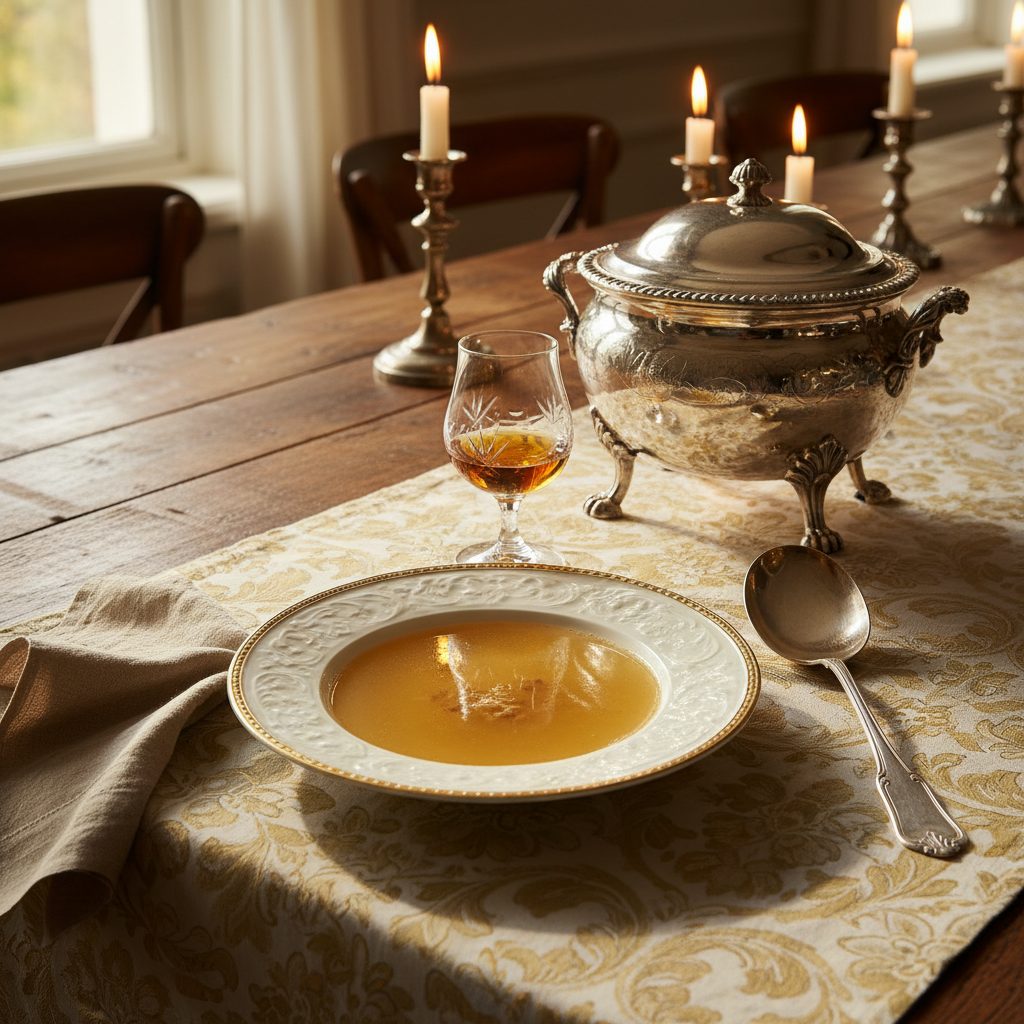
Orthodox turtle soup did not belong to the cooking of everyday life. It was a rite performed among crystal, heavy damask, silver and glances that knew more than it was proper to say. It entered the salon like a lady with an impeccable name and a troubling reputation — slowly, without explanation, aware that the whole room was already waiting for her.
Its path led from old ships to palaces, clubs and aristocratic banquets. What had once been a meal of survival, eighteenth-century Europe transformed into an edible insignia of wealth. The presence of turtle on the table signified access to a world closed to ordinary mortals.
Before the salon could be enraptured, the kitchen had to perform its own mystery.
The meat was divided according to anatomy, a secret code of the creature was deciphered. Calipash — the meat and dark green, gelatinous matter from beneath the upper shell — gave the dish depth, stickiness and a dark allure. Calipee, the yellowish meat from beneath the lower shell, brought delicacy and a soft texture. The chef was not an alchemist who separated matter only to unite it later into perfection.
In the French and British traditions the highest form was a clear, consommé-style soup. The turtle meat was cooked for a long time with veal and herbs until the broth became transparent, golden and thick with collagen. It was not to be cloudy. Luxury does not tolerate lack of clarity. It was meant to gleam in the porcelain like amber, tremble on the spoon and leave a velvet trace on the lips.
Then came sherry or Madeira — dry, deep, slightly burning. They were not an addition. They were the final anointing. The wine was poured generously, sometimes at the table itself, at the moment when the aroma rose towards the guest's face and caused the first, barely noticeable quiver of the nostrils. The soup contained eggs found in the female turtles; later their presence was recreated with chopped hard-boiled hen's egg, to preserve the classic texture and look of the dish.
The meat was baked in the enormous shell lined with puff pastry and placed in the middle of the table like a reliquary of earthly delight. Conversations fell silent. Backs straightened by themselves. Eyes followed the movement of the tureen, and the air grew thick with aroma, expectation and envy.
The first spoonful touched the tongue softly, almost intimately. The flavour was slow to reveal itself. First came the depth of the broth, then the sweetness of the meat, then the stickiness of the collagen, the warmth of the wine and a herbal twilight. It was said that turtle meat has seven natures: beef, veal, poultry, fish, pork, goat and lobster. As if nature had enclosed in one creature the entire menu of the world — for the few alone.
The second spoonful was already consent.
To greed. To the suspension of good manners. To that subtle trembling of the eyelid, when the aroma of sherry returned to the nostrils and the golden broth settled on the lips. London satirists described dignitaries emptying tureens to the bottom and forgetting that there were others at the table. For the highest circles could keep their dignity in the face of politics, scandal and bankruptcy — but not always in the face of the last portion of soup.
Luxury is not loud. It is inaccessible.
It lets itself be seen, but not possessed. It leaves a gleam in the eye, warmth on the tongue and a tension in the body that is no longer hunger, though it has not yet dared to call itself desire.
Dum vivimus, vivamus. While we live, let us live. Discreetly. Lavishly. To the last drop.
## From the hold to the salons
Before turtle soup became a byword for absolute luxury, it was the food of sailors who had no choice. In the seventeenth century European seafarers in the Caribbean discovered that sea turtles, especially the green turtle, could survive for many months in the hold, without food or water, lying on their backs. That meant fresh meat in a place where everything was fresh except the food. A living larder that did not try to run away.
Then came the planters and colonial officials returning home. They brought the taste with them, and in the 1720s turtle became a culinary sensation of the aristocracy in Great Britain. That is how it usually goes: what saves lives at sea begins to signify status on land. The sailor's hunger turns into the shipowner's snobbery.
Asia has known this soup longer and reads it differently. In China it is made from the Chinese softshell turtle, double-boiled, with ginseng or goji berries, and treated as a tonic of vitality and a wish for longevity. Portions are divided according to family order. The eldest, the heads of the family, eat the turtle's head. Children get the delicate shell, rich in collagen, as a sign of parental care. In the West the soup said: "I can afford it." In China: "I care for you." That is no small difference.
## Gluttony ex officio
Prestige always provokes. From 1761 to 1825 turtle soup was the pride of London and an obligatory part of the Lord Mayor's lavish banquets. Moralists and satirists did not spare the elite. They wrote that respectable politicians at the tureen "forgot hospitality", and newspapers complained about guests who ate the contents to the bottom and left others empty shells. Caricaturists rewarded corpulent officials with nicknames such as "Dr. Feastlove". A power that cannot share its soup rarely shares anything else.
On the other side of the ocean there was the Hoboken Turtle Club, founded in 1796, whose members included George Washington and Aaron Burr. A day at the club began with a meal at eight in the morning, and participants could drink up to ten cocktails served in jugs for breakfast. The coveted soup was served at four in the afternoon. The club's motto was precisely "Dum vivimus vivamus". It is hard to find a more honest slogan for people who waited from morning till afternoon for soup with a glass in hand.
There were also solitary enthusiasts. President William Howard Taft loved the dish so much that he hired a cook whose sole task was to make "Taft's Terrapin Soup", served, obligatorily, with champagne. In the Kennedy era "Boula Boula" became fashionable, Jackie Kennedy's favourite soup: turtle soup mixed with green pea soup, seasoned with sherry and baked under whipped cream. Luxury likes additional storeys.
## America cooks its own way
The United States did not adopt the orthodoxy; it reworked it. In New Orleans, snapping turtle soup, famous from places such as Commander's Palace and Brennan's, is a thick, spicy, dark brown stew. It rests on a dark roux, the "holy trinity" of onion, celery and green pepper, tomatoes, cloves and nutmeg. It is finished with spinach, hard-boiled egg and sherry poured straight into the plate.
Baltimore and Philadelphia reached for smaller brackish-water turtles, terrapins. In Philadelphia the soup was sometimes made with a cream sauce, which in Baltimore was considered a profanation and cause for horror. Two cities, one turtle, an eternal dispute. Cuisine will always find a way to give neighbours something not to talk to each other about.
## The mock turtle
Real turtles cost a fortune, so Mock Turtle Soup was born. It was made from the head, brain and feet of a calf, which imitated the gelatinous consistency of the original perfectly. Lower Saxony fell in love with it as a souvenir of its union with Great Britain. In Cincinnati, German immigrants turned it into a thick, sweet-and-sour broth with minced beef and cider vinegar. The imitation proved more fertile than the original.
On 14 April 1865, just before leaving for Ford's Theatre, where he was shot, Abraham Lincoln ate mock turtle soup as his last meal. History does not always have a feel for symbolism, but this time it hit the mark.
The most famous mock turtle, however, is a literary character. The weeping Mock Turtle in Lewis Carroll's "Alice in Wonderland" has a turtle's shell but a calf's head, tail and hooves. It is a satire on the Victorian middle class, which ate cheap soup made from a calf's head and pretended to aristocratic splendour. Carroll understood that the most pitiful thing about snobbery is not the lack of money. The most pitiful thing is tears over someone else's soup.
## The turtle in proverbs
China added proverbs to this story. "The turtle mocks the softshell for having no tail" is the Chinese version of our "the pot calling the kettle black". "The frog in the well", from Zhuangzi's parable, is someone who took his little well for the whole kingdom until a great turtle told him about the ocean. The British press, denouncing the elites' overindulgence in delicacies from the sea, in turn invoked an old Italian saying: "Give eels to your enemy, but don't give him wine."
Pop culture did not spare the turtle either. Shredder, the enemy of the Teenage Mutant Ninja Turtles, threatened in the 1980s cartoon that tonight he would have turtle soup for dinner. The threat sounded like something from the Lord Mayor's menu. Perhaps because turtle soup was always about power: who gets to eat, who has to watch, and who is left with an empty shell.
📖 Glossary
- calipash
- Mięso i ciemnozielona, galaretowata materia spod górnej skorupy żółwia, która daje zupie głębię, lepkość i ciemny powab.
- calipee
- Żółtawe mięso spod dolnego pancerza żółwia, które wnosi do zupy delikatność i miękką strukturę.
- Mock Turtle Soup
- Zupa z fałszywego żółwia, gotowana z głowy, mózgu i nóg cielęcia, udająca galaretowatą konsystencję oryginału.
- Boula Boula
- Ulubiona zupa Jackie Kennedy: żółwiowa zmieszana z zupą z zielonego groszku, doprawiona sherry i zapiekana pod bitą śmietaną.
- Dum vivimus, vivamus
- Dopóki żyjemy, żyjmy. Motto Hoboken Turtle Club.
Frequently Asked Questions
How did turtle soup become fashionable?
In the seventeenth century European sailors in the Caribbean discovered that sea turtles could survive for months in the hold without food or water. Planters and colonial officials brought the taste home, and in the 1720s turtle became a culinary sensation of the British aristocracy. From 1761 to 1825 the soup was an obligatory part of the Lord Mayor's banquets.
What are calipash and calipee?
Calipash is the meat and dark green, gelatinous matter from beneath the turtle's upper shell, which gives the soup depth and stickiness. Calipee is the yellowish meat from beneath the lower shell, bringing delicacy and a soft texture.
How was orthodox turtle soup prepared?
The highest form was a clear consommé: turtle meat was cooked for a long time with veal and herbs until the broth became transparent, golden and thick with collagen. Sherry or Madeira was poured in generously, sometimes at the table. Turtle eggs were later replaced with chopped hard-boiled hen's egg.
What is mock turtle soup?
Mock Turtle Soup was born because real turtles cost a fortune. It was made from the head, brain and feet of a calf, which imitated the gelatinous consistency of the original. Lower Saxony fell in love with it, and in Cincinnati German immigrants made it a sweet-and-sour broth with minced beef.
What did Lincoln eat before he died?
On 14 April 1865, just before leaving for Ford's Theatre, where he was shot, Abraham Lincoln ate mock turtle soup as his last meal.
How is turtle soup eaten in China?
In China it is made from the Chinese softshell turtle, double-boiled with ginseng or goji berries, and treated as a tonic of vitality and a wish for longevity. The eldest eat the turtle's head, while children get the delicate, collagen-rich shell as a sign of parental care.
Related Questions
- How did turtle soup become fashionable?
- What are calipash and calipee?
- How was orthodox turtle soup prepared?
- What is mock turtle soup?
- What did Lincoln eat before he died?
- How is turtle soup eaten in China?
🧠 Thematic Groups
- Historia: od żółwi zielonych w ładowniach XVII-wiecznych żaglowców do kulinarnej sensacji brytyjskiej arystokracji w latach 20. XVIII wieku.
- Technika: calipash i calipee, klarowny consommé z cielęciną i ziołami, sherry lub Madera oraz mięso zapiekane w skorupie wyłożonej ciastem francuskim.
- Władza i obyczaj: bankiety Lorda Mayora, satyrycy piętnujący obżarstwo elit, Hoboken Turtle Club, Taft i Boula Boula Jackie Kennedy.
- Imitacja i kultura: zupa z fałszywego żółwia, ostatni posiłek Lincolna, Mock Turtle Carrolla, chińskie przysłowia i groźba Shreddera.
Tags:
turtle soup
calipash
calipee
consommé
sherry
Madeira
green turtle
British cuisine
Lord Mayor
Hoboken Turtle Club
Mock Turtle Soup
mock turtle
New Orleans
Abraham Lincoln
Lewis Carroll
More in: Kuchnia niepolityczna
Content is created by Fundacja Dobre Państwo.
Edited and published by APA ONE, the Foundation's own AI-based editorial system.