Pad Thai. The taste with which the state taught people obedience
🎧 Listen (Audio)
Audio versions are read by a synthetic voice.
Listen in the Dobre Państwo podcast (Spotify) RSS
Power likes best to speak of ideas. Nation, community, modernity, patriotism. When words stop working, it reaches for a tool more effective than propaganda. Appetite.
Pad Thai is not an innocent souvenir of ancient Thailand. It is a young dish, political and carefully designed. It was created not only in the kitchen but also in government offices. The authorities wanted to forge a modern nation out of multi-ethnic Siam. They decided that a citizen should not only speak the right language, wear the right clothes and listen to the right anthem. He should also eat the right lunch.
This is how gastronomic social engineering is born.
War, floods and crisis supplied the arguments. Whole grains of rice were too valuable simply to be eaten. They could be exported. Noodles, meanwhile, were made from broken rice, inferior and cheaper. The state spread the recipe, handed out street carts and kept repeating: "Noodles are your lunch."
It was not a culinary slogan. It was an order that smelled of tamarind.
Propaganda does not look like propaganda. It has the right temperature, crunchy peanuts, a rich egg and the sour flash of lime. A person sits down at the table convinced he is satisfying his own hunger, while in fact he is consuming someone else's vision of society.
Pad Thai shows that people need not be forced to accept an ideology. It is enough to stir-fry it well.
The paradox is almost perfect. The noodles and the wok had Chinese roots, but the state took them over, renamed them and proclaimed them a symbol of pure Thainess. At the same time Chinese traders were being shut out of street commerce. First they were deprived of their taste, then of their history, and finally of the right to sell it.
This is how nationalism works, sauté version.
Cutlery became a political statement. Pad Thai was to be eaten with a spoon and fork, not chopsticks. This was not etiquette. It was a civilisational performance addressed to the colonial world. Thailand was to look modern enough that nobody would try to civilise it by force.
The dish set off into the world as an ambassador of soft power. The state supported Thai restaurants abroad. Sensors measured levels of sourness, saltiness and heat, as if national identity could be recorded in a sample of sauce.
Every government dreams of creating the one true taste, the correct language and the proper way of understanding the community.
Taste, like a human being, cannot stand complete obedience. Pad Thai from Korat is hotter and often has no egg. In Chanthaburi springy Sen Chan noodles and blue crab meat appear. In the south the dish soaks up coconut milk and curry paste.
The periphery seasons the centre in its own way.
Pad Thai is a parable: power can colonise language, ritual and memory, but it colonises everyday life most effectively. It does not need to erect monuments. It is enough to park a food cart on the street corner.
The state does not always speak from the rostrum. Sometimes it hisses in the wok. Sometimes it presses a fork into the citizen's hand. Sometimes it lets him add the chili himself, so that he keeps the illusion that he still decides his own taste.
## The prime minister, the flood and broken rice
The architect of this cuisine was Prime Minister Plaek Phibunsongkhram, known as Phibun. Fascinated by European nationalism, taking his models straight from Mussolini's fascism, he wanted to turn "backward" Siam into modern Thailand. National identity was for him a political project, a performance of modernity staged at once for his own citizens and for the world.
Cooking was given a concrete role in this project. In 1939 a dish called kway teow pad Thai, later shortened to Pad Thai, was officially presented and promoted. Then came the Second World War and the devastating floods of 1942. The government had to protect its stocks of whole rice, the key export commodity. Noodles made from broken rice, cheaper and of lower quality, were an economic solution pretending to be a culinary one.
The slogan "Noodles are your lunch" was spread by the Department of Public Welfare. Officials distributed a standardised recipe and handed out free food carts, promoting hygiene, modernity and economic patriotism along the way. Eating Pad Thai became a civic duty. Few governments have managed to fuse food policy and propaganda so effectively that citizens still consider the result their own.
## The appropriated wok
The most uncomfortable chapter concerns the Chinese minority. Wok frying and kuai tiao noodles are Chinese to the core. Phibun's government took them over and renamed them "Thai-style fried", making them part of a pure national identity. At the same time, as part of the "Buy Thai" campaign, the state barred foreigners, which meant above all the Chinese, from street trading. Pad Thai was thus a tool of assimilation and exclusion at once. Accept our taste, but do not sell it on our street.
## The hat, the fork and the anthem
The plate was only one front of the reform. The state changed customs from head to toe. Where people had eaten with their hands, the fork and spoon were introduced. The traditional chong kraben trousers and bare chests were to give way to suits, dresses and compulsory hats. The widespread chewing of betel nut was strictly banned. Regional dialects were replaced by standard Thai, and a compulsory anthem entered daily life.
Pad Thai etiquette is a relic of that revolution. Chopsticks are not used; they are reserved for noodle soups only. You eat with a spoon, and the fork serves only to push the portion onto it. This arrangement was a signal to the colonial powers: Thailand is civilised and needs no European civilising mission, which in those days often served as a pretext for occupation. The fork turned out to be cheaper than an army.
## A tradition from 1962
History has one more storey here. The historian Chatichai Muksong points out that the name "Pad Thai" and a specific recipe appear in cookbooks, among them the "Housewife's Manual", only in 1962. Today's Pad Thai would thus be as much Phibun's work as a product of the soft power of the 1960s, when American soldiers and tourists had to be fed, in search of a Thainess that was exotic but digestible.
Hence the lack of proverbs. The dish is less than ninety years old and has not had time to gather folk wisdom. Instead it has wartime government slogans and one modern maxim among cooks: Pad Thai is the ultimate test of skill, because it demands a perfect balance of four flavours. Folklore has been replaced by technique.
## A robot guarding the taste
In 2002 the "Global Thai" programme was launched to increase the number of Thai restaurants in the world and turn them into an instrument of influence. In 2014 a state-appointed committee funded a robot called e-Delicious. The device, fitted with electrochemical sensors, measures the chemical signature of a dish, that is its spiciness, saltiness and acidity, and compares it with a digital standard. The state that once taught people how to eat has now stopped trusting their tongues.
Enemy number one is ketchup. In the West it often replaces tamarind paste, and for purists that is a crime. Vinegary ketchup kills the earthy, deep sourness of tamarind, which in the eyes of the guardians of taste is a degradation of national heritage. The irony is that this heritage was invented a few decades ago and already has its own inquisition.
## The periphery and the canon
Bangkok imposed one version on the world, but Thailand cooks in its own way. Pad Mee Korat from Isan is hotter, simpler, juicier and more sour, based on tao jiew fermented soybean paste and pork belly, traditionally without egg or peanuts. In Chanthaburi springy Sen Chan noodles and blue crab meat rule. In the south Pad Thai Chaiya soaks up coconut milk and red curry paste, almost creamy.
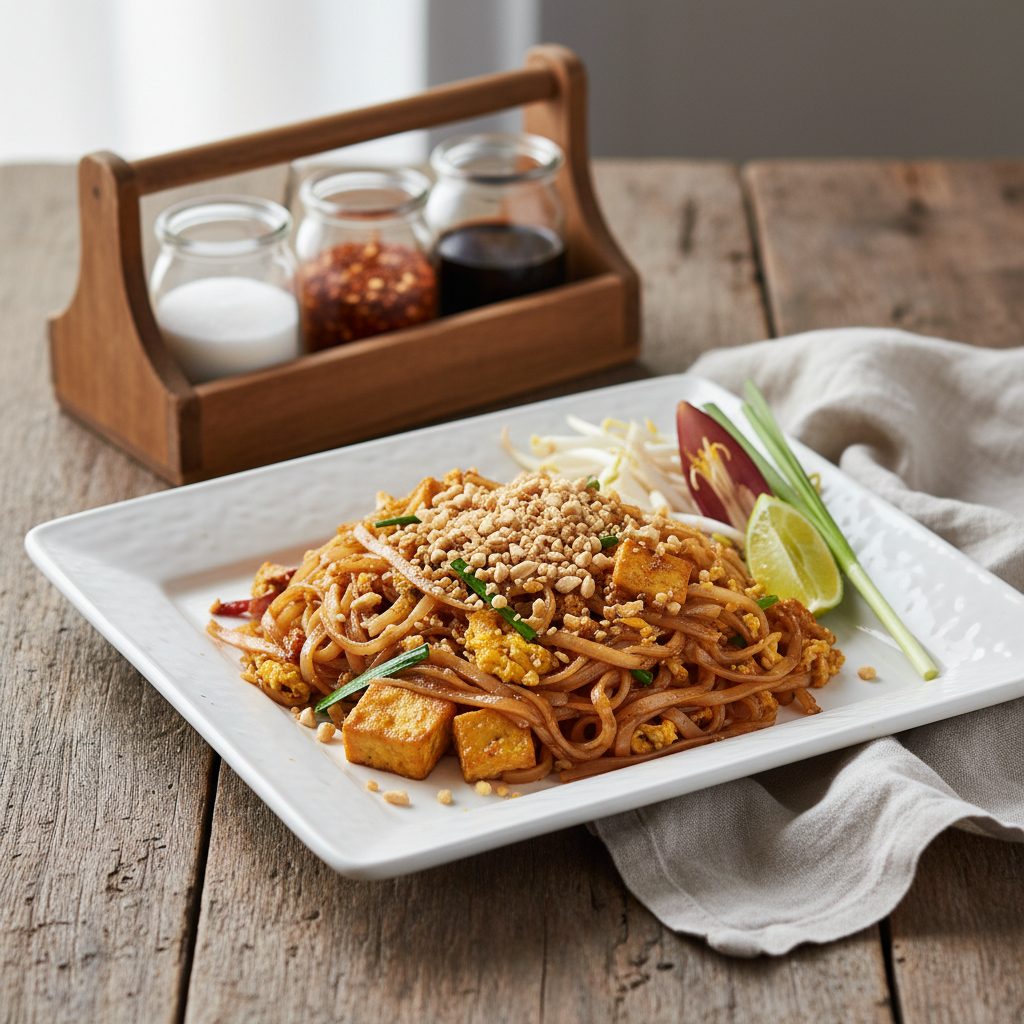
The canon of the classic version includes Sen Lek noodles, tamarind, palm sugar, fish sauce, yellow tofu, dried shrimp, pickled chai poh radish, egg, Chinese chives and peanuts. In luxury versions the egg may be a duck egg, which gives a richer, fattier taste. The noodles must be fried quickly at high heat, with the "breath of the wok", so that they absorb the sauce and stay al dente. Beside them lie raw bean sprouts, garlic chives and banana blossom, which provides the essential astringency.
And finally the last ritual. Pad Thai never leaves the kitchen fully seasoned. On the table stands the kruang prung condiment set: sugar, chili flakes, fish sauce and lime. The diner completes the taste himself. The state designed the dish, the cart, the cutlery and the robot, but left the last pinch of chili to the citizen. Perhaps out of good sense. Perhaps out of contrariness. Or perhaps because every government knows how much freedom it must leave so that people do not notice the rest.
📖 Glossary
- kruang prung
- Przyprawnik na tajskim stole z cukrem, płatkami chili, sosem rybnym i limonką, którym jedzący sam dopełnia smak Pad Thai.
- e-Delicious
- Robot z czujnikami elektrochemicznymi, sfinansowany w 2014 roku przez państwowy komitet, który mierzy pikantność, słoność i kwasowość potrawy i porównuje je z cyfrowym wzorcem.
- chai poh
- Marynowana rzodkiew, jeden ze składników klasycznego kanonu Pad Thai.
- Global Thai
- Program z 2002 roku, który miał zwiększyć liczbę tajskich restauracji na świecie i uczynić z nich narzędzie wpływu.
Frequently Asked Questions
Who invented Pad Thai?
The architect of Pad Thai was Prime Minister Plaek Phibunsongkhram, known as Phibun, who wanted to turn Siam into modern Thailand. In 1939 the dish kway teow pad Thai was officially presented, and the Department of Public Welfare handed out the recipe and free carts. The historian Chatichai Muksong notes that the name and a specific recipe appear in cookbooks only in 1962.
Why is Pad Thai made with rice noodles?
During the Second World War and after the floods of 1942 the government had to protect its stocks of whole rice, a key export commodity. The noodles were made from broken rice, cheaper and of lower quality. It was an economic solution pretending to be a culinary one, under the slogan „Noodles are your lunch”.
Is Pad Thai eaten with chopsticks?
No. In Thailand chopsticks are used only for noodle soups, and Pad Thai is eaten with a spoon, the fork serving to push the food onto it. This arrangement was a signal to the colonial powers that Thailand was civilised and needed no European civilising mission.
Why is ketchup not added to Pad Thai?
In the West ketchup often replaces tamarind paste, and for purists this is a crime. Vinegary ketchup kills the earthy, deep sourness of tamarind. In the eyes of the guardians of taste it is a degradation of national heritage.
What are the regional varieties of Pad Thai?
Pad Mee Korat from Isan is hotter and more sour, based on tao jiew fermented soybean paste and pork belly, traditionally without egg or peanuts. In Chanthaburi springy Sen Chan noodles and blue crab meat rule. In the south Pad Thai Chaiya is soaked in coconut milk and red curry paste.
What goes into classic Pad Thai?
The canon includes Sen Lek noodles, tamarind, palm sugar, fish sauce, yellow tofu, dried shrimp, pickled chai poh radish, egg, Chinese chives and peanuts. The noodles are fried quickly at high heat, with the breath of the wok. Raw bean sprouts, garlic chives and banana blossom lie beside them, and the kruang prung condiment set stands on the table.
Related Questions
- Who invented Pad Thai?
- Why is Pad Thai made with rice noodles?
- Is Pad Thai eaten with chopsticks?
- Why is ketchup not added to Pad Thai?
- What are the regional varieties of Pad Thai?
- What goes into classic Pad Thai?
🧠 Thematic Groups
- Historia i polityka: Pad Thai powstał jako projekt państwa Phibuna, łączący oszczędzanie ryżu na eksport z propagandą, higieną i patriotyzmem gospodarczym.
- Wykluczenie: chiński wok i makaron kuai tiao przemianowano na tajskie, a kampania Buy Thai odebrała chińskim handlarzom prawo do ulicznej sprzedaży.
- Obyczaj i soft power: łyżka i widelec zamiast pałeczek jako sygnał dla mocarstw kolonialnych, program Global Thai i robot e-Delicious pilnujący smaku.
- Kanon i regiony: Sen Lek, tamaryndowiec, cukier palmowy i oddech woka, a obok Pad Mee Korat, krabowa wersja z Chantaburi i kokosowy Pad Thai Chaiya.
Tags:
Pad Thai
rice noodles
Sen Lek
tamarind
palm sugar
fish sauce
wok
Thai cuisine
Thailand
Siam
Phibun
social engineering
soft power
e-Delicious
kruang prung
More in: Kuchnia niepolityczna
Content is created by Fundacja Dobre Państwo.
Edited and published by APA ONE, the Foundation's own AI-based editorial system.