Paella. The pan you must not stir
🎧 Listen (Audio)
Audio versions are read by a synthetic voice.
Listen in the Dobre Państwo podcast (Spotify) RSS
Paella is not a colourful rubbish tip for rice into which you can throw everything that is dying in the fridge. It was born around the Albufera lagoon near Valencia as a meal for people working in the rice fields, not as decoration for a hotel buffet serving tourists in socks and sandals. The name derives from the Latin "patella", a metal vessel. Yes, a vessel. By this point some readers have probably suffered intellectual muscle ache.
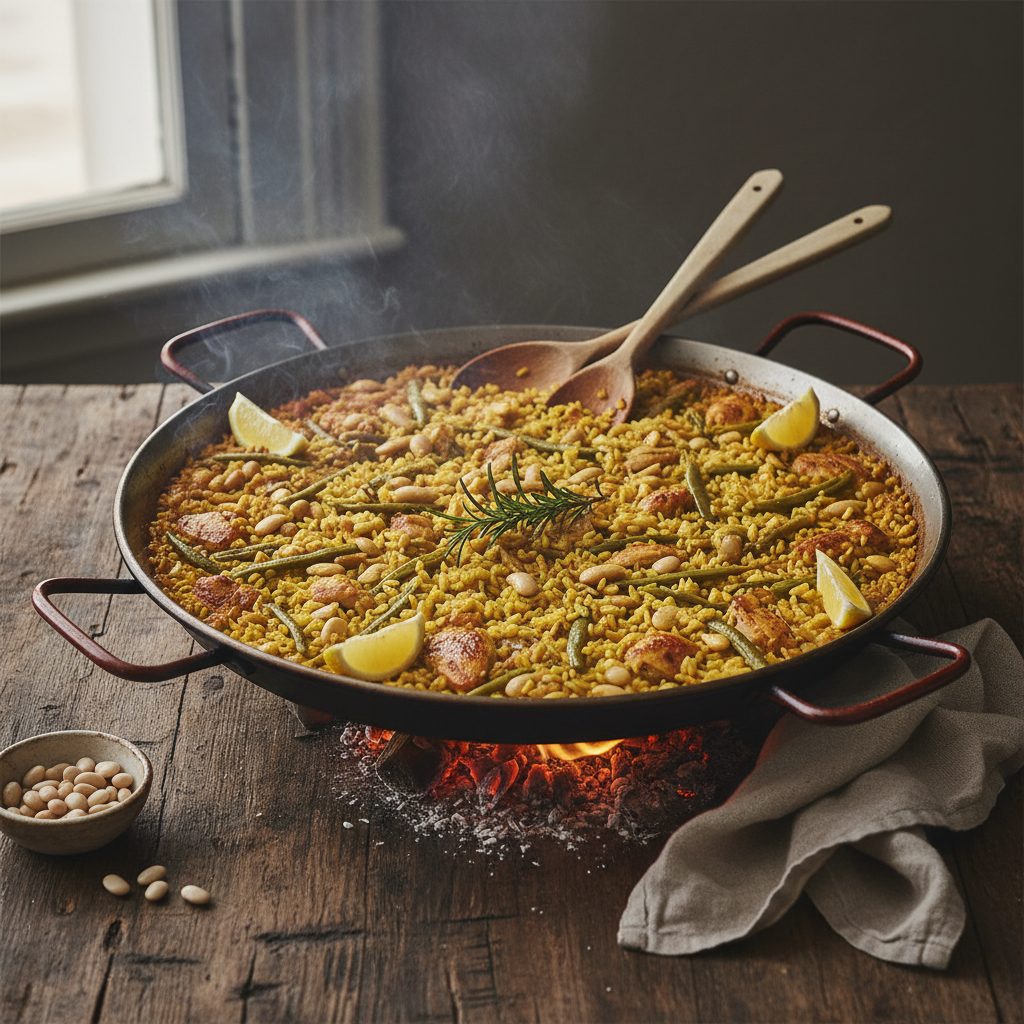
Paella valenciana contains rice, chicken, rabbit, green beans, garrofó beans, tomatoes, olive oil, saffron, paprika, rosemary, water and salt. Sometimes snails or artichokes. It does not contain seafood, onion, garlic, wine, pepper or chorizo. Chorizo in paella is like a plastic garden gnome in a cathedral. By all means put one there, if you wish to announce publicly your lack of taste, knowledge and elementary shame.
Paella is cooked in a wide, shallow pan, ideally over a fire of orange wood. First you make the sofrito, then add water and rice. From that moment on, stirring is forbidden. Whoever stirs is not cooking paella but reducing the rice to sticky degradation and producing risotto after a lobotomy. The goal is socarrat: the crisp, toasted layer on the bottom, the part of the dish over which civilised people fight with spoons instead of holding tedious discussions about boxed diet meals.
Paella is a communal dish. The pan is set in the middle of the table and eaten from together, often with wooden spoons. There are no individual portions for hypersensitive princes who ask whether the rice has touched the beans. There is a shared vessel, family, friends and the awareness that life is short and rice must not be overcooked.
When Jamie Oliver threw chorizo into paella, the Spanish united in outrage faster than in any political debate. And rightly so. Gordon Ramsay got it in the neck for chilli, Marco Pierre White for too much wine. Not because the Spanish are oversensitive, but because tradition has limits, and culinary ignorance does not become creativity just because the culprit has a television show.
Of course there are seafood paellas, black versions, mixed and vegetable ones. They are regional variants, not proof that you can pour rice into a pan, toss in a frankfurter and proclaim a Mediterranean revelation.
The Spanish say "¡Se me pasa el arroz!", "my rice is overcooking", when time is running out and it is getting too late for something. It is a beautiful metaphor. Especially for those who in a whole lifetime have not learned to tell paella from rice with random additions. Their rice overcooked long ago, damn it.
## A vessel for the gods, breakfast for a farmer
The Latin patella was a metal vessel in which the Romans made offerings to the gods. The name survived; the gods changed. Rice growing on the Albufera lagoon goes back to Arab times, but paella in the form we know began to gain popularity only in the 19th century. It was a modest, collective meal for farmers and rice-field workers, sometimes eaten even for breakfast, to give them strength for hard work. Nobody cooked it for a photograph. It was cooked to survive a day knee-deep in water.
Its promotion to national symbol came with tourism in the days of General Franco's dictatorship. The dish of one lagoon became the emblem of all Spain. That is how national cuisines are born: the region cooks, the state sells and the tourist orders.
## The Valencian canon
True paella valenciana has a short and uncompromising list of ingredients. Rice, ideally short- or medium-grain, bomba or senia. Chicken and rabbit. Flat green beans and large white garrofó beans. Tomatoes, olive oil, saffron, sweet paprika, fresh rosemary, water and salt. Optionally snails or fresh artichokes. Never any seafood. No garlic, black pepper, wine, onion or chorizo either. The canon knows more prohibitions than ingredients, and that is exactly why it is a canon.
Valencians attach importance even to the water. They believe the ideal paella needs hard water, and some contestants in cooking competitions bring their own jerrycans from their home region. Bomba rice is prized because it absorbs flavour well and does not fall apart. The greatest sin is overcooking. Any other mistake can still be called a variant. Overcooked rice cannot be called anything.
## Fire, socarrat and ten minutes of silence
Paella is cooked in a paellera, a wide, shallow pan with a thick bottom in which the rice lies in a thin layer. Tradition says it should be done outdoors, over burning orange wood. The fire embraces the pan and the rice absorbs the smoky aroma. A gas hob will cook rice. Orange wood will cook paella.
First the sofrito, the flavour base in which the meat and vegetables are browned. Then the liquid and the rice, and from that moment no stirring at all. Stirring releases starch and turns paella into a creamy risotto, which in Valencia counts as a mistake, not an interpretation. The reward for patience is socarrat, also called socarrada, the crisp, slightly caramelised layer of rice toasted onto the bottom, the tastiest part of the dish.
Finished paella must rest under a cover for about ten minutes. It is a Sunday dish around which family and friends gather. The pan is placed in the middle of the table and eaten straight from it with wooden spoons, often sprinkled with lemon juice and washed down with cold, dry white wine or beer. The shared vessel has its ethics. Everyone eats from their own edge, and the socarrat is fought over fairly.
## The chorizo war
The loudest row was started by the British cook Jamie Oliver, who used chicken thighs and heavily spiced chorizo sausage in his paella recipe. The Spanish, usually deeply divided politically, united in outrage. For Valencians chorizo ruins the taste and texture of the rice, and paella turns into ordinary rice with additions. Gordon Ramsay was ridiculed for hot chilli and accused of confusing Spain with Mexico. Marco Pierre White gave offence with too much wine and paprika. British television cooking discovered that there are nations for whom a recipe is a matter of honour.
The dispute is not new. France got to know paella as early as the second half of the 19th century as an exotic, luxurious banquet dish. In 1868 Urbain Dubois blew the recipe up to gargantuan proportions and created something like an olla podrida: beef, pork, chorizo, ham, poultry, rabbit, pigeons, partridges, eels, fish, snails and vegetables. Auguste Escoffier, in his guide, reduced paella in turn to an exclusive side dish for poultry under the name riz valenciennes. The French first made everything of it, and then almost nothing.
## Variants and counterfeits
Beyond Valencia, Spain has developed its own versions, and no reasonable person holds that against it. Paella marinera, common on the coasts, especially in Catalonia and Valencia, has prawns, mussels and squid instead of meat. Paella negra, also popular in Catalonia, owes its black colour and intense flavour to cuttlefish or squid ink. Paella mixta, frequent in Madrid, combines seafood with chicken, rabbit and vegetables. Andalusia makes a version with chicken and vegetables, and in Seville paella was also served in small portions as tapas. Galicia reaches for shellfish and seaweed, Murcia for seasonal vegetables in paella de verduras.
On the French Basque coast paella underwent "Basquisation" and, as paëlla basquaise, entered the homes of families with no Spanish roots. Twentieth-century mass tourism spread across the world a "unified paella", mixed and made from cheap ingredients, which satisfies the holidaymakers' need for Spanishness in France, Germany and the British Isles. That is not a variant. It is a holiday souvenir, like a fridge magnet.
"¡Se me pasa el arroz!" is said most often of the ticking biological clock, when the chances of having a child begin to shrink. Overcooked rice, the greatest sin of paella, has become a metaphor for lost time. It would be hard to find better proof that in Valencia cooking and life share one calendar.
## Recipe
**Ingredients:**
- bomba or senia rice
- chicken
- rabbit
- flat green beans
- white garrofó beans
- tomatoes
- olive oil
- saffron
- sweet paprika
- fresh rosemary
- water (ideally hard) and salt
- optionally snails or fresh artichokes
- to serve: lemon
**Method:**
1. Light a fire, ideally of orange wood, and set the paellera over it.
2. In olive oil, make the sofrito: brown the meat and vegetables.
3. Add the liquid and the rice. From this moment, do not stir.
4. Cook until the rice has absorbed the liquid without overcooking and a crisp socarrat has formed on the bottom.
5. Take off the heat, cover and leave to rest for about 10 minutes.
6. Set the pan in the middle of the table and eat together with wooden spoons, sprinkling with lemon juice.
📖 Glossary
- socarrat
- Chrupiąca, lekko skarmelizowana warstwa ryżu przypieczona do dna patelni, najsmaczniejsza część paelli.
- paellera
- Szeroka, płytka patelnia z grubym dnem, na której ryż do paelli leży cienką warstwą.
- patella
- Łacińskie metalowe naczynie, w którym Rzymianie składali dary bogom i od którego pochodzi nazwa paelli.
- garrofó
- Duża biała fasola, jeden z kanonicznych składników paelli valenciana.
- sofrito
- Baza smakowa paelli, w której na oliwie podsmaża się mięso i warzywa przed dodaniem płynu i ryżu.
Frequently Asked Questions
What goes into authentic paella valenciana?
The canon is bomba or senia rice, chicken, rabbit, flat green beans, white garrofó beans, tomatoes, olive oil, saffron, sweet paprika, fresh rosemary, water and salt. Optionally snails or fresh artichokes. It contains no seafood, onion, garlic, wine, pepper or chorizo.
Do you put chorizo or seafood in paella?
Paella valenciana contains neither chorizo nor seafood. When Jamie Oliver used chorizo, the Spanish united in outrage, because for Valencians the sausage ruins the taste and texture of the rice. Seafood goes into regional variants such as paella marinera or mixta.
Why must paella not be stirred?
Stirring releases starch and turns paella into a creamy risotto, which in Valencia counts as a mistake, not an interpretation. Once the liquid and rice are in, there is no stirring at all. Only then does socarrat form on the bottom and the rice stay whole.
What is socarrat?
Socarrat, also called socarrada, is the crisp, slightly caramelised layer of rice toasted onto the bottom of the paellera. It is considered the tastiest part of the dish and the reward for patience. At a shared pan it is fought over with spoons, but fairly.
Where does paella come from?
Paella was born around the Albufera lagoon near Valencia as a modest, collective meal for farmers and rice-field workers, sometimes eaten even for breakfast. In its familiar form it became popular in the 19th century, and it turned into a symbol of all Spain with tourism under Franco. The name comes from the Latin patella, a metal vessel.
What does se me pasa el arroz mean?
„¡Se me pasa el arroz!” means „my rice is overcooking” and is said when time is running out and it is getting too late for something. Most often it refers to the ticking biological clock. Overcooked rice, the greatest sin of paella, has become a metaphor for lost time.
Related Questions
- What goes into authentic paella valenciana?
- Do you put chorizo or seafood in paella?
- Why must paella not be stirred?
- What is socarrat?
- Where does paella come from?
- What does se me pasa el arroz mean?
🧠 Thematic Groups
- Historia: paella narodziła się nad laguną Albufera jako posiłek pracowników pól ryżowych, spopularyzowała się w XIX wieku, a symbolem Hiszpanii stała się dzięki turystyce za Franco.
- Technika: paellę gotuje się w paellerze nad drewnem pomarańczowym, na ryżu bomba i twardej wodzie, bez mieszania, aż powstanie socarrat, a potem odstawia na dziesięć minut.
- Kanon i spory: paella valenciana nie zna owoców morza, cebuli, czosnku ani chorizo, a Jamie Oliver, Gordon Ramsay i Marco Pierre White ściągnęli na siebie gniew Hiszpanów.
- Warianty: paella marinera, negra i mixta to regionalne odmiany, Francja znała paellę jako danie bankietowe Dubois i Escoffiera, a turystyka rozniosła paellę zunifikowaną.
Tags:
paella valenciana
paella
bomba rice
socarrat
saffron
rabbit
garrofó beans
paellera
orange wood
Valencia
Albufera
Spanish cuisine
chorizo
Jamie Oliver
paella negra
More in: Kuchnia niepolityczna
Content is created by Fundacja Dobre Państwo.
Edited and published by APA ONE, the Foundation's own AI-based editorial system.