Ramen. The soup that changed its passport but kept its memory
🎧 Listen (Audio)
Audio versions are read by a synthetic voice.
Listen in the Dobre Państwo podcast (Spotify) RSS
Ramen is sold as the essence of Japan: a bowl, steam, neon, Tokyo, a few frames from an anime, and you can already pretend to be worldly. Its ancestor was Chinese lamian, noodles pulled by hand, twisted, slapped against the table and hardened with plant-based penghui. It was brought to Japan in the 19th century by Chinese merchants and immigrants settling in the ports, especially in Yokohama. Japan did not invent ramen. It did with it what empires do best: it took over a foreign invention and gave it discipline, a myth and its own seal.
Chinese lamian is Confucian. Order without decorative bombast. Clear broth, beef or mutton, garlic, coriander, radish. The flavour is meant to be as legible as a character drawn with one sure stroke of the brush. Zhongyong, the golden mean — and the quiet logic of the dao. Nothing needs to be spelled out brutally, since harmony has already happened in the bowl. The noodles are movement, the broth is breath, and the cook does not curate an experience. The cook knows.
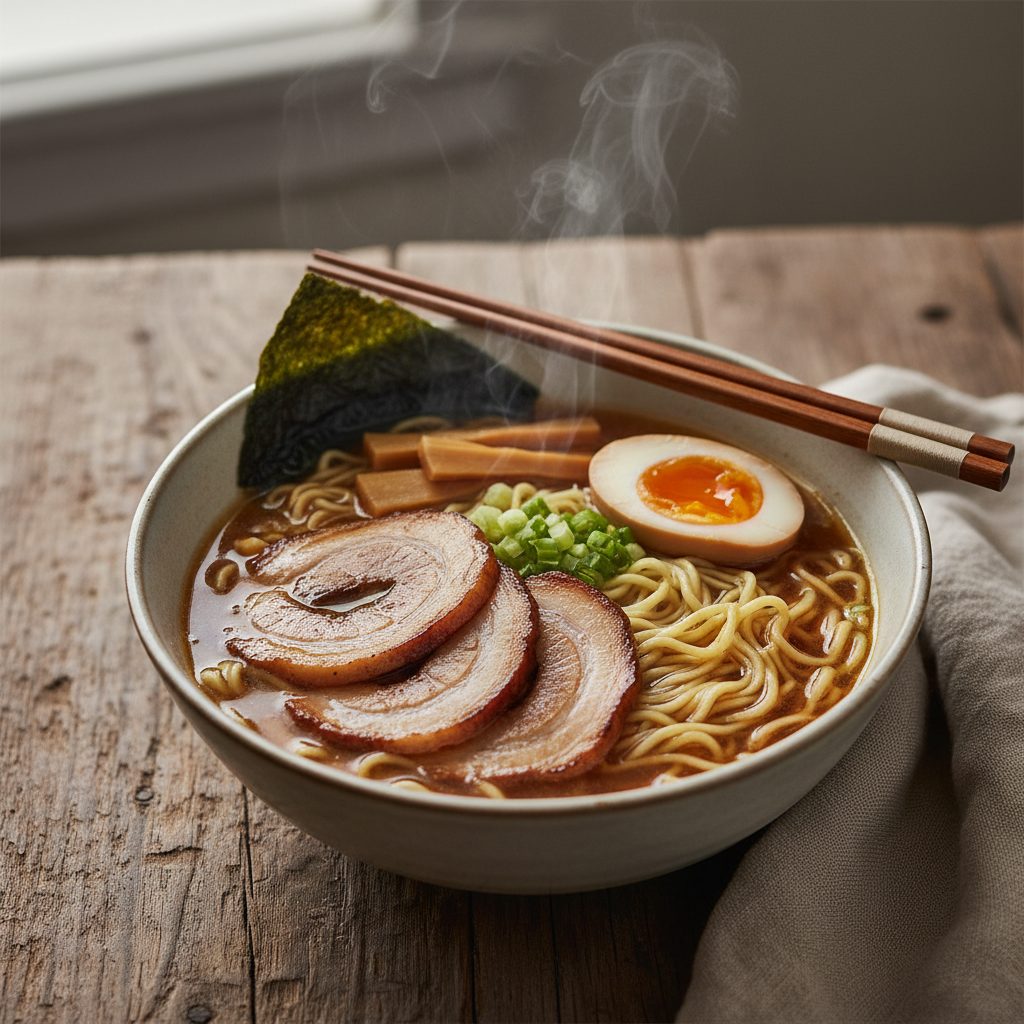
Japanese ramen begins where moderation ends. It is not a soup but an architecture of flavour. The noodles are strengthened with kansui. At the bottom waits the tare, that is shoyu, shio or miso. Above it the broth — clear chintan or heavy paitan, with tonkotsu as the fatty shogun. Then oil, chashu, ajitama, nori, menma. Every ingredient holds the rank of a courtier of the Tennō, yet the hierarchy vanishes with the first slurp.
Sapporo adds miso, butter and corn, because Hokkaido recognises no sentimentality towards the cold. Hakata drops thin noodles into a milky emulsion of pork bones, because the dockworker needed energy, not a lecture on aesthetics. Tokyo chooses clear shoyu. Kitakata, wide, flat ribbons. Behold the kokutai of ramen. Not one recipe, but a community of regional temperaments.
Ramen must be eaten at once. Noodles know nothing of deliberative democracy and will not wait while someone sets up a lamp for the photo. They swell, soften and rob the broth of its meaning. You slurp. Not for lack of manners, but out of respect for temperature, aroma and the moment. This is the Japanese ichi-go ichi-e. One encounter, one bowl, no repeat performance. An intellectual from Powiśle may adjust his glasses and say wabi-sabi, but by then the ramen has already died in the bowl.
Ramen made its way into the cup, into space, into prison economies and onto the black market. It has been chocolate, coffee, gold. After the war its sale was restricted, flour circulated underground, and street vendors met the Yakuza sooner than they met food critics. From "Shina soba" it became "Chuka soba", then ramen — a dish torn from its Chinese pedigree and dressed in a Japanese costume of craftsmanship, Buddhist focus and national pride.
Do not ask which ramen is the real one. The Chinese gave it the movement of the hand. The Japanese gave it drama. China offered a thread. Japan built a labyrinth out of it. The world poured on boiling water and decided it understood everything.
It does not. It could at least stop profaning ramen with a fork over a laptop.
## A port, not a temple
The official history is prosaic. After the borders opened in 1858, Chinese merchants and cooks flowed into Japanese ports. The first true ramen shop was reportedly "Rai-Rai Ken", opened in 1910 in Tokyo's Asakusa by a Japanese man, Kanichi Ozaki, who hired Chinese cooks. They served a nourishing soup tailored to the Japanese palate, with chashu pork, bamboo shoots and soy sauce.
The myth is more ambitious. According to a legend that historians dispute, the first ramen was eaten in the 17th century by the daimyō Tokugawa Mitsukuni, after a Chinese refugee advised him to season his udon with garlic, ginger and spring onion. Empires like a pedigree older than the documents.
## The five storeys of the bowl
Modern ramen stands on five pillars, and each has its own physics.
The noodles get kansui, an alkaline solution of potassium and sodium carbonate. It strengthens the gluten, gives the noodles springiness and a yellowish colour, and keeps them from going soggy straight away in hot broth. Broth divides into two schools: cloudy, vigorously boiled paitan emulsions, led by tonkotsu, and clear chintan, simmered below boiling point. The tare at the bottom of the bowl sets the character: soy-based shoyu, salt-based shio, or miso from fermented soybeans. Oil carries flavour and holds the heat, like burnt garlic oil mayu or chicken fat. Finally the toppings: long-braised chashu pork, ajitama egg marinated in soy, nori and menma bamboo shoots.
Here begins a difference you cannot see in a photograph. Chinese lamian from Lanzhou is pulled by hand, in one piece, and hardened with penghui, ash from desert plants. Japanese ramen is rarely made freehand today. The dough is rolled and cut by machine, and kansui is often a factory powder. China trusts the hand. Japan trusts the procedure.
## Observe, caress, bid farewell
The best treatise on ramen is a film. In the cult "Tampopo" of 1985, an old master teaches his pupil that ramen must first be looked at, its form appreciated, the noodles stroked with chopsticks, and the pork told "see you soon". It sounds like a joke, and it is a liturgy. The bowl has its order and demands attention.
Momofuku Ando, the inventor of instant ramen, used to say: "Peace will come to the world when everyone has enough to eat." The idea for the cup came to him in Los Angeles. Americans had no Japanese bowls and could not eat with chopsticks, so they broke the noodles into paper cups, poured water over them and ate them with a fork. Ando was not outraged. He built an empire on it.
## The black market, space and prison
After the Second World War, in the era of food rationing and occupation restrictions, selling ramen on the street was banned, flour circulated underground, and the Yakuza turned up at the yatai street stalls with their own price list. Ramen survived it the way it survives everything: in a warm bowl, eaten quickly and quietly.
Later it flew into space. In 2005 a "Space Ram" was prepared for the astronaut Soichi Noguchi, a version to be eaten in zero gravity. Back on Earth, after budget cuts in American prisons, instant noodles replaced cigarettes as currency. A bowl that began as food for port workers became the means of payment of people without freedom.
Japanese ingenuity knew no bounds. There has been chocolate ramen, ramen with a flake of edible gold, ramen in which coffee replaces the kansui water in kneading the dough. A cuisine that invented slurping out of respect can also slurp out of mischief.
## The change of name
Ramen's passport says the most about it. First it was "Shina soba", Chinese noodles. After the war the word "Shina" began to sound imperial and offensive, so the soup became "Chuka soba". In the 1950s, together with the era of instant noodles, the modern "ramen" took hold. In the 1990s ramen masters removed Chinese characters from their signboards and dressed in samue, garments associated with Japanese Buddhism and craftsmanship. Japanisation took place in costume and in vocabulary, but the noodle thread remembers where it came from.
The irony of history completes the picture. It was not ramen that changed China. It was Chinese cooks who brought it to Meiji-era Japan. And today it is China that eats the most instant noodles in the world, including when people must be fed quickly after a disaster, as after the Ludian earthquake in 2014. The thread came home as a cup.
So do not ask which ramen is the real one. The real one is the one you are eating now, before the noodles drink the broth.
📖 Glossary
- lamian
- Chiński makaron rozciągany rękami, skręcany i uderzany o stół, hartowany roślinnym penghui. Jest przodkiem japońskiego ramenu.
- kansui
- Alkaliczny roztwór węglanu potasu i sodu, który wzmacnia gluten i nadaje makaronowi do ramenu sprężystość i żółtawy kolor.
- tare
- Baza smakowa na dnie miski ramenu, która wyznacza jego charakter: sojowy shoyu, solny shio albo miso ze sfermentowanej soi.
- penghui
- Popiół z roślin pustynnych, którym utwardza się ręcznie wyciągany chiński lamian z Lanzhou.
- ichi-go ichi-e
- Japońska zasada jednego spotkania: jedna miska, żadnej powtórki, dlatego ramen trzeba jeść natychmiast.
Frequently Asked Questions
Does ramen come from Japan or China?
The ancestor of ramen is Chinese lamian, hand-pulled noodles hardened with plant-based penghui. It was brought to Japan in the 19th century by Chinese merchants and immigrants settling in port cities, especially Yokohama. „Rai-Rai Ken”, opened in 1910 in Tokyo's Asakusa, is considered the first true ramen shop.
What is kansui in ramen noodles?
Kansui is an alkaline solution of potassium and sodium carbonate added to the dough. It strengthens the gluten, gives the noodles springiness and a yellowish colour, and keeps them from going soggy straight away in hot broth. Today it is often a factory-made powder.
What are the components of a bowl of ramen?
Modern ramen stands on five pillars: kansui noodles, broth, tare at the bottom of the bowl, oil and toppings. The broth is either cloudy paitan, led by tonkotsu, or clear chintan, and the tare is shoyu, shio or miso. Toppings include chashu, ajitama egg, nori and menma bamboo shoots.
Why is ramen eaten quickly and slurped?
If you wait, the noodles swell, soften and rob the broth of its point. Slurping is not bad manners but respect for temperature, aroma and the moment. It is the Japanese ichi-go ichi-e: one encounter, one bowl, no repeats.
How did the name of ramen change?
First it was „Shina soba”, Chinese noodles. After the war the word „Shina” began to sound imperial and offensive, so the soup became „Chuka soba”. In the 1950s, together with the era of instant noodles, the modern word „ramen” took hold.
Who invented instant ramen?
Instant ramen was invented by Momofuku Ando. The idea for the cup came to him in Los Angeles, when he saw Americans breaking noodles into paper cups, pouring water over them and eating with a fork. Ando was not outraged; he built an empire on it.
Related Questions
- Does ramen come from Japan or China?
- What is kansui in ramen noodles?
- What are the components of a bowl of ramen?
- Why is ramen eaten quickly and slurped?
- How did the name of ramen change?
- Who invented instant ramen?
🧠 Thematic Groups
- Historia: chiński lamian dotarł do japońskich portów po 1858 roku, a pierwszą ramenownią był podobno tokijski „Rai-Rai Ken” z 1910 roku.
- Technika: miska ramenu ma pięć pięter, czyli makaron z kansui, bulion paitan lub chintan, tare, olej i dodatki takie jak chashu, ajitama i menma.
- Regiony: Sapporo dodaje miso, masło i kukurydzę, Hakata stawia na tonkotsu z cienkim makaronem, Tokio na klarowny shoyu, a Kitakata na szerokie wstęgi.
- Kultura i polityka: ramen przeszedł przez powojenny czarny rynek, kosmos i więzienny obieg, a zmiana nazwy z Shina soba na ramen była japonizacją w kostiumie i słowniku.
Tags:
ramen
lamian
kansui
tare
tonkotsu
paitan
chintan
chashu
Japanese cuisine
Chinese cuisine
Yokohama
Rai-Rai Ken
Momofuku Ando
Tampopo
Chuka soba
More in: Kuchnia niepolityczna
Content is created by Fundacja Dobre Państwo.
Edited and published by APA ONE, the Foundation's own AI-based editorial system.