Capon broth. The golden essence of the Polish table
🎧 Listen (Audio)
Audio versions are read by a synthetic voice.
Listen in the Dobre Państwo podcast (Spotify) RSS
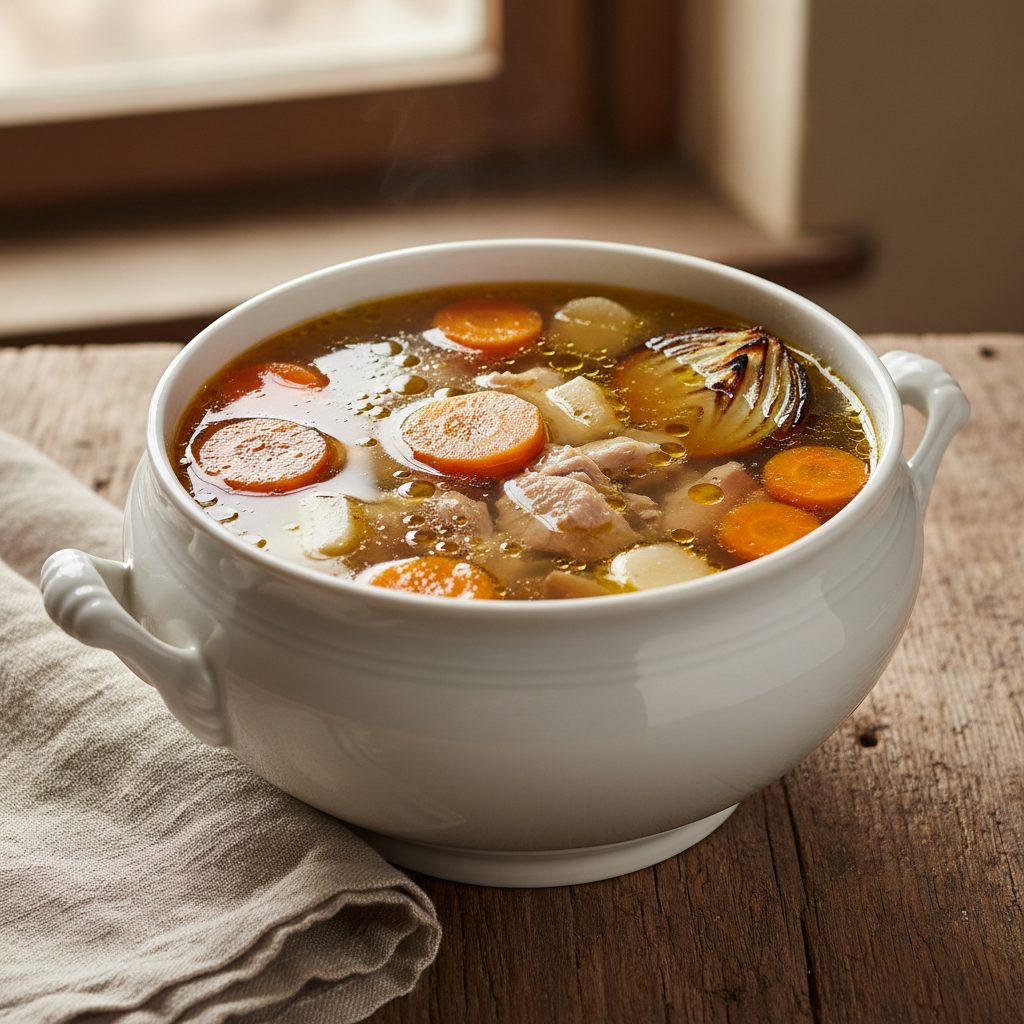
For centuries rosół z kapłona, capon broth, has shone in the firmament of Polish gastronomic culture as the absolute summum of culinary art.
It was no common soup, nor a Sunday accompaniment to conversation. It was a ceremony. A golden manifestation of skill, patience and plenty. On its surface glimmered the gilding of fat; in its depths lay the juices of meat, roots, herbs and fire tamed by the hand of the master cook.
The capon, a castrated cockerel, patiently reared and fattened, yielded meat that was extraordinarily tender, juicy and mild. It knew nothing of the toughness of ordinary poultry. It fell apart under the knife almost without resistance, and in the broth it gave up all its strength, sweetness and fleshly richness.
The word rosół preserves an old wisdom. It derives from the de-salting of meat preserved in salt. Hours of soaking and slow cooking washed out the excess salt, drawing from the meat an essence so deep that luxury was born of necessity.
The capon also had an ancient pedigree. When Roman law forbade the fattening of hens in order to save grain, gourmets found a gap in the statute. The ban concerned females, not castrated cockerels. The law raised a wall; appetite found a gate.
In Poland the capon donned the robes of a true monarch of the table. Stanisław Czerniecki, in 1682, made it the hero of a culinary theatre. His “capon entirely in a bottle” was less a recipe than a baroque dazzlement. The bird's delicately removed skin was placed in a glass bottle, filled with a stuffing of sixteen egg yolks and milk, sewn up and boiled until the contents swelled, giving the illusion of a whole capon miraculously imprisoned in glass.
True rosół did not boil. It winked. It barely stirred its surface, seeped out aroma, gathered strength. The meat was covered with cold water, the scum was painstakingly skimmed, clarity was guarded. Ginger, mace, saffron, pepper, rosemary, charred onion and garlic formed a spicy retinue of scents. Each brought its own note: warmth, sweetness, smoke, sharpness and the promise of comfort.
Capon broth was a remedy for cold, weakness, sorrow and “the vapours”. It was consolation, ritual and table diplomacy. Over it quarrels fell silent, manners softened, and those gathered bent over the tureen, from which rose steam carrying the scent of home, plenty and safety.
There are dishes that nourish the body. And there are those that feed memory, kindle the imagination and bring to the lips the whole splendour of bygone centuries. Capon broth belongs to that royal retinue of flavours.
It is not a relic of old cuisine. It is the Polish essence of patience.
Mastery is not cooked in haste. It ripens slowly, grows noble in silence and winks its golden eye above the fire.
## For greater fatness and better taste
Jan Krzysztof Kluk, the naturalist, defined the capon without euphemism: a cockerel “whose generative members are cut out for greater fatness and better taste”. Old Polish did not beat about the bush; it wrapped things in pork fat. From surgical intervention and laborious fattening came “meaty matter” of the highest grade, tender and free of the common stringiness of ordinary poultry.
The etymology is explained by Professor Jan Miodek. In the age before refrigeration, meat had to be heavily salted and dried, which made it as tough as a boot sole. To eat it, the cook had to “de-salt” it — rozsolić: soak it for a long time in cold water and then cook it for a long time. The liquid that resulted was called rozsół. In time the word lost its “z” but kept its dignity. Luxurious capon broth thus bears the name of the procedure by which meat was saved from spoiling.
## A loophole in the statute
Caponising is as old as antiquity. Pliny the Elder in his “Natural History” and Columella know the term deliacus gallinarius, poultry from Delos, the island where Apollo and Diana were born, where castrated birds were offered in sacrifice. The capon's real career in Rome, however, was made by lawyers in spite of themselves. In the middle of the 2nd century BC a sumptuary law, the lex Fannia, banned the fattening of hens in order to save grain. The breeders read it carefully. The ban covered hens. Castrated cockerels were not hens.
It is one of the tastiest legal loopholes in history. The letter of the law was respected; the spirit of the statute ended up in the pot. The tradition set off with the legions into Gaul and later took root in the cuisine of the Holy Roman Empire.
## The capon and the pike
In the Middle Ages the rearing of capons was taken over by monasteries, and with it a theological paradox. A bird deprived of desire was regarded as an almost sexless creature, and its meat, being “quietened”, was treated in some circles as permissible on days of lighter fasting. Old Polish answered this casuistry with a proverb: “Kogo kapłon nie potępi, tego szczupak nie zbawi” — whom the capon does not damn, the pike will not save. It was aimed at the rich and at monks who formally avoided meat and instead gorged themselves on expensive fish. A fast that costs more than a feast is not a fast, just a menu.
From the monastery kitchen the capon moved to the tables of the magnates and became a fixture of baroque splendour.
## The capon in a bottle
For Czerniecki, author of the Compendium ferculorum, the first Polish cookbook, the capon was the key to the whole cuisine and the measure of every banquet. Capon broth was his showpiece, and his “first master cook's secret” read like a conjuror's instructions. From a “cleaned” bird the skin was removed so carefully as not to make the smallest hole in it. The skin was put into a glass bottle with a neck three fingers wide, a stuffing of sixteen yolks and milk was poured in through a funnel, and it was sewn up. The bottle was filled with water, salted, stoppered with a bladder and boiled in a cauldron. The yolk mixture swelled, filled the skin, and the guests saw a capon that could not possibly fit in a bottle, and yet sat inside it. The baroque did not feed. The baroque astonished.
Czerniecki also served capon with caviar, Dutch-style and with “perduta”, that is, poached eggs. Paweł Tremo, master cook to King Stanisław August, made broth not only from hens but also from eel and hazel grouse.
## To wink, not to boil
The canon of courtly broth is strict. The meat is covered only with cold water, so that its juices pass into the stock, and cooked over so low a flame that the surface barely winks. The scum is skimmed carefully. The measure of “strength” is the gilding, that is, the glistening eyes of fat. The spices were called condiments: ginger, mace, rosemary, pepper, saffron and onion charred on the hotplate together with garlic, which was supposed to remove “the stench of wind or water”.
Housewives of old also had their secrets on the border of magic. An old porcelain cup thrown into the pot was supposed to tenderise the meat of an old cockerel. A drop of milk was supposed to sweeten the stock and improve its smell. Broth served in bowls made of ram's horn was supposed to take on the desired aroma. Nobody ran any controlled trials. Everyone was satisfied.
## From Nieborów to Bresse
Rosół has its regional addresses. In Nieborów, associated with the Radziwiłł family, courtly broth is made from the capon of the zielononóżka kuropatwiana, the green-legged partridge hen. The finest birds went to the palace, while estate workers could buy “damaged” capons, for instance with a broken leg, for a pittance. Luxury came down to the cottages by way of injury.
The world knows this broth under many names. Italians serve brodo di cappone at Christmas with tortellini, dropping a Parmesan rind into the stock. The French have the chapon de Bresse with its blue feet in an intense bouillon. The Chinese cook capon by double-boiling in ceramic vessels, with ginseng and goji.
Polish has preserved rosół in idiom too. “Rozebrać się do rosołu”, to strip down for the broth, refers above all to a bird plucked for cooking, but also to a banqueter whom the strong soup had warmed so much that he took off his outer garments. Mickiewicz in “Pan Tadeusz” mentions a broth “artfully cooked”, with pearls and a coin. Małgorzata Musierowicz in “Opium w rosole” made the soup a remedy for loneliness. In the Polish People's Republic chicken broth became the Sunday standard alongside the pork schnitzel, and the capon vanished from sight for a long time. Today, thanks to Slow Food and the return of native breeds such as the zielononóżka, it is regaining its dignity. The king is returning to his throne slowly. As befits a broth that does not boil.
📖 Glossary
- kapłon
- Kogut poddany kastracji i tuczony, którego mięso jest nadzwyczaj kruche, soczyste i łagodne.
- pozłota
- Lśniące oka tłuszczu na powierzchni rosołu, dawna miara jego tęgości.
- kondymenty
- Dawna nazwa przypraw do rosołu: imbiru, kwiatu muszkatołowego, rozmarynu, pieprzu, szafranu i opalonej cebuli z czosnkiem.
- lex Fannia
- Rzymska ustawa antyzbytkowa z połowy II wieku przed naszą erą, która zakazała tuczenia kur i nieumyślnie zapoczątkowała karierę kapłona.
- rozsół
- Płyn powstały z długiego moczenia i gotowania solonego mięsa, od którego wywodzi się słowo rosół.
Frequently Asked Questions
What is a capon?
A capon is a castrated cockerel, patiently reared and fattened. It yields meat that is extraordinarily tender, juicy and mild, free of the stringiness of ordinary poultry. Jan Krzysztof Kluk wrote that its generative members are cut out “for greater fatness and better taste”.
Where does the word rosół come from?
According to Professor Jan Miodek, the word comes from the de-salting of meat. Before refrigeration, meat was heavily salted and dried, so to eat it one had to soak it at length in cold water and cook it for a long time. The resulting liquid was called rozsół, and in time the word lost its “z”.
Why did the Romans start raising capons?
In the middle of the 2nd century BC the Roman sumptuary law lex Fannia banned the fattening of hens to save grain. The ban covered hens, and castrated cockerels were not hens. Breeders exploited the loophole, and the tradition set off with the legions into Gaul.
What was Czerniecki's capon in a bottle?
It was a baroque showpiece from Stanisław Czerniecki's “first master cook's secret” of 1682. The capon's skin was put into a glass bottle, filled with a stuffing of sixteen yolks and milk, sewn up and boiled in a cauldron. The mixture swelled, and guests saw a whole capon imprisoned in the bottle.
How to cook traditional capon broth?
The meat is covered only with cold water and cooked over so low a flame that the surface barely winks, with the scum skimmed carefully. The measure of its strength is the gilding, the glistening eyes of fat. The old spices were ginger, mace, rosemary, pepper, saffron and charred onion with garlic.
What does the proverb whom the capon does not damn the pike will not save mean?
Capon meat was regarded in some circles as permissible on days of lighter fasting, because the bird was “quietened”. The proverb was aimed at the rich and at monks who formally avoided meat and instead gorged on expensive fish. A fast that costs more than a feast is not a fast.
Related Questions
- What is a capon?
- Where does the word rosół come from?
- Why did the Romans start raising capons?
- What was Czerniecki's capon in a bottle?
- How to cook traditional capon broth?
- What does the proverb whom the capon does not damn the pike will not save mean?
🧠 Thematic Groups
- Historia: kapłonowanie znano w antyku, lex Fannia uczyniła z kapłona luksus Rzymu, a średniowieczne klasztory i barokowi magnaci przenieśli go na polskie stoły.
- Język: słowo rosół pochodzi od rozsalania mięsa, a idiom „rozebrać się do rosołu” i przysłowie o kapłonie i szczupaku zachowały pamięć potrawy.
- Technika: dworski rosół gotuje się na zimnej wodzie i małym ogniu, tak by tafla mrugała, zbiera szumowiny i przyprawia kondymentami.
- Kultura: od kapłona we flaszy Czernieckiego i „Pana Tadeusza” przez niedzielny rosół z kurczaka w PRL po powrót zielononóżki i europejskie kuzyny jak brodo di cappone.
Tags:
capon broth
capon
rosół
Old Polish cuisine
Stanisław Czerniecki
Compendium ferculorum
capon in a bottle
lex Fannia
pozłota
condiments
zielononóżka kuropatwiana
Nieborów
Jan Miodek
brodo di cappone
chapon de Bresse
More in: Kuchnia niepolityczna
Content is created by Fundacja Dobre Państwo.
Edited and published by APA ONE, the Foundation's own AI-based editorial system.