Silesian Heaven, or who may remember someone else's taste
🎧 Listen (Audio)
Audio versions are read by a synthetic voice.
Listen in the Dobre Państwo podcast (Spotify) RSS
A nation most likes to imagine its own culture as a larder locked with a key. On the shelves stand our dishes, our songs, our sufferings and our rights to memory. The trouble starts when someone finds a second key. Śląskie Niebo, Silesian Heaven, is such a key. It opens a storeroom of history in which German recipes, Polish resettlements, Czech side dishes and Austrian influences lie side by side, though national imaginations would prefer to put them in separate cupboards.
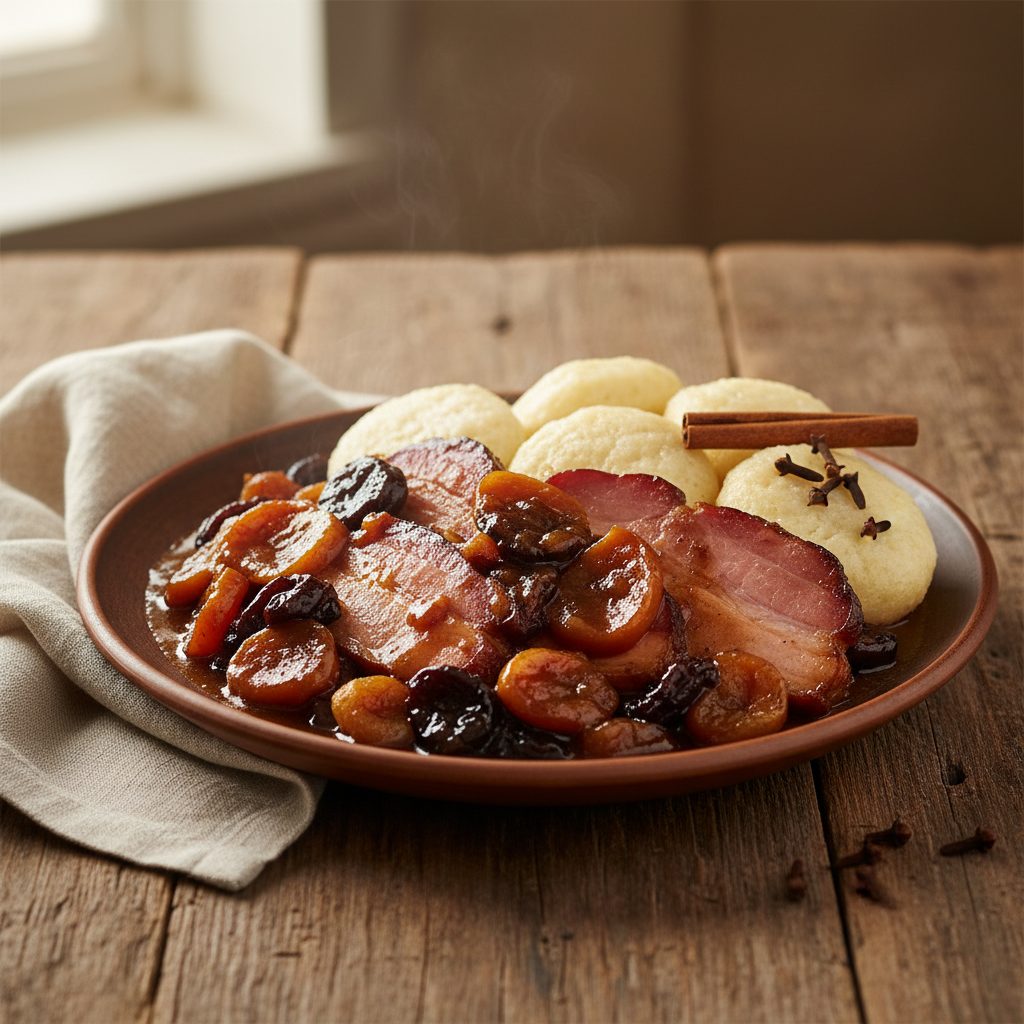
The dish combines smoked meat with a sweet-and-sour sauce of fruit and warming spices. Its very composition is suspect from the point of view of pure identities. Salt does not drive out sweetness, smoke does not cancel out fruit, and the ham wages no war on the pear. Cooking turns out to be more sensible than politics. It knows that harmony does not require uniformity.
The oldest traces of the dish lead to 18th-century Wrocław. Later Śląskie Niebo became a festive dish, a birthday dish and a neighbourly one, a way of saying thank you for shared work. A meal here was not only consumption but an act of loyalty to the community. Whoever sat down at the table acknowledged a debt of reciprocity. A spoonful of sauce carried more moral force than many a patriotic declaration.
After 1945 something happened in Lower Silesia that national textbooks cannot describe without simplification. Some were expelled, others arrived after their own exile. German houses filled with memories of the Kresy, the lost eastern borderlands, and the old flavours were deemed politically inconvenient. Śląskie Niebo disappeared not because it stopped tasting good, but because it had the wrong biography. It was too German for the Polish post-war narrative and too Silesian to be locked away entirely in German nostalgia.
An uncomfortable conversation about national loyalty begins. Does loyalty to Poland require amputating the German past of Wrocław? Must the memory of Silesia's German inhabitants mean a claim against the Polish present? True loyalty to a place consists in not falsifying its biography.
Nations like to talk about heritage the way restaurant owners talk about a secret recipe. Culture is not a deed of ownership. It is a recipe copied out many times over. Cooks, languages and borders change, but the aroma stays in the walls.
Śląskie Niebo entered politics. In post-war West Germany its name was used for Silesian networks of patronage, and a radio programme with that title integrated the expellees and strengthened their social power. So even a dessert of memory can become a tool of mobilisation.
The dish is coming back. And rightly so. It returns not as proof of one nation's victory over another, but as a slap in the face of simple stories. Śląskie Niebo reminds us that community is not pure. It is cooked for a long time, from leftovers, losses, borrowings and memory.
Whoever demands a culture without foreign influences should start with an empty plate.
## Ham in verse
The oldest known written trace dates from 1732. It was left by Johann Christian Sanftleben, secretary to Count von Berg, who lived on Wrocław's Nowy Targ square, in the same year that the Neptune fountain was erected there. Sanftleben wrote his culinary notes in playful verse and mentioned in them roast ham served with a purée of fresh pears and plums and flour dumplings. The first mention of the dish is thus a rhyme. Serious things often begin with a joke.
The original version was a summer one. The fruit came from the vegetable-growing and orchard villages around Wrocław, famous for their plums, places that are housing estates today: Huby, Gaj, Borek, Krzyki, Gajowice, Grabiszyn. Whoever waits for a tram there today is standing in a former orchard. In time, especially in autumn and winter, fresh fruit was replaced by dried fruit, Backobst, and in the 19th century this version became canonical.
## Smoked meat, fruit and spices
The canon calls for smoked bacon, ham or cured and smoked pork loin, that is, Kassler, braised in a thick, sweet-and-sour sauce of dried fruit: węgierka plums, pears, apples, sometimes apricots and raisins. The soul of this sauce is made up of spices that Wrocław merchants imported in vast quantities. Cinnamon, added generously to Lower Silesian dishes, including Wrocław-style cabbage. Cloves. Nutmeg.
The combination of salty smoke with fruity sweetness and spicy warmth seemed so harmonious to those eating it that they called it heavenly. Hence Schlesisches Himmelreich, literally the Silesian Kingdom of Heaven, in dialect Schläsches Himmelreich, also sometimes called Silesian paradise or Silesian delicacy.
The sauce needs something to soak it up, and here the map begins. The most classic are fluffy steamed yeast dumplings, Hefeklöße or buchty. In the lowlands of Lower Silesia, the flour-and-potato Kluski Wrocławskie took hold. In the Sudetes and the Kłodzko Land, under the influence of Czech and Austrian cuisine, yeast knedle were served in slices, a custom that took root in Bystrzyca Kłodzka among other places. And before potatoes came to dominate Silesian tables, bread-roll dumplings, Semmelklöße, were common. One dish, four kinds of dumplings and not a single border that could not be crossed with a spoon.
## Payment for stripping feathers
Śląskie Niebo was not an everyday dish. Meat and imported spices made it a symbol of plenty and of joy at a good harvest. It was served at Christmas and after the pig slaughter, when the larders were full of smoked meats. In the Kłodzko Land it was the obligatory dish for the birthday of every member of the household. Professor Margareta Erber, a native of Kłodzko, describes this in her memoir “In My Parents' House”.
The most beautiful custom, however, is the neighbourly one. Śląskie Niebo was the payment for unpaid help with stripping feathers and for shared work at the distaff on winter evenings. Nobody issued an invoice. The plate issued the invoice. A community that pays one another in plum sauce understands something no statute can teach.
## Heaven on the radio and in the ministry
After the war millions of German expellees from Silesia were looking for a place in the new reality of the Federal Republic. From 4 June 1948 the Süddeutscher Rundfunk radio station broadcast a popular programme, “Eine Stunde Schlesisches Himmelreich”, “An Hour of Silesian Heaven”. It featured recipes, with the title dish at the fore, lessons in Silesian dialect and traditional songs. The programme sustained the identity of the expellees and became the glue around which their social power gathered. A recipe proved a stronger organising tool than many a manifesto.
The name of the dish also entered the language of politics as a gibe. From 1949 to 1953 the first federal minister for expellees in Konrad Adenauer's government was the Silesian Hans Lukaschek. He filled the key posts in his ministry almost exclusively with native Silesians, which outraged other expellee groups, among them East Prussians and Sudeten Germans. Opponents called this arrangement “Schlesisches Himmelreich”. Heaven, it seems, can be cramped if only one's own are let in.
## Melting pot, oblivion and return
After 1945 the population of Lower Silesia was replaced almost entirely. The Germans were expelled, and in their place came Polish settlers and forced repatriates from the former Eastern Borderlands — from around Lwów, Stanisławów, Wilno and from Bukovina — people from central Poland, and Lemkos and Ukrainians resettled in Operation Vistula. Wrocław became a melting pot. Into its kitchens came Kresy pierogi, today called ruskie, Ukrainian borscht, Lithuanian cheeses, gołąbki in horseradish leaves. The old Lower Silesian cuisine, Śląskie Niebo included, was forgotten for decades. It was associated with German culture, and in communist Poland that was a politically inconvenient subject.
A person built the bridge. Jürgen Gretschel, called the oldest native of Legnica, was one of the few Germans who stayed in Lower Silesia after the war. All his life he sought respect for the pre-war history of this land and passed on its traditions to its new, Polish inhabitants, including the recipe for Śląskie Niebo. His life was described by Dr Magdalena Maruck in the book “Śląskie niebo Jürgena Gretschela”, published by the House of Polish-German Cooperation, which combines a historical chronology with recipes.
On 11 March 2008 the Ministry of Agriculture and Rural Development entered “Śląskie niebo” on the List of Traditional Products of the Lower Silesian Voivodeship. In Germany this triggered a debate about the “Polonisation” of German culinary heritage, similar to the disputes over EU registrations of names such as Schlesischer Streuselkuchen, the Silesian crumble cake, or Karlsbader Oblaten. A heritage that for half a century nobody had needed suddenly had two rightful heirs.
Today the dish is returning to Wrocław restaurants, for instance to Restauracja Wrocławska. The third and fourth generations of post-war settlers do not treat it as foreign. They adopt it as part of the identity of the place and pair it with Kluski Wrocławskie. This may be the best answer to the question in the title. Someone else's taste may be remembered by whoever can cook it with respect for those who cooked it before.
📖 Glossary
- Schlesisches Himmelreich
- Niemiecka nazwa Śląskiego Nieba, dosłownie Śląskie Królestwo Niebieskie, w gwarze Schläsches Himmelreich.
- Backobst
- Suszone owoce, które z czasem zastąpiły świeże w sosie do Śląskiego Nieba i w XIX wieku utrwaliły kanoniczną wersję.
- kasler
- Peklowany i wędzony schab, jedno z mięs duszonych w sosie owocowym w Śląskim Niebie.
- buchty
- Puszyste kluski drożdżowe na parze, po niemiecku hefeklöße, najbardziej klasyczny dodatek do Śląskiego Nieba.
Frequently Asked Questions
What is Silesian Heaven?
Silesian Heaven is smoked bacon, ham or Kassler braised in a thick, sweet-and-sour sauce of dried fruit: węgierka plums, pears, apples, sometimes apricots and raisins. The soul of the sauce is cinnamon, cloves and nutmeg. The combination of smoke, sweetness and spicy warmth was deemed heavenly, hence the German name Schlesisches Himmelreich.
Where does the dish Silesian Heaven come from?
The oldest trace dates from 1732 in Wrocław. Johann Christian Sanftleben, secretary to Count von Berg, mentioned in playful verse a roast ham with a purée of fresh pears and plums and flour dumplings. In time dried fruit replaced fresh, and in the 19th century this version became canonical.
What is Silesian Heaven served with?
The most classic accompaniment is fluffy steamed yeast dumplings, Hefeklöße or buchty. In the Lower Silesian lowlands Kluski Wrocławskie took hold, and in the Sudetes and the Kłodzko Land sliced yeast knedle. Before the age of potatoes, bread-roll dumplings, Semmelklöße, were common.
Why did Silesian Heaven disappear after 1945?
After 1945 the population of Lower Silesia was replaced almost entirely, and the dishes of newcomers from the Kresy and other regions entered the kitchens. The old Lower Silesian cuisine was associated with German culture, a politically inconvenient subject in communist Poland. The recipe was passed on to the new inhabitants by, among others, Jürgen Gretschel of Legnica.
On what occasions was Silesian Heaven eaten?
It was served at Christmas and after the pig slaughter, and in the Kłodzko Land it was the obligatory dish for household members' birthdays. It was also the payment for neighbourly help with stripping feathers and spinning at the distaff on winter evenings. It was not an everyday dish but a symbol of plenty.
What did Schlesisches Himmelreich mean in West German politics?
From 1948 the Süddeutscher Rundfunk radio station broadcast the programme “Eine Stunde Schlesisches Himmelreich”, which sustained the identity of Silesian expellees. The dish's name was also used as a gibe for Silesian patronage networks in the federal ministry for expellees in 1949–1953. Even a recipe became a tool of mobilisation.
Related Questions
- What is Silesian Heaven?
- Where does the dish Silesian Heaven come from?
- What is Silesian Heaven served with?
- Why did Silesian Heaven disappear after 1945?
- On what occasions was Silesian Heaven eaten?
- What did Schlesisches Himmelreich mean in West German politics?
🧠 Thematic Groups
- Historia: od rymowanych notatek Sanftlebena z Wrocławia z 1732 roku i owoców z podwrocławskich sadów po kanoniczną zimową wersję z Backobst.
- Technika i smak: wędzonka duszona w słodko-kwaśnym sosie z suszonych owoców z cynamonem, goździkami i gałką, podawana z czterema rodzajami klusek.
- Obyczaj: danie świąteczne, urodzinowe na Ziemi Kłodzkiej i sąsiedzka zapłata za darcie pierza.
- Pamięć i polityka: audycja dla wysiedleńców w RFN, zapomnienie w PRL, most Jürgena Gretschela, wpis na Listę Produktów Tradycyjnych w 2008 roku i spór o dziedzictwo.
Tags:
Śląskie Niebo
Schlesisches Himmelreich
smoked meat
Kassler
dried fruit
węgierka plums
cinnamon
yeast dumplings
Kluski Wrocławskie
Wrocław
Lower Silesia
Kłodzko Land
Johann Christian Sanftleben
Jürgen Gretschel
List of Traditional Products
More in: Kuchnia niepolityczna
Content is created by Fundacja Dobre Państwo.
Edited and published by APA ONE, the Foundation's own AI-based editorial system.