Solianka. The soup that slips out of gastronomy
🎧 Listen (Audio)
Audio versions are read by a synthetic voice.
Listen in the Dobre Państwo podcast (Spotify) RSS
Solianka has a peculiar quality: the harder you try to reduce it to the role of a soup, the more clearly it slips out of gastronomy and starts telling the history of Eastern Europe. It is a dish born not of abundance but of the ability to give meaning to what was left over. Leftovers meet in the pot, yet they do not make a leftover culture. On the contrary, they arrange themselves into a flavour that is intense, impudent and impossible to fake.
The name, sielanka, pointed towards the village, simplicity and peasant origins. The later solianka shifted the accent from place to taste: salt, sourness, pickles, smoke. Hidden in that linguistic shift is a story of social advancement. What was supposed to stay in the tavern learned to walk into the salons without asking permission.
The first versions of solianka were not soup at all, but a thick dish of cabbage, meat and cucumbers fried in a pan. The Russian columnist Konstantin Skalkovsky called it a parody of Polish bigos. Parody is a word lined with envy. Cuisine rarely knows pure beginnings. It prefers borrowings, reworkings and brazen adaptations. Where historians look for precedence, cooks simply improve the taste.
Bigos is said to have reached Moscow with the Polish armies, carried in saddlebags and reheated at every halt. One could say, then, that some cultural influences cross borders not thanks to treaties, but because they take well to being reheated.
Later, solianka made an unexpected career in the GDR. Soviet in concept, German in execution, Hungarian thanks to tinned lecsó, it became the culinary equivalent of the Eastern Bloc, only far more efficient than its institutions. In an economy of shortage it showed that scarcity need not breed only frustration. Sometimes it breeds style.
A perverse anecdote arrived after German reunification, when Western police officers reportedly took the capers and mushrooms in a solianka for larvae. A forensic biologist was brought into the case. The concrete Wall no longer existed, but the wall of preconceptions was still standing firm.
Solianka remains something more than a dish. It is a reminder that culture grows on the margins, from impure sources and unlikely combinations. What the centre considers provincial, derivative or too heavy often turns out, in time, to be exactly what best preserves memory.
The pot holds a history of poverty, migration, war, shortage and people's astonishing ability to turn an accident into a tradition. Not everything inherited must be worshipped, and not everything left over must be thrown away. Sometimes it is enough to change the proportions.
## From village to salt
The original name was selanka, from sioło, the village. It meant something like country soup, settlers' food, a peasant stew. Fatty, simple, hardly refined, it was long regarded as food for the poor and had no entry to aristocratic salons. Its rise began in the taverns. There the flavour grew sharper: salt was added, pickled cucumbers, kvass, salted meats and fish. Folk etymology did the rest and linked the name with sol, salt. Selanka became solanka. The village turned into a seasoning.
For its first centuries solianka was not a soup at all. Seventeenth-century mentions describe a hot, thick dish of braised cabbage, onion, pickled cucumbers and various meats, fish or mushrooms, fried in a pan and strongly sour from vinegar or brine. In 1794 Nikolai Osipov published one of the first written recipes for a thick selianka: sauerkraut, chopped onion, butter, vinegar, pepper and slices of ham, all properly fried, and in many versions pickled cucumber as well. In 1822 the Dictionary of the Russian Academy still saw it exclusively as a main course.
It became a soup only in the 1830s. In 1834 Gerasim Stepanov placed a "selianka with herring" in his book, in the section on varieties of shchi, and instructed the reader to pour good broth over the fried cabbage. From the 1840s solianka was an independent first course. Cuisine changes its state of matter more slowly than politics, but more effectively.
There is also a myth to debunk. The Soviet food historian William Pokhlebkin claimed that the name already appears in the sixteenth-century Domostroy. It was checked: the word "solianka" is found neither there nor in the later list of tsarist dishes from 1610–1613. There are only general mentions of salted dishes and dishes in brine. Over-interpretation built a chronology that never existed. Even historians like to add a pinch of salt.
## A parody of bigos
The most intriguing hypothesis leads to Moscow at the beginning of the seventeenth century. Some food historians believe that solianka arose as a local attempt to recreate Polish bigos, which the soldiers of Hetman Stanisław Żółkiewski brought to Moscow in 1610. The Poles packed cooked bigos into leather saddlebags and reheated it at their halts. The longer the cabbage cooked, the better it tasted. East Slavic cooks imitated this nourishing dish and created their own version of braised leftover meat with cabbage and cucumbers.
Konstantin Skalkovsky (1843–1906) described the connection with rare candour. He had eaten, as he recalled, a great many dishes of Polish cuisine, one of the heaviest in the world, discovered the charm of "bigus" and decided that the Moscow pan-fried selianka was merely its parody. His memoirs also contain a maxim attributed to the Polish nobility: the longer you cook sour cabbage, the better it tastes.
The parody, however, went its own way. Bigos stayed thick and braised, while the Eastern cooks added more and more liquid, pickle brine and kvass, until a thick, warming soup with a salty-sour profile was born. The imitator stopped imitating and became an original itself.
## Three elements and tavern freedom
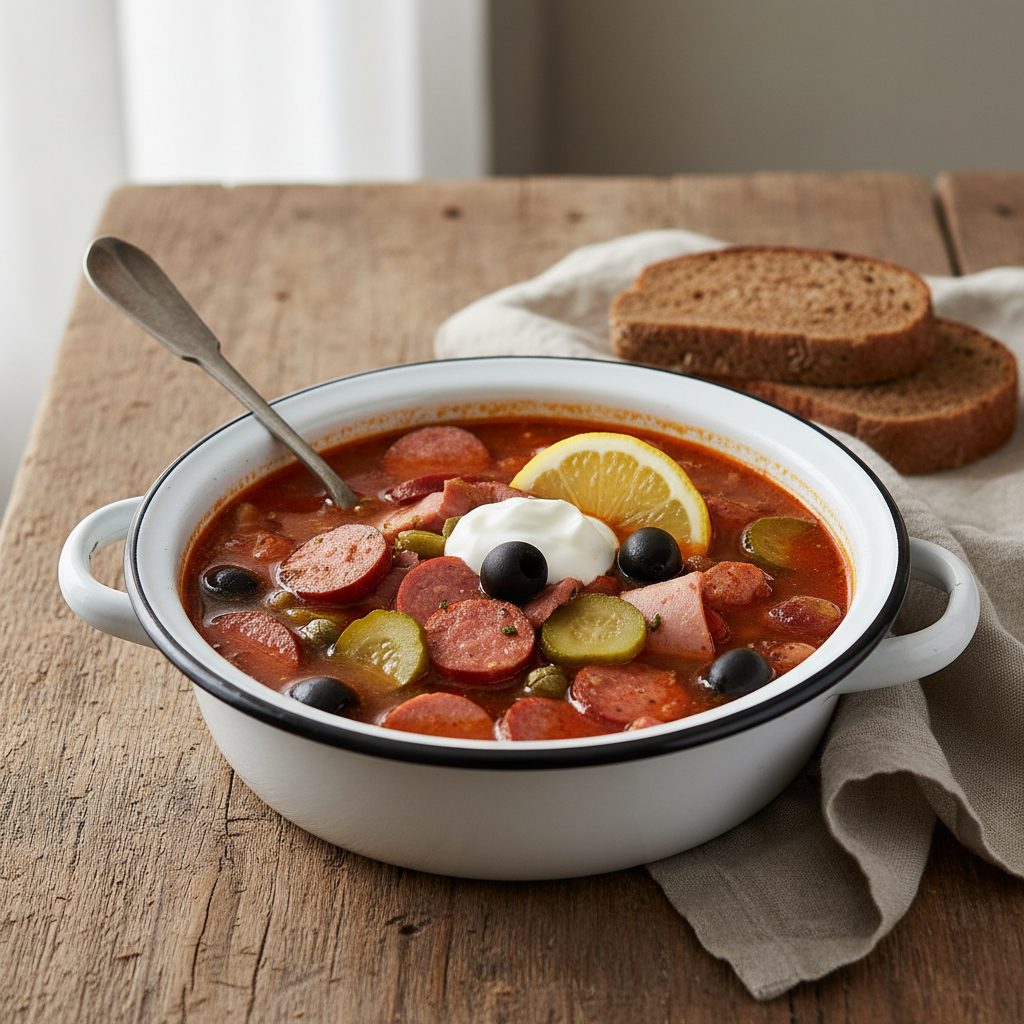
Today three classic varieties are distinguished. Meat solianka, sbornaya, the "assorted" one, is the most popular and the most filling. First an intense broth is cooked from bones and fatty cuts, such as pork knuckle or smoked ribs, then a whole range of sliced cured meats goes in: bacon, ham, sausage, even frankfurters, and fatback. Fish solianka rests on a stock of various fish, boiled, salted and smoked all at once, and the most "boyar" versions are made from sturgeon. Mushroom solianka combines dried, pickled, fresh and marinated mushrooms, saffron milk caps for instance. The cabbage in it is braised with tomato paste, and the whole thing is often baked under breadcrumbs.
The greatest virtue of solianka is the lack of a single, official recipe. From tsarist taverns to modern restaurants, every cook composed his own version from whatever was at hand and drew guests in with an aroma that could not be copied. Capers, olives, lemon slices, even mussels are the fruits of this culinary anarchy. Where there is no canon, talent grows.
Solianka has always gone hand in hand with vodka. In taverns it was ordered as a salty zakuska during drinking and as a rescue in the morning. Hence its unofficial nickname: pokhmelka.
## The culinary Warsaw Pact
After the Second World War solianka crossed borders and made a career in the GDR. It was brought by Soviet soldiers stationed there, and it quickly found its way into restaurants and workers' canteens. In a planned economy with a permanent shortage of fresh vegetables, it proved the ideal dish. The Germans treated it as Resteküche, leftover cooking. Meats were replaced by cold cuts, Jagdwurst sausage, smoked Kasseler ham and frankfurters. Instead of tomatoes came lecsó imported from Hungary in tins or jars, which gave a sweet-and-sour, paprika character. Russian in name and concept, Hungarian in its main ingredient, German in execution. An alliance that, unlike the political one, actually worked.
People called it "the soup of the friendship of nations" or, jokingly, "soup made of whatever survived yesterday". It was so well loved that it stayed on the menus of the eastern Länder long after the Soviet troops had gone home. Angela Merkel, who grew up in the GDR, recalled in interviews that she still has a weakness for solianka and lecsó and still feels the need to keep a stock of them in the pantry. Habits of scarcity outlive political systems.
## The dispute over worms
After the fall of the Wall, officials and police officers from the West arrived in the former GDR, called by the locals Besserwessis, Western know-it-alls. They approached the thick, red dishes of the Eastern canteens with suspicion. During a joint shift they were served a traditional solianka. After a few spoonfuls, panic broke out: the guests from the West accused their Eastern colleagues of deliberately putting fly larvae in the soup and trying to poison them. The Eastern officers explained that these were capers, mushrooms and spices. Nobody listened.
The matter came close to an official investigation. The contents of the plate were examined by the forensic biologist and entomologist Mark Benecke. The result was unequivocal: the alleged worms turned out to be capers and bits of mushroom. The farce went down in history as a metaphor for the gulf between Ossis and Wessis during the transition. The concrete could be torn down. The wall on the plate required a laboratory report.
📖 Glossary
- selanka
- Pierwotna nazwa solianki, od sioła, czyli wsi. Oznaczała zupę wiejską, potrawę osadników i chłopski gulasz.
- sbornaja
- Mięsna, „zbiorowa” odmiana solianki, najpopularniejsza i najbardziej sycąca, na bulionie z kości z dodatkiem wielu rodzajów wędlin.
- Resteküche
- Niemieckie określenie kuchni z resztek. Tak w NRD traktowano soliankę gotowaną z wędlin i leczo z puszki.
- pohmielka
- Nieoficjalny przydomek solianki, zamawianej w karczmach jako słona zakąska do wódki i jako ratunek o poranku.
- Besserwessis
- Zachodnie mądrale, jak mieszkańcy dawnego NRD nazywali przybyłych po upadku Muru urzędników i policjantów z Zachodu.
Frequently Asked Questions
Where does the name solianka come from?
The original name was selanka, from sioło, the village, so it meant something like country soup or peasant stew. When tavern cooks sharpened the flavour with salt, pickled cucumbers and salted meats, folk etymology linked the name with salt. Selanka became solanka.
Does solianka come from Polish bigos?
Some food historians believe solianka arose as a Moscow attempt to recreate the bigos that Hetman Żółkiewski's soldiers brought to Moscow in 1610 in leather saddlebags. Konstantin Skalkovsky called the Moscow pan-fried selianka a parody of Polish „bigus”. Eastern cooks kept adding liquid, however, and the imitator became an original.
When did solianka become a soup?
Seventeenth-century mentions describe a thick pan-fried dish of cabbage, onion, cucumbers and meats, and in 1822 the Dictionary of the Russian Academy still treated it as a main course. It became a soup in the 1830s: in 1834 Gerasim Stepanov told cooks to pour broth over the fried cabbage. From the 1840s solianka was an independent first course.
What are the types of solianka?
Three classic varieties are distinguished. Meat sbornaya rests on a broth of bones and smoked cuts with a whole range of cold cuts, the fish version on a stock of boiled, salted and smoked fish, and the mushroom version combines dried, pickled, fresh and marinated mushrooms. There is no official recipe, hence capers, olives, lemon and even mussels.
Why was solianka popular in the GDR?
It was brought by Soviet soldiers, and in a planned economy short of fresh vegetables it proved the ideal dish. Germans treated it as Resteküche made with cold cuts such as Jagdwurst and Kasseler, and used tinned Hungarian lecsó instead of tomatoes. It was called „the soup of the friendship of nations”.
What was the dispute about worms in solianka?
After the fall of the Wall, Western police officers served solianka on a joint shift accused their Eastern colleagues of putting fly larvae in the soup. The plate was examined by the forensic biologist and entomologist Mark Benecke. The alleged worms turned out to be capers and bits of mushroom, and the story became a metaphor for the gulf between Ossis and Wessis.
Related Questions
- Where does the name solianka come from?
- Does solianka come from Polish bigos?
- When did solianka become a soup?
- What are the types of solianka?
- Why was solianka popular in the GDR?
- What was the dispute about worms in solianka?
🧠 Thematic Groups
- Historia i etymologia: selanka od sioła zmieniła się w soliankę od soli, a z gęstego dania smażonego na patelni w zupę dopiero w latach 30. XIX wieku.
- Rodowód: hipoteza wiąże soliankę z bigosem żołnierzy Żółkiewskiego z 1610 roku, a Skalkowski nazwał ją parodią polskiego bigosu.
- Technika i odmiany: solianka mięsna sbornaja, rybna i grzybowa, bez jednego kanonu, z kiszonymi ogórkami, kaparami, oliwkami i cytryną.
- Polityka i kultura: w NRD solianka z leczem z puszki była zupą przyjaźni narodów, a po zjednoczeniu Niemiec spór o rzekome larwy rozstrzygał biolog sądowy.
Tags:
solianka
selanka
bigos
pickled cucumbers
capers
kvass
solianka sbornaya
Russian cuisine
GDR
Resteküche
lecsó
Konstantin Skalkovsky
Stanisław Żółkiewski
Mark Benecke
William Pokhlebkin
More in: Kuchnia niepolityczna
Content is created by Fundacja Dobre Państwo.
Edited and published by APA ONE, the Foundation's own AI-based editorial system.