Tiramisu. A litany for those hungry for wonder
🎧 Listen (Audio)
Audio versions are read by a synthetic voice.
Listen in the Dobre Państwo podcast (Spotify) RSS
Tiramisu is received with reverence, like a slice of bread blessed with the sign of the cross, like a holiday cake taken out of the dresser by a grandmother who knew that God also dwells in vanilla, coffee and the patient beating of egg yolks.
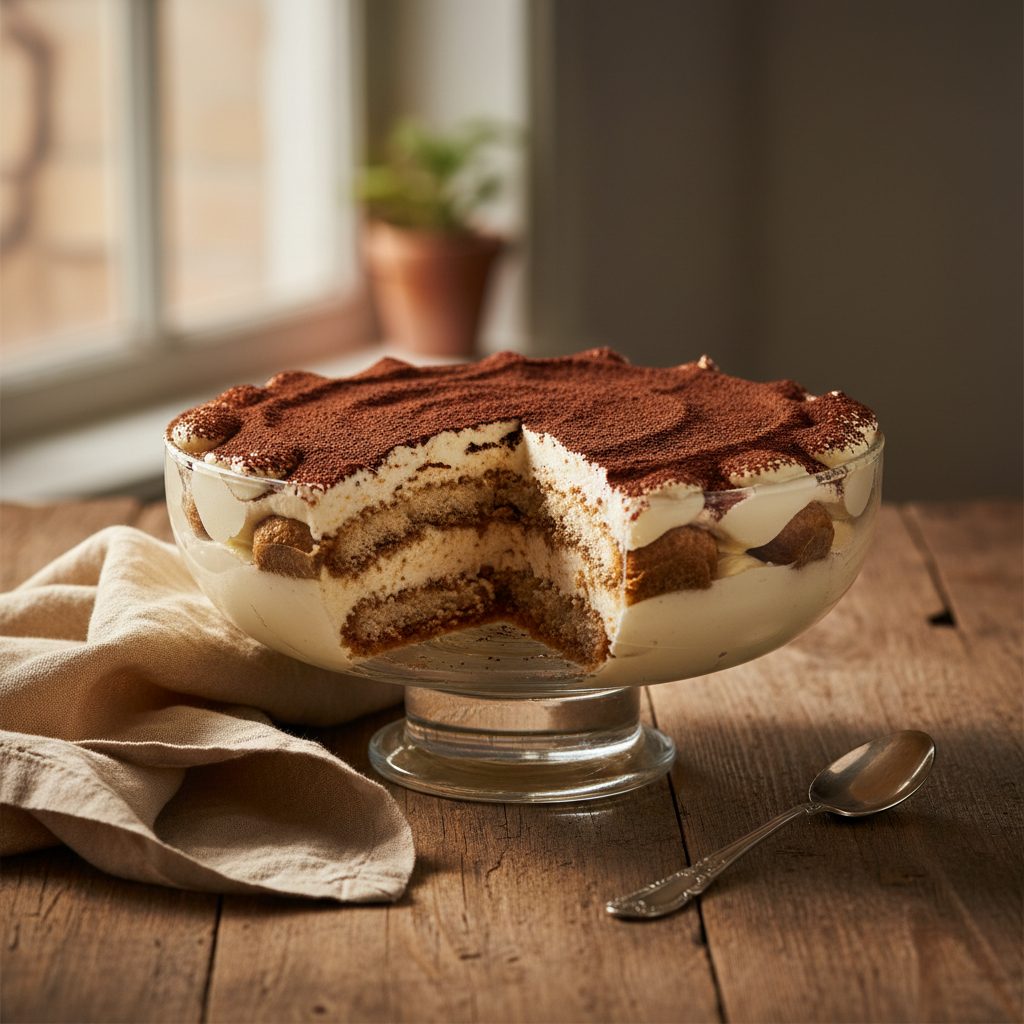
The scent of coffee revealed itself. Dark, strong, almost penitential. It is like the voice of a bell over a small town at dawn, like a call to awaken body and soul. Then the mascarpone — white, gentle, soft as a tablecloth spread on the Sunday table. Cocoa settles on the cream like the ash of Ash Wednesday, but it does not say that everything passes. It whispers. Since it passes, taste it more attentively.
Marsala carries the warmth of the South, the sponge fingers drink the coffee like weary earth drinks rain, and each layer is laid with the solemnity of bricks in a wayside shrine. Tiramisu is a small architecture of faith. Not in dogma, but in transformation. In the belief that ordinary things — egg, sugar, cream, coffee — can, through patience, be raised up.
In Treviso they speak of it as of a family relic. Some point to the Le Beccherie restaurant, others to old recipes, household legends, winter windows and the metal cages in which the dessert chilled overnight. The history of tiramisu is not a closed book. It resembles a folk life of a saint: a little fact, a little miracle, a little family boasting at the table. And perhaps that is precisely why it is true.
In tiramisu, Italy meets itself. Savoyard sponge fingers, Lombard mascarpone, Neapolitan coffee, Sicilian Marsala. A unification achieved without generals, without cannons and without speeches. The Risorgimento served with a teaspoon. A homeland that can be divided among the guests.
The dessert carries plebeian religiosity, the unlearned, bodily kind, full of signs. The kind that places a figurine of the Virgin Mary among the geraniums, blesses Easter baskets, kisses the Christmas wafer, traces a cross on a loaf and believes that a good meal can push despair away for at least one evening. In the old invocation lift up my soul there sounds not a drawing-room metaphor but the plea of a person who is tired, chilled and hungry. God, give me a little more strength.
Tiramisu is innocent and sensual, homely and shameless. It belongs to the kitchen and to legend, to the family table and to tales of houses of pleasure. The sacred sits down beside the profane, like the priest and the innkeeper at a village wedding. They eye each other suspiciously, then drink to the health of the newlyweds.
A Renaissance sybarite would not ask how many calories tiramisu has. That is the question of someone who has mistaken life for bookkeeping. He would ask: how many memories does it carry? How many winters has it brightened? How many quarrels has a portion placed on the table interrupted? How many times has someone who could not say I love you said have some more?
The teaspoon cuts through the layers.
Coffee mingles with cream. Bitterness takes sweetness by the arm. The white is stained with cocoa. The perfect construction falls apart so that the revelation of flavour can take place.
That is how grace works. It does not keep things untouched; it transforms them into nourishment.
One ought to make the sign of the cross over tiramisu — not out of blasphemy, but out of gratitude.
For the coffee that wakes.
For the cream that soothes.
For the bitterness that does not prevail.
For the sweetness that does not pretend.
For the table at which a person stops being alone.
## Three cities and one cream
Professional literature is silent about tiramisu until the 1960s. That silence suggests the dessert was codified recently. Oral tradition, however, claims it is much older, and as oral tradition tends to, it has several witnesses who disagree with one another.
The official version leads to Treviso, to the Le Beccherie restaurant. There, under the eye of the owner Roberto Linguanotto, the modern architecture of layers is said to have been created. The American version belongs to Carminantonio Iannaccone, an American of Italian descent, who maintains that it was he who developed the recipe and on 24 December 1969 delivered the finished dessert to Le Beccherie. In this story the restaurant would have been merely the distributor of someone else's genius. The Tuscan version reaches back to the seventeenth century and Siena, where zuppa del duca was supposedly created in honour of Grand Duke Cosimo III. The technique was different, but the idea was the same: a dessert that lifts the spirits.
Three cities, three dates, one cream. Italians can quarrel over a recipe more fiercely than over borders. Borders have changed; the recipe remains.
## A great-grandmother, Casanova and a window cage
The most beautiful pedigree is a family one. Giuseppina Tiretta, who lived from 1829 to 1917 and was the great-grandmother of the writer Giovanni Comisso, served her version as early as the nineteenth century. She called it "Tirame-pau-sa-su". For her it was an appeal to God: lift up my soul. Not a dessert for the salons, but an energising winter supper, eaten in silence in front of the window cage in which the cream chilled in the frosty air of Treviso.
Those cages are a chapter of technology in their own right. Before the age of refrigerators, tiramisu was put out of the window at night in metal frames so that the cold would set the mixture. A kitchen without electricity had winter instead.
The Tiretta family adds a character from a picaresque novel to the story. Edoardo Tiretta, a friend of Casanova, returned from India to Treviso with a daughter known as l'Indiana, "the Indian girl". She wore green dresses and became a colourful element of the town's legend, and with her a taste of the exotic is said to have entered Venetian home cooking. According to the family account, a portion of tiramisu was Giuseppina's last meal in life. It is hard to imagine a more consistent loyalty to a single dessert.
## The sponge as a declaration of loyalty
For Giovanni Comisso tiramisu was not a sweet but a political treatise. In his interpretation, based on family accounts from the time of the Risorgimento, the choice of base was a confession of faith. Savoiardi sponge fingers stood for the House of Savoy and unification with the Kingdom of Italy. Pan di Spagna had pro-Habsburg connections and a distant kinship with the Portuguese pão de ló.
Comisso supported unification ideologically, but in his private exegesis of taste he chose pan di Spagna. He claimed it was firmer and more porous, took the coffee applied with a brush better and gave a more lasting structure. Savoiardi soaked in coffee reminded him of the Italian ships sunk at Lissa by the Venetian-Austrian frigates. A patriot who does not want to eat his own fleet's defeat is a very human figure.
Marsala had fundamental significance in this reading. Comisso saw in the Sicilian wine the birth of Italy from the fragments of the Kingdom of the Two Sicilies. He called the very act of eating a short novel of taste: a narrative that begins with bitter coffee and ends with the sweetness of mascarpone.
## A work of masonry
Authentic tiramisu is an opera muratoria e architettonica, a work of masonry and architecture. Every layer bears weight, and none of them is decoration.
Mascarpone is not a cheese in the strict sense. It is cream soured with lemon, without rennet, originating in Lombardy: from Abbiategrasso, Lodi, Como and Lecco. The canon calls for six eggs. All the yolks are beaten with sugar into a fluffy mass, but of the six whites only four are whisked to stiff peaks, and these close the structure of the cream. The coffee must be strong, Neapolitan-style. The prohibitions are absolute: no butter, no oil, no baking. Tiramisu is a raw dessert and does not accept fire.
Comisso proposed one more heresy. Instead of cocoa dust he wanted shards of dark chocolate, because the dust can make you choke on the first spoonful, while the shavings give the texture of rough stone. In Treviso there is also a Christmas variant in which mascarpone is combined with mostarda di Cremona and candied fruit. Beyond that it is a free-for-all: strawberries, pineapple, amaretto, even beer. The form is alive, since it can bear so much.
## Lift me up
The name travelled from prayer to a wink. The great-grandmother's religious "lift up my soul" became a frivolous "lift me up", and the story connects this change with Italian brothels. A dessert with invigorating properties was supposedly sold in front of them to weary customers. The film "Tiramisù" recalled this without mincing words. The sacred and the profane are once again sitting at the same table, and neither intends to get up.
Pastry chefs have their say on tiramisu too. Iginio Massari claims that no sweet dessert will satisfy the palate unless it is told. Loris Oss Emer observes that a teaspoon is small only until it meets tiramisu, and that tiramisu does not solve problems but makes them wait in line with greater patience.
Today Asolo and Treviso, once landscapes of courtesy, have turned into a stage set overrun by a locust swarm of cyclists and tourists. The dessert from the window cage has become the last bastion of authenticity. You can eat it in a hurry. You can also, over it, believe for a moment that culture begins at the table.
## Recipe
**Ingredients:**
- 6 eggs
- sugar
- mascarpone
- strong Neapolitan-style coffee
- Marsala wine
- savoiardi sponge fingers or pan di Spagna
- bitter cocoa or dark chocolate shavings
**Method:**
1. Beat all the yolks with sugar into a fluffy mass and combine with the mascarpone.
2. Of the six whites, whisk only four to stiff peaks and gently fold them into the cream so that they close its structure.
3. Soak the sponge fingers in strong coffee, preferably applying it with a brush. Do not leave out the Marsala, which the canon considers essential.
4. Arrange alternating layers of sponge and cream. Use no butter or oil and bake nothing.
5. Sprinkle the top with cocoa or dark chocolate shavings.
6. Chill until the cream sets.
📖 Glossary
- mascarpone
- Śmietana zakwaszana cytryną, bez podpuszczki, pochodząca z Lombardii. Nie jest serem w ścisłym sensie.
- savoiardi
- Biszkopty, które w interpretacji Comissa oznaczały dynastię sabaudzką i zjednoczenie z Królestwem Włoch.
- pan di Spagna
- Biszkopt o powiązaniach prohabsburskich, daleki kuzyn portugalskiego pão de ló, twardszy i bardziej porowaty od savoiardi.
- zuppa del duca
- Deser stworzony podobno w XVII-wiecznej Sienie na cześć Wielkiego Księcia Kosmy III, uznawany w wersji toskańskiej za przodka tiramisu.
- opera muratoria e architettonica
- Dzieło murarskie i architektoniczne, czyli określenie autentycznego tiramisu, w którym każda warstwa niesie ciężar.
Frequently Asked Questions
Where does tiramisu come from?
The official version leads to the Le Beccherie restaurant in Treviso and its owner Roberto Linguanotto. Carminantonio Iannaccone claims he developed the recipe and delivered the dessert to Le Beccherie on 24 December 1969. The Tuscan version reaches back to seventeenth-century Siena and the zuppa del duca made in honour of Cosimo III.
What does the name tiramisu mean?
Giuseppina Tiretta called her dessert „Tirame-pau-sa-su” and understood it as an appeal to God: lift up my soul. Over time the religious meaning turned into a frivolous „lift me up”, which the story links with Italian brothels.
How to make tiramisu according to the canon?
The canon calls for six eggs: all the yolks are beaten with sugar, but only four of the six whites are whisked to stiff peaks. The sponge is soaked in strong Neapolitan-style coffee, and Marsala is essential. The prohibitions are absolute: no butter, no oil and no baking.
Is mascarpone a cheese?
Mascarpone is not a cheese in the strict sense. It is cream soured with lemon, without rennet, originating in Lombardy, from Abbiategrasso, Lodi, Como and Lecco.
Which sponge for tiramisu savoiardi or pan di Spagna?
According to Giovanni Comisso, savoiardi stood for the House of Savoy, while pan di Spagna had pro-Habsburg connections. Comisso chose pan di Spagna because it is firmer and more porous, takes coffee applied with a brush better and gives a more lasting structure.
How was tiramisu chilled before refrigerators?
In Treviso tiramisu was put out of the window at night in metal cages so that the cold would set the mixture. A kitchen without electricity had winter instead.
Related Questions
- Where does tiramisu come from?
- What does the name tiramisu mean?
- How to make tiramisu according to the canon?
- Is mascarpone a cheese?
- Which sponge for tiramisu savoiardi or pan di Spagna?
- How was tiramisu chilled before refrigerators?
🧠 Thematic Groups
- Historia: trzy rodowody tiramisu, czyli Le Beccherie w Treviso, roszczenia Carminantonia Iannaccone i XVII-wieczna zuppa del duca ze Sieny.
- Tradycja rodzinna: Giuseppina Tiretta podawała „Tirame-pau-sa-su” jako zimową kolację i chłodziła krem w okiennej klatce.
- Polityka smaku: dla Giovanniego Comissa savoiardi, pan di Spagna i Marsala były wyznaniem wiary w czasach Risorgimento, a deser jednoczy Italię bez armat.
- Technika: kanon z sześciu jaj i czterech ubitych białek, mascarpone, mocna kawa po neapolitańsku, bez masła, oleju i pieczenia.
Tags:
tiramisu
mascarpone
savoiardi
pan di Spagna
Marsala
Neapolitan coffee
cocoa
Italian cuisine
Treviso
Le Beccherie
Giuseppina Tiretta
Giovanni Comisso
Risorgimento
zuppa del duca
no-bake dessert
More in: Kuchnia niepolityczna
Content is created by Fundacja Dobre Państwo.
Edited and published by APA ONE, the Foundation's own AI-based editorial system.