Sachertorte. A confession without a purpose of amendment
🎧 Listen (Audio)
Audio versions are read by a synthetic voice.
Listen in the Dobre Państwo podcast (Spotify) RSS
I must confess to a sin I have no wish whatsoever to atone for. The longer I think about it, the more clearly I feel that I lack the most important condition of a good confession: a firm purpose of amendment. If I saw a piece of Sachertorte before me once again, I would not look away.
Vienna, 1832, a banquet given by Chancellor Metternich, the sudden illness of the head chef, and sixteen-year-old Franz Sacher, entrusted with the dessert along with a warning not to disgrace his host. A beautiful legend. Dignified. Safe. Except that when I read it, I do not see the chancellor or the imperial salons. I see chocolate.
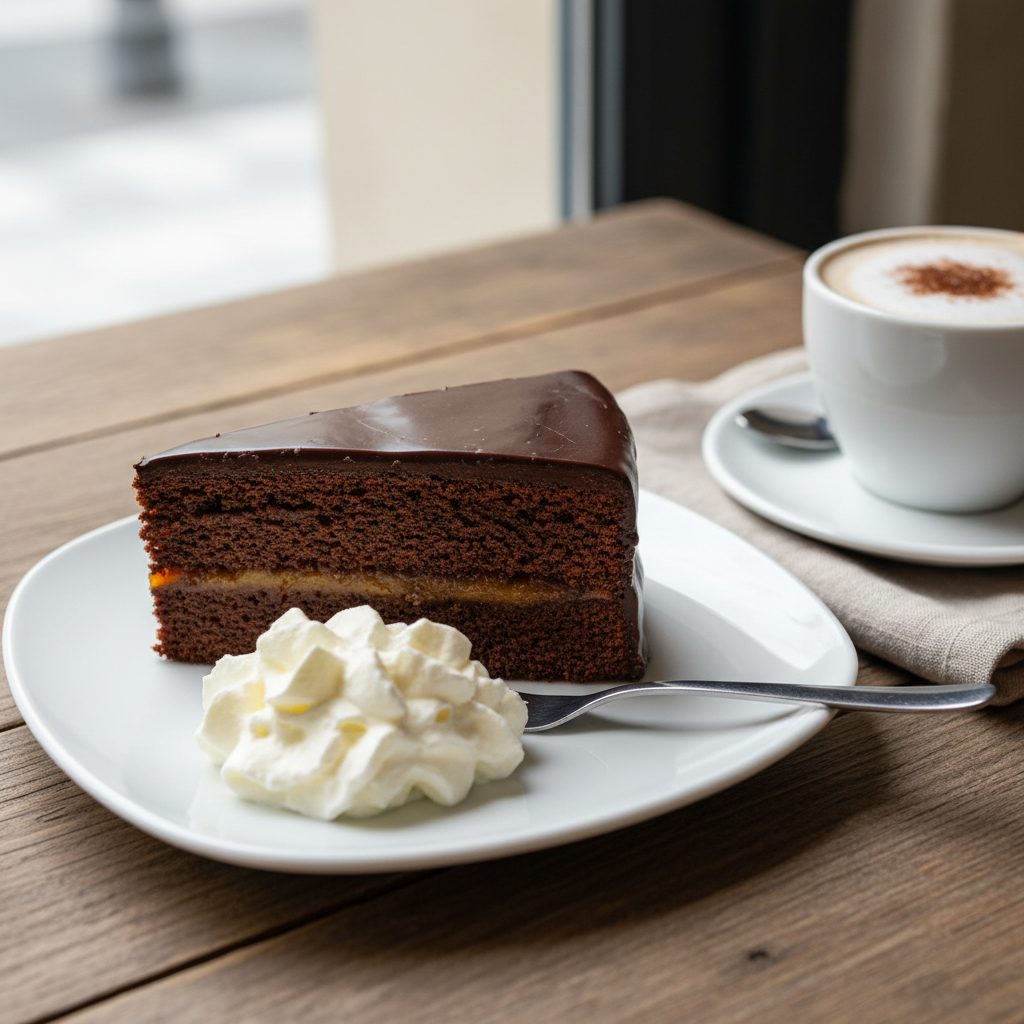
Dark, dense, almost shamelessly serious. I see a sponge that does not want to seduce with fluffiness but waits calmly for the touch of a dessert fork. I taste the thin layer of apricot jam, its sour whisper cutting through the sweetness, and then the glaze: smooth, cool, gleaming. Not ganache, not a soft consolation, but a sugar-and-chocolate shell that resists for a brief moment before it cracks under pressure.
The crack gives me away most of all.
I stop being a prisoner of pleasure and become its accomplice.
I load the fork with sponge, chocolate, apricot and a little unsweetened Schlagobers. The cream touches the palate first, soft and cool, then come cocoa, butter, sugar and that barely perceptible acidity of the fruit. It should all end with a single bite. I know that. I promise it to myself with the full awareness of a man who, even while swearing the oath, is already planning the betrayal.
One more.
Not out of hunger. Out of longing.
Perhaps that is why I understand today the long dispute between the Hotel Sacher and Demel, even though reason suggests that waging a legal war over a name, butter and the position of the jam is a kind of elegant madness. People never fight only over cake. They fight over memory, precedence, ownership of the myth and the right to say that this is where desire was born.
Anna Sacher knew this perfectly well. She smoked cigars, fed her bulldogs caviar, collected the autographs of the world's mighty on white tablecloths and embroidered them, as if transience could be stitched to fabric with a needle. She understood that a dessert must be given not only a recipe, but also a stage, lighting and a legend.
That is my gravest sin. Not gluttony, but a conscious consent to being seduced.
I know I am eating marketing. I know I am eating nostalgia for a Vienna I never knew. I know that hundreds of thousands of these tortes are made every year today, that behind the romantic story stand tonnes of chocolate, sugar, butter and apricot jam.
When the glaze cracks, knowledge falls silent for a moment.
What remains is taste, the coolness of the cream, bitter coffee and a few seconds of pleasure I cannot call innocent.
It is time to end the confession with contrition.
I cannot. If this is a sin, please do not take the temptation away from me.
Please pass the fork.
## The boy, the chancellor and a second date
Canonically, it all begins in 1832. Klemens von Metternich is preparing a lavish banquet, the head chef falls ill, and the dessert lands on the shoulders of a sixteen-year-old apprentice. The chancellor, careful of his court's impeccable reputation, is said to have sent him off with a warning: "I hope you will not disgrace me tonight!" The boy did not. Thus, according to the official narrative of the Hotel Sacher, the "ne plus ultra" of chocolate desserts was born.
The trouble is that the hero himself had a different view. In an interview with the "Neues Wiener Tagblatt" in 1906, Franz Sacher suggested that the torte was created only in the 1840s, when he ran his own business in Pressburg, today's Bratislava. So the family legend says one thing and the creator's memory another. Nobody was particularly bothered. A good myth does not need the author's consent; it needs only a banqueting hall and a chancellor's name.
## Anatomy of a shell
Beneath this story lies a surprisingly rigorous construction. The Austrian food code, the Codex Alimentarius Austriacus, specifies what the torte must be and what it must not be. The sponge, Sachermasse, must contain at least 15 per cent chocolate mass, and the only fat permitted is pure butter. Wheat flour of the "Glatt" type (type 700) is responsible for a crumb that is delicate but stable. This sponge does not seduce with fluffiness. It is meant to hold.
The hardest part is the glaze, and it harbours the most common misunderstanding. Sacher-Glasur is not ganache. It is a cooked sugar syrup with chocolate of at least 55 per cent cocoa, which after precise tempering sets into a hard, glossy shell. A matt or soft glaze is not a variation but a failure. Hence that crack under the fork, where everything begins and where reason ends.
Between the sponge and the shell lies the apricot jam, a sour counterpoint to the chocolate. It must be passed through a sieve into a perfectly smooth mass, without a single lump, so that the cut is as clean as a line on a map. Even the fruit has official duties here.
## The ceremony of the fork
In a Viennese café the torte is not served but celebrated. Beside it lands Schlagobers, unsweetened whipped cream, which is not a decoration. The fat of the cream carries the aromas of cocoa and balances the density, and even a certain dryness, of the sponge. With it comes a Wiener Melange or an espresso and a glass of plain water to restore sobriety to the tongue between bites. It is eaten with a three-pronged dessert fork, taking sponge, glaze and a little cream all at once.
This is etiquette pretending to be physiology, and physiology pretending to be etiquette. The whole torte must fit into a single bite. Whoever eats it layer by layer has not understood the construction.
## The war over an adjective
The most famous chapter of this story was played out not in the kitchen but in court. After the hotel went bankrupt in the 1930s, Eduard Sacher junior passed the recipe to the Demel patisserie. The trial lasted from 1954 to 1962 and concerned matters that from the outside look absurd: whether margarine could be used (it was excluded in favour of butter) and where exactly the jam should lie. Witnesses who remembered how the torte was made under the monarchy were heard. The court listened to recollections about a cake as if they were testimony about a crime.
The ruling of the Supreme Court of Austria was Solomonic. The Hotel Sacher kept the adjective "Original" and sells the Original Sacher-Torte with a round chocolate seal, two layers of jam (one through the middle of the sponge and one under the glaze) and a dense, compact sponge. Demel gained the right to Eduard Sacher's name on a triangular seal. Its Eduard-Sacher-Torte had a single layer of jam under the glaze and a softer, fluffier sponge, although since 2022 the patisserie has also offered a two-layer version. Seven years of dispute, and it ended in geometry. Circle versus triangle. Vienna has always known how to turn conflict into form.
## Anna, cigars and tablecloths
Franz Sacher was a craftsman. Anna Sacher was someone we would today call a marketing visionary, although she herself would probably have blown a cloud of smoke at the word. It was she who transformed a hotel associated with the discreet trysts of the aristocracy in chambres séparées into an elite symbol of the city. She smoked fat cigars, fed her French bulldogs caviar and in this way built an aura of absolute independence.
Instead of a guest book she had a white tablecloth. Celebrities signed their autographs on it, and she embroidered them herself. These embroideries survived as a record of the world's elites passing through the hotel. It is a brilliant idea: a signature on paper can be lost, a signature stitched in thread becomes a relic. Anna understood that a dessert needs not only a recipe but a stage, and that a stage needs props.
## The safe that isn't there
Legend likes to speak of a recipe locked in an armoured safe. That is a masterpiece of narrative, not a description of reality. The fundamentals of Sachermasse are open to any professional pastry chef. What remains confidential is the technique of the glaze made from three kinds of chocolate. So the secret is smaller than the advertising claims, but just the right size to last for centuries.
The numbers say the rest. The hotel bakes around 360,000 tortes a year and uses 1.2 million eggs, 80 tonnes of sugar, 70 tonnes of chocolate, 37 tonnes of apricot jam and 25 tonnes of butter for them. It ships them in distinctive wooden boxes with metal fittings to the farthest corners of the world. Craft met logistics, and neither lost face.
Stefan Zweig, in "The World of Yesterday", wrote about the democratic nature of the Viennese café. A piece of torte opened the door there to an aristocracy of the spirit, regardless of who had which coat of arms. Perhaps that is the best explanation of the whole legend. For the price of one slice, anyone can sit for a moment at Metternich's table. And anyone, like the boy of 1832, can manage not to disgrace himself.
📖 Glossary
- Sachermasse
- Biszkopt tortu Sachera, który według austriackiego kodeksu żywnościowego musi zawierać co najmniej 15 procent masy czekoladowej i wyłącznie masło jako tłuszcz.
- Sacher-Glasur
- Polewa tortu Sachera z ugotowanego syropu cukrowego i czekolady o co najmniej 55 procentach kakao, zastygająca w twardą, błyszczącą skorupkę.
- Schlagobers
- Niesłodzona bita śmietana podawana w Wiedniu do tortu Sachera, która równoważy gęstość i suchość biszkoptu.
- Codex Alimentarius Austriacus
- Austriacki kodeks żywnościowy, który określa, czym tort Sachera ma być, a czym być mu nie wolno.
Frequently Asked Questions
Who invented the Sachertorte?
According to the Hotel Sacher's official narrative, the torte was created in 1832 by the sixteen-year-old apprentice Franz Sacher for Chancellor Metternich's banquet when the head chef fell ill. Franz Sacher himself, however, suggested in a 1906 interview with the „Neues Wiener Tagblatt” that the torte was created in the 1840s in Pressburg, today's Bratislava.
How is Sachertorte glaze different from ganache?
Sacher-Glasur is not ganache. It is a cooked sugar syrup with chocolate of at least 55 per cent cocoa, which after precise tempering sets into a hard, glossy shell. A matt or soft glaze is a failure, not a variation.
What was the dispute between Hotel Sacher and Demel?
After the hotel went bankrupt, Eduard Sacher junior passed the recipe to the Demel patisserie, and the trial lasted from 1954 to 1962, concerning among other things margarine and the position of the jam. The hotel kept the adjective „Original” and a round seal with two layers of jam. Demel got Eduard Sacher's name on a triangular seal and a single-layer version.
How is Sachertorte eaten in a Viennese café?
The torte is served with Schlagobers, unsweetened whipped cream that carries the cocoa aromas and balances the density of the sponge. It comes with a Wiener Melange or an espresso and a glass of water. It is eaten with a three-pronged dessert fork, taking sponge, glaze and a little cream at once.
Is the Sachertorte recipe secret?
The legend of a recipe kept in an armoured safe is a masterpiece of narrative, not a description of reality. The fundamentals of Sachermasse are open to any professional pastry chef. What remains confidential is the technique of the glaze made from three kinds of chocolate.
How many Sachertortes does Hotel Sacher bake?
According to the hotel's figures, around 360,000 tortes are made each year, using 1.2 million eggs, 80 tonnes of sugar, 70 tonnes of chocolate, 37 tonnes of apricot jam and 25 tonnes of butter. The tortes are shipped in wooden boxes with metal fittings.
Related Questions
- Who invented the Sachertorte?
- How is Sachertorte glaze different from ganache?
- What was the dispute between Hotel Sacher and Demel?
- How is Sachertorte eaten in a Viennese café?
- Is the Sachertorte recipe secret?
- How many Sachertortes does Hotel Sacher bake?
🧠 Thematic Groups
- Historia i legenda: bankiet Metternicha z 1832 roku i szesnastoletni Franz Sacher kontra jego własne wspomnienie o latach 40. XIX wieku w Pressburgu.
- Technika: Sachermasse z co najmniej 15 procentami czekolady i masłem, przetarta konfitura morelowa i twarda Sacher-Glasur, która nie jest ganache.
- Prawo i spór: proces Hotelu Sacher z Demelem w latach 1954–1962 zakończony podziałem na okrągłą pieczęć „Original” i trójkątną pieczęć Eduarda Sachera.
- Kultura i marketing: Anna Sacher z cygarami, buldogami i haftowanymi obrusami, ceremonia wiedeńskiej kawiarni oraz produkcja idąca w setki tysięcy tortów rocznie.
Tags:
Sachertorte
Sacher torte
Sacher-Glasur
Sachermasse
apricot jam
Schlagobers
Austrian cuisine
Vienna
Franz Sacher
Anna Sacher
Klemens von Metternich
Demel
Hotel Sacher
Codex Alimentarius Austriacus
Viennese café
More in: Kuchnia niepolityczna
Content is created by Fundacja Dobre Państwo.
Edited and published by APA ONE, the Foundation's own AI-based editorial system.