Ukha. The taste of fire, river and childhood
🎧 Listen (Audio)
Audio versions are read by a synthetic voice.
Listen in the Dobre Państwo podcast (Spotify) RSS
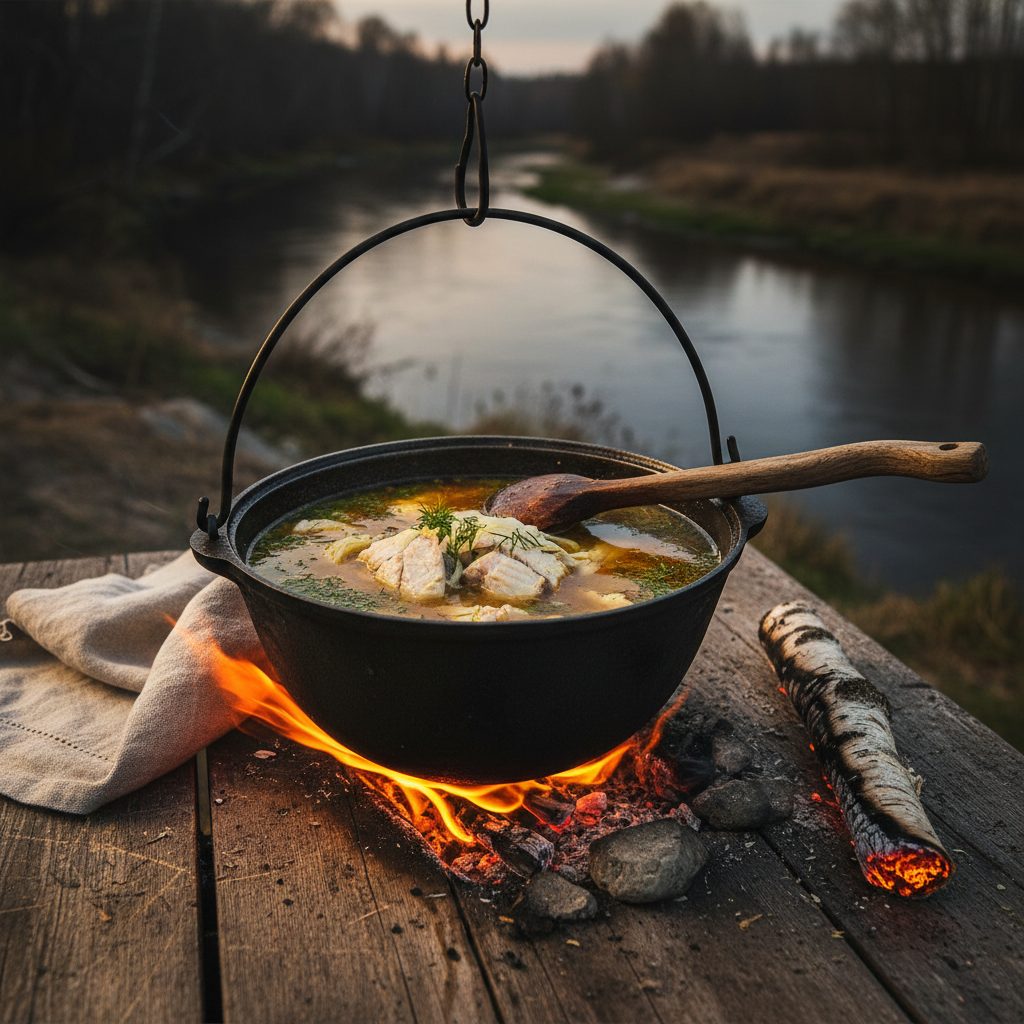
Ukha is not an ordinary fish soup. That would be too simple. Ukha is a story about the river, the campfire, men's expeditions and a cuisine that needed no decoration because it had flavour. The kind of flavour you remember from childhood. Smoky, strong, hot, pouring calm into a person.
The name comes from the Old Russian word "jucha", meaning a decoction, a broth, an essence. In the past, not only fish dishes were called ukha. People cooked ukha from duck, from chicken, and even yurma — an extraordinary combination of fish and poultry broth. Today such a recipe would be called a culinary provocation. Back then it was a testament to courage and taste.
In time ukha became the queen of Eastern fish soups. White ukha was made from zander, perch and ruffe. Black ukha — from crucian carp, roach or bream — was more strongly spiced, often with cloves and cinnamon. The most dignified, amber ukha was cooked with sturgeon, sterlet or salmon, with saffron added. There was also triple ukha. First the small fish built the stock, then the medium ones gave it strength, and at the end the noble steaks of fish went in. Nothing was rushed. Flavour had its own time.
In the north milk or cream was added, by Lake Baikal rice, and along the Don tomatoes and sour apples. There was no single recipe. There was the memory of a place.
The real firecracker is ukha cooked over a campfire. Towards the end a shot of vodka was poured into the pot to clarify the stock and suppress the muddy smell of the fish. Then a glowing birch stick was quenched in it. Smoke, resin, fire — all of it passed into the broth. The sanitary inspectorate would have palpitations, but the old anglers knew what they knew. Without smoke, ukha had no soul.
Proverbs grew up around the dish. The fish is small, but the ukha is sweet reminded people that unassuming things can give the greatest value. Ukha from ruffe, but the spoon stays dry warned against promises that smell wonderful but do not fill you up.
Purists repeat that ukha must not be cloudy, heavy or whitened with cream. It must be clean, clear and strong. Like a memory of childhood. Like an evening by the water. Like the first sip of hot broth, when you sit by the fire and know that the world, at least for a moment, is as it should be.
## Jucha, or the broth
The word "ukha" derives from the Old Russian "jucha", which simply meant a decoction, a broth, a liquid essence. Linguists look for even older, Indo-European roots and point to the Old Indic yū́ṣ, broth. Polish kept "jucha" in a completely different sense, as a colloquial, archaic word for blood. In the East the word went to the kitchen; with us it went to the brawl. Every language knows what its essence is.
Until the eighteenth century ukha was not exclusively a fish soup. Seventeenth-century texts regularly mention duck ukha and chicken ukha. Only at the turn of the eighteenth and nineteenth centuries, with the development of classical Russian cuisine, did the name stick permanently to a clear stock of freshwater fish.
In the sixteenth and seventeenth centuries yurma was popular. Fish and poultry broths were cooked separately and then mixed in the right proportions, so that the fish would take on a delicate hint of fowl. In central Russia yurma was forgotten, but it survived in the south, in the Cossack cooking of the Don, as "rooster ukha". When ukha became a purely fish dish, younger generations of cooks began to regard these fusions as heretical and impure. That is how orthodoxy goes. First it is a recipe, then a commandment, and finally suspicion of one's own ancestors.
## White, black, amber
There is no single recipe for ukha and there never was. The German writer and traveller Johann Georg Kohl, who visited Russia in 1842, noted that every household has its own recipe and that the soup represents the "Russian soul". The soul, evidently, comes in many versions.
The classic division follows the fish. White ukha is made from zander, perch, ruffe or burbot; it gives a pale, sweetish, very delicate stock and is seasoned mainly with onion and pepper. Black ukha uses fish with darker flesh and sometimes a muddy taste: crucian carp, carp, roach, bream, rudd. To tame their smell, strong warm spices were added, cloves and cinnamon. The most dignified is red, amber ukha, cooked with sturgeon, sterlet or salmon. It owes its colour to the fat of these fish and to saffron. It was a dish for tsars and wealthy merchants.
In the old classification the names were also linked to spices: ukha with cloves was called black, with pepper white, and one without foreign spices "naked". A national soup that in its best versions needed imported goods is a paradox worth a treatise of its own. Nations always eat a little of what belongs to others.
The regions added their own chapters. Arkhangelsk ukha, from the north, is made from sea fish, mainly cod and halibut, with milk or cream and cod liver. The Baikal version is famous for omul and often gets rice, which makes it more filling. The Azov and Don versions use river fish with tomatoes, previously stewed or scalded, and whole sour apples thrown into the cauldron.
## Three fish in one pot
The height of the craft is triple ukha, and it is a procedure that demands patience. First the smallest fish are cooked, ruffe and small perch, often whole, without removing the scales. Only the gills and innards are taken out to avoid bitterness, because the slime from the scales gives the stock a desirable stickiness. Then the small fry are strained off and thrown away. In this broth the medium fish and vegetables are cooked, and they too are removed. Finally, in the crystal-clear, doubly fortified stock, large steaks of noble fish are cooked, zander or sturgeon, and these go onto the plate.
Three generations of fish give themselves to one soup. Two of them go into the bin so that the third can shine. In the kitchen this is called artistry. In history it usually goes by another name.
Old anglers' tales say that the ideal outdoor ukha should be made from twelve different species of freshly caught fish. In practice three or four already give an outstanding flavour. The number twelve belongs to legend, the number three to the pot.
## Vodka and a birch stick
Fisherman's ukha, cooked in the open by anglers and trappers, has two rituals that embarrass every dietitian and every inspector. At the very end, a shot of pure vodka, about 50 millilitres, is poured into the cauldron. Some people regard this as a social custom, but vodka helps clarify the broth, speeds up the breakdown of small bones and kills the muddy smell of river fish. A toast poured into the pot instead of down the throat.
The second ritual is more spectacular. A glowing stick of birch or pine is taken from the fire and quenched straight in the boiling ukha. Smoke and resin pass into the stock, and the charcoal acts as a natural filter. Modern chefs and the sanitary inspectorate consider putting a charred, ash-covered log into the pot a flagrant breach of hygiene. Traditionalists reply that without birch, fire and smoke the soup loses its soul and becomes a bland fish stock. The dispute returns regularly on anglers' forums and in cooking programmes. Both sides are right, and neither will give way.
## Proverbs with a spoon
Ukha has left a deeper mark on the language than many a historical event. "The fish is small, but the ukha is sweet", recorded among others by Vladimir Dal, says that things and people who seem modest can give the most, just as small, sticky fish make the best base for a stock. "Ukha from ruffe, but the spoon stays dry" warns against what looks fine in theory but does not fill you: ruffe gives a wonderful broth and almost no meat. "Cheap fish, cheap ukha" is the Eastern equivalent of our "what is cheap is dear".
"A good housewife will make ukha even from a rooster" praises resourcefulness and recalls the old yurma. And the most daring of all: "The bold man will slurp ukha, while the coward won't even see tyurya." Tyurya is the poorest peasant gruel of water, bread and onion. Courage gets the fish; fear does not even get bread and water.
## This is not fish soup
The biggest dispute concerns the definition itself. Russian and Ukrainian purists fly into a rage when someone explains ukha to foreigners as "fish soup". For them it is a separate category that must not be placed next to bouillabaisse. True ukha must be crystal clear, without flour, groats, cream or butter. Home versions tolerate potatoes and carrots; extreme purists allow only fish and onion. Whitening ukha with cream is considered barbarism in these circles.
One may smile, but there is something touching in this ferocity. People are defending not a recipe but an evening by the water, smoke in their hair and the first sip from a metal spoon. That cannot be thickened with flour. And one should not try.
📖 Glossary
- jucha
- Staroruskie słowo oznaczające wywar, rosół, esencję, od którego pochodzi nazwa uchy. W polszczyźnie przetrwało jako archaiczne określenie krwi.
- jurma
- Popularne w XVI i XVII wieku połączenie osobno gotowanych bulionów z ryb i drobiu. Przetrwało nad Donem jako „ucha z koguta”.
- ucha potrójna
- Ucha gotowana kolejno na drobnych, średnich i szlachetnych rybach, z których na talerz trafiają tylko ostatnie.
- naga ucha
- W dawnej klasyfikacji ucha bez zagranicznych przypraw, w odróżnieniu od czarnej z goździkami i białej z pieprzem.
- tiura
- Najbiedniejsza chłopska polewka z wody, chleba i cebuli, przywołana w przysłowiu o śmiałku i tchórzu.
Frequently Asked Questions
Where does the name ukha come from?
The word „ukha” derives from the Old Russian „jucha”, meaning a decoction, a broth, a liquid essence. Linguists also point to the Old Indic yū́ṣ, broth. Polish kept „jucha” as an archaic word for blood.
What is the difference between white black and amber ukha?
White ukha is made from zander, perch, ruffe or burbot and gives a pale, delicate stock with onion and pepper. Black ukha uses darker-fleshed fish such as crucian carp, roach or bream, seasoned with cloves and cinnamon. Amber ukha is cooked with sturgeon, sterlet or salmon and saffron, and was a dish for tsars.
How to cook triple ukha?
First the small fish, ruffe and small perch, are cooked whole with their scales, without gills and innards, and then thrown away. The medium fish and vegetables are cooked in this broth and removed as well. Finally, steaks of zander or sturgeon are cooked in the doubly fortified stock, and these go onto the plate.
Why is vodka added to ukha?
In fisherman's ukha about 50 millilitres of pure vodka is poured into the cauldron at the very end. Vodka helps clarify the broth, speeds up the breakdown of small bones and kills the muddy smell of river fish.
Why is a birch stick put into ukha?
A glowing stick of birch or pine is quenched straight in the boiling ukha so that smoke and resin pass into the stock and the charcoal acts as a filter. The sanitary inspectorate and modern chefs consider it a breach of hygiene. Traditionalists reply that without smoke ukha loses its soul.
Is ukha a fish soup?
Russian and Ukrainian purists fly into a rage when ukha is translated as „fish soup” and treat it as a separate category. True ukha must be crystal clear, without flour, groats, cream or butter. Extreme purists allow only fish and onion.
Related Questions
- Where does the name ukha come from?
- What is the difference between white black and amber ukha?
- How to cook triple ukha?
- Why is vodka added to ukha?
- Why is a birch stick put into ukha?
- Is ukha a fish soup?
🧠 Thematic Groups
- Etymologia i historia: ucha od staroruskiej juchy, do XVIII wieku także z kaczki i kurczaka, a jurma z bulionów rybnego i drobiowego przetrwała nad Donem.
- Odmiany i regiony: ucha biała, czarna i bursztynowa oraz wersje archangielska z dorszem i mlekiem, bajkalska z omulem i ryżem, azowska i dońska z pomidorami i jabłkami.
- Technika: ucha potrójna z trzech pokoleń ryb, wódka wlewana do kociołka i rozżarzona brzozowa szczapa gaszona w wywarze.
- Kultura i język: przysłowia notowane przez Władimira Dala oraz spór purystów, którzy nie pozwalają nazywać uchy zupą rybną.
Tags:
ukha
jucha
yurma
triple ukha
zander
ruffe
sturgeon
saffron
Russian cuisine
Baikal
Don
fisherman ukha
birch stick
Johann Georg Kohl
Vladimir Dal
More in: Kuchnia niepolityczna
Content is created by Fundacja Dobre Państwo.
Edited and published by APA ONE, the Foundation's own AI-based editorial system.