Wątrobianka. A scandalously good young lady made of offal
🎧 Listen (Audio)
Audio versions are read by a synthetic voice.
Listen in the Dobre Państwo podcast (Spotify) RSS
Please don't look away. I know you're watching, sir.
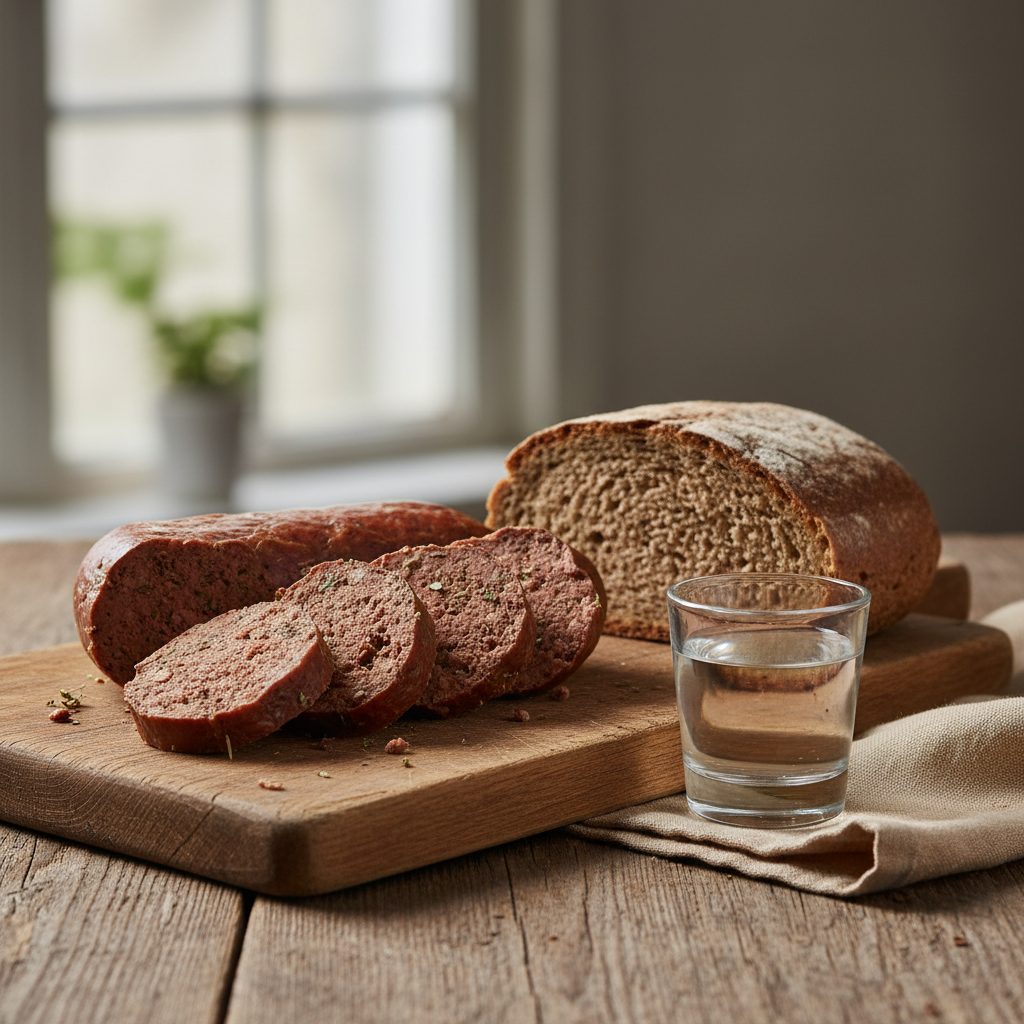
I lie on a slice of bread, pale, soft and utterly innocent. At least that is how I look. They call me wątrobianka, liver sausage, though in Silesia they whisper leberka about me, and more intimately leberwuszt. I used to be jętrznica. It sounds almost like the name of a young lady one should not invite for a walk without a chaperone. I was invited everywhere: to peasant cottages, workers' kitchens, butchers' workshops and the tables of Bałuty.
I am not pasztetowa, the pâté sausage. Please don't confuse us, or I shall take offence. Pasztetowa is mild, fluffy and ready to melt at the first stroke of the knife. I have more liver, a stronger flavour and a texture that lets me be cut into proper slices. I am a girl with character. I smell of marjoram, pepper and smoke. Sometimes I pretend to be modest, but after a moment I linger on the fingers, on the lips and in the memory.
In Greater Poland they wrapped me in cold smoke for many hours. In Silesia they left little pieces of meat in me so that I would not be too smooth and drawing-room. The Kashubians forced me into casings using cattle horns. What a method! I ought to be outraged, but tradition has its rights, and well-bred young ladies do not ask too loudly how they were stuffed.
In the Lublin region they poured chicken or rabbit broth into me. In Bałuty they spread me on sznytki, slices of bread, and ate me without needless ceremony. Sometimes I was accompanied by a kojsa, that is, a small glass of vodka. I myself, of course, did not drink. I only blushed from the marjoram.
The Polish People's Republic turned me into a girl with a terrible reputation. Instead of noble liver came rinds, fat, starch and other ingredients a lady does not ask about at the table. It was even said that paper was added to pasztetowa. The rumour was so juicy that it outlived more than one product. A single glance at the grey mass was enough for people to suspect the worst. Ah, how easy it is to ruin the good name of a young lady who keeps company with the meat industry.
I am coming back. And not as an embarrassed cousin from the provinces, but as an artisan speciality. I have real liver in me, fatback, pepper, marjoram, nutmeg, sometimes garlic, sometimes a drop of cognac. Please don't make that face. Cognac does not make me loose. Only more French.
I taste best on thick bread, without plastic decorations and without culinary pomposity. I don't need microgreens, edible gold or a waiter who spends a quarter of an hour explaining that the plate symbolises transience. A knife, a slice of bread and a person unafraid of simple things will do.
Coquetry is not about showing everything. It is about smelling so good that someone comes closer of their own accord.
I'm only asking now.
A slice?
Or two at once? Like nipples.
## From ętro to Leber
The young lady's pedigree is older than her modest appearance suggests. Proto-Slavic ętrьnica came from ętro, meaning the innards and the liver. Old Polish, from the fifteenth to the eighteenth century, spoke of jętrznice, sausages stuffed with blood and offal. Then the neighbours from the west arrived and brought the word Leber. Thus leberka and leberwuszt were born, Polonised forms that took hold in the Prussian partition, in Greater Poland, Silesia and Łódź. In Silesia, in fact, nobody said "wątrobianka". People said leberwuszt or leberka, and a sznytka with leberka gave a man the strength to work down the pit.
The change of name went hand in hand with a change of body. Nineteenth-century industrialisation moved the product from the craftsman's room to the butcher's shop, and the steam engine drove the wolves, the mincing machines. Only they made it possible to achieve the perfectly smooth, spreadable texture characteristic of the Germanic model. Jętrznica was rough like old Polish custom. Leberka came out of the machine as smooth as a Prussian official.
## Two sisters, one table
Wątrobianka and pasztetowa are two distinct beings, even though everyday speech has lumped them together for years. Pasztetowa is a mixture of lungs, kidneys, spleen and rinds with a small addition of liver. It is soft, uniform, highly emulsified, mild and fatty, with a distinct note of onion. It is boiled or scalded.
Wątrobianka is based on a dominant share of good liver, pork, beef or poultry. It is firm and can be cut into stable slices. After scalding it goes into cold smoke, alder for instance, and that is where its flavour comes from: intense, deep, with marjoram and smoke. One sister is for spreading. The other for conversation.
The key moment of the craft happens before anything goes into the casing. The liver is blanched for two or three minutes in boiling water to set the proteins and get rid of bitterness. Before that it must be cleaned of membranes and veins. Butchers had a separate small knife for this. Craft begins with a tool nobody sees.
## A map of temperaments
Every region brought up its young lady in its own way. Leberka from Greater Poland rests on marjoram and twelve hours of cold smoking. Silesian leberwurst from Górki is coarsely ground, with visible pieces of meat, because smoothness is a feature of salons, not of coal mines. The Lublin wątrobianka from Krzczonów gets raw pork shoulder and chicken or rabbit broth instead of water.
Kashubian léberka has the most picturesque biography. There the casings were stuffed using cattle horns. It sounds like a rite, but it was pure economics. Farms had no professional stuffers, and a horn turned out to be a natural, free and durable funnel. The village did not know the word "recycling", because it did not need a name for it.
Łódź's Bałuty made leberka the foundation of the workers' menu. It was spread on sznytki, and at house parties it was obligatorily accompanied by a kojsa. Children rode on fajerki, rolling stove rings along with a wire, and made kopyciaki, primitive skates of wooden blocks and wire. The adults ate leberka. Everyone had their own entertainment.
## A young lady on ration
In the planned economy wątrobianka became a rationed commodity, a coveted prize one had to court like a lady's favour. The prize, however, resembled the ideal less and less. Noble liver was being displaced by a protein-and-fat emulsion of rinds, fat and starch fillers. Fears about lower-grade meat, especially from emergency slaughter, were masked with excess salt and spices.
People responded the way they always respond to uncertainty: with a legend. It was widely believed that toilet paper was added to pasztetowa, which was supposed to explain its grey colour. Cellulose in sausage is an urban legend. The distrust of industrial sausage was entirely real.
That period also left behind a few words that outlived the product itself. In the dialects of Greater Poland and Silesia a "lebera" is an idler or a sluggard, because the pallor of offal sausages was associated with a lack of vitality. "Mieć pasztet", to have a pâté, means to be in trouble. Language remembered the bad years better than the butchers did.
## Back from the provinces
Old recipes show how much a good seasoning matters. A pre-war recipe by M. Disslowa from 1930 speaks of half a kilogram of liver, half a kilogram of pork jowl and a block of fatback, seasoned with salt, marjoram and "bitter pepper", that is, simply ground black pepper. The liver is scalded and the mass pressed through a sieve. Modern recipes reach for turkey or pork liver with half the amount of fatback, for shoulder boiled for an hour and a half, for nutmeg, allspice, smoked salt. There are also jar versions, with bacon, eggs, garlic and cognac, baked at 120°C. Cognac, as we know, only makes the young lady more French.
The rehabilitation continues. The return to artisan standards, without chemical emulsions and with a high share of liver, is restoring wątrobianka's former dignity. Products such as wątrobianka from Kruszewo show that offal need not be ashamed. It only needs to fall into good hands.
It is best eaten with relish, on proper bread, while it is fresh. A kojsa for the road remains a matter of conscience. Tradition has its rights, and the young lady of offal always knew that true charm needs no decoration.
📖 Glossary
- jętrznica
- Staropolska nazwa kiszki nadziewanej krwią i podrobami, od prasłowiańskiego ętra, czyli wnętrzności i wątroby.
- leberka
- Spolszczona od niemieckiego Leber nazwa wątrobianki, używana w Wielkopolsce, na Śląsku i w Łodzi.
- kojsa
- Mały kieliszek wódki, który na łódzkich Bałutach towarzyszył sznytkom z leberką.
- sznytka
- Kromka chleba, na Śląsku i na Bałutach smarowana leberką.
- wilk
- Maszynka do mielenia, która napędzana maszyną parową pozwoliła uzyskać gładką, smarowną strukturę leberki.
Frequently Asked Questions
What is the difference between wątrobianka and pasztetowa?
Pasztetowa is a mixture of lungs, kidneys, spleen and rinds with a small addition of liver, soft, mild and highly emulsified. Wątrobianka is based on a dominant share of good liver, is firm and can be sliced. After scalding it goes into cold smoke, which gives it an intense flavour with marjoram.
Where does the name leberka come from?
Old Polish spoke of jętrznice, from the Proto-Slavic ętro, meaning innards and liver. Neighbours from the west brought the German word Leber, from which the Polonised leberka and leberwuszt developed. These forms took hold in the Prussian partition, in Greater Poland, Silesia and Łódź.
How is liver sausage made in different regions of Poland?
Leberka from Greater Poland rests on marjoram and twelve hours of cold smoking, while Silesian leberwurst from Górki is coarsely ground with visible pieces of meat. The Lublin wątrobianka from Krzczonów gets raw pork shoulder and chicken or rabbit broth. In Kashubia casings were stuffed using cattle horns.
Was paper added to pasztetowa in communist Poland?
It was widely believed that toilet paper was added to pasztetowa, which was supposed to explain its grey colour. Cellulose in sausage is an urban legend. What was real was the displacement of liver by an emulsion of rinds, fat and starch fillers, and the distrust of industrial sausage.
How to prepare liver for liver sausage?
The liver must first be cleaned of membranes and veins, for which butchers had a separate small knife. It is then blanched for two or three minutes in boiling water to set the proteins and get rid of bitterness.
What was the pre-war recipe for wątrobianka?
M. Disslowa's recipe from 1930 speaks of half a kilogram of liver, half a kilogram of pork jowl and a block of fatback with salt, marjoram and „bitter pepper”, that is ground black pepper. The liver is scalded and the mass pressed through a sieve.
Related Questions
- What is the difference between wątrobianka and pasztetowa?
- Where does the name leberka come from?
- How is liver sausage made in different regions of Poland?
- Was paper added to pasztetowa in communist Poland?
- How to prepare liver for liver sausage?
- What was the pre-war recipe for wątrobianka?
🧠 Thematic Groups
- Historia i język: od prasłowiańskiej ętrьnicy i staropolskiej jętrznicy do niemieckiego Leber, leberki i leberwusztu w zaborze pruskim.
- Technika: dominujący udział wątroby, blanszowanie, parzenie i zimne wędzenie odróżniają wątrobiankę od zemulgowanej pasztetowej.
- Regiony: wielkopolska leberka z majerankiem, grubo mielony śląski leberwurst, lubelska wątrobianka krzczonowska, kaszubska léberka nadziewana rogiem i bałuckie sznytki.
- PRL i powrót: wątrobianka na przydział, emulsje i miejska legenda o papierze, a dziś rzemieślnicze receptury z wysokim udziałem wątroby.
Tags:
wątrobianka
leberka
leberwuszt
jętrznica
pasztetowa
pork liver
marjoram
cold smoking
Polish cuisine
Silesia
Greater Poland
Kashubia
Bałuty
kojsa
communist Poland
More in: Kuchnia niepolityczna
Content is created by Fundacja Dobre Państwo.
Edited and published by APA ONE, the Foundation's own AI-based editorial system.