Zupa nic. A dessert made from nothing that could cost a fortune
🎧 Listen (Audio)
Audio versions are read by a synthetic voice.
Listen in the Dobre Państwo podcast (Spotify) RSS
A name as modest as a larder the day before payday, but a taste fit for a lord. Zupa nic, "nothing soup", is one of those Polish miracles in which milk, eggs and sugar turn into something so delicate that the spoon itself begs for seconds.
Many people associate it with communist Poland, empty shelves and a grandmother who could conjure a dessert worthy of a palace out of three ingredients. But zupa nic was not born in a concrete tower block. Its roots reach back to 19th-century gentry kitchens and aristocratic salons. Recipes for a milky legumina, a sweet pudding-soup, with fluffy nice, little clouds of whipped egg white, appeared in old cookbooks as early as 1861.
Lucyna Ćwierczakiewiczowa served it with rice, sugar and cinnamon. Wincentyna Zawadzka seasoned it with vanilla. When you take milk, eggs and sugar, you do not have to behave like an ascetic.
The name probably comes from nice, light foams poached in milk. One can also put it more simply: it was a soup made of nothing. Except that this "nothing" smelled of vanilla, cinnamon and childhood.
The French know similar desserts as île flottante or œufs à la neige. The Hungarians have madártej, bird's milk. The French pour caramel over their islands and scatter almonds on top, but the Polish version is lighter, homelier, and does not pretend to have just stepped out of Versailles.
Zupa nic comes with an anecdote that could have rattled the entire Wilanów dinner service. At a dinner in 1890, Countess Aleksandra Potocka served it to her guests. Her nephew, Konstanty "Kocio" Potocki, instead of politely praising the dessert, blurted out a bawdy rhyme.
"For a soup so sweet and fine, I'll kiss Auntie's bum divine!"
The countess did not appreciate the wit. According to the story, she summoned a notary and disinherited her unruly relative. The moral? You can season the soup with vanilla, but table talk is better seasoned with good sense.
Under communism, zupa nic enjoyed a second youth. When the shops lacked almost everything, housewives whipped egg whites, beat yolks with sugar and made liquid ptasie mleczko, bird's milk. For children it was a dessert; for adults, proof that poverty need not mean shoddiness.
Zupa nic returns as the taste of home, of summers at grandma's, of a world in which nothing went to waste. Making it, however, requires tenderness. The whites must be whipped stiff, the foams poached briefly, and the yolks tempered with hot milk so that you do not end up with sweet scrambled eggs.
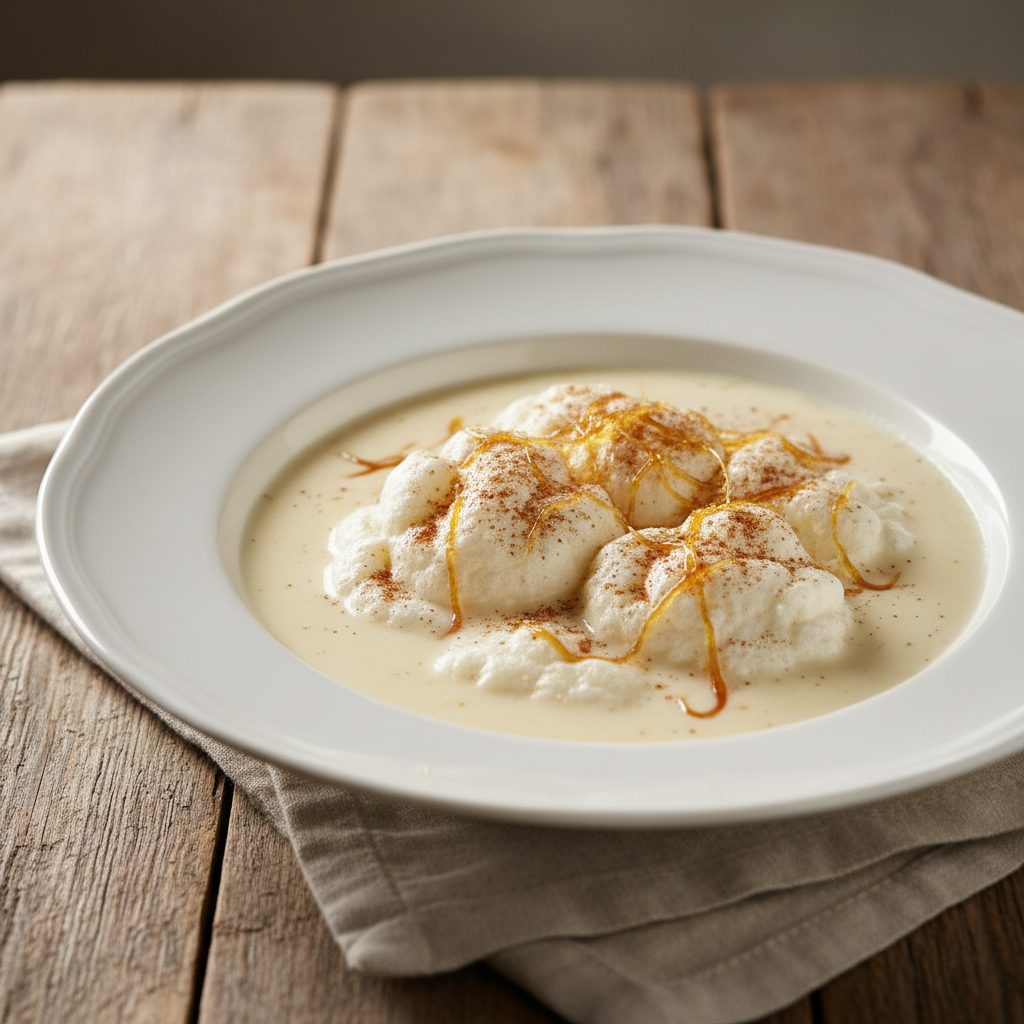
It tastes best well chilled, with vanilla, cinnamon or a thread of caramel. Light, fluffy and shamelessly good.
Zupa nic proves something basic: sometimes something comes out of nothing. Sometimes something so delicious that it can cost you an inheritance.
## Nic, or a little cloud
The word, which today sounds like a joke about an empty plate, once had concrete content. The Warsaw Dictionary from the early 20th century records "nice" as light, airy foams of whipped egg white, poached in milk or water. Zupa nic was therefore a soup of nice, not a soup of nothing. History added the second meaning. Milk, eggs and sugar were always at hand, so the dessert could be made when there was nothing else left in the larder.
Both etymologies are true in their own way. The first tells you what the soup was made of. The second tells you in what times it was loved.
## The salon before the tower block
Before zupa nic became a symbol of resourcefulness, it was the elegance of the gentry table. In "365 Dinners for 5 Złoty", Ćwierczakiewiczowa advised serving the legumina with its foams in a tureen or separately, and cooking soft, sticky rice with sugar and cinnamon to go with it. Zawadzka, in her "Lithuanian Cook" of 1900, reached for vanilla and cinnamon. This is not the cooking of want. It is the cooking of those who know that simplicity requires finesse, and finesse costs more than truffles.
The European siblings of zupa nic show how flavours wandered across the continent. The French île flottante, the "floating island", rests on a thicker crème anglaise and is usually sweeter. Hungarian madártej is sometimes thickened with a little flour. The Germans know Schneegestöber, the "snowstorm". The Polish version is the most pourable and the least pretentious. It does not need almonds to know who it is.
## Wilanów, a rhyme and a will
Countess Aleksandra Potocka, née Branicka, the last of the Potockis to be mistress of Wilanów, was known as a deeply pious woman attached to rustic Polish cooking. She could not stand foreign novelties. On her table, zupa nic was a declaration, not an accident.
According to the story, at a New Year's dinner in 1890 the young guests, used to French menus, ate this "peasant" soup without enthusiasm. Konstanty "Kocio" Potocki, her nephew and presumed heir, when asked how he liked it, answered with a rhyme that went down in history. The countess left the dining room in silence. On 3 January a notary was summoned to the palace. The new will passed Wilanów to Ksawery Branicki, and the Branickis owned the estate until 1945.
Did a single rhyme really shift the fate of a great fortune? So the story goes, and stories told at table have their own truth. The moral remains current. You may not love your host, but you had better not insult his soup.
## Liquid bird's milk
Communist Poland gave zupa nic a second life. When the shelves shone with emptiness, three basic ingredients were enough to put something fluffy and festive on the table. Children called it liquid bird's milk, and it is hard to imagine a better review. Zupa nic became proof that scarcity need not mean shoddiness, and that tenderness in the kitchen can be cheaper than rationed meat.
Kinga Dębska's 2021 film "Zupa nic", a prequel to "My Daughters, Cows", turned it into a metaphor for an entire era. A world in which something beautiful had to be made out of nothing, and shortages were made up for with family warmth and ingenuity.
Zupa nic also appears in poetry. Irit Amiel, a Polish-Jewish poet nominated for the Nike Award, in her poem "My Pompeii" recalls the destroyed pre-war world, and among its scents a zupa nic smelling of a safe home, alongside Jewish tzimmes and night-scented stock. Here a dessert of milk and eggs carries a weight of memory that no monument could bear.
## An art that looks like simplicity
Three ingredients are a trap for the overconfident. A drop of yolk in the whites and the foam will not rise. Milk too hot and the foams turn rubbery. Milk poured in too quickly and the yolks set into sweet scrambled eggs. Zupa nic does not forgive haste. It is a test of patience that you pass not by the recipe, but by the hand.
Perhaps that is why it is so moving. It reminds us that goodness rarely comes from abundance. More often from attention.
## Recipe
**Ingredients (4 servings):**
- 1 litre of milk, preferably full-fat (at least 3.2%)
- 4 very fresh eggs, carefully separated into yolks and whites
- 80–100 g caster sugar (some for the yolks, some for the whites)
- 1 vanilla pod (or a good vanilla paste or extract)
- to serve: a pinch of cinnamon, threads of caramel; optionally fluffy boiled rice or sponge fingers
**Method:**
1. Whip the whites until stiff in a dry, grease-free bowl. Towards the end, gradually add part of the sugar until the foam turns glossy. A pinch of salt or a few drops of lemon juice will stabilise it.
2. Heat the milk with the vanilla pod until it barely "shivers" (about 85–90°C, not boiling).
3. Shape the foam into puffs with a large spoon and lay them on the milk. Poach for 1–1.5 minutes on each side, lift out with a slotted spoon and drain.
4. Beat the yolks with the rest of the sugar and the vanilla seeds into a pale, fluffy kogel-mogel.
5. Pour the hot milk left from poaching into the yolks in a very thin stream, whisking vigorously all the time.
6. Heat over a very low flame or in a water bath, stirring constantly, without exceeding about 80°C. As soon as the custard begins to coat the spoon, take it off the heat and pour it into another vessel.
7. Chill thoroughly. Serve in wide bowls or glass cups, with islands of foam on top, dusted with cinnamon or decorated with threads of caramel.
📖 Glossary
- nice
- Lekkie, napowietrzone pianki z ubitych białek gotowane na mleku albo na wodzie. Od nich prawdopodobnie pochodzi nazwa zupy nic.
- płynne ptasie mleczko
- Dziecięca nazwa zupy nic z czasów PRL-u, gdy deser z mleka, jajek i cukru zastępował brakujące słodycze.
- île flottante
- Francuska „pływająca wyspa”, deser pokrewny zupie nic, oparty na gęstszym kremie angielskim, polewany karmelem i posypywany migdałami.
- madártej
- Węgierski deser pokrewny zupie nic, czyli ptasie mleczko, bywa zagęszczany odrobiną mąki.
Frequently Asked Questions
Where does the name zupa nic come from?
The name most likely comes from nice, light meringue puffs of whipped egg whites poached in milk. The Warsaw Dictionary from the early 20th century records „nice” in exactly that sense. The second meaning, soup made from nothing, was added by history, because milk, eggs and sugar were always at hand.
Is zupa nic a dessert from communist Poland?
No, zupa nic has its roots in 19th-century gentry kitchens and aristocratic salons, and recipes appeared in cookbooks as early as 1861. It enjoyed a second youth under communism, when shops lacked almost everything and children called it liquid bird's milk.
What is the story of zupa nic and the disinheritance at Wilanów?
According to the tale, at a New Year's dinner in 1890 Countess Aleksandra Potocka served zupa nic and her nephew Konstanty „Kocio” Potocki answered with a bawdy rhyme. The countess summoned a notary, and a new will left Wilanów to Ksawery Branicki. The Branicki family owned the estate until 1945.
How is zupa nic different from île flottante?
The French île flottante rests on a thicker crème anglaise, is usually sweeter, drizzled with caramel and sprinkled with almonds. The Polish zupa nic is lighter, the most pourable and the least pretentious. Related desserts include Hungarian madártej and German Schneegestöber.
How to make zupa nic without curdling the yolks?
Pour the hot milk left from poaching into the beaten yolks in a very thin stream, whisking vigorously the whole time. Then heat the custard over a very low flame or in a water bath, without exceeding about 80°C, and take it off the heat as soon as it coats the spoon.
At what temperature to poach the meringues for zupa nic?
Heat the milk with vanilla until it barely shivers, about 85–90°C, without boiling. Poach the meringues for 1–1.5 minutes on each side. Milk that is too hot makes them rubbery.
Related Questions
- Where does the name zupa nic come from?
- Is zupa nic a dessert from communist Poland?
- What is the story of zupa nic and the disinheritance at Wilanów?
- How is zupa nic different from île flottante?
- How to make zupa nic without curdling the yolks?
- At what temperature to poach the meringues for zupa nic?
🧠 Thematic Groups
- Historia: zupa nic wywodzi się z XIX-wiecznych kuchni ziemiańskich, a przepisy podawały Ćwierczakiewiczowa w „365 obiadach za 5 złotych” i Zawadzka w „Kucharce litewskiej”.
- Anegdota: rym Kocia Potockiego na noworocznym obiedzie w Wilanowie w 1890 roku miał kosztować go spadek, który przeszedł na Ksawerego Branickiego.
- Kultura i pamięć: w PRL-u zupa nic stała się płynnym ptasim mleczkiem, a film Kingi Dębskiej i wiersz Irit Amiel uczyniły z niej metaforę epoki i utraconego domu.
- Technika: białka ubite na sztywno, pianki gotowane krótko w mleku o temperaturze 85–90°C i żółtka hartowane gorącym mlekiem, by nie powstała słodka jajecznica.
Tags:
zupa nic
nice
liquid bird milk
milk
eggs
vanilla
legumina
Polish cuisine
Lucyna Ćwierczakiewiczowa
Wincentyna Zawadzka
Aleksandra Potocka
Wilanów
communist Poland
île flottante
madártej
More in: Kuchnia niepolityczna
Content is created by Fundacja Dobre Państwo.
Edited and published by APA ONE, the Foundation's own AI-based editorial system.