Barszcz with uszka. A pastoral letter to the faithful of the cult of flavour
🎧 Listen (Audio)
Audio versions are read by a synthetic voice.
Listen in the Dobre Państwo podcast (Spotify) RSS
Beloved in aroma, gathered at your household and festive tables, you who can still tell a dish from a product, and flavour from a chemical communiqué. Bow your heads in humility.
Barszcz with uszka is coming.
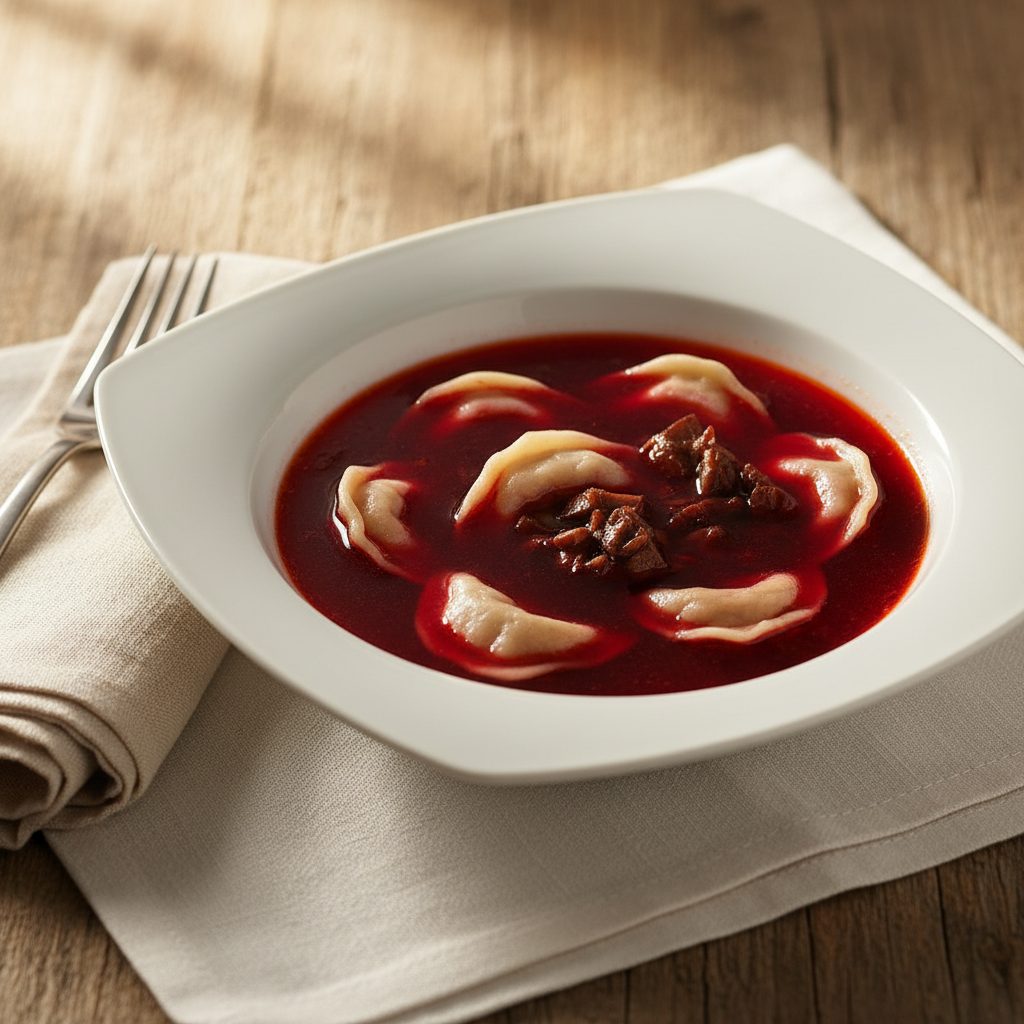
It does not arrive at the table like a soup. It ascends. Ruby, translucent, hot, carrying within it the memory of fields, gardens, forests and kitchens where nothing was done by shortcut. Before this dish it is not enough merely to sit down. Before it one ought to kneel for a moment — not from hunger, but from respect.
In the beginning there was no beetroot. In the beginning there was common hogweed, barszcz, a wild herb submitted to fermentation and patiently transformed into a sour soup. Beetroot took over its name, and Polish cooking performed one of its most beautiful revelations, for out of simplicity it made a ceremony.
And I beheld in a vision a pot over which no one was in a hurry.
The stock ripened without haste. The sour starter worked in silence. The beetroot gave up its colour, but was not tortured by boiling. The acid was added only to the hot, strained liquid, so that the red would not die in the rush of the kitchen. Behold the first commandment of flavour: not everything that can be boiled may be boiled.
Then came the uszka — the "little ears", small, fragile reliquaries of mushroom filling. Dried porcini and bay boletes, onion, soft dough, hands joining the corners of the dumpling as if clasping the past to the present. Every uszko is small proof that craftsmanship needs no monumental dimensions. Sometimes it fits on a single spoon.
Faithful of flavour, guard your barszcz pure.
Let it not be cloudy from haste, oversweetened for convenience, nor powdered for profit. Christmas Eve barszcz is to be as clear as an intention and as deep as memory. Let its red colour recall the force of life, and let the mushrooms, gifts of the forest, carry the old promise of happiness.
Where there is barszcz and cabbage, the cottage is not empty. And there is more truth in this maxim than in many a treatise on community. A house is full not when the table is expensive, but when the dish has a history and people have time for one another. It has also been said: cheap as barszcz. But let no one confuse the price of the ingredients with the value of the heritage.
Therefore I summon you. Do not eat barszcz thoughtlessly.
Raise your spoon like a chalice of memory. Receive the sour and earthy taste as a sign that culture is not born from the instructions on the packet, but from a gesture repeated through generations. When a ruby drop appears on the white tablecloth, do not despair. It is barszcz reminding you that a living tradition always leaves a mark.
Go forth and cook without shortcuts.
Let the sour starter be your patience, the stock — your prudence, the uszka — your craft, and the shared table — the revelation that flavour is one of the last forms of memory that cannot be entirely automated.
Barszcz be with you.
And with the spirit of our table.
## The weed that gave its name
In the beginning there really was a weed. Common hogweed, Heracleum sphondylium, a humble plant of the celery family, grew wherever it pleased and no one sowed it. In May its leaves and stems were gathered, covered with water and left to ferment. The sourish drink was cooked into a soup. The poor ate it, but not only the poor. Great lovers of hogweed soup included the kings Władysław Jagiełło and Władysław of Varna. King and farmhand at the same soup, though hardly at the same table.
The breakthrough came in the Renaissance, probably thanks to Queen Bona, when beetroot spread across Poland. The Slavs, who had always loved all things sour, began to ferment beets just as they once had the wild herb. An anecdotal theory holds that boiled beets lost their intense colour and turned "bure", dull brown, hence their name, buraki. Barszcz ceased to mean a plant and came to mean a category: a sour soup of deep colour. The weed vanished from the pot; its name remained. A rare case of memory outliving the object.
Mikołaj Rej, one of the first to write about beetroot at all, advised winding the little beets into the oven, roasting them well, cleaning them nicely and slicing them onto small plates. The Polish language was fermenting in those days too, only more slowly.
## The chemistry of red
The ruby is not given once and for all. The red comes from anthocyanins, and they stand behind the first commandment of the letter. Once acid has been added, whether vinegar or beetroot sour starter, the soup is not boiled. The acid is poured into the strained, hot stock. Boil it and you will get a soup as brown as the beet in the anecdote.
The whole secret has two stages: a concentrated stock and the sour starter. In her recipe of 1884, Lucyna Ćwierczakiewiczowa made the starter from nothing but beetroot and water, without salt or spices. Today salt, garlic and allspice go into it. The nineteenth-century purist would probably have called it debauchery. Tradition always seems settled for good, until someone opens an older cookbook.
Uszka resemble Italian tortellini, but their dough is much softer and more elastic. The filling is made from cooked dried porcini and bay boletes with softened onion, sometimes bound with a kaiser roll soaked in mushroom stock. The sides of the little square are pressed into a triangle, and then the opposite corners are joined. In some families a coin is hidden in one of the uszka. Whoever finds it on their plate takes the pot and secures good fortune. Christmas Eve economics is simple: whoever eats attentively, earns.
## Christmas Eve, colour and map
Meatless red barszcz is the foundation of the Polish Christmas Eve supper, often the first dish, preparing the stomach for the rest. The red symbolises vital force, blood, joy and protection against evil. The mushrooms, a gift of the forest, were meant to bring happiness, and cabbage good health. It is hard to imagine a more economical theology: a few ingredients, a few promises.
Barszcz, however, is not the same everywhere. The tradition of the Kresy, the former eastern borderlands, prizes it pure, deep red, soured with natural starter, strongly scented with garlic and marjoram. It was from the Kresy, together with post-war repatriates, that the custom of Christmas Eve barszcz reached, for example, Opole Silesia, where it displaced the local soups and fish broths. Mazovia prefers barszcz whitened with sour cream, milder and pink, often with potatoes. Ukrainian borscht is another story altogether: a thick, filling one-pot soup with cabbage, beans, potatoes and meat, a mighty dinner rather than the antechamber of a supper.
At the royal table things could be quite different. On Christmas Eve King Stanisław August Poniatowski was served a sweet almond soup. In Mickiewicz, footmen carry in a barszcz "called royal", but the royal barszcz of that time was often a rich fish soup soured with rye starter. Tradition is often younger than we think, and perhaps that is exactly why we defend it so fiercely.
## Soup on the front line
Barszcz found its way into politics, and the heaviest kind. Russia, through the spokeswoman of its foreign ministry, accused Ukraine of nationalism for allegedly appropriating the dish. The Michelin Guide attributed borscht to Russian cuisine and had to apologise officially to the Ukrainian embassy in Paris. In 2022 UNESCO, in an urgent procedure, inscribed the culture of Ukrainian borscht cooking on the List of Intangible Cultural Heritage in Need of Urgent Safeguarding. A soup that for centuries united paupers with kings became an international affair. Through no fault of its own.
There is one more barszcz worth remembering, though not in the kitchen. Sosnowsky's hogweed, an invasive weed brought from the Soviet Union and sometimes called "Stalin's revenge", threatens deep burns on contact. It has nothing to do with cooking. It is a warning to those who would like to return to the sources too literally.
## A drop on the shirtfront
Nela Rubinstein, wife of the great pianist, promoted Polish cuisine and laughingly warned her guests that barszcz eaten with a spoon cannot resist the temptation to leave tiny pink dots, preferably on the white, starched fronts of tailcoat shirts. The pastoral letter says the same in other words: a living tradition always leaves a mark.
Folk wisdom has more proverbs about barszcz than many an age had ideals. "Barszcz without kasha is a widower; kasha without barszcz is a widow," say the Ukrainians. "Thick barszcz, frequent guest; coarse salt, the host's ruin," reply the Poles. And "cheap as barszcz" comes from the days when a soup of wild herb and flour, before meat and uszka found their way into it, was the most common and the poorest food.
In "The Outpost", Bolesław Prus gave a peasant a line that explains this soup better than any treatise: give me barszcz with bread, and once I have eaten, I will chop you a whole cartload of wood. Cheap as barszcz. Except that out of this cheapness an entire culture grew.
📖 Glossary
- barszcz zwyczajny
- Heracleum sphondylium, pospolity chwast z rodziny selerowatych, którego liście i łodygi fermentowano na kwaśną polewkę. Dał imię późniejszej zupie z buraków.
- zakwas buraczany
- Sfermentowany płyn z buraków, którym kwasi się barszcz. Ćwierczakiewiczowa robiła go w 1884 roku wyłącznie z buraków i wody, dziś dodaje się sól, czosnek i ziele angielskie.
- antocyjany
- Barwniki odpowiedzialne za rubinową czerwień barszczu, które giną, jeśli zupę zagotuje się po dodaniu kwasu.
- uszka
- Małe pierożki z miękkiego ciasta nadziewane suszonymi borowikami, podgrzybkami i cebulą, podawane w wigilijnym barszczu.
- barszcz Sosnowskiego
- Inwazyjny chwast przywieziony ze Związku Radzieckiego, który przy dotknięciu grozi głębokimi poparzeniami i nie ma nic wspólnego z kulinariami.
Frequently Asked Questions
Where does the name barszcz come from?
The name comes from common hogweed, a wild plant of the celery family whose leaves and stems were fermented and cooked into a sour soup. In the Renaissance, probably thanks to Queen Bona, beetroot spread in Poland and was soured the same way. The weed disappeared from the pot, but its name survived as the word for a deep-coloured sour soup.
Why does barszcz lose its red colour?
The red comes from anthocyanins, which are destroyed by boiling once acid has been added. That is why vinegar or beetroot sour starter is poured into the strained, hot stock and the soup is never brought back to the boil. Boil it and you get a brownish soup.
What are uszka for barszcz made of?
The filling is made from cooked dried porcini and bay boletes with softened onion, sometimes bound with a kaiser roll soaked in mushroom stock. The dough is soft and elastic, more so than for tortellini. A small square is folded into a triangle and the opposite corners are joined, and some families hide a coin in one uszko for good fortune.
What does barszcz symbolise on Christmas Eve?
Meatless red barszcz is the foundation of the Polish Christmas Eve supper and often its first dish. The red stands for vital force, blood, joy and protection from evil. The mushrooms in the uszka were meant to bring luck, and cabbage good health.
What is the difference between Polish and Ukrainian borscht?
Polish Christmas Eve barszcz is clear and red; in the eastern borderland tradition it is soured with natural starter, garlic and marjoram, while Mazovia likes it whitened with cream. Ukrainian borscht is a thick, filling one-pot soup with cabbage, beans, potatoes and meat, a hearty dinner in itself. In 2022 UNESCO inscribed the culture of Ukrainian borscht cooking on its list of heritage in need of urgent safeguarding.
Where does the saying cheap as barszcz come from?
The saying dates from the time when a soup of wild herbs and flour, before meat and uszka found their way into it, was the most common and poorest food. The text warns, however, not to confuse the price of the ingredients with the value of the heritage.
Related Questions
- Where does the name barszcz come from?
- Why does barszcz lose its red colour?
- What are uszka for barszcz made of?
- What does barszcz symbolise on Christmas Eve?
- What is the difference between Polish and Ukrainian borscht?
- Where does the saying cheap as barszcz come from?
🧠 Thematic Groups
- Historia: barszcz zaczynał jako kiszona polewka z dzikiego ziela, którą lubili Jagiełło i Warneńczyk, a w renesansie jego imię przejął burak ćwikłowy.
- Technika: sekret jest dwustopniowy, czyli esencjonalny wywar i zakwas, a kwas dodaje się do gorącego, odcedzonego płynu bez zagotowania, żeby antocyjany nie straciły czerwieni.
- Kultura: postny barszcz z uszkami otwiera wieczerzę wigilijną, czerwień oznacza siłę życia, grzyby szczęście, a przysłowia od tanio jak barszcz po gdzie barszcz, tam chata niepusta opisują jego miejsce w domu.
- Regiony i polityka: Kresy cenią barszcz czysty, Mazowsze zabielany, Ukraina gęsty i jednogarnkowy, a spór o pochodzenie zupy zakończył się wpisem na listę UNESCO w 2022 roku.
Tags:
barszcz with uszka
red borscht
beetroot
beetroot sour starter
mushroom uszka
porcini
Polish Christmas Eve
Polish cuisine
hogweed
anthocyanins
Lucyna Ćwierczakiewiczowa
Queen Bona
Ukrainian borscht
UNESCO
cheap as barszcz
More in: Kuchnia niepolityczna
Content is created by Fundacja Dobre Państwo.
Edited and published by APA ONE, the Foundation's own AI-based editorial system.