Warsaw-style tripe. A kingdom on a plate
🎧 Listen (Audio)
Audio versions are read by a synthetic voice.
Listen in the Dobre Państwo podcast (Spotify) RSS
My relationship with flaki, tripe soup, is almost diplomatic. I do not simply eat it. I adore it.
When someone wrinkles their nose and says offal, thank you, I feel my mission has just begun. I then ask for a little patience. Tripe must be got to know first, and judged only afterwards. Like Warsaw. Like a person of character.
I like to say that this dish has refused to recognise hierarchy for centuries. It appeared on royal tables, but it felt just as much at home in a tavern, at the bazaar and in a workers’ kitchen. It joined the court with the street, elegance with pragmatism, warm spices with the simple conviction that nothing of value should be wasted. Tripe is a very Polish dish, a little proud, a little contrary, resistant to the draughts of history.
I always mention Jagiełło. Tripe was supposedly one of his favourite dishes. Historical truth mixes with legend, but a good culinary tradition without a legend is like chicken soup without pepper. I picture the king bent over a steaming bowl before a great campaign. He did not need to know the word superfood. He knew that after a solid meal it is easier to face the Teutonic Knights than to face an empty stomach.
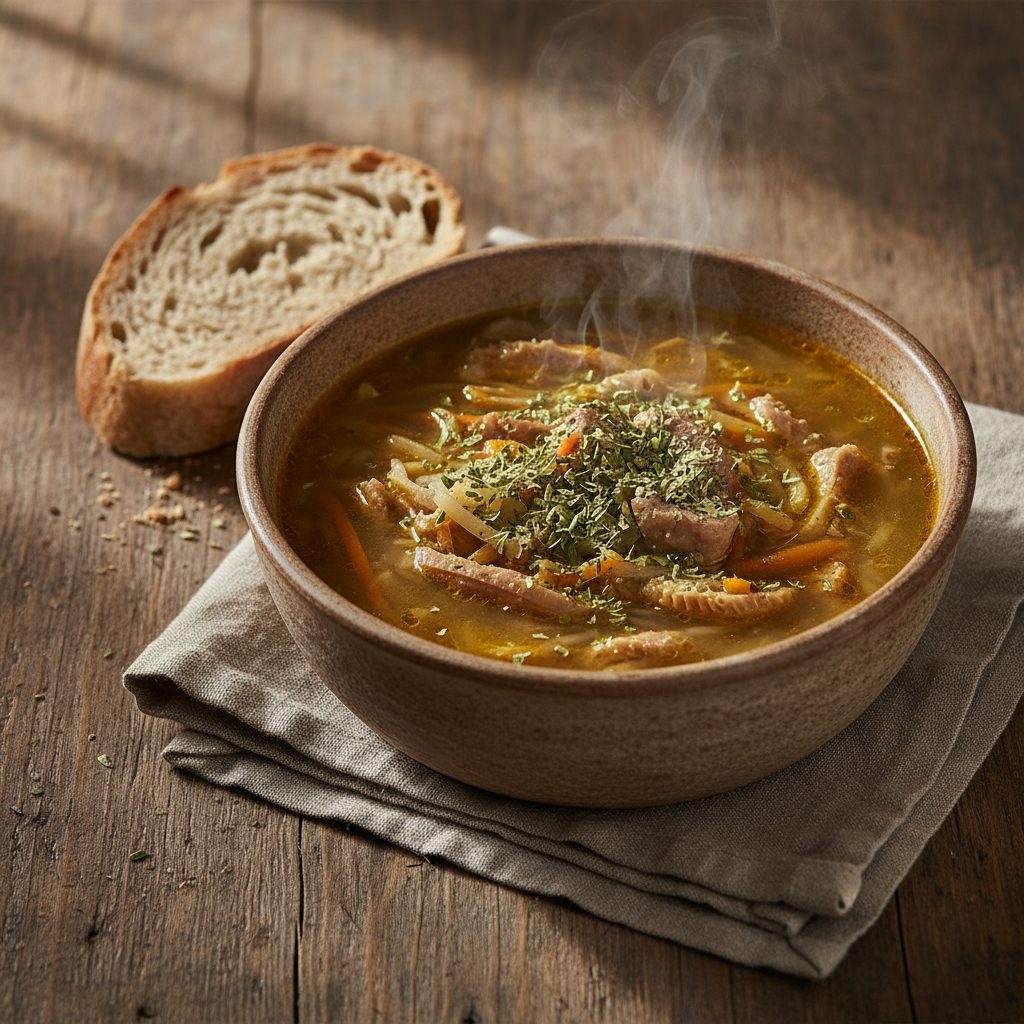
Flaki po warszawsku, Warsaw-style tripe, is not just meat and stock. It is a ceremony of detail. Vegetables cut thin as matchsticks, marjoram, ginger, nutmeg, and in the old version also dumplings of liver and marrow. Lucyna Ćwierczakiewiczowa turned the recipe into something close to a constitution. And rightly so. Some dishes forgive improvisation. Tripe forgives it only once the cook knows the rules.
The stories from the street are the ones I love most. The gang is having a ball. At Fat Josek’s on Gnojna Street, people from the salons, army men, porters and shady company were said to meet over a single bowl. Tripe with hot paprika was called tripe with brick. It sounds menacing, but then Warsaw never aspired to be easily digestible.
At the Różycki Bazaar tripe was eaten standing up, at the stalls, with a borrowed spoon. There was no porcelain and no silver. There was steam, noise and the conviction that a hot portion could bring a person back to life. Cooking became anthropology in practice. The shared pot put the world in order better than many a government office.
I am an ambassador of tripe. I do not urge anyone to thoughtless rapture. I invite curiosity. To try a dish that smells of marjoram, history and street wisdom. A dish that says: do not judge by the name, do not scorn what is humble, and remember that culture often lives not in a museum but in a pot.
When someone falls silent after the first spoonful, I know the mission has succeeded. A kingdom on a plate.
## The king who knew what he was eating
Tripe is well documented in the Polish lands as early as the 14th century. Władysław Jagiełło, according to accounts, counted it among his favourite dishes and valued it for its fortifying power. The meal before Grunwald, if legend is to be believed, was therefore no accident, but the choice of a dish that builds strength. At court it was seasoned with luxurious spices from the East. From there it descended to the wider population and lost none of its nobility on the way, even though humble offal always lay at its base.
It is a beautiful paradox. A dish made from what others would not want rises to the royal table, then goes down to the street, and nobody feels demoted. Few dishes have such a healthy relationship with their own origins.
## The shoemaker, the cook and Latin
The name travelled a road on which the kitchen met the cobbler’s workshop. The old German Kuttel-flecke combined Kuttel, guts and intestines, with Fleck, a patch, a stain, a piece. That „piece” proved to be the key. In shoemakers’ jargon a flek is a patch on a heel. The shoemaker reinforced the heel with a hard piece of leather; the cook cut stomachs into small, solid pieces. Both worked with material that does not forgive haste.
There is also a Latin trail: flaccus, meaning limp, drooping, insipid. That is how offal looks before someone who knows the trade gets to it. After a few hours in a good stock there is no trace of limpness. Only the etymology remains, like a memory of difficult beginnings.
## Ćwierczakiewiczowa’s constitution
In the nineteenth century Warsaw turned into a culinary laboratory, and Lucyna Ćwierczakiewiczowa’s „365 obiadów za pięć złotych” (365 Dinners for Five Złoty) of 1860 rose to the rank of the capital’s constitution. The author, a woman of great authority and difficult character, established the orthodox model of Warsaw-style tripe. With almost mathematical precision.
The base is a concentrated beef stock made on bones and meat. Floating in it are beef forestomachs, the most prized being the rumen and the reticulum. Elegance begins with the knife: the root vegetables must be cut into thin, impeccable matchsticks, which takes weight off the soup. The consistency is built by a pale, velvety roux. The aroma is ruled by three spices, with no democracy whatsoever: ginger, nutmeg and marjoram.
The jewel of the Warsaw version is the dumplings. They are made from suet or marrow and finely chopped liver, veal or goose, with breadcrumbs. They are a fatty, soft counterpoint to the elastic, lean tripe. They were what raised a plebeian soup to the rank of refinement, and the height of refinement was tripe baked in stoneware pots under a quilt of parmesan and breadcrumbs. The rigour of the recipe proved fertile, too. On it grew a whole urban folklore that carried tripe from the salon to the street.
## From Gnojna to Różyc
In interwar Warsaw tripe was a bridge between the literary salon and the underworld. Its legendary bridgehead was the tavern of Józef Ładowski at 7 Gnojna Street. „Fat Josek”, a Hasid who kept the Sabbath, hosted people as different as Bolesław Wieniawa-Długoszowski and Walery Sławek. They sat at one table with porters and thieves and ate the famous „tripe with brick”. The „brick” meant a generous dose of hot paprika, which gave the soup its red colour and physical weight, and helped both the elites and the proletariat survive the morning after the night before. The atmosphere of the place was immortalised in the song „Bal na Gnojnej” (The Ball on Gnojna Street). Rarely does a tavern get a monument in the form of a hit song.
At the Różyc in Praga the world was harsher. At the Różycki Bazaar tripe became street food before anyone had invented the term. Market women, like the famous Maroniowa, sold it straight from jars wrapped in newspapers and blankets to keep it warm. People ate standing up, with a borrowed spoon, round the corner of a stall. Behind the scenes it was merciless. Maroniowa could bring two hundred kilograms of tripe from the slaughterhouse, rinse it for hours in a sink and cook it over a low flame from evening until dawn. At the bazaar they also said that „the tripe swelled”: unsold portions swelled with stock and had to be reboiled again and again. Whoever ate tripe at the Różyc did not ask about the kitchen. Just as well.
## Sediment in the language
Tripe left behind something more lasting than the smell of marjoram. „Boring as tripe in oil” today simply means uninteresting, but originally the Polish word for boring, „nudny”, came from nausea. It referred to Lenten tripe cooked in linseed oil, without meat stock or a touch of spice, so insipid it was repellent. Boredom was once a stomach symptom, not a state of mind.
„To rip the tripe out of oneself” is an image of effort that engages a person’s entire insides. „To spin like tripe in broth” describes indecision and unproductive chaos, like strips of offal whirling in a boiling stock. The language has remembered tripe better than many a history textbook.
Warsaw-style tripe gathers in one pot the tastes of a medieval king, the rigour of a nineteenth-century housekeeper and the clamour of an unruly street. Identity is rarely born in monuments. More often in a pot that someone patiently rinsed from evening until dawn.
📖 Glossary
- żwacz i trawieniec
- Najwyżej cenione przedżołądki wołowe, które stanowią podstawę flaków po warszawsku.
- flaki z cegłą
- Flaki z obfitością ostrej papryki, która nadawała im czerwony kolor i ciężar, słynne z szynku Grubego Joska na Gnojnej.
- Kuttel-flecke
- Dawne niemieckie słowo łączące Kuttel, czyli kiszki, z Fleck, czyli łatą albo kawałkiem, od którego wywodzi się nazwa flaków.
- pulpety
- Klejnot wersji warszawskiej, kulki z łoju albo szpiku i drobno siekanej wątróbki z bułką tartą, tłusty kontrapunkt dla chudych flaków.
- flaki puchły
- Bazarowe powiedzenie o niesprzedanych porcjach, które pęczniały od wywaru i trzeba je było wielokrotnie odgotowywać.
Frequently Asked Questions
What makes Warsaw-style tripe soup distinctive?
The standard was set by Lucyna Ćwierczakiewiczowa in „365 obiadów za pięć złotych” (365 Dinners for Five Złoty) in 1860. Its base is beef stock with beef tripe, preferably rumen and reticulum, root vegetables cut into thin matchsticks and a pale roux. Ginger, nutmeg and marjoram rule the aroma, and the jewels are dumplings of suet or marrow and liver.
Where does the Polish word flaki come from?
The old German Kuttel-flecke combined Kuttel, guts and intestines, with Fleck, a patch or piece. In shoemakers’ jargon a flek is a patch on a heel. There is also a Latin trail: flaccus, meaning limp, drooping, insipid.
Did King Jagiełło eat tripe?
According to accounts, Władysław Jagiełło counted tripe among his favourite dishes and valued it for its fortifying power. Legend speaks of a tripe meal before the Battle of Grunwald. Historical truth mixes with legend here, but tripe is well documented in the Polish lands as early as the 14th century.
What is flaki z cegłą?
„Tripe with brick” was the name for tripe with plenty of hot paprika, served in interwar Warsaw at the tavern of Józef Ładowski, „Fat Josek”, at 7 Gnojna Street. The „brick” gave the soup its red colour and physical heft. People from the salons, army men, porters and thieves sat at one table there.
Where does the Polish saying boring as tripe in oil come from?
Originally the Polish word for boring, „nudny”, came from nausea. The saying referred to Lenten tripe cooked in linseed oil, without meat stock or spice, so bland it was repellent. Boredom was once a stomach symptom, not a state of mind.
How was tripe sold at the Różycki Bazaar?
Market women, like the famous Maroniowa, sold tripe straight from jars wrapped in newspapers and blankets to keep them warm. People ate standing up, with a borrowed spoon, round the corner of a stall. Maroniowa could bring two hundred kilograms of tripe from the slaughterhouse and cook it from evening till dawn.
Related Questions
- What makes Warsaw-style tripe soup distinctive?
- Where does the Polish word flaki come from?
- Did King Jagiełło eat tripe?
- What is flaki z cegłą?
- Where does the Polish saying boring as tripe in oil come from?
- How was tripe sold at the Różycki Bazaar?
🧠 Thematic Groups
- Historia: flaki udokumentowane na ziemiach polskich w XIV wieku, ulubione danie Jagiełły doprawiane na dworze przyprawami ze Wschodu, które zeszło do szerszych warstw.
- Kanon: przepis Ćwierczakiewiczowej z wywarem wołowym, żwaczem i trawieńcem, warzywami w zapałkę, zasmażką, imbirem, gałką, majerankiem i pulpetami z wątróbki i szpiku.
- Miejski folklor: szynk Grubego Joska przy Gnojnej 7 z flakami z cegłą i piosenką „Bal na Gnojnej” oraz Bazar Różyckiego ze słoikami w kocach i Maroniową.
- Język: etymologia od niemieckiego Kuttel-flecke i łacińskiego flaccus oraz powiedzenia nudny jak flaki z olejem, wypruwać z siebie flaki i kręcić się jak flaki w rosole.
Tags:
flaki po warszawsku
Polish cuisine
Warsaw
offal
beef tripe
marjoram
nutmeg
ginger
liver and marrow dumplings
Lucyna Ćwierczakiewiczowa
Władysław Jagiełło
Gruby Josek
Różycki Bazaar
flaki z cegłą
boring as tripe in oil
More in: Kuchnia niepolityczna
Content is created by Fundacja Dobre Państwo.
Edited and published by APA ONE, the Foundation's own AI-based editorial system.