Duck Poznań-style. Fatty, ruddy and fully aware of its advantage
🎧 Listen (Audio)
Audio versions are read by a synthetic voice.
Listen in the Dobre Państwo podcast (Spotify) RSS
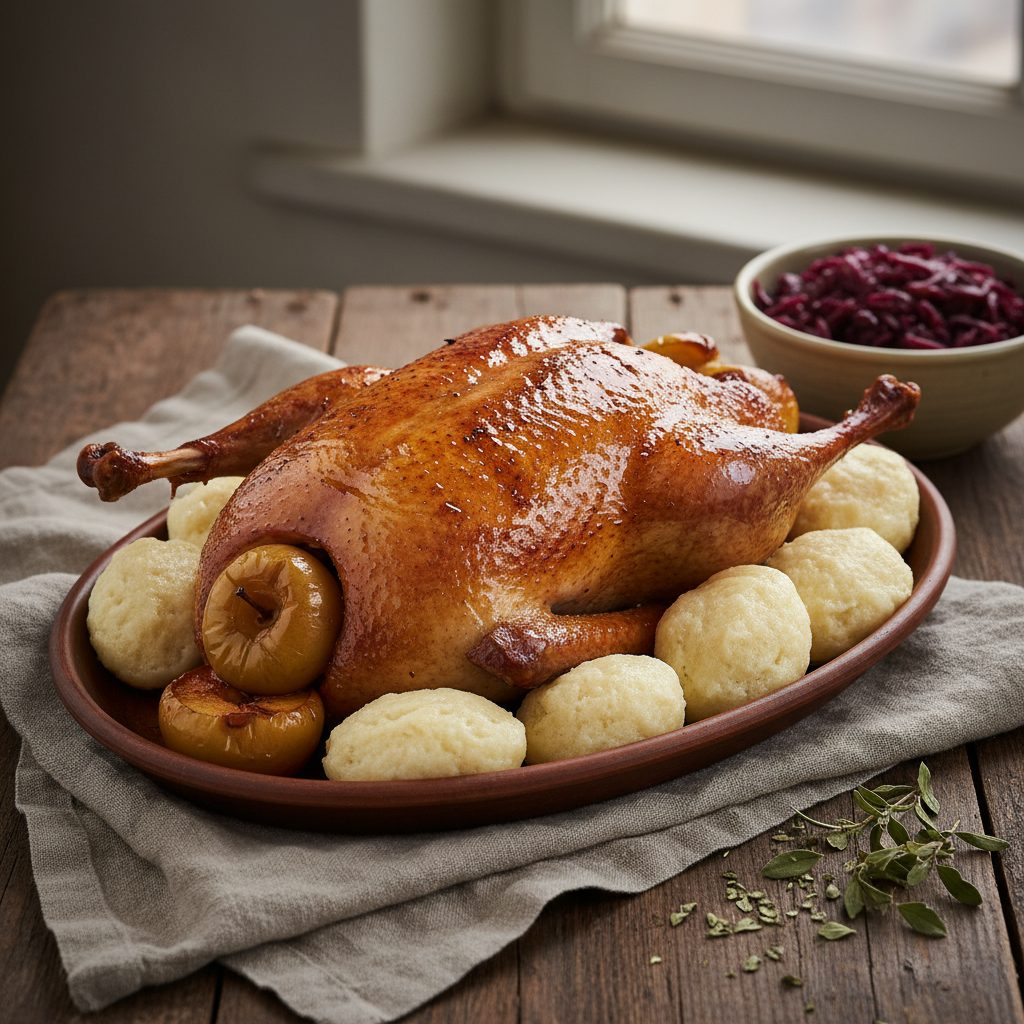
Let's not fool ourselves. Kaczka po poznańsku, duck Poznań-style, is not a dish for people who order a salad and then steal chips from someone else's plate. It demands courage, appetite and a readiness to get your fingers dirty. There is no room here for false modesty. The fat should drip. It should smell of marjoram. The skin should gleam. You should look at the platter with that particular kind of desire which it is not polite to declare at table, but which nobody manages to hide anyway.
First the duck is rubbed with salt, pepper, garlic and a solid helping of marjoram. Solid, meaning Greater Polish. Not a pinch for an alibi, but enough for the aroma to get into the meat, settle into the kitchen and let the neighbours know that today in your house there will be no fitness compromise. Marjoram has a practical purpose here: it softens the characteristic smell of duck fat and aids digestion. In Poznań even pleasure must be rationally justified.
The inside of the duck is filled with sour, firm apples, ideally Antonówka or Szara Reneta. It sounds innocent, but do not be deceived. Malic acid helps loosen the structure of the meat, so the roast becomes tender, juicy and indecently yielding to the fork. Here chemistry flirts with tradition, and collagen slowly loses its resistance.
Then comes the heat. First sharp, high, without ceremony. The skin must brown, tighten and give up its fat. Later the temperature drops, the roasting slows, and the duck matures under a lid, regularly basted with its own juices. With every minute it gets softer, glossier and harder to ignore.
At last it arrives at the table in the best company. Modra kapusta, red cabbage, is sour, sweet and lightly spiced. Yeast pyzy, our kluchy na łachu, soak up the sauce without a shred of shame. Nothing is wasted here. The fat runs down the meat, the sauce soaks into the dumplings, and the smell of apples, garlic and marjoram strips you of the last remnants of culinary restraint.
The real delights begin.
Lick your fingers. Suck the bones. Crunch the skin slowly, though reason suggests saving some for later. Nothing is saved. Kaczka po poznańsku does not tolerate cold calculation. It wants total commitment. It wants sighs, second helpings and that brief silence that falls at the table when everyone is too busy with pleasure to keep up polite conversation.
The dish has the temperament of a girl who knows perfectly well the whole room is looking at her but pretends to be straightening her napkin. It is ruddy, fragrant, a little brazen and definitely has no intention of apologising for its curves.
Greater Poland does not flirt with empty promises. Greater Poland serves duck. And watches to see if you ask for more.
## From commodity to calling card
The domestic duck descends from the wild mallard and was domesticated about 2,500 years ago. Its meat was prized as early as ancient Rome. In the Polish lands poultry was for centuries treated above all as a commodity. A peasant raised a duck in order to sell it, and ate it himself only on high holidays. Luxury always goes to market first.
The breakthrough came in the 19th century. Economic changes under Prussian rule and the growing prosperity of the peasantry meant that meat appeared more often on tables in Greater Poland. Oskar Kolberg recorded near Rawicz a song that says it better than many a treatise: once there were peas and cabbage for dinner, now there is roast mutton and fat duck. Economic history in two lines.
Since 2008 "kaczka pieczona po wielkopolsku", roast duck Greater Poland-style, has been on the List of Traditional Products, and Greater Poland is the national leader in duck farming. The region not only roasts it but supplies it too. Consistency worthy of a Poznań native.
## A hybrid on one platter
Kaczka po poznańsku is a culinary mixture of cultures, though it pretends to pure nativeness. The sweet-and-sour red cabbage betrays a clear influence of Prussian traditions and of the German settlers known as Bambrzy. Meanwhile, where the Germans serve potato dumplings, Greater Poland opted for its own fluffy yeast dumplings. It borrowed the cabbage but kept its own dumplings. This is what a well-negotiated identity looks like.
The comparison with Asia is instructive. Peking duck lives for its skin: dried, lacquered with maltose, crisp, eaten with pancakes. Greater Poland seeks something else, the deep juiciness of meat steeped in the aroma of orchard and forest, apples and marjoram. Beijing looks at the surface. Poznań looks inside, which suits the regional character.
This juiciness is no accident. The essential oils of marjoram mask the bland smell of duck fat. Malic acid from the fruit inside reacts with collagen and speeds its breakdown, so the meat becomes tender. The two stages of roasting divide the labour: first the fire renders the fat and browns the skin, then the low temperature under a lid gives the meat time. Greater Polish thrift in its purest form. Nothing goes to waste, not even a minute.
## Szagówki, kluchy na lumpie and black soup
Without the Poznań dialect this cuisine would be mute. Kluchy na łachu or na lumpie are pampuchy, yeast dumplings cooked in steam. The łach or lump is a linen cloth or a muslin nappy stretched over a pot, on which the dumplings rise under a lid. Szagówki are kopytka, potato dumplings, and the name comes from the dialect "na szagę", meaning diagonally, because the roll of dough is always cut at a slant. The language remembered the movement of the knife.
There is also czernina, the black soup, cooked on broth with the addition of duck or goose blood, in old Polish called jusznik. Its meaning went far beyond the kitchen. Served to a young man, it signified refusal of a maiden's hand. That is exactly how Jacek Soplica was humiliated in "Pan Tadeusz", and his bitterness drove the tragic plot of the poem. Soup as a letter of rejection. The Polish nobility had no need of a postal service.
Polish idiom knows the duck well. Something runs off someone like water off a duck. A "kaczka dziennikarska", a journalistic duck, is an invented sensation. "A niech to kaczka kopnie!", may a duck kick it, deals with any kitchen failure. And in Greater Poland they repeat a short maxim that closes any discussion about the menu: if tomorrow's dinner is duck, there must be pyzy and red cabbage.
## Kaczka Dziwaczka and tearing the drake
Children's literature has its own duck satire on gastronomy. Jan Brzechwa's Kaczka Dziwaczka, the Wacky Duck, combed herself with a toothpick, swallowed coins, ate a ribbon thinking it was pasta, and when the cook roasted her in a roasting tin, she turned into a hare with beetroot. Anyone who has ever ordered a dish in an unfamiliar restaurant knows the feeling. A folk poem by Zbigniew Szałkiewicz tells in turn of a drunken duck who, instead of splashing in the river, distilled moonshine from currants in the bushes and got the forest company drunk, until people roasted her and ate her. The moral is Greater Polish: debauchery ends in the oven.
The most peculiar custom lives on in Wtórek. Since 1904, with roots reaching back to 18th-century carnival festivities, the butchers' guild has organised contests there in "zrywanie kaczora", tearing the drake. Riders gallop, rise in their stirrups and try to tear the head off a dead drake hung several metres above the ground. Greater Poland knows how to have fun. Only always to the benefit of the kitchen.
## Recipe
**Ingredients:**
- a duck weighing 1.5–3 kg, cleaned of feathers
- salt
- freshly ground pepper
- garlic
- a large amount of marjoram
- sour, firm apples (e.g. Antonówka or Szara Reneta)
- to serve: a thick sauce, modra (red) cabbage braised with fruit and cloves, yeast dumplings
**Method:**
1. Rub the duck dry with salt, freshly ground pepper, garlic and a large amount of marjoram.
2. Chill the marinated duck for 2 to 12 hours.
3. Fill the inside with sour, firm apples.
4. Roast uncovered at a high temperature, about 210–230°C, for about 30 minutes, until the fat is rendered and the skin browns.
5. Lower the temperature to 150–160°C and roast covered for about an hour per kilogram of weight, regularly basting the bird with the rendered fat.
6. Serve with a thick sauce, red cabbage and yeast dumplings.
📖 Glossary
- kluchy na łachu
- Pampuchy, czyli drożdżowe pyzy gotowane na parze na lnianej ściereczce albo tetrowej pielusze naciągniętej na garnek. W gwarze także kluchy na lumpie.
- szagówki
- Poznańska nazwa kopytek, od gwarowego „na szagę”, czyli ukośnie, bo wałek ciasta tnie się pod skosem.
- czernina
- Czarna polewka, zupa na bulionie z krwią kaczki albo gęsi, w dawnej polszczyźnie jusznik. Podana kawalerowi oznaczała odmowę ręki panny.
- modra kapusta
- Czerwona kapusta na słodko-kwaśno, zasmażana z owocami i goździkami, z wyraźnym wpływem tradycji pruskich i Bambrów.
- zrywanie kaczora
- Zawody organizowane we Wtórku przez cech rzeźników od 1904 roku, w których jeźdźcy w cwale próbują urwać głowę zawieszonemu martwemu kaczorowi.
Frequently Asked Questions
How do you make Poznań-style duck?
The duck is rubbed dry with salt, pepper, garlic and plenty of marjoram, chilled for 2 to 12 hours and stuffed with sour apples. It is first roasted uncovered at 210–230°C for about 30 minutes, then covered at 150–160°C for about an hour per kilogram. Throughout, it is basted with the rendered fat.
Why are marjoram and sour apples added to duck?
The essential oils of marjoram mask the characteristic smell of duck fat and aid digestion. Malic acid from firm, sour apples such as Antonówka or Szara Reneta speeds up the breakdown of collagen. As a result the meat becomes tender and juicy.
What is Poznań-style duck served with?
The duck is served with a thick sauce, modra, that is red, cabbage braised with fruit and cloves, and yeast dumplings called kluchy na łachu. In Greater Poland they say that if there is duck for dinner, there must be pyzy and red cabbage.
Where does the tradition of Greater Poland roast duck come from?
For centuries peasants raised ducks mainly to sell, eating them only on high holidays. In the 19th century economic changes under Prussian rule and growing peasant prosperity brought meat to Greater Polish tables more often, as Oskar Kolberg recorded. Since 2008 Greater Poland roast duck has been on the List of Traditional Products.
How does Poznań-style duck differ from Peking duck?
Peking duck lives for its skin, dried, lacquered with maltose and crisp, eaten with pancakes. Poznań-style duck seeks the deep juiciness of meat steeped in the aroma of apples and marjoram. Beijing looks at the surface; Poznań looks inside.
What did black soup served to a suitor mean?
Czernina, black soup made from broth with duck or goose blood, once called jusznik, signified refusal of a maiden's hand when served to a young man. That is how Jacek Soplica was humiliated in "Pan Tadeusz", and his bitterness drove the poem's tragic plot.
Related Questions
- How do you make Poznań-style duck?
- Why are marjoram and sour apples added to duck?
- What is Poznań-style duck served with?
- Where does the tradition of Greater Poland roast duck come from?
- How does Poznań-style duck differ from Peking duck?
- What did black soup served to a suitor mean?
🧠 Thematic Groups
- Historia: udomowienie kaczki, drób jako towar na sprzedaż, XIX-wieczny wzrost zamożności pod pruskim panowaniem, piosenka zanotowana przez Kolberga i wpis na Listę Produktów Tradycyjnych w 2008 roku.
- Technika: majeranek maskujący zapach tłuszczu, kwas jabłkowy rozkładający kolagen i dwa etapy pieczenia, najpierw gorąco, potem długo pod przykryciem.
- Tożsamość i hybryda: modra kapusta po Bambrach, własne kluski drożdżowe zamiast knedli oraz kontrast z kaczką po pekińsku.
- Język i obyczaj: gwara poznańska z kluchami na lumpie i szagówkami, czarna polewka z „Pana Tadeusza”, Kaczka Dziwaczka Brzechwy i zrywanie kaczora we Wtórku.
Tags:
kaczka po poznańsku
roast duck Greater Poland-style
marjoram
sour apples
Antonówka
red cabbage
kluchy na łachu
yeast dumplings
szagówki
czernina
Greater Poland
Poznań
Bambrzy
Oskar Kolberg
tearing the drake
More in: Kuchnia niepolityczna
Content is created by Fundacja Dobre Państwo.
Edited and published by APA ONE, the Foundation's own AI-based editorial system.