Chicken de volaille. A gastronomic young gentleman in a golden coat
🎧 Listen (Audio)
Audio versions are read by a synthetic voice.
Listen in the Dobre Państwo podcast (Spotify) RSS
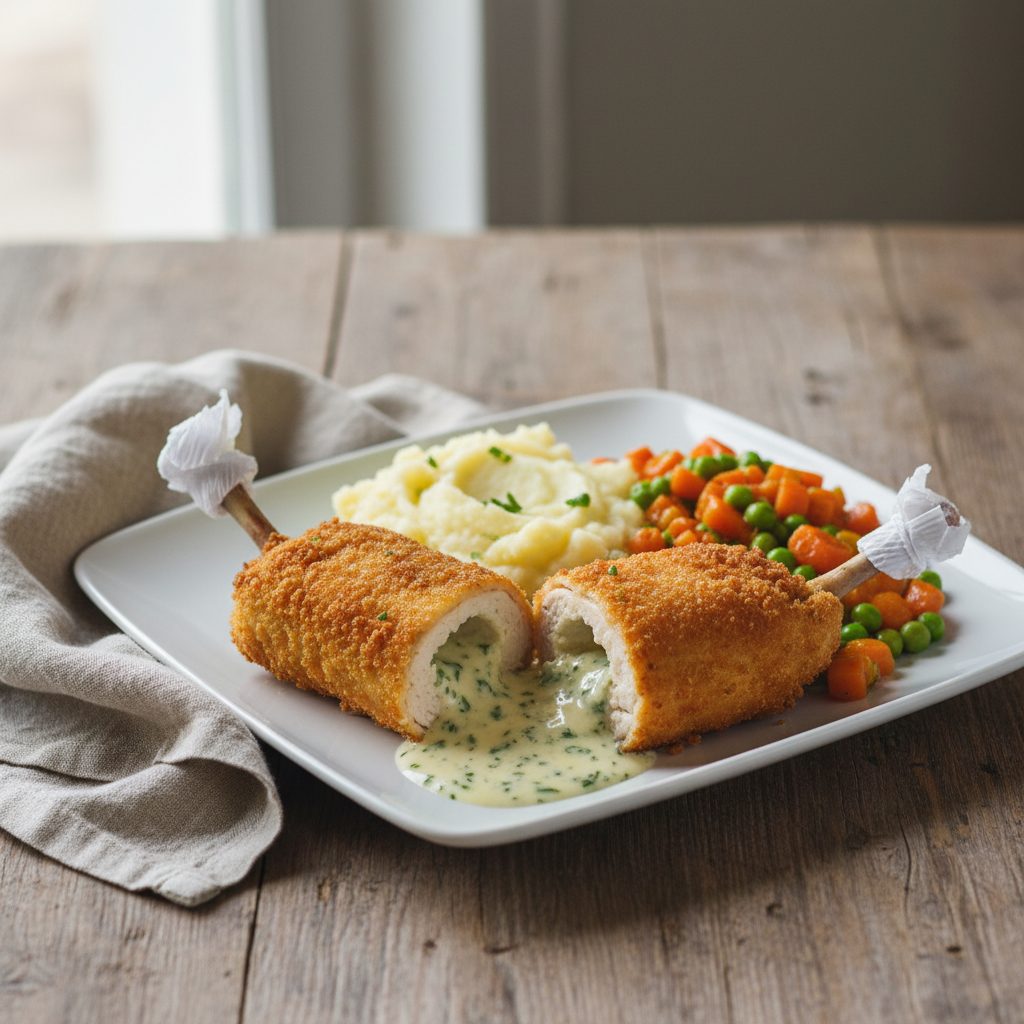
Kotlet de volaille, in our tongue dewolaj, is not just chicken in breadcrumbs. It is a gastronomic young gentleman in a golden coat, stuffed with butter like a nouveau riche wallet with dollars from Pewex, the communist hard-currency shop. Supposedly France, supposedly the court, supposedly a paper frill on the bone, and underneath good homely substance. Poultry, fat and the hope that nothing will shoot out onto your shirt, or into your face.
You take a chicken breast and pound it with feeling, but without excessive tenderness, because meat, like life, must know who holds the mallet. Inside goes a roll of hard, frozen butter. Everything is wrapped tightly, with no gaps and no nonsense.
The roll must be firm, plump and sealed, because a dewolaj, like more than one acquaintance made at a dance hall, first promises delight and then stains your clothes. The whole thing is dredged in flour, egg and breadcrumbs, preferably twice, so the golden crust keeps its shape. Frying happens in deep fat, in clarified butter or lard, because oil is for people who have forgotten the taste of the station buffet.
After frying, the cutlet goes into the oven so that its interior turns hot, liquid and shamelessly ready to flow out. Now begins the savoir-vivre of a serf after social promotion. You must not cut the dewolaj straight in half, because hot butter may squirt into your neighbour's cleavage, your mother-in-law's glasses or onto a suit bought with three months' wages. First you must prick it with a fork. Slowly. With feeling. Let it let off steam. Rushing at the hot centre always ends in a stain, a scream and a story the family will repeat for the next twenty years.
Although the name sounds French, the cutlet made its career in the Russian Empire, at tsarist tables, where the cooking smelled of truffle, cream and other people's sweat. Then came the revolution, the USSR and a great clean-up of the dictionary. After 1928 there were attempts to root out the bourgeois "de volaille" and christen the dish clumsily as chicken stuffed with butter. The revolution could take away estates, titles and names, but it could not take away the cutlet's French charm. People forgot the slogans on the posters, but they did not forget the dewolaj.
In Poland the cutlet enjoyed its real promotion in People's Poland. From tsarist salons it moved to weddings, First Communions, works balls and parties where luxury was measured by the number of platters, and prestige by whether the meat had butter inside or only the memory of butter. Next to it stood vegetable salad, orangeade, a bit of herring and Uncle Zdzisław, who after the fifth round promised a voucher for a Fiat 126p, an allocated flat and a cousin from Pewex.
Poles improved on the classic, because here every tradition must be stuffed to the brim. Inside went cheese, ham and mushrooms. A Frenchman would get a migraine, a Russian would order vodka, and a Polish aunt would just say: "Put more cheese in, or they'll think we're poor."
The dewolaj is a monument to an era when elegance was pinned to the bone with a paper frill, luxury smelled of lard, and the USSR tried to correct even the names of dishes. Long live the dewolaj. Golden, fatty, pumped up and dangerous. Like People's Poland after two glasses, a Soviet parade, and a night-time acquaintance after which in the morning there remains a stain, a hangover and the firm conviction that it was worth it after all.
## A French name, a tsarist passport
"De volaille" simply means "of poultry". The name is French, the pedigree Russian. The dish was born in the Russian Empire at the turn of the 18th and 19th centuries. Its authorship is attributed to Marie-Antoine Carême, the famous French cook, who served breaded poultry fillets at the court of Tsar Alexander I. So it was the cook who came from France, not the cutlet.
The first versions did not contain butter alone. They hid an elaborate filling of thick cream, minced meat and truffles. Pure butter came later, and the inspiration was the Pozharsky cutlet, known for soaking up fat like a sponge. So evolution went from refined luxury to simple luxury. Truffles are for connoisseurs. Everyone understands butter.
Then came the revolution and the great clean-up of the dictionary. After 1928 in the USSR, as part of the struggle against French, bourgeois words, there were attempts to rename the dish "chicken cutlet stuffed with butter". It did not catch on. A name can be decreed, but it cannot be ordered at the table.
## Engineering the roll
A dewolaj requires what may, without exaggeration, be called culinary engineering. Traditionally it is made from chicken breast, leaving the wing bone attached. The meat is pounded carefully, and inside goes shaped, firmly frozen butter seasoned with garlic, salt, pepper or herbs, parsley or dill.
The most interesting part is a detail few people know. The role of internal seal is played by the small inner fillet of the breast. It closes in the butter before the breadcrumbs do. The roll is wrapped very tightly into a spindle shape. Then a double coating of flour, beaten eggs and breadcrumbs. It is fried briefly in deep fat, in clarified butter or lard, until golden, and then finished in the oven. This way the butter inside melts and the crust does not burn. A paper frill is put on the protruding bone. Elegance, as everyone knows, begins with the bone.
## A safety valve
The famous squirting butter is no legend, just physics. Hot fat sealed in a tight shell has only one desire: to get out as fast and as far as possible. That is why savoir-vivre demands decompression. Under no circumstances do you cut the cutlet straight in half. You must pierce the roll with the tines of a fork in several places or make a small cut by the bone. It works like a safety valve: the steam escapes, and the hot fat flows calmly onto the plate instead of landing on the neighbours.
The world paid for this knowledge with stains and burns. Exploding butter ruined ball gowns, and in British restaurants in the 1960s guests ordering the dish were routinely handed plastic bibs. Some dishes call for wine. The dewolaj called for protective equipment.
## Dewolaj, Polish-style
In pre-war Poland the cutlet was a delicacy of elegant, expensive restaurants. In People's Poland, when there was little meat other than poultry, it was promoted to the star of weddings, First Communions and prestigious family receptions. Poles loved the French name so much that they polonised it. Dewolaj sounds homely, and yet still a little lordly.
Out of thrift, but also from the cooks' imagination, people began putting yellow cheese, mushrooms or ham inside. Here this is sometimes called traditional de volaille, although by design it is closer to Swiss cordon bleu. Polish cooking does not recognise empty space. If there is an interior, it must be filled with something.
The cutlet has a family too. The English-speaking world and Ukraine know it as chicken Kiev, Chicken Kiev or Kyiv. Western Ukraine has the Lviv cutlet, of minced poultry combined with cheese, shaped flat. In Serbia a similar meat roll is Karađorđeva šnicla, of veal or pork, filled with kajmak. In Albania it is called Skenderbeg. Every nation has wrapped in meat whatever it thinks is best in itself.
## The chicken that made politics
On 1 August 1991 in Kyiv, US President George H.W. Bush gave a speech in which he spoke with reserve about Ukrainian independence and warned against nationalism. William Safire in "The New York Times" immediately dubbed it the "Chicken Kiev speech". In American slang "chicken" means a coward, and the pun mocked Washington's caution towards the break-up of the Soviet Union. Analysts still use the term for diplomatic caution. A cutlet that keeps the hot stuff inside became a symbol of a politics that also prefers to keep hot issues inside.
The name returned to politics after the outbreak of the war in Ukraine. Many British chains, Sainsbury's for example, renamed the dish "Chicken Kyiv", to show support and use the Ukrainian transliteration. The USSR wanted to throw France out of the name. British shelves threw out the Russian spelling.
## Butter in the inflation basket
In 1979 the success of the British chain Marks & Spencer made chicken Kiev the first mass-market ready meal after pizza. Sales were so enormous that the cutlet was added to the basket on which British inflation was measured. A tsarist dish ended up as a statistical indicator. Hard to find better proof of the democratisation of luxury.
Literature noticed it too. In "The Master and Margarita" Mikhail Bulgakov has his characters wonder whether chicken cutlets de volaille can be allowed to go to waste. They cannot. Not then, not now.
## Recipe
**Ingredients:**
- chicken breast with the wing bone, with its small inner fillet
- butter, shaped into a roll and firmly frozen
- for the butter: garlic, salt, pepper, parsley or dill
- flour
- eggs
- breadcrumbs
- clarified butter or lard for frying
- to serve: mashed potatoes or carrots with peas
- a paper frill for the bone
**Method:**
1. Season the butter with garlic, salt, pepper or herbs, shape it into a roll and freeze it firmly.
2. Carefully pound the chicken breast with its wing bone.
3. Lay the frozen butter on the meat, cover it with the small inner fillet as a seal and roll very tightly into a spindle shape, with no gaps.
4. Coat the roll in flour, beaten eggs and breadcrumbs, then repeat the breading so the crust is double.
5. Fry briefly in deep fat, in clarified butter or lard, until golden.
6. Finish in the oven until the butter inside has melted.
7. Put a paper frill on the bone and serve at once, with mashed potatoes or carrots with peas.
8. Before eating, prick the cutlet with a fork in several places or make a cut by the bone. Do not cut it straight in half.
📖 Glossary
- de volaille
- Francuskie określenie znaczące z drobiu, od którego pochodzi nazwa kotleta, spolszczona na dewolaj.
- papilot
- Papierowa ozdoba zakładana na wystającą kostkę skrzydłową kotleta de volaille.
- kotlet pożarski
- Rosyjski kotlet znany z tego, że chłonie tłuszcz jak gąbka, który zainspirował wypełnienie dewolaja czystym masłem.
- Karađorđeva šnicla
- Serbski mięsny rulon z cielęciny albo wieprzowiny wypełniony kajmakiem, krewny kotleta de volaille.
- przemówienie Chicken Kiev
- Nazwa nadana przez Williama Safire'a przemówieniu George'a H.W. Busha w Kijowie z 1991 roku, oznaczająca dziś dyplomatyczną ostrożność.
Frequently Asked Questions
Where does chicken de volaille come from?
De volaille means of poultry. The name is French, but the dish was born in the Russian Empire at the turn of the 18th and 19th centuries, and its authorship is credited to Marie-Antoine Carême at the court of Tsar Alexander I. The first versions hid a filling of cream, minced meat and truffles; pure butter came later.
How to make chicken de volaille so the butter does not leak?
Firmly frozen butter is placed on the flattened breast with its wing bone, and the small inner fillet of the breast acts as an internal seal. The roll is wrapped very tightly into a spindle shape and breaded twice. It is fried briefly in deep fat and then finished in the oven.
How to eat chicken de volaille so the butter does not squirt?
Under no circumstances cut the cutlet straight in half. Pierce it with a fork in several places or make a small cut by the bone, which works like a safety valve. The steam escapes and the hot fat flows calmly onto the plate.
How does Polish dewolaj differ from the original?
Out of thrift and the cooks' imagination, Poles began putting yellow cheese, mushrooms or ham inside. This is sometimes called traditional de volaille, though it is closer to Swiss cordon bleu. Poles also polonised the name as dewolaj.
What was the Chicken Kiev speech?
On 1 August 1991 in Kyiv, George H.W. Bush spoke with reserve about Ukrainian independence and warned against nationalism. William Safire in The New York Times dubbed it the Chicken Kiev speech, since chicken is American slang for a coward. The term still denotes diplomatic caution.
Why was chicken Kiev included in the inflation basket?
In 1979 Marks & Spencer made chicken Kiev the first mass-market ready meal after pizza. Sales were so huge that the cutlet was added to the basket used to measure British inflation.
Related Questions
- Where does chicken de volaille come from?
- How to make chicken de volaille so the butter does not leak?
- How to eat chicken de volaille so the butter does not squirt?
- How does Polish dewolaj differ from the original?
- What was the Chicken Kiev speech?
- Why was chicken Kiev included in the inflation basket?
🧠 Thematic Groups
- Historia: francuska nazwa i carski rodowód, Carême na dworze Aleksandra I, farsz z trufli ustępujący czystemu masłu i radziecka próba przechrzczenia dania po 1928 roku.
- Technika: pierś z kostką skrzydłową, zmrożone masło, polędwiczka jako uszczelka, podwójna panierka, smażenie w głębokim tłuszczu i dopiekanie oraz nakłuwanie przed krojeniem.
- Polska i rodzina dania: dewolaj jako gwiazda wesel PRL-u, wersja z serem i pieczarkami, kotlet po kijowsku i lwowsku, serbska Karađorđeva šnicla i albański Skenderbeg.
- Polityka i kultura: przemówienie Chicken Kiev Busha z 1991 roku, zmiana nazwy na Chicken Kyiv, brytyjski koszyk inflacji i kotlety de volaille u Bułhakowa.
Tags:
chicken de volaille
dewolaj
chicken breast
garlic butter
double breading
paper frill
Polish cuisine
Russian cuisine
communist Poland
Marie-Antoine Carême
chicken Kiev
Chicken Kyiv
cordon bleu
George H W Bush
Marks & Spencer
More in: Kuchnia niepolityczna
Content is created by Fundacja Dobre Państwo.
Edited and published by APA ONE, the Foundation's own AI-based editorial system.