Racuchy with kefir and apples. A small thing, a big deal
🎧 Listen (Audio)
Audio versions are read by a synthetic voice.
Listen in the Dobre Państwo podcast (Spotify) RSS
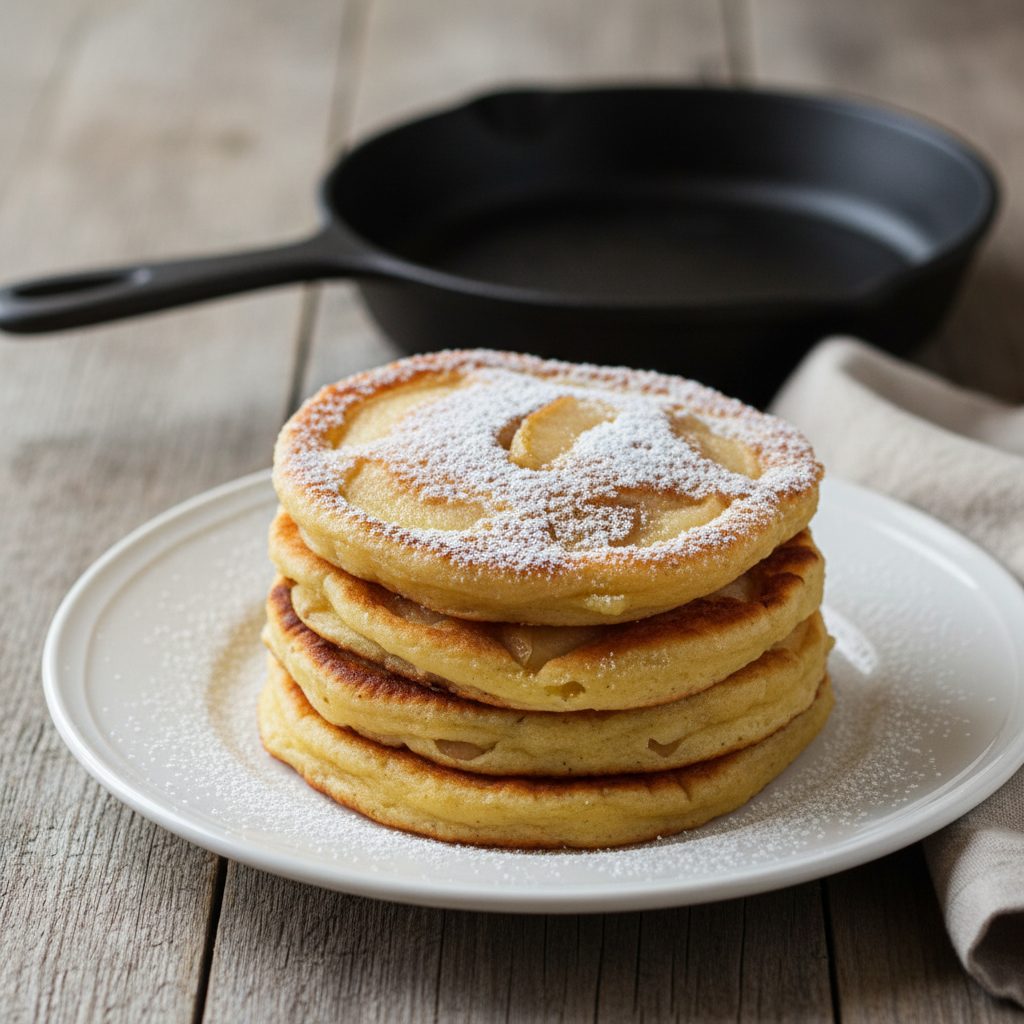
The racuch does not pretend to be a dessert with aspirations. It needs no foams, no mists, no deconstruction and no plate bigger than the table. A frying pan, an apple, kefir and a dash of chemistry are enough — chemistry our grandmothers did not call chemistry, but know-how.
Lactic acid meets baking soda. A spark flies. Carbon dioxide is released, the batter rises, and for a moment the house regains its proper order of things. No hours of waiting for yeast, no ceremony and no unnecessary deliberation. The fluffiness appears at once, almost demonstratively, as if the racuch wanted to remind us that effectiveness is sometimes simpler than procedure.
Kefir came to us from the Caucasus, surrounded by legend, desire and mystery. Kefir grains were called the millet of the Prophet, their secret was jealously guarded, and their spread was supposedly helped along by the story of Irina Sakharova, a Caucasian prince, an abduction, a tsarist court and a peculiar ransom paid in kefir grains. In Poland kefir was promoted by Klaudia Sigalina, who set up an establishment on Warsaw's Królewska Street with a plaster panorama of the Caucasus. Experience marketing. Back then, courage and a good product were enough.
Racuchy have many homelands. In Kashubia they were ruchanki, made from leftover bread dough. In Kuyavia they were fried in lard, sometimes even served with żur. In Podlasie they made their way onto the Christmas Eve table. In the south of Poland the flowers of the black locust were dipped in the batter, producing an almost vanilla aroma. There were buckwheat racuchy, potato ones, yeasted ones, with raisins, rosemary and plum butter.
They feel best in the company of apples, that is, antonówka, szara reneta, ligol. The fruit should keep its character even after frying. A valuable hint, and not only a culinary one.
The racuch was the food of thrift. It was made from whatever was at hand, in a peasant cottage, in a flat in a prefab concrete block, in a kitchen where the smell of fried apples seeped through the door and built community more effectively than many an official programme.
The racuch is not just a little pancake. It is an exercise in Polish continuity. From leftovers it makes wholeness, from sour milk — softness, from simplicity — luxury. It does not shout that it is a symbol. That is why it remains one.
This modest dish, present on our tables for centuries, is testimony to the extraordinary adaptability of home cooking.
## Small and round
The word “racuchy” comes from old Polish and is linked to a dialect term for something small and round. The name, then, is a description, not a metaphor. The racuch always knew what it was.
Its roots are peasant roots. From flour and apples stored in cellars one could make a filling dish even during the hungry pre-harvest weeks and the frosty months. The Kashubian ruchanki were made from leftover bread dough and took their name from “ruch”, movement, that is, the rising of the dough. They were slightly sour and eaten for breakfast instead of bread. Poorer households reached for buckwheat flour. Wheat came later, when people began to desire a more delicate texture. The road from leftovers to wholeness led through the mill.
## A revolution in a bottle
In the old days racuchy were made with water, sweet milk or soured milk. Their fluffiness came from yeast or, in the drawing-room version, from whisked egg whites. Elżbieta Kiewnarska, in “Potrawy z kasz i mąki” of 1931, gave a recipe for “better racuszki”: butter creamed with egg yolks, whisked whites, served with plum or bilberry preserves and thick sour cream. This is a racuch in white gloves.
Kefir and buttermilk changed the rules of the game. The lactic acid in kefir reacts violently with alkaline baking soda, and the carbon dioxide trapped in the batter makes the pancake puff up spectacularly the moment it meets hot fat. Lightness without proving, a golden crust and a moist interior. There is one condition, prosaic and often ignored: the eggs and kefir should be at room temperature. Grandma's chemistry had its procedures too; it just did not write them down in a manual.
## The millet of the Prophet
According to legend, kefir grains were Muhammad's gift to the peoples of the Caucasus, hence “the millet of the Prophet”, and the secret of their production was guarded for centuries. Kefir reached Poland in the time of the Russian partition, and its spread is wrapped in a story worthy of a serialised novel. A Moscow merchant sent the beautiful Irina Sakharova to Prince Bek-Mirza Baichorov for kefir grains. The prince, having fallen in love, abducted her, the gendarmes freed her, and the affair ended up before the tsar's court. Irina withdrew the charge in exchange for a ransom: ten pounds of kefir grains. Thanks to this, kefir went into wider production. It is not often that an abduction ends in a factory.
In Poland the fashion for kefir was started by Klaudia Sigalina, who brought the grains from Georgia. At Królewska Street 31 in Warsaw she founded the First Special Kefir Establishment and placed a huge plaster model of the Caucasus mountains in the shop window. She won gold medals at exhibitions in Warsaw in 1896 and in Paris. Kefir was an elite product then. Only later did it come down from the plaster mountains to the ordinary frying pan.
## A map of the pancake
The Kuyavian yeasted ruchańce were fried in lard, especially at carnival time, and owed their fluffiness to melted butter in the batter. They were served with marmalade, with curd cheese and sometimes with żur, which proves that Kuyavia recognises no division between savoury and sweet. In Podlasie racuchy have kept a sacred character and belong among the twelve dishes of Christmas Eve, in their Lenten version. In the Lublin region and along the Vistula there is Vistula kefir, made from the milk of cows grazed on the meadows of Kazimierz Dolny and Sandomierz, and the List of Traditional Products includes racuchy baranowskie and yeasted racuchy with apples from Dokudów.
The south fried whole white clusters of black locust blossom in the batter, for a vanilla note. The eastern and Lithuanian borderlands added cinnamon, raisins and fresh rosemary. Marja Śleżańska, in “Kucharz Polski” of 1932, described racuchy made from boiled, sieved potatoes, served with young sour cream and granulated sugar. The racuch adapts to every larder. There is no snobbery in it, only the instinct to survive.
## The apple and the stairwell
The apple has to be the right one. Antonówka, ligol, golden delicious, szara reneta — varieties that do not turn to mush when fried. The apple has its cult in Poland. Jan Brzechwa, in “Entliczek-pentliczek”, made eating apples an occupation for the whole family, from grandparents to parents, and the proverb reminds us that the apple does not fall far from the tree. The continuity of generations, sealed in a little pancake.
For generations growing up in prefab concrete blocks, racuchy made with kefir are the taste of childhood. Quick, nourishing, cheap. The smell of fried apples filled the stairwells and turned neighbours into a community, if only for a quarter of an hour. No residents' committee ever achieved that. The racuch had no programme. It had a frying pan.
📖 Glossary
- ruchanki
- Kaszubskie racuchy z resztek ciasta chlebowego, lekko kwaśne, jedzone na śniadanie zamiast pieczywa; nazwa od „ruchu”, czyli wyrastania ciasta.
- proso proroka
- Legendarna nazwa ziaren kefirowych, uważanych za dar Mahometa dla ludów Kaukazu.
- kefir nadwiślański
- Kefir z mleka krów wypasanych na łąkach Kazimierza Dolnego i Sandomierza, z Lubelszczyzny i pasa nadwiślańskiego.
- racuszki lepsze
- Salonowa wersja racuchów z przepisu Elżbiety Kiewnarskiej z 1931 roku: masło utarte z żółtkami i ubite białka, z powidłami i kwaśną śmietaną.
Frequently Asked Questions
Why are kefir racuchy so fluffy?
The lactic acid in kefir reacts violently with alkaline baking soda, and the carbon dioxide trapped in the batter makes the pancake puff up the moment it meets hot fat. This gives lightness without proving, a golden crust and a moist interior. The eggs and kefir should be at room temperature.
Where does the name racuchy come from?
The word “racuchy” comes from old Polish and is linked to a dialect term for something small and round. The name is a description, not a metaphor. The Kashubian ruchanki, in turn, took their name from “ruch”, the rising of the dough.
How did kefir come to Poland?
Kefir came from the Caucasus, where kefir grains were called the millet of the Prophet, and reached Poland in the time of the Russian partition. According to the story, its spread was helped by a ransom in kefir grains that Irina Sakharova received from Prince Bek-Mirza Baichorov. In Poland the fashion was started by Klaudia Sigalina and her establishment at Królewska 31 in Warsaw with a plaster model of the Caucasus.
Which apples are best for racuchy?
The best are varieties that do not turn to mush when fried: antonówka, ligol, golden delicious and szara reneta. The fruit should keep its character even after frying.
What are the regional variants of racuchy?
In Kashubia there were ruchanki made from leftover bread dough, and in Kuyavia yeasted ruchańce fried in lard, served even with żur. In Podlasie racuchy belong among the twelve Christmas Eve dishes, and in the south black locust flowers were fried in the batter. There were also buckwheat and potato racuchy, and ones with raisins, cinnamon and rosemary.
Related Questions
- Why are kefir racuchy so fluffy?
- Where does the name racuchy come from?
- How did kefir come to Poland?
- Which apples are best for racuchy?
- What are the regional variants of racuchy?
🧠 Thematic Groups
- Chemia: kwas mlekowy z kefiru reaguje z sodą, a dwutlenek węgla daje racuchom puszystość bez drożdży, pod warunkiem składników w temperaturze pokojowej.
- Historia: racuch ma chłopskie korzenie, a kefir przybył z Kaukazu z legendą o porwaniu Iriny Sacharowej i trafił do Warszawy dzięki Klaudii Sigalinie.
- Regiony: ruchanki z Kaszub, ruchańce z Kujaw, wigilijne racuchy z Podlasia, racuchy z kwiatami robinii z południa i wpisy na Listę Produktów Tradycyjnych.
- Kultura: racuchy z jabłkami to smak dzieciństwa w blokach z wielkiej płyty, a jabłko ma w Polsce kult od Brzechwy po przysłowie o jabłoni.
Tags:
racuchy
kefir racuchy
kefir
apples
antonówka
szara reneta
baking soda
kefir grains
ruchanki
Kashubia
Kuyavia
Podlasie
Klaudia Sigalina
Irina Sakharova
Polish cuisine
More in: Kuchnia niepolityczna
Content is created by Fundacja Dobre Państwo.
Edited and published by APA ONE, the Foundation's own AI-based editorial system.