Rogal świętomarciński. Poznań's November banner
🎧 Listen (Audio)
Audio versions are read by a synthetic voice.
Listen in the Dobre Państwo podcast (Spotify) RSS
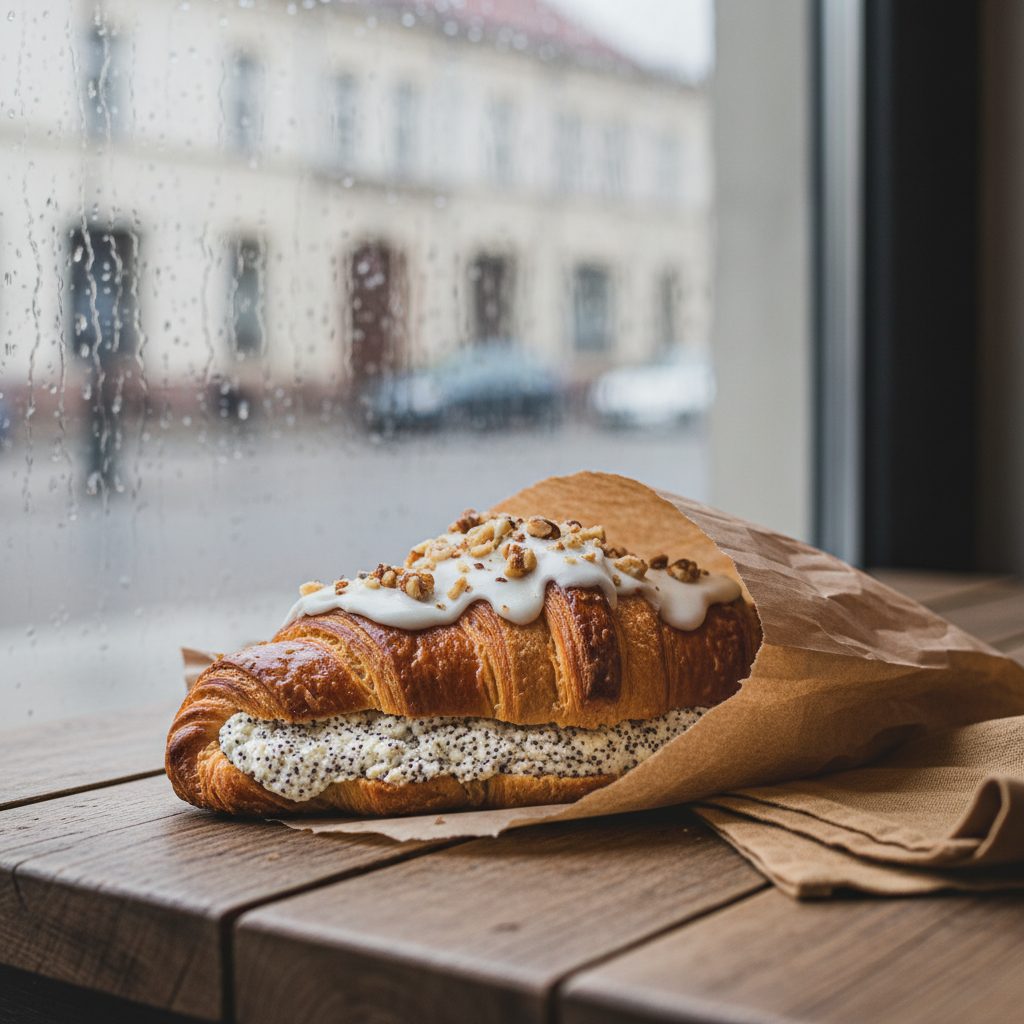
The rogal świętomarciński, St Martin's croissant, is Poznań's November banner, carried through the streets in a scent of white poppy seed, icing and a warm tytka. When the sky turns grey, the rain settles on the cobbles and the day shrinks without mercy, the rogal marches in like a small hero of everyday life. It does not dispel the gloom. It triumphantly tames it.
Its history leads from ancient rites, in which the shape of a horn had a sacrificial meaning, to the legend of St Martin, his horse and a lost horseshoe. It leads, too, to the year 1891, when Father Jan Lewicki called on the people of Poznań to help the poor, and the confectioner Józef Melzer answered with deeds. The well-off bought rogale, the poor received them free of charge. So sweetness became a duty of the community, and the pastry took on the taste of mercy.
The rogal marches through the generations. It goes from the patisserie to the home, from the home to memory, from memory to a child's delight. A gzub does not ask about certificates. He watches to see whether the glanc will crack under his finger. A szczun carries the tytka carefully, a mela nibbles at the nuts, and the grown-ups pretend they bought the pastry for the children.
The rogal demands a discipline worthy of the craftsmanship of Greater Poland. The semi-puff pastry must be folded and rolled until it forms eighty-one layers. Inside wait white poppy seed, dried fruit and nuts, raisins and candied fruit, and on top fondant icing and a scattering of nuts. Even emotion has its technology, proportions and order here.
The rogal enjoys legal protection as a Protected Geographical Indication. It may be made only within a designated area of Poznań and Greater Poland, according to a set recipe. This is very Poznań: memory has a document, tradition has a standard, and sentiment passes quality control.
Critics fault the certified recipe for margarine, flavourings and industrial uniformity. They ask whether tradition can be protected by stripping it of its artisan soul. The dispute was dubbed “Rogalgate”, because even icing can become a battlefield over authenticity.
On 11 November the disputes fall silent. St Martin rides in on a grey horse and receives the keys to the city, and the people of Poznań set off after him with rogale in their hands. In the streets children, seniors, szczuny, mele and gzuby meet. Everyone carries the same sign, though each remembers a different home, a different patisserie and a different hand that once gave them their first piece.
The rogal świętomarciński is more than a pastry. It is an edible archive in which childhood does not pass away but waits beneath a layer of glanc. It is proof that community begins with a simple gesture: I have something good and I will not eat it alone.
When November stands at the door, cold, grey and gloomy, Poznań will answer it without fear:
Tej, come on in. The rogale are here.
## Ox horns, a horseshoe and a crescent
The tradition begins with blood and ends with icing. During an autumn festival, oxen were once sacrificed to pagan deities. In time the bloody ritual was replaced by dough rolled into the shape of ox horns. The Latin Church took over the custom and gave it new meaning. The most popular interpretation speaks of the horseshoe lost by St Martin's horse when he stopped to help a beggar. The ox gave way to the horse, the sacrifice to almsgiving. The shape stayed the same.
There is a military version too. According to tradition, Jan III Sobieski captured many Ottoman banners bearing the crescent at Vienna, and the confectioners of Poznań were supposed to have commemorated that shape. Every era reads the rogal in its own way: the pagan sees a horn, the Christian a horseshoe, the patriot a crescent. The gzub sees icing, and he is right.
The oldest advertisement for the rogal appeared in the “Dziennik Poznański” in 1860, but the modern tradition begins in November 1891. Father Jan Lewicki, parish priest of St Martin's, then appealed for help for the poor. The confectioner Józef Melzer persuaded his employer to revive the pastry. The rich bought, the poor received it free. Delicacy and mercy went into a partnership that lasts to this day. Caritas of the Archdiocese of Poznań hands out thousands of rogale every year; in 2016 it was 20,000.
## Tradition with a statute
The rogal świętomarciński is among the most strictly protected regional products in Poland. Commission Regulation (EC) No 1070/2008 entered it in the register as a Protected Geographical Indication. The right to the name is granted by the Chapter of the Poznań Traditional St Martin's Croissant, established by the Guild of Confectioners and Bakers, the Chamber of Crafts and Poznań City Hall. A certified rogal may be baked only within the boundaries of Poznań and in 26 districts of Greater Poland, from Chodzież to Września. Poznań leaves nothing sentimental to chance.
The specification is meticulous. The wheat flour must contain more than 27 per cent elastic gluten, because only such a dough does not tear when it is repeatedly layered with fat. The dough is a yeasted semi-puff pastry made with margarine, milk, eggs, sugar and salt, with obligatory lemon flavouring. The filling is white poppy seed, sugar, sponge crumbs, egg mass, margarine, nuts, raisins, fruit in syrup or candied — cherries, pear, orange peel — and almond flavouring. The rogal weighs from 150 to 250 grams, in line with an amendment of 2013. The proportions are sacred: 60 per cent dough, 30 per cent poppy seed filling, 8 per cent icing, 2 per cent topping. Even emotion has its percentage.
The scale is impressive. On 11 November alone an average of 250 tonnes of rogale are sold, and annual production reaches 500 tonnes, around 2.5 million pieces. In 2017 the rogal appeared on stamps in the series “Polish Regional Products”, and there is also a commemorative coin, “Rogal Marciński”.
## Rogalgate
The certificate has its opponents. Some food critics and restaurateurs speak of the industrialisation of tradition. They fault the recipe for its obligatory margarine instead of butter, pasteurised egg mass instead of fresh eggs, peanuts instead of walnuts and synthetic flavourings instead of natural extracts. Traditionalists bake their own way, with butter, walnuts and almonds, often under the name “Rogal Marciński”, because the other one is protected.
The dispute is, at bottom, a question that every protected tradition asks. Does the standard guard memory, or freeze it? The certificate guarantees that the rogal will be the same every year. The artisan replies that tradition is a hand and butter, not a clause. Both sides love the same pastry. They are arguing over which of them smells of home.
## Dialect, goose and a grey horse
In Poznań, 11 November is above all the name day of Święty Marcin street. The procession is led by the saint on a grey horse, who receives the keys to Poznań from the city's mayor. Lech Poznań sends rogale to other clubs in the Ekstraklasa and treats its fans to them at the stadium. In a tenement house on the Old Market Square the Croissant Museum of Poznań operates, where visitors make rogale themselves with traditional tools, and from the windows you can see the billy goats.
The rogal also requires knowledge of the language. A szczun is a boy, a mela is a girl, a gzub is a little one. Bejmy is money, usually no small amount, given the price of a rogal. A tytka is the paper bag in which you carry it out of the patisserie, and glanc is the icing. Whoever does not know these words will eat the rogal, but will not understand it.
Martin also rules the calendar. “On St Martin's Day, goose is best.” “On St Martin's Day, winter begins.” If the breast of the Martinmas goose is bluish, the winter will be harsh; if white, mild. The first frost or snow is the saint arriving on his grey horse. In folk tradition, after St Martin's the land was to rest until spring and work in the fields came to a stop. The rogal is therefore also a farewell to labour. A sweet reward at the start of a long winter.
## Recipe
**Ingredients (weight proportions of the finished rogal: 60% dough, 30% poppy seed filling, 8% icing, 2% topping):**
- wheat flour with a high content of elastic gluten (above 27%)
- for the yeasted semi-puff pastry: margarine, milk, eggs, sugar, salt, lemon flavouring
- for the filling: white poppy seed, sugar, sponge crumbs, egg mass, margarine, nuts, raisins, fruit in syrup or candied (cherries, pear, orange peel), almond flavouring
- to decorate: fondant (icing) and chopped nuts
**Method:**
1. Layer the yeast dough with margarine, then fold and roll it repeatedly until it forms 81 layers.
2. Cut the dough into triangles.
3. Spread the moist white poppy seed filling in layers between the sheets of dough as you roll them, and bend the rogale into a horseshoe shape.
4. Bake.
5. After baking, pour fondant icing generously over the top and sprinkle with chopped nuts.
📖 Glossary
- glanc
- Poznańskie określenie lukru, czyli pomady, którą obficie polewa się rogala świętomarcińskiego.
- tytka
- W gwarze poznańskiej papierowa torebka, w której wynosi się rogala z cukierni.
- Chronione Oznaczenie Geograficzne
- Unijna ochrona nazwy nadana rogalowi rozporządzeniem nr 1070/2008; certyfikowany rogal wolno piec tylko w Poznaniu i w 26 powiatach Wielkopolski według określonej receptury.
- Rogalgate
- Spór o certyfikowaną recepturę rogala, której krytycy zarzucają margarynę, masę jajową, fistaszki i syntetyczne aromaty zamiast rzemieślniczych składników.
Frequently Asked Questions
Where does the shape of the St Martin's croissant come from?
During an autumn festival oxen were once sacrificed to pagan deities, and in time they were replaced by dough shaped like ox horns. The Church gave it a new meaning: the most popular interpretation speaks of the horseshoe lost by St Martin's horse. According to a military version, the shape commemorates the crescent on the banners captured by Jan III Sobieski at Vienna.
Since when have St Martin's croissants been baked in Poznań?
The oldest advertisement for the rogal appeared in the “Dziennik Poznański” in 1860, but the modern tradition begins in November 1891. Father Jan Lewicki then appealed for help for the poor, and the confectioner Józef Melzer persuaded his employer to revive the pastry. The rich bought rogale, the poor received them free.
What must a certified St Martin's croissant contain?
A yeasted semi-puff pastry made from flour with more than 27 per cent gluten forms 81 layers, and the filling is white poppy seed with nuts, fruit and almond flavouring. On top go fondant and nuts, in proportions of 60 per cent dough, 30 per cent poppy seed filling, 8 per cent icing and 2 per cent topping. The rogal weighs 150 to 250 grams and may be baked only in Poznań and 26 districts of Greater Poland.
What is Rogalgate?
Rogalgate is the dispute over the certified recipe for the rogal. Critics fault it for obligatory margarine instead of butter, pasteurised egg mass, peanuts instead of walnuts and synthetic flavourings. Traditionalists bake with butter and walnuts, often under the name “Rogal Marciński”, because the other one is protected.
What do the words szczun mela gzub and tytka mean?
These are words from the Poznań dialect. A szczun is a boy, a mela a girl, a gzub a little one, and bejmy is money. A tytka is the paper bag in which you carry the rogal out of the patisserie, and glanc is the icing.
How is 11 November celebrated in Poznań?
In Poznań, 11 November is the name day of Święty Marcin street. The procession is led by the saint on a grey horse, who receives the keys to Poznań from the mayor, and the people follow him with rogale. On that day alone an average of 250 tonnes of rogale are sold, and Caritas hands out thousands to the poor.
Related Questions
- Where does the shape of the St Martin's croissant come from?
- Since when have St Martin's croissants been baked in Poznań?
- What must a certified St Martin's croissant contain?
- What is Rogalgate?
- What do the words szczun mela gzub and tytka mean?
- How is 11 November celebrated in Poznań?
🧠 Thematic Groups
- Historia i legenda: od pogańskich ofiar z wołów i wolich rogów przez podkowę konia świętego Marcina i półksiężyc spod Wiednia po apel księdza Lewickiego z 1891 roku.
- Prawo i technologia: Chronione Oznaczenie Geograficzne, Kapituła, 81 warstw ciasta, mąka z ponad 27 procentami glutenu i święte proporcje 60/30/8/2.
- Spór o autentyczność: Rogalgate przeciwstawia certyfikowaną margarynę i aromaty rzemieślniczemu maślanemu „Rogalowi Marcińskiemu”.
- Kultura Poznania: imieniny ulicy Święty Marcin, święty na siwym koniu, Rogalowe Muzeum, gwara poznańska i ludowe przysłowia o marcinowej gęsi.
Tags:
rogal świętomarciński
Poznań
Greater Poland
white poppy seed
semi-puff pastry
glanc
St Martin
11 November
Protected Geographical Indication
Rogalgate
Józef Melzer
Father Jan Lewicki
Poznań dialect
Rogal Marciński
Polish cuisine
More in: Kuchnia niepolityczna
Content is created by Fundacja Dobre Państwo.
Edited and published by APA ONE, the Foundation's own AI-based editorial system.