Schabowy. The Polish constitution in breadcrumbs
🎧 Listen (Audio)
Audio versions are read by a synthetic voice.
Listen in the Dobre Państwo podcast (Spotify) RSS
The schabowy did not fall from the sky together with Mieszko I, the white eagle and the national duty to complain. Its ancestor was the Lombard cotoletta alla milanese, bone-in veal fried in butter for people who had palaces, servants and a healthy lack of scruples. The Austrians pounded it thinner, the Germans swapped expensive veal for cheaper pig, and the Poles turned it into a Sunday religion.
In Poland the recipe appeared only in 1860, in Ćwierczakiewiczowa. Before that, pork was considered a common meat at lordly tables. The gentry ate game, poultry and veal, and the pig had to work for its social advancement. It succeeded only under communism, when schabowy with potatoes and cabbage became the symbol of working-class prosperity. A man might have no passport, no freedom of speech and no toilet paper, but on Sunday he was to get his cutlet.
A good schabowy does not come from tossing meat into a pan and saying a Hail Mary. Schab, pork loin, comes from the thoracic-lumbar section of the half-carcass. The white membrane must be scored, or during frying it will shrink and turn the cutlet into a bowl. Before pounding, the slice should be about two centimetres thick; then it is beaten from the centre towards the edges, preferably through cling film. Next the meat is soaked in milk with onion, sometimes overnight. Then flour, egg, breadcrumbs and plenty of lard or clarified butter. Vegetable oil is permitted, just as sandals with a suit are permitted, but there is little dignity in it.
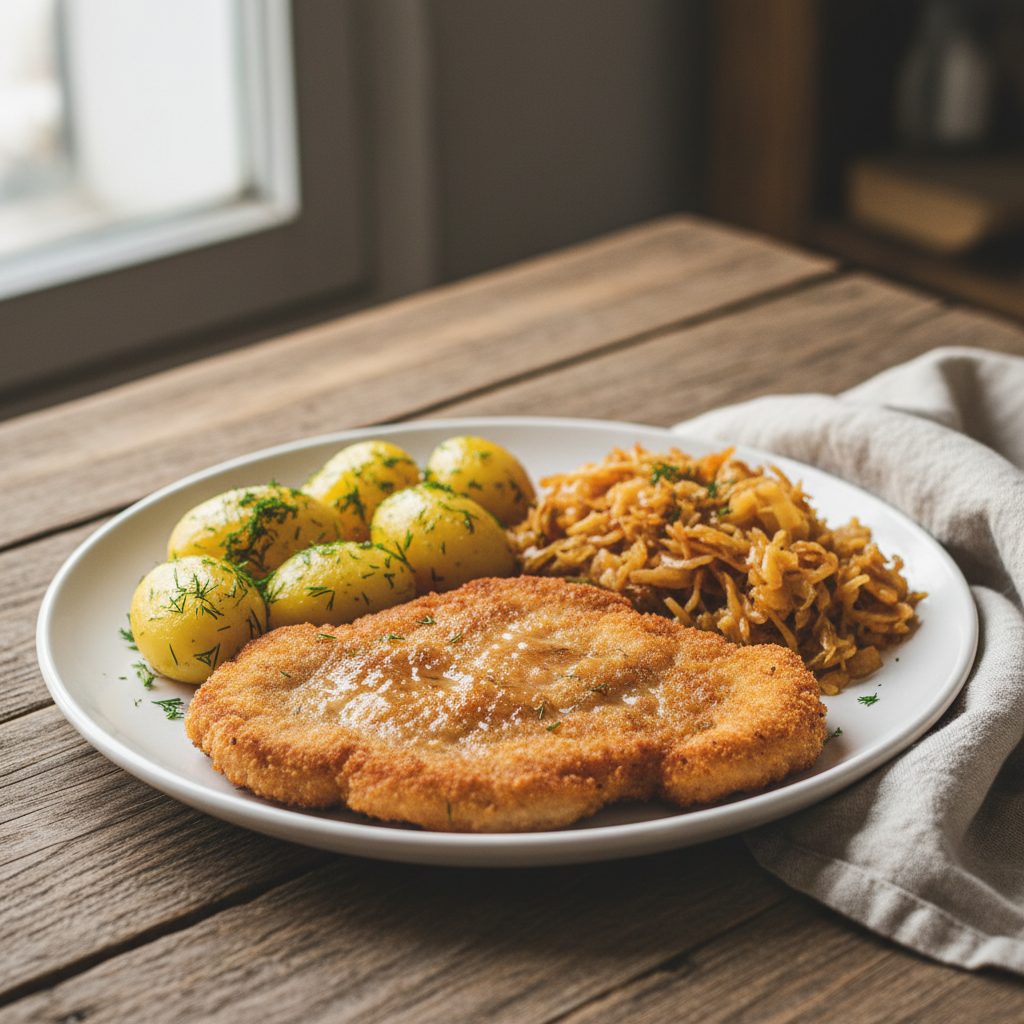
The cutlet is fried briefly and hard, and served at once. The coating is meant to crunch, not steam under a lid like a civil servant during an inspection. Potatoes with dill, fried cabbage, mizeria cucumber salad or a sauerkraut slaw. On Sunday mornings whole housing estates hear the thud of meat mallets. It is the Polish national concert. Percussion from the prefab blocks, performed between nine and eleven.
The schabowy can be a measure of ambition. In country inns it ought to hang over the edge of the plate, because in Poland the size of a cutlet often compensates for the smallness of everything else. Record-holders exceed thirty centimetres. In Kashubia, dried mushroom powder goes into the coating. Highlanders add bacon, oscypek cheese and cranberries, because if you can overdo it, you should overdo it properly. Warsaw produces schab served cold, stuffed with egg and horseradish, set in aspic. Silesia keeps its distance, since the queen of Sunday there is the roulade, and not every newcomer in breadcrumbs is welcome.
Rises in meat prices helped spark workers' revolts in 1970 and 1980. The communist authorities long failed to understand that the nation would endure censorship, but not an empty hook in the butcher's shop. The schabowy was drafted into the culture war. Politicians were photographed with plates of meat, raised the spectre of crickets and defended the cutlet against an alleged plot by environmentalists. The Sejm even acquired its own schabowy index, because the price of an MP's lunch sometimes says more about the state than the prime minister's policy speech.
The schabowy is the story of pork's social ascent, a technology of butchery, a family ritual, a tool of propaganda and a crunchy test of social anger. Poland can argue about anything, but when someone touches the cutlet, the jokes end and politics begins.
## From Milan to Sunday
The genealogy is longer than a patriot would like. Cotoletta alla milanese, traced back to 12th-century Lombardy, was a bone-in veal cutlet coated in breadcrumbs, fried in butter and served at the courts of wealthy patricians. The Italians passed it on to Austria, and legend credits Marshal Radetzky with bringing the recipe home. Wiener Schnitzel was still made of expensive veal, but pounded extraordinarily thin and fried in lard or clarified butter. In 19th-century Germany veal was displaced by cheaper and more readily available pork. Thus the Schweineschnitzel was born, the direct model for the Polish schabowy.
In Poland the word "kotlet" and a recipe for breaded pork loin appeared only in Lucyna Ćwierczakiewiczowa's "365 Dinners for Five Złoty" of 1860. Noble and Sarmatian cuisine regarded pork as an inferior meat, fit for the lower orders and for people doing physical labour. After the war the authorities bet on pig farming, and pork became the basic national meat. Under communism the pig made a career many people could only dream of.
## The anatomy of Sunday
Pork loin has its own geometry, and the old butchery standard PN-86/A-82002 described it with a precision worthy of a surveyor. At the front the loin ends between the fourth and fifth thoracic vertebrae, where it borders the neck. At the back, between the last lumbar vertebra and the first sacral one, where the ham begins. At the top it runs along the spine; at the bottom it is cut away from the belly and the ribs. Inside are 12 halved thoracic vertebrae with the upper sections of the ribs, 6 lumbar vertebrae and the main protagonist, the longissimus dorsi muscle, colloquially called the tenderloin.
The cutlet can be bone-in or boneless. During frying the bone releases collagen and glutamic acid, so the meat comes out juicier and with a deeper flavour. The white membrane on the outside needs scoring every 1–2 centimetres. It is what turns the cutlet into a little bowl if ignored. A small thing, as so often in history, decides the shape of the whole.
## The war for the cutlet
Empty meat hooks were the most frequent cause of social anger in communist Poland. Rises in meat prices triggered workers' protests in December 1970 and in July and August 1980, and the latter led to the founding of "Solidarity". One can therefore say without great exaggeration that the struggle for the right to a schabowy helped bring down communism. Freedom came in breadcrumbs.
In 2023 the cutlet returned to the front pages. The pretext was a report by C40 Cities, an association of environmentally minded metropolises to which Warsaw belongs, recommending that meat consumption be limited to 16 kilograms per person per year. Right-wing politicians rode to the rescue of the "traditional Polish schabowy", posed with plates of cutlets and warned of compulsory crickets. The schabowy was promoted to a symbol of sovereignty and personal freedom.
Then there is the schabowy index. Journalists regularly check how much a cutlet costs in the Sejm restaurant, subsidised from the budget of the Chancellery of the Sejm. When inflation is raging across the country, an MP's cheap cutlet becomes a plate scandal. Nothing annoys a voter like someone else's cheap Sunday.
## The cutlet in regional costume
Podhale lays a slice of crisp bacon or smoked ham and a thick slice of oscypek on the breaded cutlet, bakes it until the cheese melts and serves it, obligatorily, with cranberries. The Kashubians have the chrzeptnik. Always with a bone, often marinated in thick sour cream with grated garlic and onion, coated with a powder of dried porcini or bay boletes.
On Sundays Silesia bows to the roulade with dumplings and red cabbage, and if it does make pork loin, it does so its own way. The slices are cooked in salted water with cloves until half-tender, rolled in breadcrumbs, briefly fried and served with a dark sauce of the stock, plum butter, red wine, cloves and sugar. The role of the everyday breaded cutlet there was played rather by karminadle, meat patties traditionally made with added rabbit. Mazovia has Warsaw-style pork loin, which has nothing to do with a hot dinner. It is a cold starter from the communist era: roast loin cut into pockets, stuffed with eggs, horseradish and mayonnaise, covered in clear aspic.
## Recipe
**Ingredients:**
- pork loin, bone-in or boneless
- milk
- onion
- optional for the marinade: garlic, salt, pepper
- wheat flour, ideally krupczatka (coarse-grained flour)
- eggs beaten with salt and pepper
- breadcrumbs, not too fine
- pork lard or clarified butter
- to serve: new potatoes with dill, fried cabbage, mizeria cucumber salad or sauerkraut slaw
**Method:**
1. Score the white membrane on the outside of the loin with a sharp knife every 1–2 cm.
2. Cut the loin into slices 1.5–2 cm thick.
3. Place the slices between two sheets of cling film and pound them with a mallet from the centre towards the edges to a thickness of 0.5–1 cm.
4. Cover the cutlets with milk and sliced onion (optionally with garlic, salt and pepper) and refrigerate for at least 2 hours, ideally overnight.
5. Pat the meat dry with kitchen paper and coat it in turn in flour, egg and breadcrumbs.
6. Heat plenty of fat in a frying pan (a layer of about 0.5 cm), hot but not smoking.
7. Fry for 2–3 minutes on each side until golden, then lower the heat slightly so the meat cooks through.
8. Serve at once, straight from the pan, uncovered.
📖 Glossary
- cotoletta alla milanese
- Lombardzki panierowany kotlet cielęcy z kością, smażony na maśle, przodek Wiener Schnitzel i polskiego schabowego.
- Schweineschnitzel
- XIX-wieczny niemiecki sznycel z wieprzowiny w miejsce cielęciny, bezpośredni wzorzec kotleta schabowego.
- chrzeptnik
- Kaszubski kotlet zawsze z kostką, marynowany w gęstej kwaśnej śmietanie z czosnkiem i cebulą, panierowany z pudrem z suszonych grzybów.
- schab po warszawsku
- Zimna przystawka z PRL-u: pieczony schab nacięty w kieszenie, nadziany jajkami, chrzanem i majonezem, zalany auszpikiem.
- karminadle
- Śląskie kotlety mielone, tradycyjnie z dodatkiem królika, które pełniły tam rolę codziennego kotleta w panierce.
Frequently Asked Questions
Where does the schabowy pork cutlet come from?
Its ancestor is the Lombard cotoletta alla milanese, a breaded bone-in veal cutlet fried in butter. The Austrians pounded it thinner into Wiener Schnitzel, and in 19th-century Germany veal was replaced by cheaper pork, producing the Schweineschnitzel. In Poland the recipe first appeared in 1860 in Lucyna Ćwierczakiewiczowa's 365 Dinners for Five Złoty.
How to keep a schabowy from curling?
The white membrane on the outside of the loin must be scored every 1–2 centimetres. If it is ignored, it shrinks during frying and turns the cutlet into a little bowl.
Why soak schabowy in milk?
The pounded slices are covered with milk and sliced onion, optionally with garlic, salt and pepper, and left in the fridge for at least 2 hours, ideally overnight. It is a fixed step in making a good schabowy before coating it in flour, egg and breadcrumbs.
What fat to fry schabowy in?
Ideally in plenty of pork lard or clarified butter, in a layer about half a centimetre deep. Vegetable oil is permitted, but according to the text there is little dignity in it. The cutlet is fried 2–3 minutes per side and served at once, uncovered, so the coating stays crisp.
What are the regional variants of schabowy?
Podhale bakes the cutlet with bacon or smoked ham and oscypek cheese and serves it with cranberries. Kashubia has chrzeptnik, bone-in and marinated in sour cream with garlic, coated with dried mushroom powder. Mazovia has Warsaw-style pork loin, a cold starter with egg and horseradish in aspic, while Silesia prefers roulade on Sundays.
What is the schabowy index?
Journalists regularly check how much a cutlet costs in the parliamentary restaurant, subsidised from the budget of the Chancellery of the Sejm. When inflation is raging, an MP's cheap cutlet becomes a plate scandal.
Related Questions
- Where does the schabowy pork cutlet come from?
- How to keep a schabowy from curling?
- Why soak schabowy in milk?
- What fat to fry schabowy in?
- What are the regional variants of schabowy?
- What is the schabowy index?
🧠 Thematic Groups
- Historia: od lombardzkiej cotoletta alla milanese przez Wiener Schnitzel i niemiecki Schweineschnitzel do przepisu Ćwierczakiewiczowej z 1860 roku i awansu wieprzowiny w PRL-u.
- Technika: schab z odcinka piersiowo-lędźwiowego nacina się, kroi na 1,5–2 cm, rozbija przez folię, moczy w mleku z cebulą, panieruje i smaży krótko na smalcu lub maśle klarowanym.
- Regiony: Podhale dokłada boczek, oscypek i żurawinę, Kaszuby robią chrzeptnik w grzybowej panierce, Warszawa schab na zimno w galarecie, a Śląsk woli roladę i karminadle.
- Polityka: podwyżki cen mięsa współtworzyły protesty robotnicze z 1970 i 1980 roku, a w 2023 roku raport C40 Cities uczynił ze schabowego symbol w wojnie kulturowej.
Tags:
schabowy
Polish pork cutlet
pork loin
breadcrumb coating
lard
cotoletta alla milanese
Wiener Schnitzel
Schweineschnitzel
Polish cuisine
Lucyna Ćwierczakiewiczowa
communist Poland
chrzeptnik
Warsaw-style pork loin
schabowy index
Solidarity
More in: Kuchnia niepolityczna
Content is created by Fundacja Dobre Państwo.
Edited and published by APA ONE, the Foundation's own AI-based editorial system.