Sękacz, or the Commonwealth on a spit
🎧 Listen (Audio)
Audio versions are read by a synthetic voice.
Listen in the Dobre Państwo podcast (Spotify) RSS
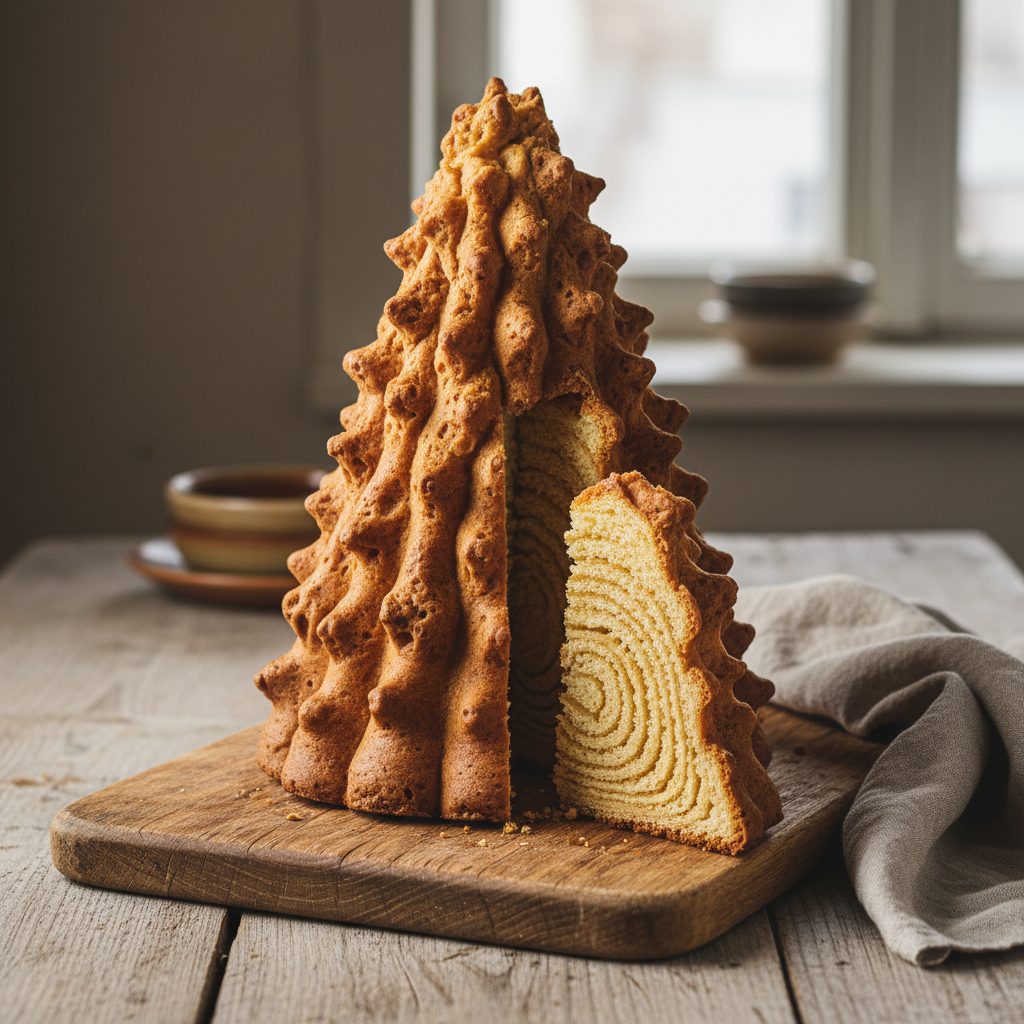
Sękacz is not a cake. A cheesecake is a cake: it rests on the plate and waits to be praised. Sękacz, by contrast, stands upright, flaunts its spikes, smells of smoke and butter, and announces with its whole bearing that it remembers the Jagiellonians, the Yotvingians and several weddings of which no written sources survive.
It comes from the Kresy, the eastern borderlands — the Suwałki region, Podlasie and the Lithuanian and Belarusian lands — where for centuries it has been baked on a rotating wooden spit over a live fire. This is not confectionery in the bourgeois sense but a full-scale military campaign. There is wood, embers, sweat, the risk of losing the entire batter, and a man who must master the flame like a hetman commanding an unruly cavalry banner.
Legend has it that Queen Bona was treated to sękacz at the wedding of Sigismund Augustus. Historians, naturally, demand documents, seals and three independent accounts, because that is what they are for. The intellectual tourist from Powiśle, however, will maintain a proper epistemological balance: he will not believe it without reservation, but he will take a photo. A legend is not there to be checked. A legend is there to raise the price per kilo and the temperature of the conversation.
Sękacz demands dozens of fresh eggs and butter with at least 82 per cent fat and not a gram of moral wavering. Margarine here is high treason, powdered egg — usurpation, and artificial flavouring — an attempt to turn an ancestral manor house into a snack bar at a petrol station. An industrial sękacz may be even, yellow and politely symmetrical, but gravestones can be just as symmetrical.
The layers of batter are poured one after another onto the rotating spit. Each must bake before the next one runs down. Gravity pulls the batter towards the earth, fire sets it in mid-flight, and from this conflict between the laws of nature the knots — the sęki — are born. Newton would no doubt have described the phenomenon with a formula, a Sarmatian nobleman would have raised a glass to it, but the confectioner simply has to get there before disaster strikes.
Once cut, it reveals concentric rings that make the cake look like the trunk of a tree that at some point abandoned forestry for gastronomy. The Podlasie sękacz has long, bold icicles, the Lithuanian šakotis resembles an armed Christmas tree, and the German Baumkuchen stays smooth and orderly, as if even dessert had to comply with the regulations of a housing association.
At weddings sękacz symbolises the durability of marriage, prosperity and happiness. It is an impressive catalogue of promises, especially since the cake itself can survive many weeks without preservatives. Hours of scorching the successive layers dry it out and protect it from spoiling. Once it was fit for long journeys; today it copes perfectly with courier delivery. Tradition knows how to use e-commerce, as long as nobody makes it open a TikTok account.
In Żytkiejmy a five-metre giant weighing 80 kilograms was baked, using a thousand eggs. That was no longer a dessert but critical infrastructure.
Sękacz is not only to be eaten. It should be read like a chronicle, looked at like a sculpture and treated as proof that in eastern Poland even a sponge can have a pedigree, a temperament and its own politics of history.
## The Yotvingians, Grunwald and Bona
The pedigree of sękacz is so long that some of its branches grow in the mist. The oldest theory leads to the Baltic Yotvingians, who are said to have adapted open hearths to bake long-lasting cakes indispensable in the primeval forest. Another tradition sees in sękacz the provisions of the armies marching to Grunwald: high in calories, resistant to spoiling, ideal for the road. That sounds plausible, which in the case of legends is always suspicious.
The most beautiful story is a courtly one. The first sękacz in its present form was supposedly baked by a cook named Jan in Berżniki near Sejny, to delight Queen Bona Sforza at the wedding of her son Sigismund Augustus. The queen fell in love with it and brought the cake to the tables of Wawel. There is no seal, there are no three independent accounts, but there is a taste that explains why someone wanted to tell the story.
A historian of confectionery, however, will point to another date. In 1682 Johannes Sigismund Elsholz, court physician to the Elector, described the cake under the Latin name Placenta cylindrica and declared it a Berlin speciality. Latin is merciless towards patriotic myths. It does not rob them of their charm, though; it merely adds a footnote.
Polish culinary writing sees in sękacz an evolution of the noble “baba z rożna”, the spit-baked baba. Elżbieta Kiewnarska described these gigantic, many-egged sponge cakes as the technical ancestor of today's sękacz. So the cake from Podlasie acquires a Sarmatian pedigree and immediately holds itself better.
## Eggs, butter, quince
The recipe for sękacz is a study in abundance. The standard is 40 to 60 eggs per kilogram of flour, and in Lithuanian variants as many as 64. Such a quantity of protein and lecithin makes a batter sticky enough to cling to the spit and pliable enough for gravity to draw knots out of it. The butter must have at least 82 per cent fat. Margarine has a different melting point and a different composition, so it does not allow the small, noble protrusions to form. This is not snobbery; it is physics.
The flavouring has a history too. Today lemon and vanilla dominate, but sources point to quince juice, which once gave the cake a tart-sweet note. Anyone looking for authenticity today can start with quince and end up convinced that vanilla is a newfangled novelty.
## Master of fire
The baking begins with the spit. Oak or alder, in the shape of an elongated cone, so that the cake can later be slid off. It is wrapped in baking parchment and heated. The riskiest step is the first: searing the first layer onto the spit. A mistake at this stage risks the whole batter, weighing several kilograms, sliding straight into the fire. Bourgeois confectionery knows no drama of this kind.
Then the batter is poured on in the thinnest layers, 30 to 60 times, over a fire of birch or alder that holds a steady 250–280 degrees, at moments up to 300. The knots form when excess batter drips from the rotating spit. Gravity wants to tear the drop away, the heat sets it in flight and fixes its shape. In cross-section you can see rings, the result of the caramelisation of sugars in the outer part of each layer. A tree grows for years, a sękacz for hours, and they look the same.
The difficulty of the method makes the craftsman a master of fire and makes every sękacz unique. It cannot be made the same way twice, because fire never burns the same way twice.
## A wedding without sękacz is no wedding
In Podlasie and the Suwałki region sękacz adorns weddings, christenings and holidays. There is an unwritten law: a wedding without sękacz is no wedding. It stands upright, because the vertical position is a declaration of plenty and permanence. Guests break off the crunchy knots, which children especially love, and cutting it into horizontal rounds is left for portioning. The cake symbolises the durability of marriage, like a strong tree, as well as plenty and good fortune.
Its durability, moreover, is entirely literal. Hours of scorching over the embers of hardwood dry out the cake and preserve it much as smoking does. Every layer passes through high temperature, and the outer crust is a barrier to microbes. In a dry place sękacz lasts many weeks, even months. Once this was an answer to long journeys and celebrations lasting several days. Today it is an asset in mail-order sales, because few traditional bakes survive several days in a parcel unscathed.
## The spit-baked family
Sękacz has relatives all over Europe, and each has a different character. The Podlasie one has long, dynamic icicles. The Lithuanian šakotis, often with a dash of spirit added, is spikier, harder and resembles a Christmas tree or a pagoda, because Lithuanians use a thinner batter and faster rotation. The German Baumkuchen is smooth on the outside, reveals its rings only when cut, and is often given a chocolate glaze. France has the gâteau à la broche. Polish craftsmanship favours a more massive form, which translates into a more buttery, sponge-like flavour.
The List of Traditional Products includes the Masurian sękacz and the Sejny one, known as bankuchen, both entered in 2006, the sękacz from Suchowola from 2014 and the sękacz from the Romincka Forest from 2020. The register is official, but every entry is someone's kitchen and someone's spit.
## Records and fakes
The present day has set sękacz two challenges. The first is fakes. Mass production reaches for margarine, powdered eggs, carotene, artificial colourings and flavourings, which outrages traditional craftsmen. The genuine article is recognised by its irregular knots and moist interior. The industrial product tends to be dry and suspiciously symmetrical. A real sękacz often costs 80–120 zloty per kilogram, and no wonder, since half its weight is work at the fire.
The second challenge is merrier. In 2019 the Żytkiejmska Struga Association baked a sękacz 5 metres long and weighing 80 kilograms, using a thousand eggs. In doing so it unofficially beat the Lithuanian Guinness record of 67 kilograms and 3.5 metres. The Polish-Lithuanian rivalry over the spit cake goes on, and it is probably the sweetest border dispute in this part of Europe.
Sękacz is a reminder that some things come into being only when someone stands by the fire and does not walk away. Layer by layer. Year by year. Like a tree.
📖 Glossary
- sęki
- Kolce i sople na sękaczu, powstające, gdy nadmiar ciasta spływa z obracającego się wałka, a żar ścina go w locie.
- šakotis
- Litewski krewny sękacza z rzadszej masy, pieczony przy szybszych obrotach, bardziej kolczasty i twardszy, często z dodatkiem spirytusu.
- Placenta cylindrica
- Łacińska nazwa ciasta z rożna, pod którą w 1682 roku opisał je Johannes Sigismund Elsholz, uznając za specjalność berlińską.
- baba z rożna
- Szlacheckie, gigantyczne i wielojajeczne ciasto biszkoptowe, które Elżbieta Kiewnarska opisywała jako technicznego przodka sękacza.
Frequently Asked Questions
Where does sękacz come from?
Sękacz comes from the Kresy, the Suwałki region, Podlasie and the Lithuanian and Belarusian lands. Theories link it to the Yotvingians and to the provisions of the armies at Grunwald, and legend to a cook named Jan from Berżniki and the wedding of Sigismund Augustus. In 1682 Johannes Sigismund Elsholz described the cake as Placenta cylindrica and declared it a Berlin speciality.
How do the spikes on sękacz form?
The batter is poured in thin layers, 30 to 60 times, onto a rotating spit over a birch or alder fire at 250–280 degrees. The spikes form when excess batter drips from the spit: gravity wants to tear the drop away, and the heat sets it in flight. The rings in cross-section result from the caramelisation of sugars in each layer.
How many eggs does sękacz need?
The standard is 40 to 60 eggs per kilogram of flour, and in Lithuanian variants as many as 64. That much protein and lecithin makes the batter sticky enough to cling to the spit and pliable enough to form spikes. The butter must have at least 82 per cent fat.
Why does sękacz keep for so long?
Hours of scorching over hardwood embers dry out the cake and preserve it much as smoking does. Every layer passes through high temperature, and the outer crust is a barrier to microbes. In a dry place sękacz lasts many weeks, even months.
How does sękacz differ from šakotis and Baumkuchen?
The Podlasie sękacz has long, dynamic icicles and a more massive, buttery form. The Lithuanian šakotis, made from a thinner batter with faster rotation, is spikier and harder, resembling a Christmas tree or a pagoda. The German Baumkuchen is smooth outside, shows its rings only when cut and often has a chocolate glaze.
How to recognise a genuine sękacz?
A genuine sękacz has irregular spikes and a moist interior, while the industrial product tends to be dry and suspiciously symmetrical. Mass production uses margarine, powdered eggs, carotene and artificial flavourings. A real sękacz often costs 80–120 zloty per kilogram.
Related Questions
- Where does sękacz come from?
- How do the spikes on sękacz form?
- How many eggs does sękacz need?
- Why does sękacz keep for so long?
- How does sękacz differ from šakotis and Baumkuchen?
- How to recognise a genuine sękacz?
🧠 Thematic Groups
- Historia i legenda: od Jaćwingów i prowiantu spod Grunwaldu przez wesele Zygmunta Augusta i królową Bonę po Placenta cylindrica Elsholza z 1682 roku.
- Technika: 40–60 jaj na kilogram mąki, masło 82 procent, wałek z dębu albo olchy i 30–60 warstw nad ogniem 250–280 stopni tworzą sęki i słoje.
- Obyczaj: na Podlasiu i Suwalszczyźnie wesele bez sękacza to nie wesele, a ciasto stoi pionowo jako znak dostatku i trwałości małżeństwa.
- Współczesność: rodzina z rożna od šakotisa po Baumkuchen, wpisy na Listę Produktów Tradycyjnych, przemysłowe podróbki i rekord z Żytkiejm z 2019 roku.
Tags:
sękacz
šakotis
Baumkuchen
spit cake
Podlasie
Suwałki region
Kresy
eggs
butter
Queen Bona
Placenta cylindrica
baba z rożna
Żytkiejmy
List of Traditional Products
Polish cuisine
More in: Kuchnia niepolityczna
Content is created by Fundacja Dobre Państwo.
Edited and published by APA ONE, the Foundation's own AI-based editorial system.